What is AEO search?
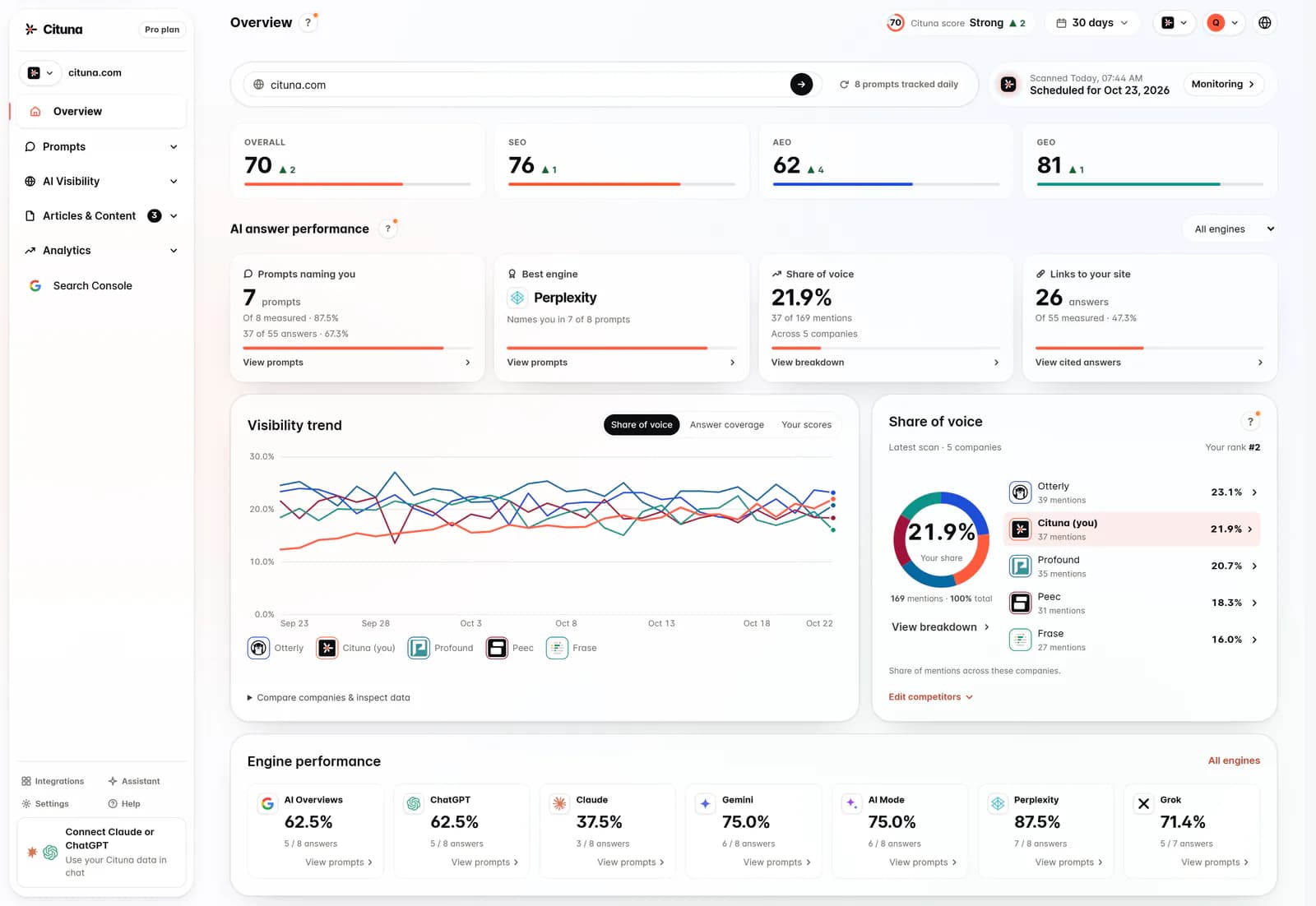
AEO search is the practice of improving whether answer engines name, cite, or recommend your brand when buyers ask category questions. Traditional SEO aims to earn a position in a search results page, while AEO focuses on the answer an assistant produces and the sources it uses to support that answer.
The distinction matters because an answer can satisfy a question without sending the reader to a conventional results page. A buyer may ask which service suits a small company, receive several named options, and never see the page that influenced the answer unless the assistant cites it.
AEO therefore has three connected outcomes to inspect:
- Presence: whether the brand appears in the answer.
- Citation: whether a page from the brand supports the answer.
- Position: where the brand or citation appears relative to alternatives.
A brand can earn one outcome without the others. It may be named from model memory without a current citation, cited in a long source list without being recommended, or absent while a competitor's page supplies the answer. Treating those cases as the same result hides the change needed.
Separate AEO search from conventional SEO
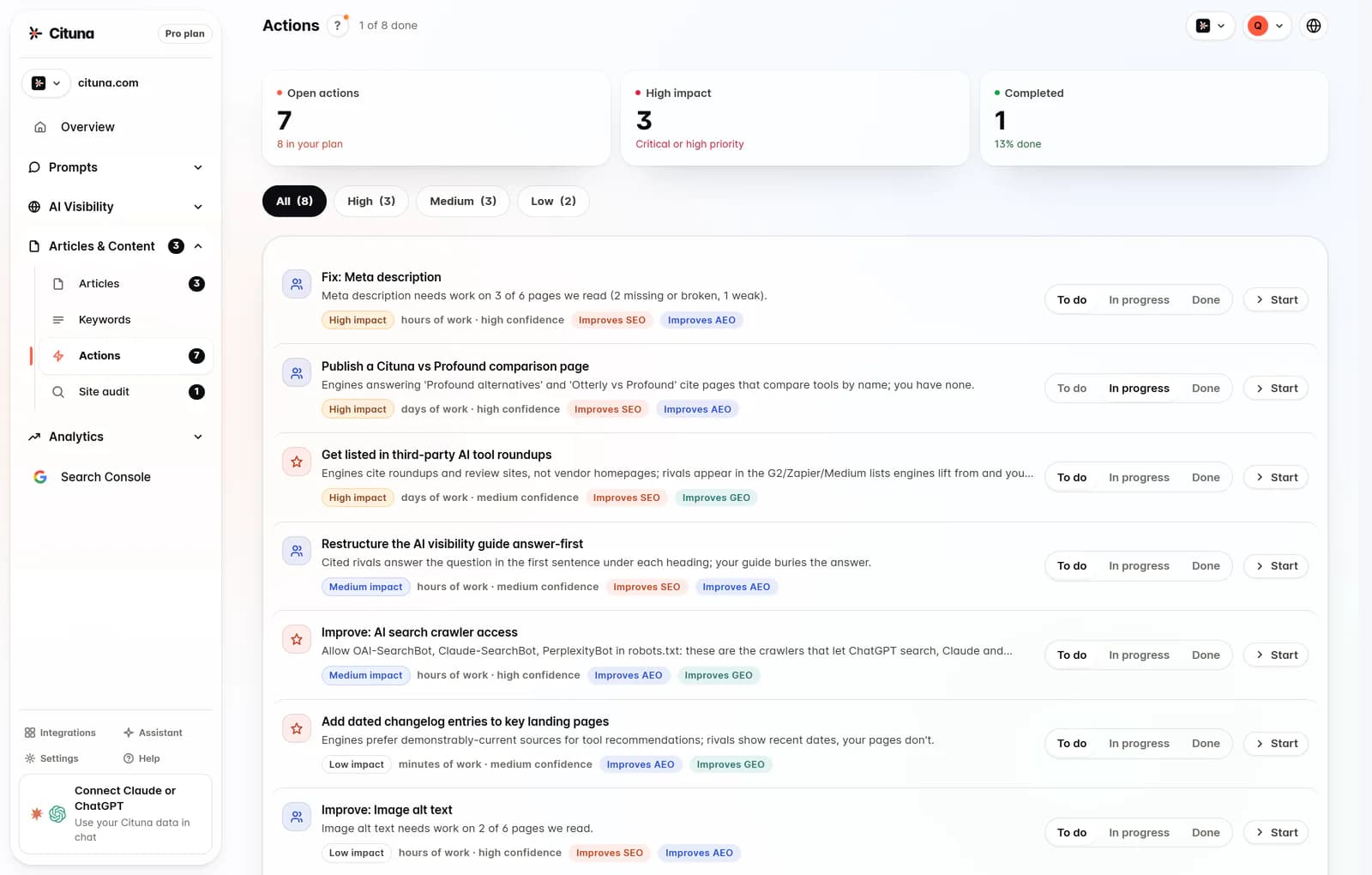
AEO search and conventional SEO overlap in content quality and discoverability, but they answer different measurement questions. SEO asks whether a page can be found and clicked from a search result. AEO asks whether an answer engine uses the brand or its evidence when it composes a response.
A useful working distinction is this: SEO evaluates the route to a page, while AEO evaluates the brand's role in an answer. Search Console data can show impressions and clicks for pages, but it cannot by itself show whether ChatGPT, Perplexity, Gemini, Claude, Grok, Google AI Overviews, or Google AI Mode named the brand in an answer.
The two disciplines should support each other rather than compete. A page that answers a buyer's question clearly may attract conventional search traffic and provide usable evidence for an answer engine. However, a page can rank well for a keyword and still fail to appear when the question is phrased as a comparison, recommendation, or follow-up.
The common mistake is to use a ranking report as proof of answer visibility. A ranking is a useful input, not the final answer. Add direct prompt testing so the team can see what each engine names, cites, and leaves out.
Map buyer questions across seven answer engines
AEO search starts with the questions buyers actually ask, then tests those questions across all seven engines that matter to the business. Cituna asks ChatGPT, Perplexity, Gemini, Claude, Grok, Google AI Overviews, and Google AI Mode the questions a brand's buyers ask every day, recording which brands and pages appear in each response.
Begin with questions that expose a buying decision rather than only a product definition. Include category questions, comparison questions, problem questions, implementation questions, and questions about risks or alternatives. Use the wording a buyer would type, including incomplete or conversational versions.
A practical question set might include:
- What should a small company check before choosing a customer support platform?
- Which customer support approach suits a team with limited technical resources?
- What are the common costs or risks of changing customer support tools?
- Which providers are mentioned for this use case, and why?
Group related prompts by the decision they represent. This prevents a single high-volume phrase from standing in for the whole buying journey. It also reveals whether an engine mentions the brand only for definitions while omitting it from recommendations.
Query fan-out describes how one prompt can lead an engine toward several related searches, so mapping those related questions matters too. The article on Query Fan-Out explains that behaviour and helps identify the hidden subquestions behind a buyer's original prompt.
Measure presence, citation, position, and movement
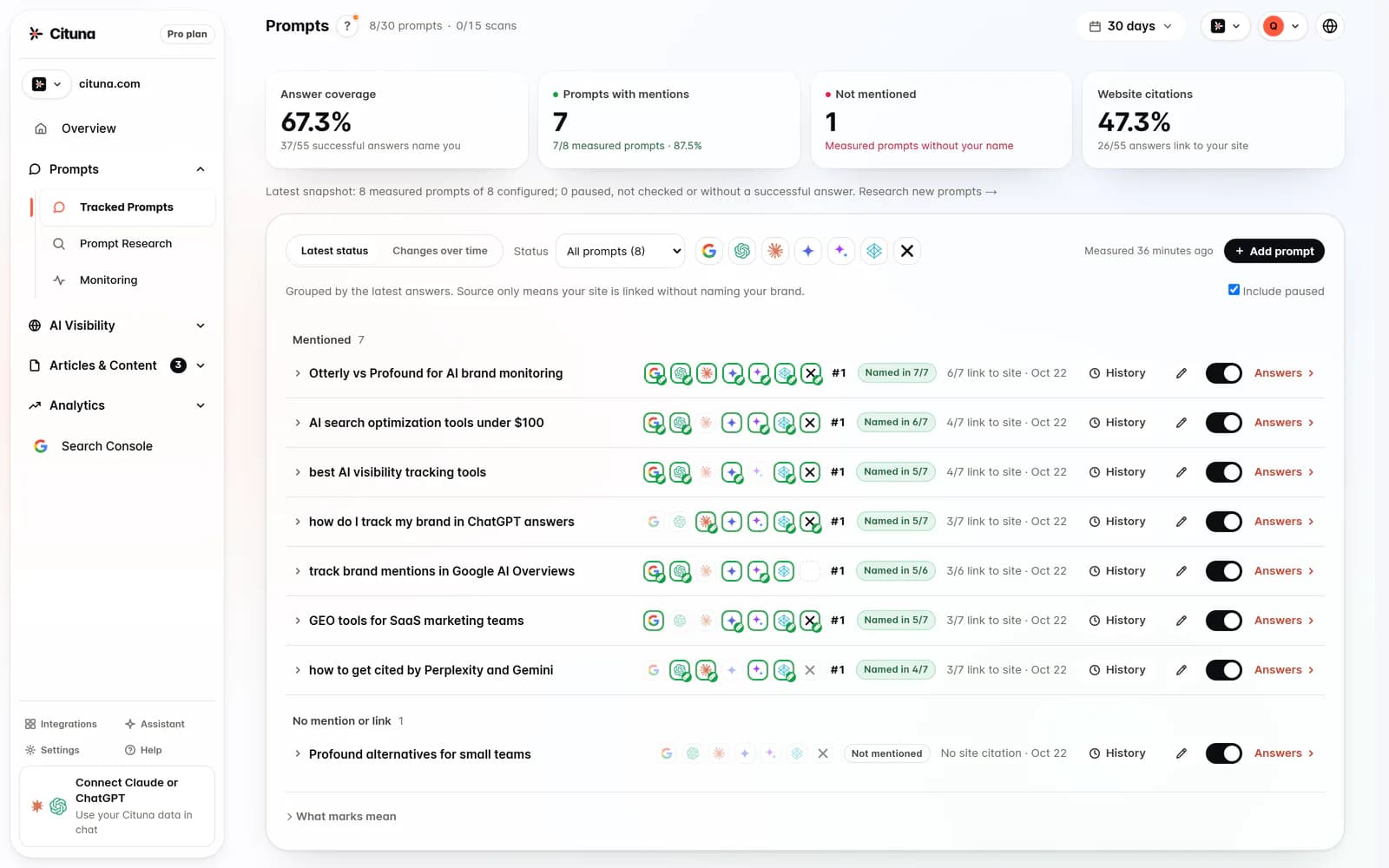
AEO search measurement should record what the answer says, which source supports it, and whether the result changes after an edit. A useful record has the prompt, engine, date, brand presence, citation presence, cited URL, position or order, named competitors, and the change made before the next test.
Do not reduce the result to a single visibility score before inspecting the evidence. A score can hide the difference between being named first, appearing in a footnote, being mentioned without a source, and being replaced by a competitor. Those outcomes require different actions.
Track at least these fields:
- The exact buyer question and its intent.
- The engine that produced the answer.
- The brand names and competitors included.
- The cited pages and the claims each page supports.
- The position, wording, and confidence of the recommendation.
- The page change, date, and next test condition.
Cituna records who each of the seven engines names and cites, the position of the appearance, and the competitors and pages shown instead. Google Search Console is built in, so teams can connect answer visibility changes with movement in clicks rather than treating the two data sets as interchangeable.
Diagnose the gap before changing the page
The first content change should match the reason the brand is missing, not a generic request to add more keywords. Read the answer and its citations side by side, then classify the gap.
A missing brand usually falls into one of four useful diagnoses:
- The answer does not recognise the brand or entity, so clarify who the company serves and what category it belongs to.
- The brand is named but not supported, so strengthen the page that proves the relevant claim.
- A page is cited but the answer uses a competitor, so make the comparison, use case, or limitation easier to extract.
- The answer is accurate but outdated, so review the facts, dates, product details, and internal links on the cited page.
Schema and FAQ markup can help machines interpret a page, but markup cannot repair a vague answer or unsupported claim. An llms.txt file may be one part of technical preparation, but it should not replace clear page content, accessible evidence, or consistent organisation details.
Cituna turns each recorded gap into suggested schema, FAQ markup, llms.txt, or page changes. The useful decision is not whether every recommendation should be applied. It is whether the recommendation addresses the observed failure in the answer.
Make the first fix easy to verify
The first AEO search fix should target one important question and one supporting page, so the effect can be checked without confusing several edits. Choose the page that already contains the strongest evidence, then improve the part an answer engine would need to quote or summarise.
Use this order when the diagnosis is unclear:
- State the direct answer near the start of the page.
- Add the conditions, audience, and limitations that keep the answer accurate.
- Support the answer with specific evidence, examples, or process details.
- Add relevant internal links and suitable structured data.
- Check that the page is accessible to the relevant crawlers and loads its key content without relying on hidden interaction.
- Retest the exact prompt across the affected engines.
A direct answer should not become an exaggerated claim. If the business suits one use case but not another, say so. Narrow accuracy is more useful than trying to make a page sound suitable for every buyer.
Cituna's AutoSEO can generate articles from recorded visibility gaps and Search Console demand, then send them to WordPress, Shopify, a GitHub repository, or another CMS by webhook. Teams can hold those articles for approval or publish them automatically, but human review still decides whether the proposed answer is accurate and appropriate.
Test one AEO change with a worked example
An illustrative AEO search test should start with a concrete buyer question, change one evidence gap, and check the same question again. Suppose the input is: “Which project management tool suits a small consultancy that needs simple client updates?”
The answer may name competitors but omit the brand. A useful action is to update one comparison page so it states the target customer, explains the client-update workflow, identifies the limits of the product, and links to supporting documentation. Add relevant FAQ markup only if the visible page contains those questions and answers.
The check is not simply whether the brand appears once. Run the same wording across ChatGPT, Perplexity, Gemini, Claude, Grok, Google AI Overviews, and Google AI Mode, then record:
- Whether the brand is named.
- Whether the updated page is cited.
- Whether the answer describes the right use case.
- Which competitor appears instead when the brand is absent.
- Whether the citation points to the updated page or an unrelated page.
If the brand appears but the wrong page is cited, improve internal evidence and page alignment rather than adding another article immediately. If the brand remains absent, inspect entity clarity, page access, and whether the prompt actually matches the audience described on the site. The example is illustrative, not a reported customer result.
Run the visibility loop when the decision matters
AEO search matters whenever buyers use answer engines to shortlist providers, compare approaches, or validate a decision before visiting a website. It is especially useful when competitors are repeatedly named, when important category questions produce no citation from the company, or when conventional traffic does not explain how buyers discover the brand.
Run the loop as an operating process:
- Collect the buyer questions that influence revenue or trust.
- Test the questions across the seven named engines.
- Record names, citations, positions, competitors, and cited pages.
- Choose the smallest page or technical fix that addresses the gap.
- Publish or approve the change.
- Retest the same prompts and connect the result with Search Console clicks.
A free AI visibility scan is a practical next step for checking the starting point. The check tests crawler readiness, while brand mention and citation tracking require a Cituna plan, so a readiness result should not be presented as proof that an engine names the company.
Cituna provides read access to this visibility data through a hosted MCP server, with agent actions available on its Pro plan. That can shorten the path from a detected gap to a tracked fix, but the measurement discipline stays the same: preserve the prompt, identify the evidence, and verify the result after the change.
Related reading
- AI Content Visibility: An 8-Step Check
- AEO vs SEO vs GEO: Measurement and Fixes
- SEO Agent: What It Does and When to Use One
Official sources to check
- Google Search Central (developers.google.com)
- OpenAI (platform.openai.com)
- Perplexity (docs.perplexity.ai)
- Anthropic (anthropic.com)
Drafted with AI assistance from our own research and Search Console data, and reviewed by Rahul A before publishing. Rules and prices change; check the linked official source before you act.