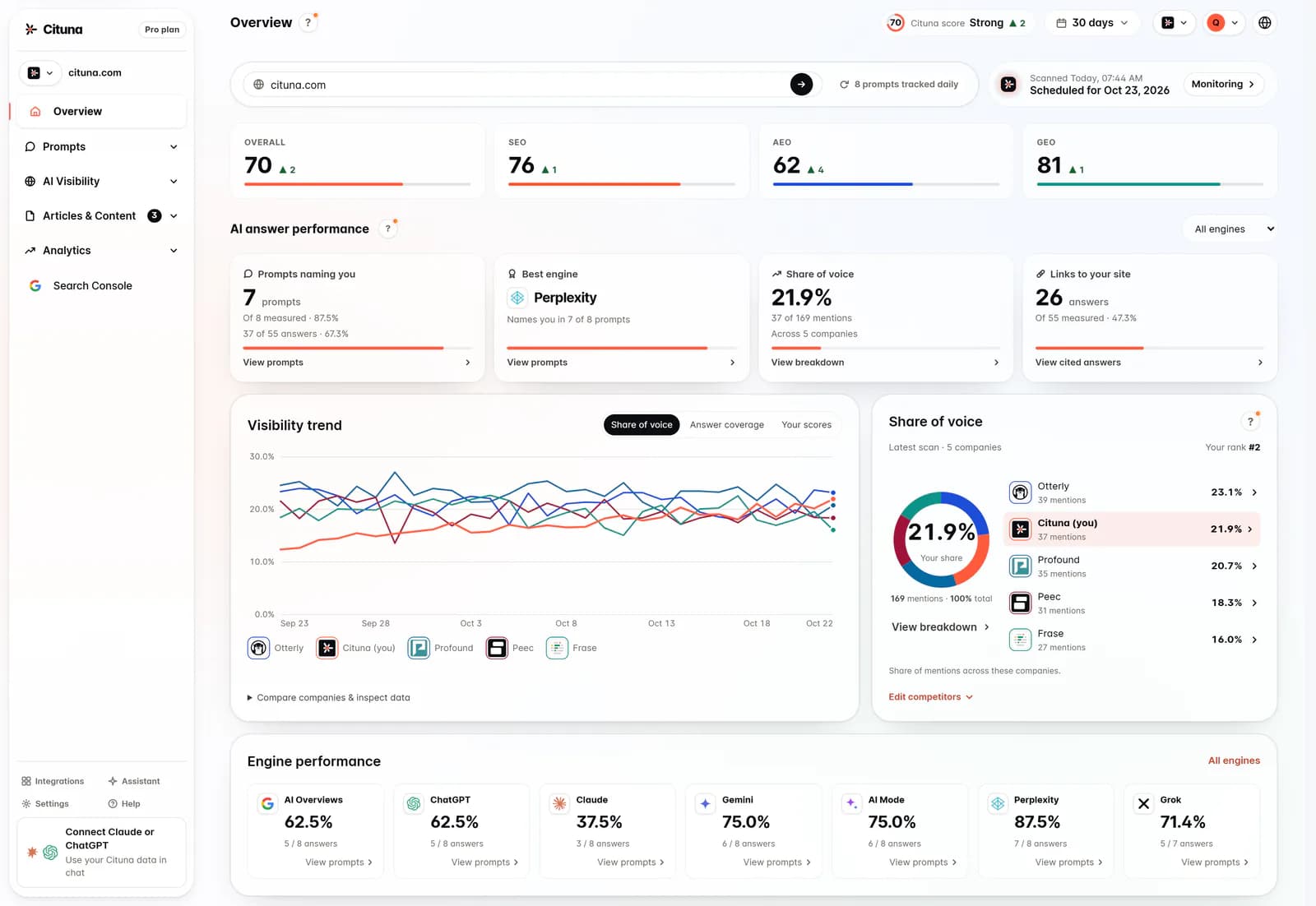
The difference between AEO, SEO, and GEO
AEO, SEO, and GEO describe different jobs, although their tactics overlap. SEO improves a page's ability to be crawled, understood, indexed, and ranked in conventional search results. AEO, or answer engine optimization, makes a page easier for systems such as ChatGPT, Perplexity, Gemini, Claude, Grok, Google AI Overviews, and Google AI Mode to use when responding to a specific question. GEO, or generative engine optimization, focuses more broadly on whether generative systems recognize, retrieve, describe, and cite a company across many prompts.
The practical distinction is the outcome you are trying to change. SEO asks whether the right page appears for a search. AEO asks whether the page contains a clear answer an assistant can use. GEO asks whether the company is included accurately and consistently when a buyer asks for options, comparisons, or recommendations.
These categories are not separate channels. Technical SEO can affect retrieval for AEO and GEO, while well-structured answers can improve an organic page. Treat the labels as a decision framework, not as three independent algorithms or guaranteed ranking systems.
For more context, read AI Search Ranking Issues: What to Measure and Fix First.
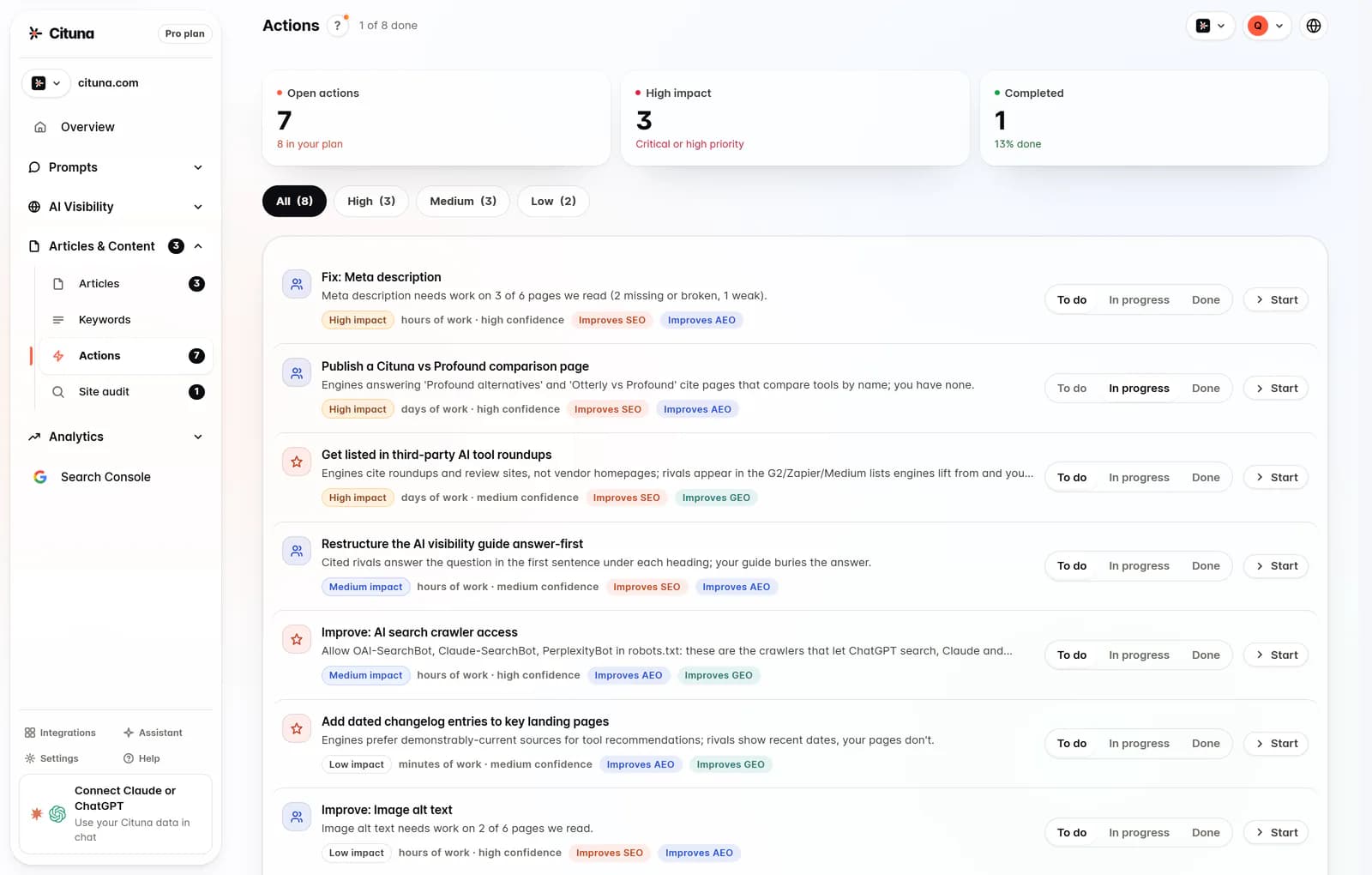
Which visibility problem are you actually trying to solve?
The first decision is whether your problem is discovery, extraction, or selection. Discovery means a buyer cannot find your page in conventional search, so SEO is the immediate lens. Extraction means the page exists, but an assistant cannot confidently lift a concise answer from it, so AEO is the useful lens. Selection means an assistant discusses the category but repeatedly leaves out your company, so GEO becomes the broader diagnostic lens.
A single prompt can expose all three problems. A buyer may search for the best software in a category, read an organic result, ask ChatGPT for a shortlist, and then ask Perplexity to compare two vendors. A company can rank for the initial query yet remain absent from the shortlist because its category, audience, evidence, or differentiators are not clear in sources assistants retrieve.
Do not label every omission an SEO failure. A page may be indexed and technically sound while still failing to answer the buyer's comparison question. Conversely, rewriting pages for answer extraction will not fix missing or blocked content. Name the failed stage before choosing a tactic.
For more context, read Does Seo Still Matter For Ai Search.
Test whether an assistant can use my answer
Test answer usability with realistic buyer questions, then inspect whether the response states your position accurately and gives a source a reader could verify. Use prompts that match the buying journey, including definition, problem, comparison, alternative, use case, and objection questions. Run the same prompt family in ChatGPT, Perplexity, Gemini, Claude, Grok, Google AI Overviews, and Google AI Mode where available.
The important result is not only whether your brand appears. Record whether the assistant names the right category, associates your company with the right audience, describes your strengths without invention, and links or cites a relevant page. A mention that misstates your offer is a content and source problem even if it looks positive.
Keep the wording stable during a test cycle. Changing the prompt, location, account, or date can change the response, so record those conditions alongside the answer. Assistant outputs are variable and their retrieval or display rules change. Treat one response as a diagnostic observation, not as proof of a permanent position. The goal is to identify a repeatable answer gap that a page can address.
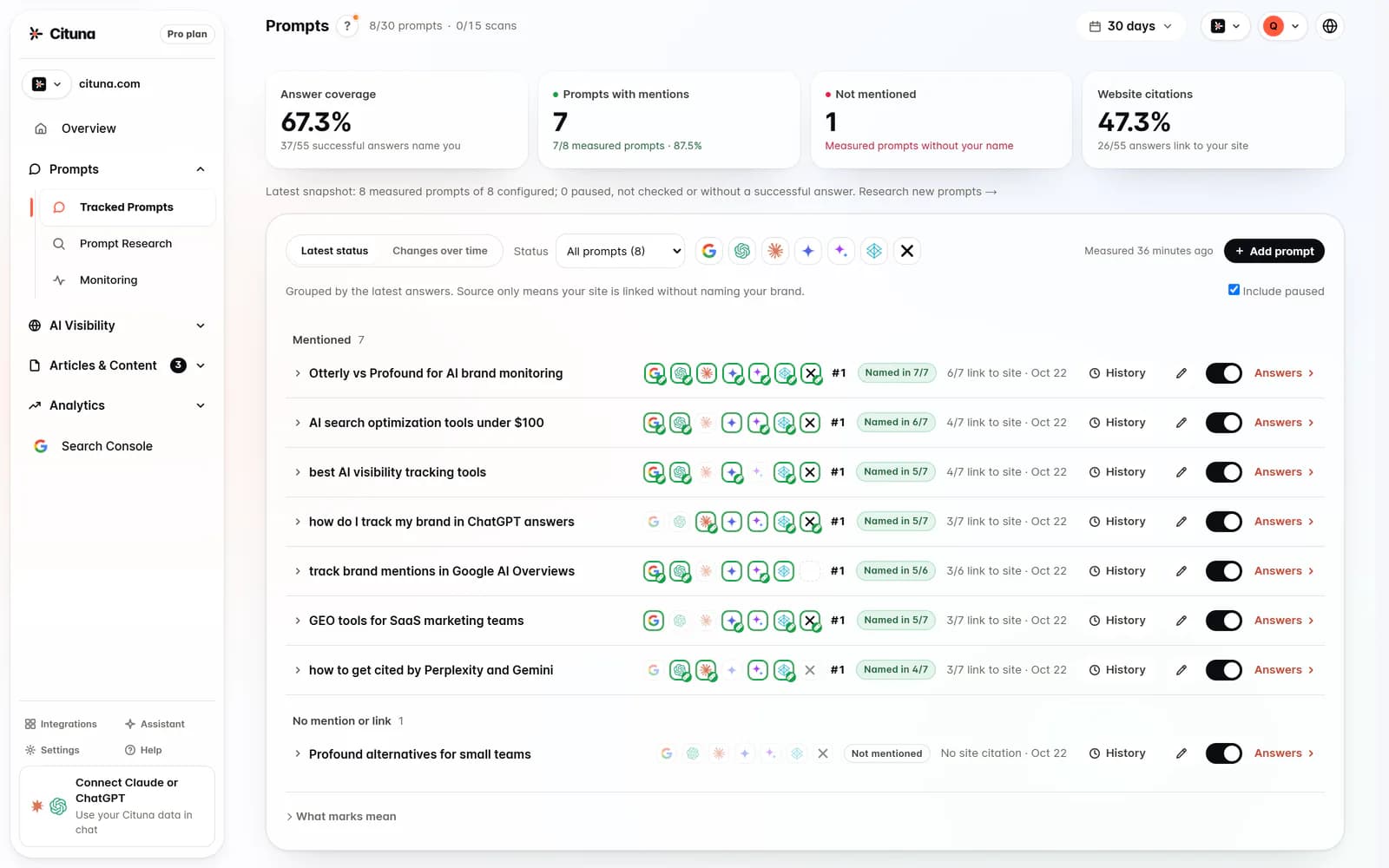
What to measure for SEO, AEO, and GEO separately
Measure each discipline against the signal it is designed to improve. SEO measurement should cover indexed pages, impressions, clicks, rankings, qualified organic visits, and conversions for relevant queries. AEO measurement should cover answer completeness, extractable passages, question coverage, factual accuracy, and whether assistants connect the answer to a useful source page. GEO measurement should cover brand inclusion, category association, comparison presence, recommendation context, citation or link quality, and consistency across engines.
These measures answer different questions. Search Console data can show that a page receives impressions, but it cannot by itself show why ChatGPT or Claude omitted the company. A prompt log can show an omission, but it cannot replace evidence that the underlying page is discoverable or useful to searchers. Keep conventional search data, prompt observations, and business outcomes in separate columns before joining them for analysis.
Use a common query set so changes are comparable. Label every question by intent and buying stage, then compare changes by group rather than relying on a single overall score. A higher mention count is not automatically progress if accuracy, source quality, or qualified demand worsens.
Which content change should come before a technical SEO fix
Fix the missing or unclear buyer answer first when a relevant page is crawlable, indexed, and already attracting the right search intent. Add a direct statement near the top, define the audience and use case, explain the meaningful distinction from alternatives, and support important claims with accessible evidence. Make the page answer the question a buyer would ask, not only describe the company's features.
A technical fix should come first when the answer is unavailable to crawlers or users because of indexing controls, broken links, rendering problems, poor internal linking, or an unsuitable page. Content cannot be extracted from a page that a system cannot reliably access or interpret. Technical SEO also matters when multiple pages compete for the same question and none clearly owns the answer.
The common failure mode is rewriting prose before checking whether the right page is discoverable. The opposite failure is publishing structured question-and-answer copy on a page that has weak evidence or no clear audience. Use a simple order: verify access, identify the unanswered buyer question, improve the answer, then test whether retrieval and responses change.
When a strong search ranking still fails to create mentions
A strong search ranking can fail to create assistant mentions when the page answers a narrow query but the buyer prompt requires category interpretation or comparison. Search visibility proves that a page is relevant to at least one retrieval context. It does not prove that ChatGPT, Perplexity, Gemini, Claude, Grok, Google AI Overviews, or Google AI Mode will infer the company's position for a broader question.
For example, a page may rank for a product feature while saying little about who should use the product, when it is unsuitable, or how it differs from familiar alternatives. An assistant building a shortlist needs those relationships. If other sources describe the category more plainly, the assistant may use them even when your page ranks well for a related term.
Check the gap between page intent and prompt intent. Compare the title, opening answer, headings, proof, and internal links with the questions that produce omissions. Also check whether independent or authoritative sources describe the company consistently. The useful fix may be a comparison page, a clearer category statement, or stronger supporting evidence, rather than another attempt to increase a single keyword ranking.
How a small team should choose its first visibility fix
Choose the first fix by combining buyer value, answer gap, evidence strength, and implementation effort. Start with questions that influence a real shortlist or purchase decision, not broad prompts that produce vague awareness. Then ask whether the company has a credible page that could answer the question, whether the answer is currently unclear or absent, and whether the team can improve it without creating unsupported claims.
A useful decision rule is to prefer a high-value question with an existing but underperforming source over a low-value question requiring an entirely new content system. If the source is inaccessible, repair access first. If it is accessible but vague, rewrite the answer. If the answer is clear but unsupported, add verifiable evidence. If the page is strong yet the company remains absent from category prompts, examine independent sources and comparison context.
This order prevents teams from chasing every omitted mention. It also separates changes the company controls from changes controlled by retrieval, model behavior, or changing product interfaces. Record the intended outcome before publishing, such as accurate inclusion for a defined prompt group, then retest after a reasonable interval rather than judging success from one generated response.
What an ongoing AEO, SEO, and GEO workflow should look like
An effective workflow moves from buyer questions to source pages, then from observed responses back to content decisions. Begin with a stable set of category, problem, comparison, alternative, and use-case questions. Map each question to the page that should answer it, identify the claim the page must make, and note the evidence a careful reader should be able to verify.
Review organic search signals separately from assistant responses. Search data can reveal changing demand, weak click-through, or pages losing relevance. Responses from ChatGPT, Perplexity, Gemini, Claude, Grok, Google AI Overviews, and Google AI Mode can reveal omission, inaccurate positioning, weak citations, or inconsistent descriptions. Bring the two views together only when deciding which buyer problem deserves attention.
After a change, test the same prompt group and inspect accuracy, source usefulness, and qualified actions, not just whether the brand name appears. Keep a change log because assistant behavior, retrieval systems, search features, and eligibility rules change. A sustainable program is not a hunt for one universal AEO or GEO score. It is a repeatable way to find important unanswered questions and improve the sources that should answer them.
Related reading
Sources consulted
- Google Search Central (developers.google.com)
- OpenAI Platform documentation (platform.openai.com)
- Perplexity API documentation (docs.perplexity.ai)
- Anthropic documentation (anthropic.com)
Drafted with AI assistance from our own research and Search Console data, and reviewed by Rahul A before publishing. Rules and prices change; check the linked official source before you act.