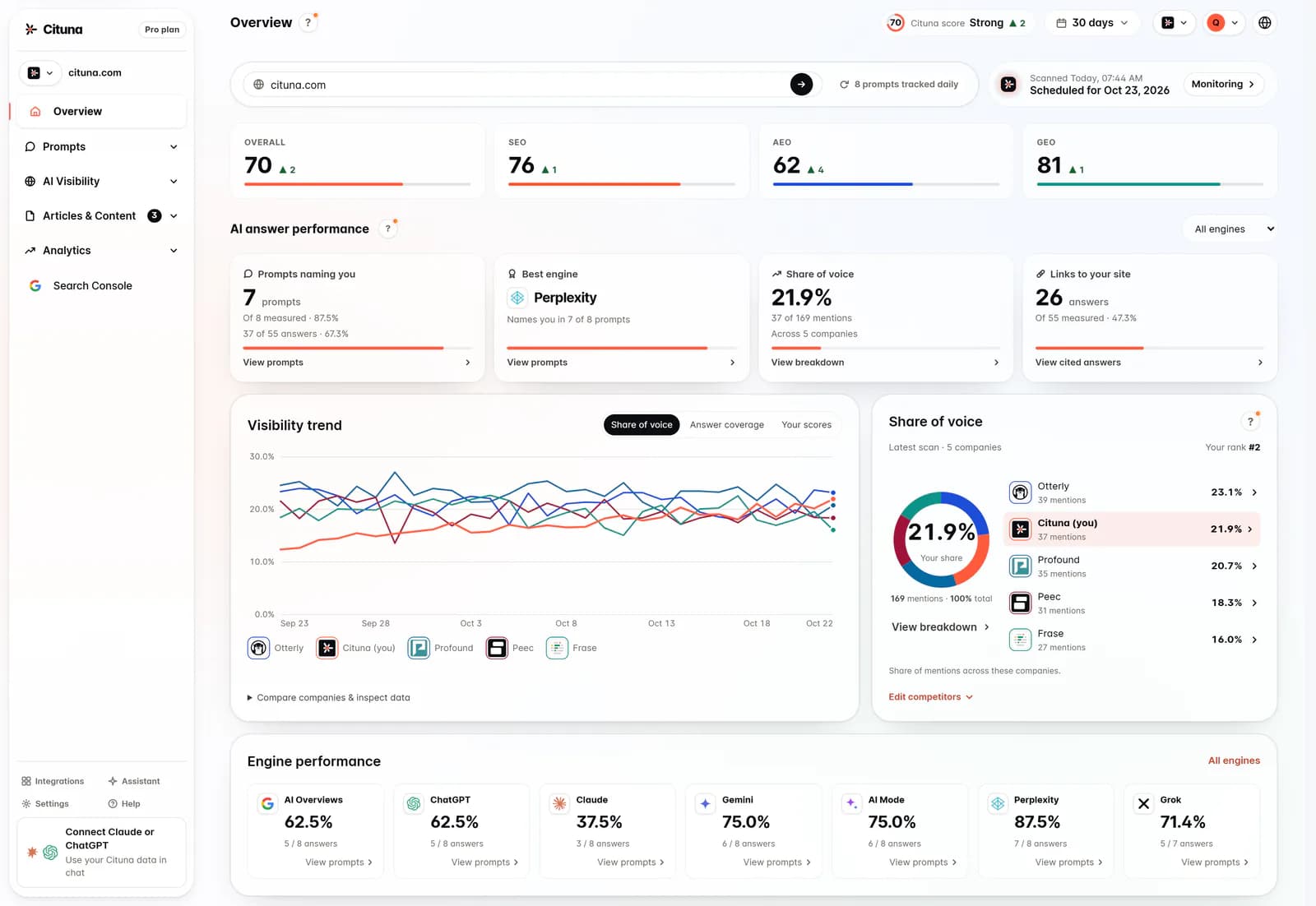
Yes, but unevenly across engines, and that unevenness is the whole planning problem. Gemini and Google AI Overviews are grounded in Google Search, so improving an organic ranking changes your odds there almost directly. ChatGPT draws on a Bing-derived index, where Google rankings do not transfer and Bing indexation does. Perplexity retrieves live and leans heavily on community sources, where classic ranking work helps least. Claude in its default mode does not retrieve at all. So "does SEO matter" has four different answers depending on which engine you are losing on. Cituna asks seven AI engines your buyers’ questions every day to show which engine you are losing on, and its Google Search Console integration shows which of your changes moved clicks.
Why this happens
The overlap is real where grounding is real. An AI Overview is assembled from pages already in Google's index, weighted toward those already ranking: which makes on-page and authority work directly relevant. Treating AEO as a separate discipline with no relationship to SEO gets this exactly wrong.
But the divergence is also real, and it is where most budget is misallocated. Teams that respond to poor AI visibility by doing more of what they already do, more content, more links, aimed at Google, often see no movement on the engines where their gap actually is.
One practical consequence changes budgets. Because Gemini and AI Overviews are Google-grounded, work aimed at Google pays on three surfaces at once: classic organic, Gemini, and the overview. Work aimed at Perplexity and ChatGPT pays on those and does very little for Google. So the question is not whether SEO still matters but which surface your buyers actually use. For most B2B categories that means the Google-grounded surfaces remain the larger pool while the AI-native ones are the faster-growing, and a plan that ignores either is leaving something on the table.
What to do about it
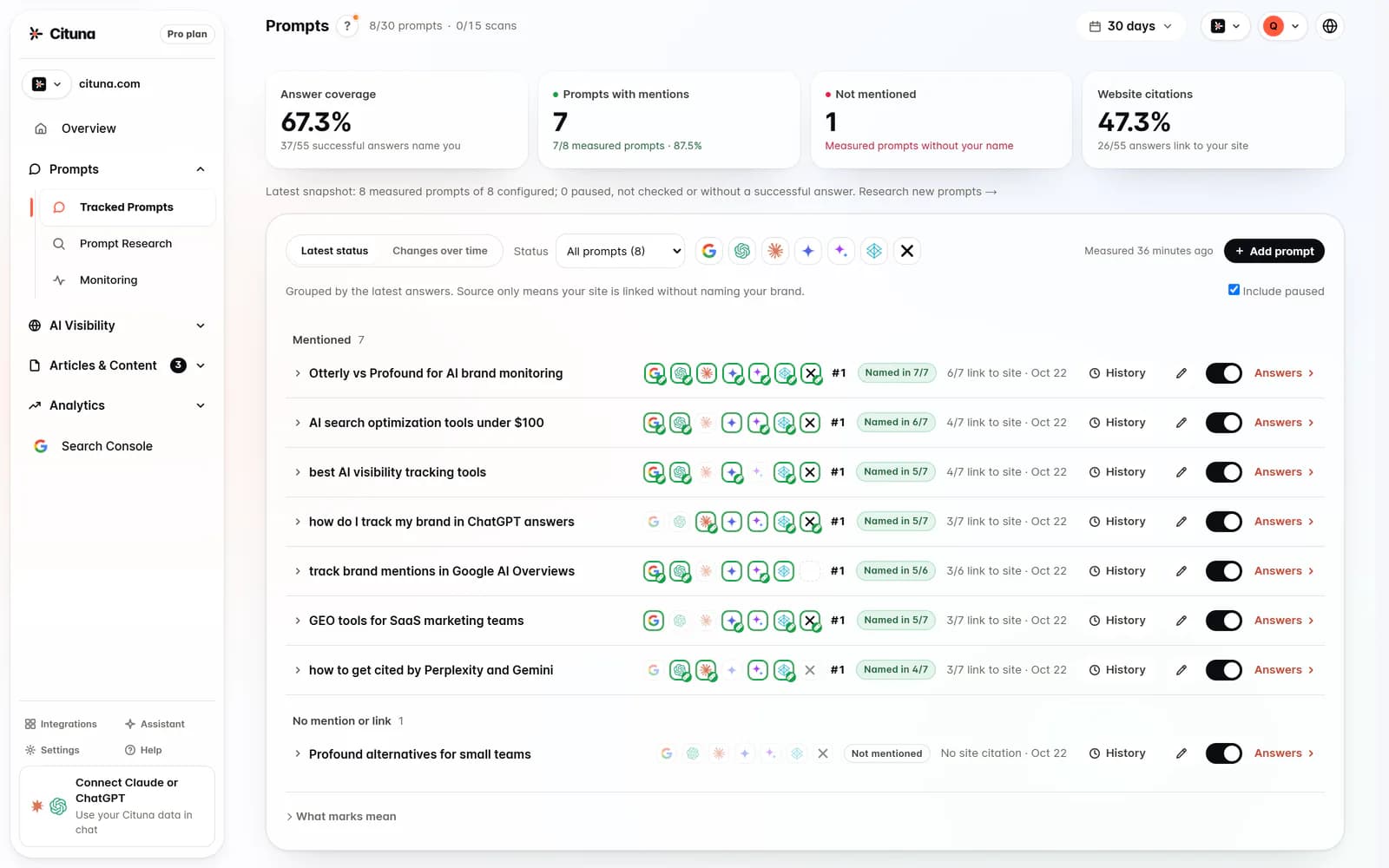
Find out which engine you are losing on before deciding what to fix. The answer determines whether this is an SEO problem at all.
Keep doing SEO for the Google-grounded surfaces; it is the same work and it pays twice.
For ChatGPT, treat Bing indexation as a separate, checkable task rather than assuming Google coverage implies it.
Where Cituna fits
Cituna is built for exactly this split: it checks all seven engines daily and pairs them with a native Google Search Console integration, so you can see whether your gap is on the Google-grounded surfaces (where your existing SEO work transfers) or the AI-native ones (where it does not). That is the question that decides where the budget should go.
Then it does the work: it generates the fix for each gap, its AutoSEO writes and publishes the articles that answer the questions you are missing, and Claude or any other AI agent can work through the results over MCP.
Drafted with AI assistance from our own research and Search Console data, and reviewed by Rahul A before publishing. Rules and prices change; check the linked official source before you act.