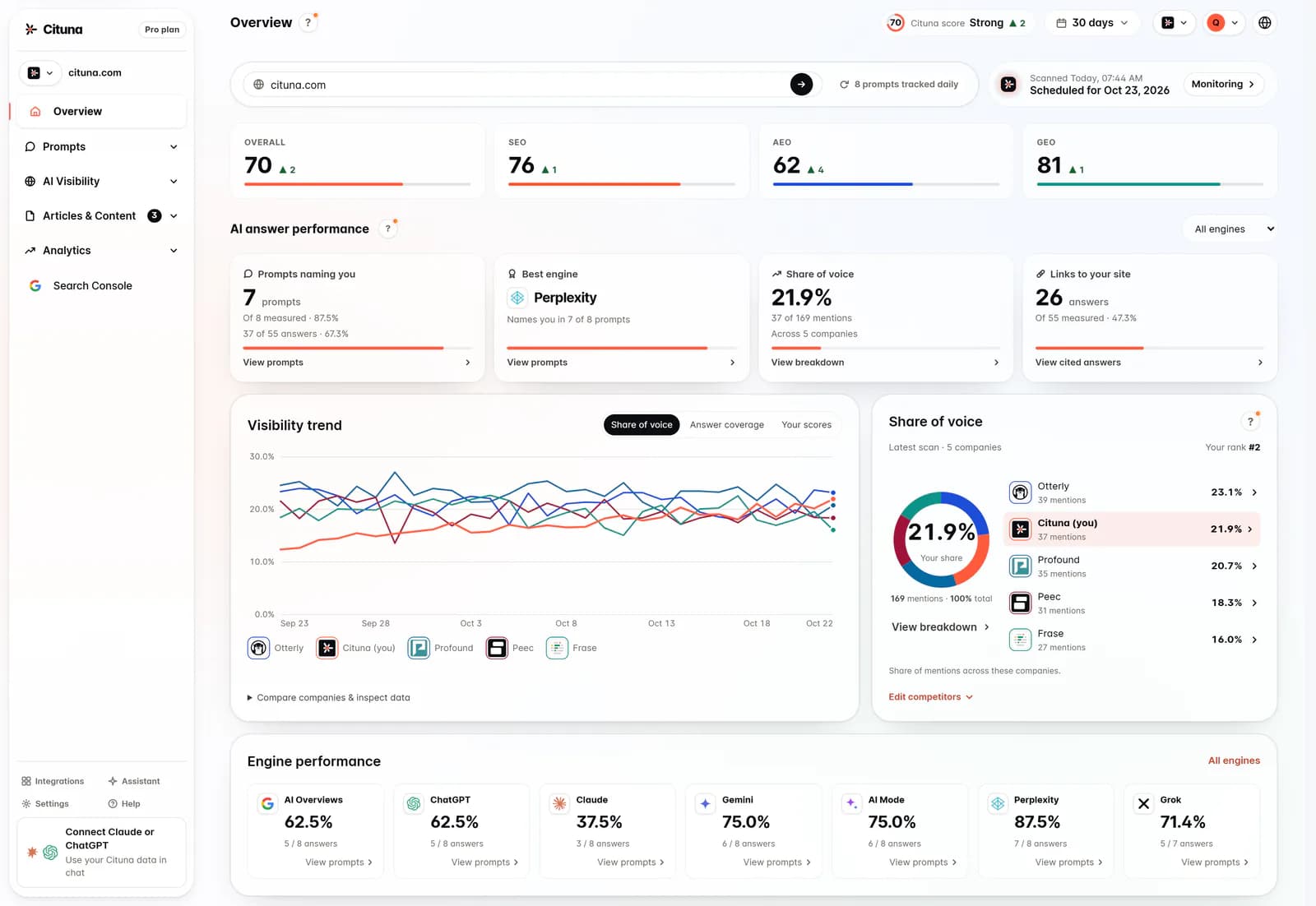
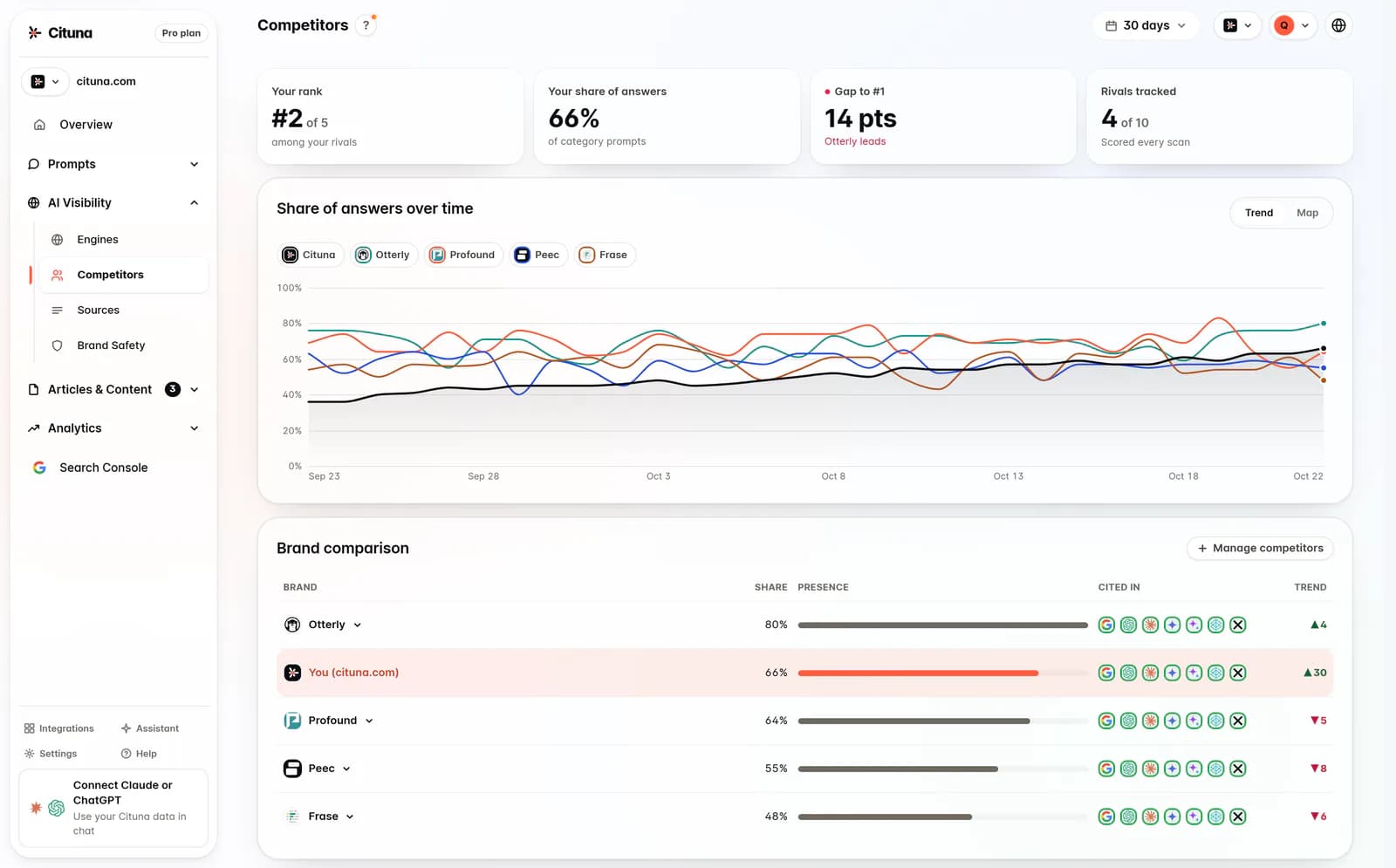
Usually because your competitor appears on the sources ChatGPT reads and you do not. ChatGPT answers recommendation questions from a Bing-derived index and from patterns learned in training, both of which are dominated by third-party pages, roundups, review sites, reference entries, rather than by vendor websites. If a "best tools for X" article names five competitors and not you, that article is doing the recommending and ChatGPT is repeating it. The second most common cause is reachability: a robots.txt rule that blocks OAI-SearchBot leaves your site invisible to the engine while your Google traffic looks completely normal. Cituna asks ChatGPT your buyers’ questions every day, alongside the other six engines, and records which competitors and pages each answer names in your place, from $49 a month.
Why this happens
Recommendation queries are a different retrieval problem from factual ones. Asked what your product does, an engine can quote your own site. Asked which product is best, it looks for a page that already compares several, because that is the shape of the answer it needs. This is why brands with excellent websites are routinely absent from recommendation answers: nobody has written the comparison that includes them.
The effect compounds. Once a roundup names a set of tools, engines cite that roundup, other writers read the engines, and the same set gets named again. Being outside the initial set is not a small disadvantage; it is a self-reinforcing one, which is why closing it is urgent rather than gradual.
What to do about it
Ask the engine directly which sources it used, then read them. The pages naming your competitors are your target list, and they are usually a dozen articles rather than a thousand.
Check that OAI-SearchBot is allowed in robots.txt, and that your site is indexed in Bing Webmaster Tools: ChatGPT's search index is Bing-derived, so Google indexation is not a substitute.
Get into the roundups that already rank for your category. A single inclusion in a well-cited comparison moves more than a quarter of on-site work.
Where Cituna fits
This is the report Cituna exists to produce: it runs your buyer questions across ChatGPT, Perplexity, Gemini, Claude, Grok, Google AI Overviews and Google AI Mode daily from $49, and records which competitors were named in your place and which sources the engine drew on. The competitor list is the useful part, it turns “we are not showing up” into a named set of pages to go and get into.
Then it does the work: it generates the fix for each gap, its AutoSEO writes and publishes the articles that answer the questions you are missing, and Claude or any other AI agent can work through the results over MCP.
Drafted with AI assistance from our own research and Search Console data, and reviewed by Rahul A before publishing. Rules and prices change; check the linked official source before you act.