What does an SEO agent do?
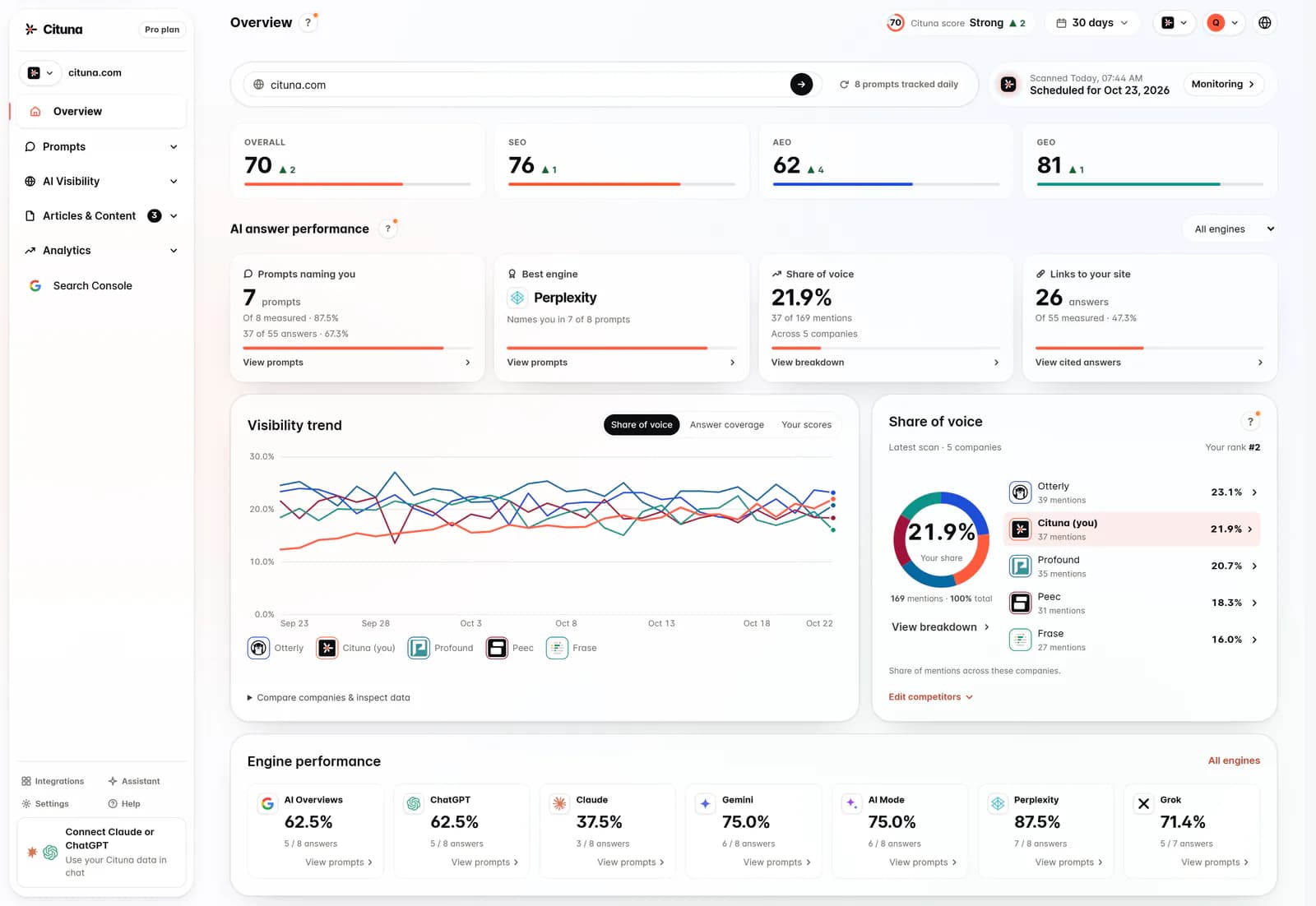
An SEO agent is software that observes search demand and answer visibility, decides which SEO task matters next, makes or proposes the change, and checks the result. A keyword report stops at information; an agent connects the observation to an action and a follow-up measurement.
For a company missing from AI answers, the loop should look like this:
-
Collect the questions buyers ask about the category, problem, products, and alternatives.
-
Ask those questions across ChatGPT, Perplexity, Gemini, Claude, Grok, Google AI Overviews, and Google AI Mode.
-
Record which brands and pages each answer names or cites, including the position of the mention.
-
Match each gap to a practical change, such as clearer page sections, FAQ markup, schema, or llms.txt.
-
Re-run the relevant questions and compare the new answer with the previous one.
An agent is useful only when the loop reaches a measurable check. Generating an article without checking whether the target answer changed is automation, but not a complete SEO agent.
Separate an SEO agent from adjacent tools
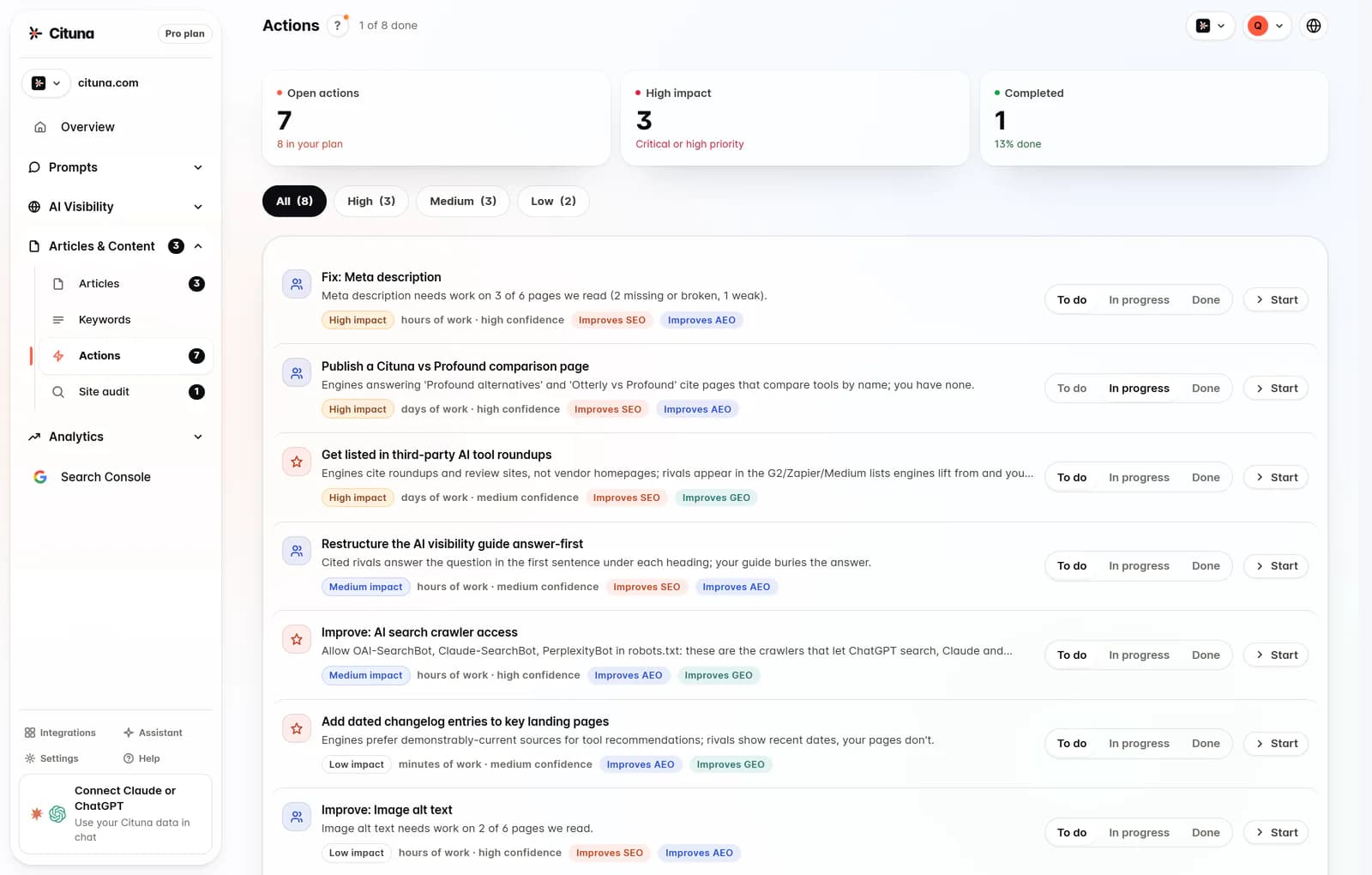
An SEO agent differs from a content generator, a rank tracker, and a chatbot because it joins diagnosis, execution, and verification. Each neighbouring tool can be useful, but none necessarily closes the full loop on its own.
A content generator turns a brief into words. A rank tracker reports positions in conventional search. A technical crawler identifies issues in a site. A chatbot responds to an instruction. An SEO agent uses signals from these activities to select work, apply a change, and inspect what happened afterward.
The distinction matters when AI assistants answer category questions without naming a company. A traditional ranking increase may not change whether ChatGPT or Google AI Mode cites the page. Conversely, a page can be useful to an answer engine even when the team is not tracking that answer separately. Measure both forms of visibility rather than treating a conventional rank as proof of an AI citation.
The first failure mode to avoid is giving an agent an unrestricted publishing job. Define the question set, allowed destinations, approval rule, and success signal before automation starts.
Start with buyer questions across seven engines
The first practical SEO agent input is a maintained set of buyer questions, not a loose list of keywords. Questions expose the language, comparison criteria, objections, and category assumptions that an answer engine uses when deciding what to say.
Group questions into a few useful types:
-
Problem questions, such as how to solve a recurring operational issue.
-
Category questions, such as what a particular type of product does.
-
Comparison questions, such as which options suit a small team.
-
Proof questions, such as what evidence supports a recommendation.
-
Action questions, such as how to start or configure a solution.
Run the same prompts across ChatGPT, Perplexity, Gemini, Claude, Grok, Google AI Overviews, and Google AI Mode. Keep the wording stable when measuring change, but add new questions when sales calls, Search Console demand, or product language reveal a new concern.
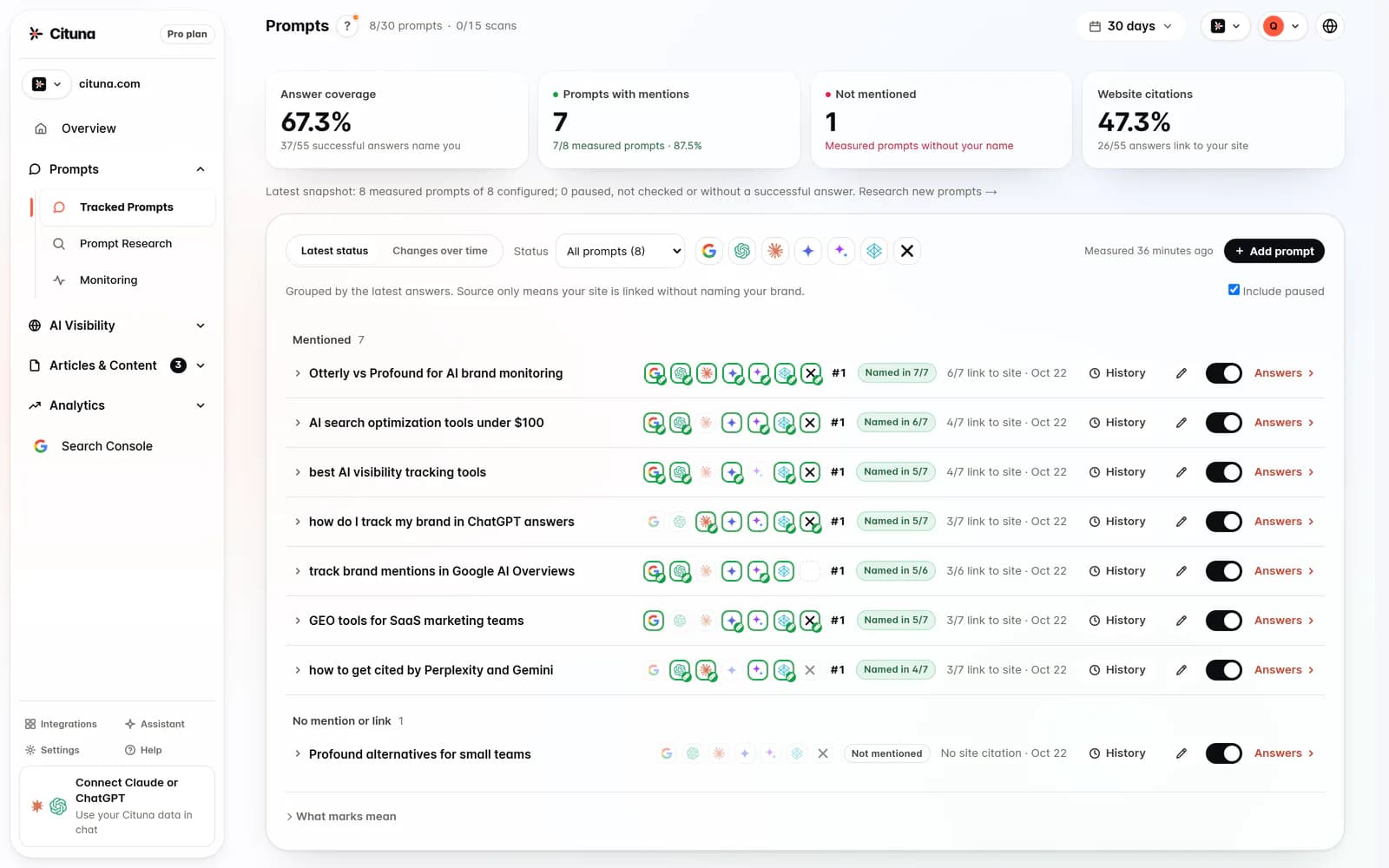
Cituna asks those buyer questions across all seven engines every day on every plan, then records named brands, cited pages, positions, and competitors appearing instead. A team can use that output to separate a missing brand mention from a missing source page.
Measure the visibility gap before changing pages
Measure the gap as a set of specific missing outcomes: no brand mention, no citation, a weak position, the wrong page, or a competitor appearing instead. Naming the failure precisely prevents an SEO agent from applying the same content fix to every prompt.
For each tracked question, capture:
-
Whether the brand appears in the answer.
-
Whether the answer cites a page the team controls.
-
Which page or competitor appears instead.
-
The position and wording of the mention.
-
Whether the question also has relevant search demand or clicks.
A no-mention result calls for a different investigation from a citation to an outdated page. A citation to the wrong page may need internal linking, clearer page purpose, or structured information rather than a new article. A competitor appearing for a question with no corresponding page may justify creating a focused resource, but only after checking that the question matches the company’s actual offer.
AI agent referral measurement adds a second check: compare answer visibility with visits or conversions attributed to AI referrals. A mention can be valuable even when it produces little traffic, while a referral spike without a clear citation may require analytics inspection.
Turn each missing answer into a bounded fix
An SEO agent should convert a visibility gap into one bounded change with an owner, destination, and verification prompt. The fix must answer why the page was absent, not merely add more text.
Useful fix types include schema for machine-readable context, FAQ markup for direct questions, llms.txt where it supports the site’s chosen publishing approach, a rewritten section that answers the missing question, or a new page for a genuine topic gap. The recommendation should identify the target URL, the evidence behind the change, and what result would count as movement.
Cituna generates fixes for gaps using schema, FAQ markup, llms.txt, and page changes. Its AutoSEO can write articles from those gaps and from Search Console demand, then publish them to WordPress, Shopify, a GitHub repository, or another CMS through a webhook. Article publishing can be held for approval or automated, with plan-based volumes of 30, 90, or 300 articles per month.
SEO Autopilot is useful when the chosen fix is a repeatable article workflow, but automation should not replace editorial review for claims, positioning, regulated topics, or pages that affect conversions.
Choose automation by risk and approval
The right level of SEO agent automation depends on the cost of a wrong change, not on how impressive the agent sounds. Low-risk diagnostics can run continuously, while changes to important pages should usually pass a review gate until the team trusts the workflow.
Use a held-for-approval workflow when a change could alter positioning, legal language, product accuracy, internal links, or a high-value landing page. Use automatic publishing only for defined content types with clear templates, known owners, and a rollback process. Keep technical recommendations separate from editorial approval so a useful schema fix is not delayed by a full content review.
Cituna includes Google Search Console so teams can connect visibility work with changes in clicks. Its hosted MCP server connects Claude or another AI agent to the same data. Read tools are available on every plan, while the Pro workflow can run scans, edit tracked prompts, move fixes forward, and queue articles.
Before switching on automation, check:
-
The target pages and CMS permissions are explicit.
-
Approval and rollback owners are named.
-
Prompts are versioned so comparisons remain meaningful.
-
Every published change has a follow-up scan.
-
A failed check pauses the workflow instead of creating more content.
Test one illustrative SEO agent change end to end
A small, controlled prompt test shows whether an SEO agent is improving visibility rather than merely producing output. The following example is illustrative, not a reported customer result.
Suppose the input is the buyer question, “Which website visibility approach suits a small property management firm?” The agent finds that the company is not named, a competitor is cited, and the company has a general services page but no section addressing that decision.
-
Save the exact question and the current answers from the seven engines.
-
Add a concise section to the most relevant page that explains the decision criteria, the company’s scope, and who the service suits.
-
Add appropriate FAQ or schema markup only where the page content supports it.
-
Hold the change for review, then publish it through the approved CMS workflow.
-
Re-run the same question after the team’s chosen review interval and compare mentions, citations, cited URLs, and click data.
A successful check is not simply “the article was published.” The team should see whether the intended page became eligible to cite, whether the answer now names the company accurately, and whether the change created unwanted claims or traffic to the wrong destination. A failed check sends the work back to diagnosis rather than triggering another article automatically.
Decide when an SEO agent earns a place in the stack
An SEO agent earns its place when a team has recurring buyer questions, enough site or Search Console activity to prioritise work, and a way to review or reverse changes. A company with no defined audience questions will get noisy recommendations, however capable the software is.
Use an agent first when the team repeatedly loses time collecting answer evidence, comparing competitor pages, translating gaps into technical or editorial tasks, or checking whether published changes had an effect. Keep a human decision-maker responsible for brand claims, product accuracy, compliance, and the choice of pages worth changing.
Cituna is one option when a team wants measurement and execution in the same workflow. Its plans ask all seven engines buyer questions, record mentions and citations, generate fixes, and connect publishing with Search Console data. The practical next step is to run a free AI visibility scan, then turn one confirmed gap into a tracked prompt and a reviewed change.
An SEO agent is not a replacement for strategy. It is a way to make the observation-to-change loop repeatable, with evidence at each handoff.
Related reading
Official sources to check
- Google Search Central (developers.google.com)
- OpenAI (platform.openai.com)
- Perplexity (docs.perplexity.ai)
- Anthropic (anthropic.com)
Drafted with AI assistance from our own research and Search Console data, and reviewed by Rahul A before publishing. Rules and prices change; check the linked official source before you act.