What is Profound AI?
Profound AI usually refers to Profound, a platform that helps teams study how answer engines represent brands, products and competitors. Its public material focuses on brand visibility, citations, sentiment and the sources appearing in generated answers, rather than on building a general-purpose AI model.
The phrase can also be used loosely for AI search optimization. That broader meaning includes making pages easier for ChatGPT, Perplexity, Gemini, Claude, Grok, Google AI Overviews and Google AI Mode to interpret, retrieve and cite. A marketing lead searching for “Profound AI” may therefore be looking for the product, the category, or a way to solve a missing-brand problem.
For a company that is absent from answers, the product name matters less than the diagnostic question: are the engines unable to crawl the evidence, unable to connect it to the brand, or choosing a competitor despite seeing it?
Separate crawlability from brand visibility
Crawlability tells you whether an automated system can reach and process your pages; brand visibility tells you whether an answer names or cites the brand for a buyer question. Passing the first check does not prove the second.
A homepage can be accessible while a product page lacks the facts an answer engine needs, such as who the product serves, which problem it solves, how it differs, or what evidence supports the claim. A crawler-readiness result is therefore a technical starting point, not a citation report.
Run a free AI visibility scan before changing content. Use its result to check whether the basic access and page signals are present, then use a prompt-level visibility tracker when the real question is who gets named. Cituna’s free check tests crawler readiness, while brand mention and citation tracking requires a plan.
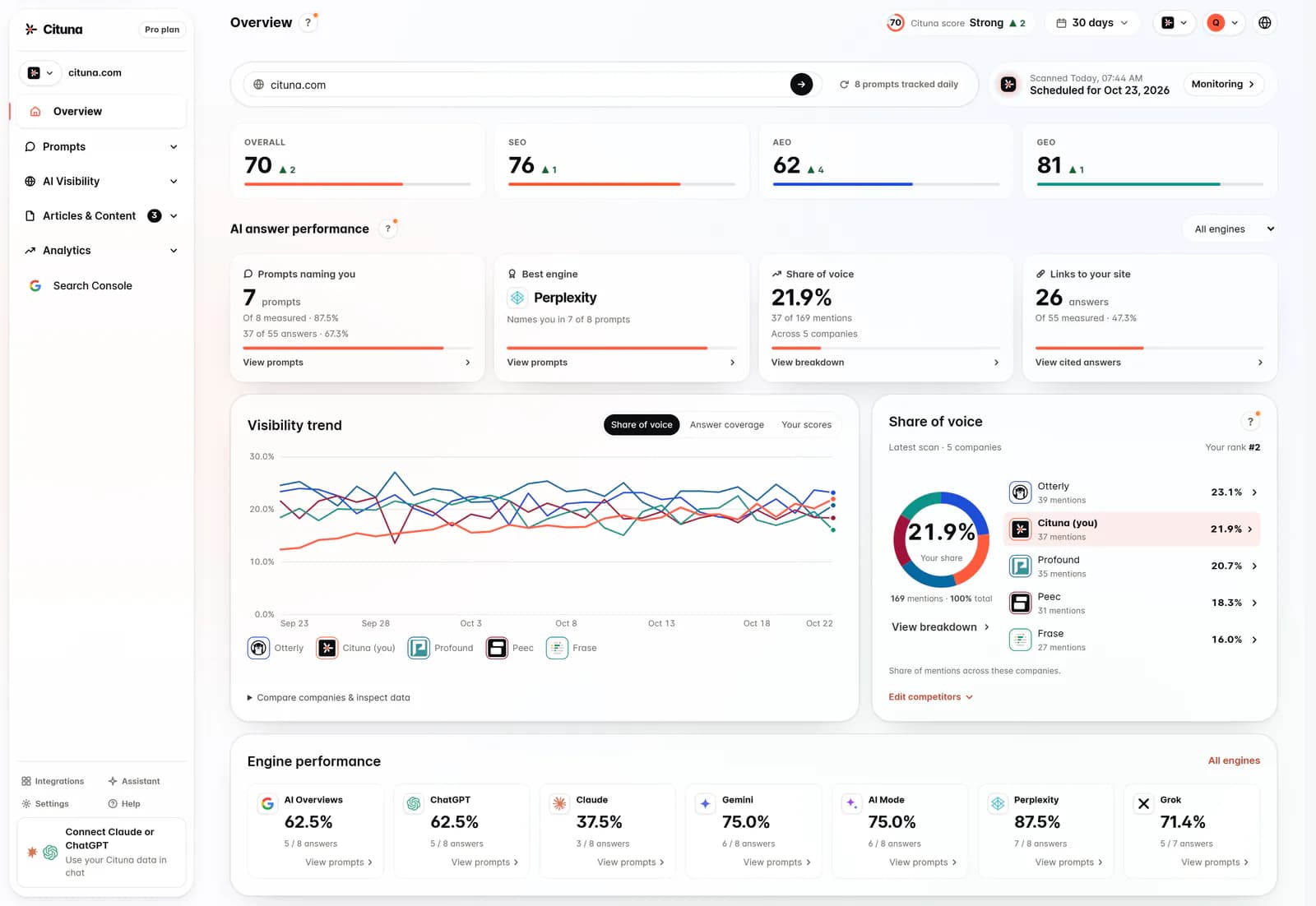
Measure the buyer questions across seven engines
A useful Profound AI comparison starts with the same buyer questions asked across ChatGPT, Perplexity, Gemini, Claude, Grok, Google AI Overviews and Google AI Mode. Measuring only one answer engine can hide a distribution problem or make a temporary result look like a durable gain.
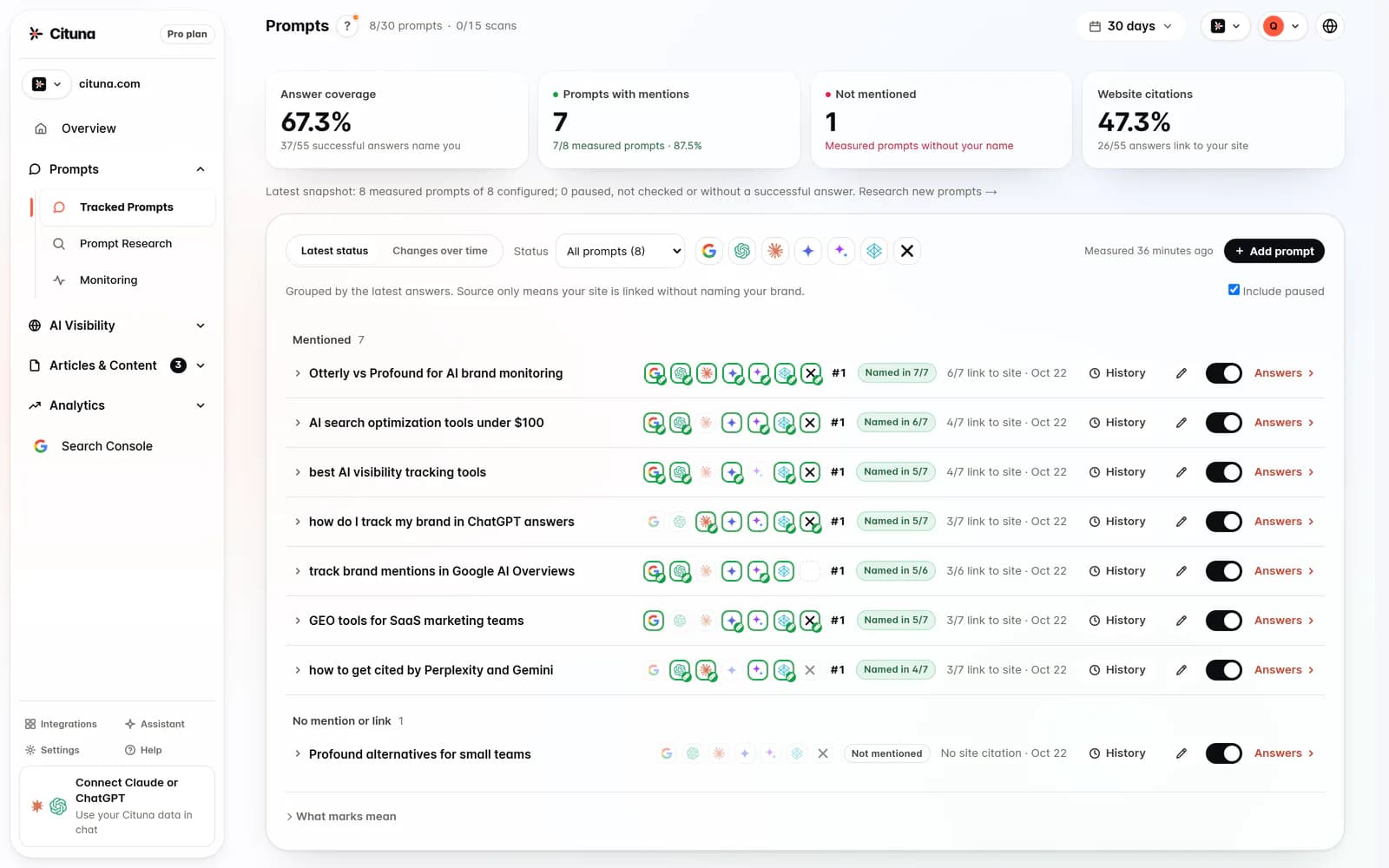
Build a prompt set from the language buyers actually use, not just branded queries. Include category questions, comparison questions, implementation questions, problem questions and questions that mention a competitor. Record the answer, named brands, cited URLs, citation position, competitors present and the date of each run.
Cituna asks the seven engines these buyer questions every day on every plan and records which brands and pages appear. That setup makes the important unit of analysis a prompt and its evidence, rather than a single site-wide visibility score.
Track these fields for each prompt:
- Whether the brand is named.
- Whether the brand is cited.
- Which page is cited.
- Which competitor appears instead.
- Whether the answer describes the brand accurately.
- Whether the result changes across engines.
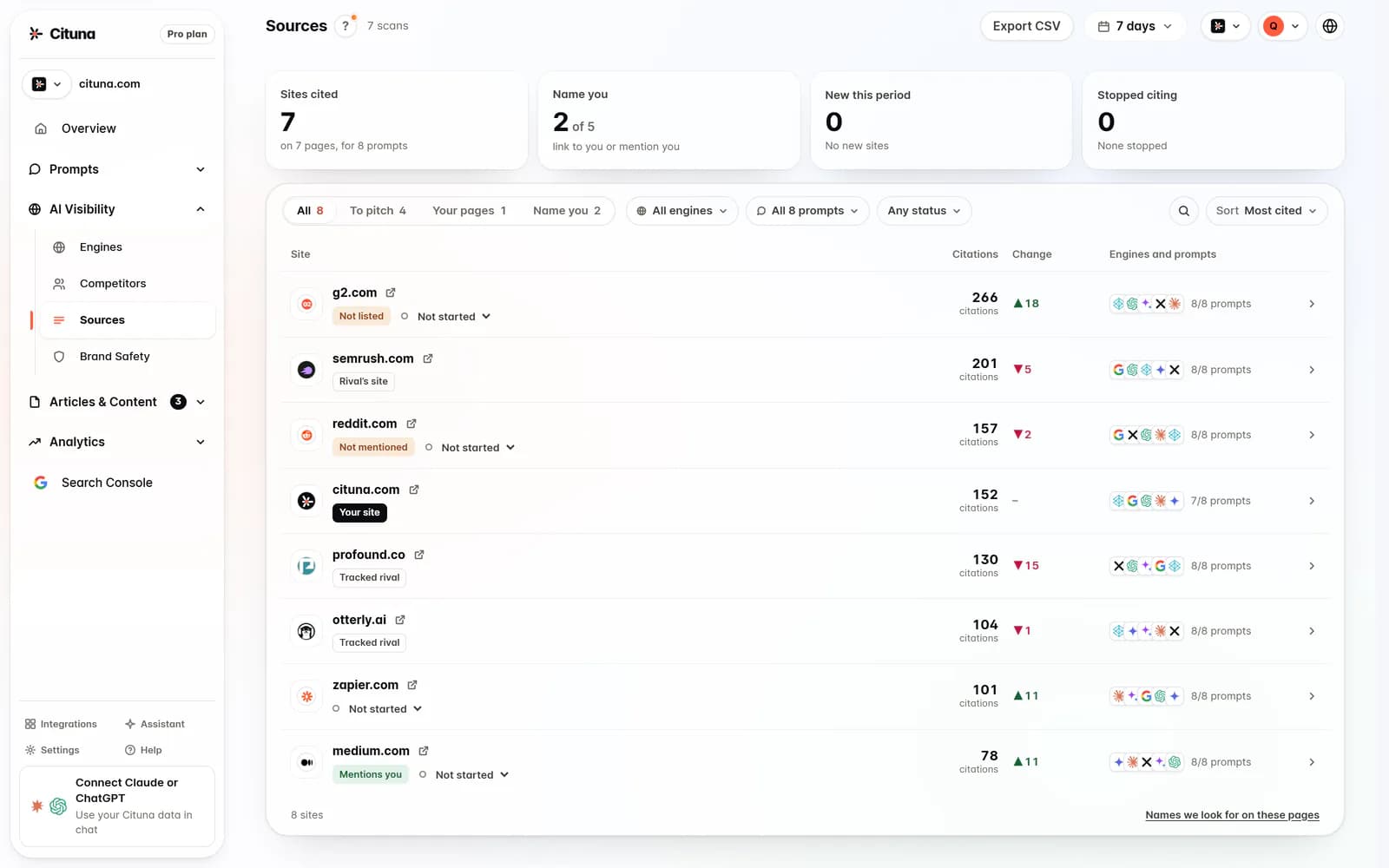
A brand that is named but never cited has a different problem from a brand that is cited on an irrelevant page. Keep those cases separate.
Diagnose the reason a competitor appears
A competitor appearing in an answer usually points to an evidence or interpretation gap, not one universal ranking failure. Diagnose the answer before rewriting the page.
Use the cited competitor page as a comparison reference, not as a template to copy. Ask which buyer fact the competitor makes easier to verify: a clear audience, a specific use case, a comparison with alternatives, implementation detail, independent references, or consistent terminology across pages.
Then classify the gap:
- Access gap: the important page is blocked, poorly linked or difficult to process.
- Entity gap: the page does not clearly connect the company, product and category.
- Evidence gap: the claim lacks concrete support or a source an engine can cite.
- Coverage gap: no page answers the buyer’s exact question.
- Freshness gap: an old page no longer reflects the current offer.
- Selection gap: the engine sees the brand but chooses another source as more useful.
The last category is often missed. Adding more generic content will not solve a selection gap if the existing page already answers the question but buries its strongest evidence.
Turn each visibility gap into one page change
The first content change should make one missing buyer fact explicit on the page most likely to be cited. Avoid publishing a broad article before identifying the prompt, answer weakness and destination page.
For example, imagine the prompt is “Which analytics tool suits a 20-person ecommerce team that needs weekly reporting without a data engineer?” The answer engine names a competitor, while your site has a product page that says only “advanced analytics for modern teams.” Rewrite that page with the audience, reporting workflow, setup expectation and relevant proof stated in plain language. Check the result by rerunning the same prompt and inspecting whether the answer names the brand and cites the revised page.
The example is illustrative, not a customer result. The check is important because a polished rewrite is not evidence of improvement by itself.
Cituna turns identified gaps into proposed fixes such as schema, FAQ markup, llms.txt and page changes. Its AutoSEO can also write articles from visibility gaps and Search Console demand, then send them to WordPress, Shopify, a GitHub repository or another CMS by webhook, with approval or automatic publishing as the workflow requires.
For each proposed fix, write down:
- The exact prompt it should improve.
- The page that owns the answer.
- The fact that was missing or unclear.
- The change made.
- The date and engine used for the retest.
That record prevents teams from confusing publishing activity with measurable progress.
Retest the same prompts before expanding the work
Retest the original prompt set before adding more topics, because changing the question makes the result difficult to interpret. Keep the wording, target page and comparison set stable for the first check.
Review both gains and regressions. A brand may become visible for a category prompt while disappearing from a comparison prompt, or gain a citation while the answer still describes the offer incorrectly. Search Console data can add a second signal by showing whether changes are associated with movement in search clicks, but search traffic and answer-engine citations are not interchangeable measures.
Use a simple decision rule:
-
If the page cannot be reached or understood, fix access and structure first.
-
If the page is reachable but absent for a prompt, add the missing buyer evidence.
-
If the page is cited but inaccurate, correct the explanation and supporting proof.
-
If the page improves on one engine only, keep testing before treating the change as broad visibility progress.
Cituna includes Google Search Console so teams can view search-click movement beside the visibility work. The two signals answer different questions and should not be collapsed into one score.
Choose the platform by the work after measurement
Choose an AI visibility platform by what happens after a missing citation is detected, not only by the dashboard it provides. Cituna is one option for teams that want measurement connected to generated fixes, publishing workflows and Search Console context; Profound is the product most directly associated with the “Profound AI” search, while other tools may suit teams focused on different monitoring or comparison needs.
A fair evaluation should ask whether the platform can:
- Ask the engines and prompts that matter to your buyers.
- Show names, citations, positions, competitors and source pages.
- Separate crawlability from brand mentions.
- Recommend a concrete page or technical change.
- Let the team approve, publish and retest the change.
- Connect visibility movement with search demand or clicks.
Teams comparing adjacent platforms can read Peec AI vs Profound for a narrower comparison of engines and pricing. Teams evaluating another monitoring workflow can also read Goodie AI vs Profound before choosing what to test.
The Goodie AI vs Profound comparison is useful when the decision depends on price and engine coverage as well as monitoring workflow.
This article’s decision is whether the workflow can move from an observed absence to a checked correction.
Start with one scan and a controlled prompt set
The practical next step is to run a crawler-readiness scan, prepare a small set of real buyer questions, and then track the exact answers where the brand is missing. Start with one high-value category prompt, one comparison prompt and one problem prompt rather than trying to measure every possible query.
Use the scan to remove basic access problems. Then ask ChatGPT, Perplexity, Gemini, Claude, Grok, Google AI Overviews and Google AI Mode the same questions, record the named and cited sources, and choose the one gap with the clearest page-level fix. Retest that prompt after the change before expanding the set.
This sequence gives a founder or marketing lead an actionable answer to “Profound AI” without treating a visibility score as the finish line. The useful outcome is a repeatable loop: question, answer, missing evidence, targeted change and controlled retest.
Related reading
Official sources to check
- Profound blog (tryprofound.com)
- Profound for PR and Brand Teams (tryprofound.com)
Drafted with AI assistance from our own research and Search Console data, and reviewed by Rahul A before publishing. Rules and prices change; check the linked official source before you act.