What are the five pros of AI for business?
Artificial intelligence is software that performs tasks associated with human intelligence, such as recognising patterns, generating language, making predictions and supporting decisions. It works by processing data with models trained to identify relationships, rather than by thinking like a person.
For a small or mid-size company, the five most useful pros of AI are:
-
Faster routine work, because software can draft, classify, summarise or analyse information.
-
Wider access to assistance, because customers and employees can get useful guidance without waiting for a person.
-
More consistent decisions, because the same rules or prompts can be applied repeatedly.
-
Personalised experiences at scale, because AI can adapt content or recommendations to different contexts.
-
Continuous learning and improvement, because teams can review outputs, feedback and performance patterns.
Those benefits matter only when they improve a real task. A faster content process is not automatically valuable if the content is inaccurate, and an answer that helps a customer is not a marketing win if it never identifies the company that can solve the problem.
For more context, read AI Content Visibility: An 8-Step Check.
Turn each AI benefit into a measurable visibility question
AI visibility shows whether answer engines associate a buyer’s question with your company, page or competitor, so every general AI benefit needs a visibility measure before it becomes a marketing decision. The key distinction is between AI helping your team do work and AI naming your business when a buyer asks for help.
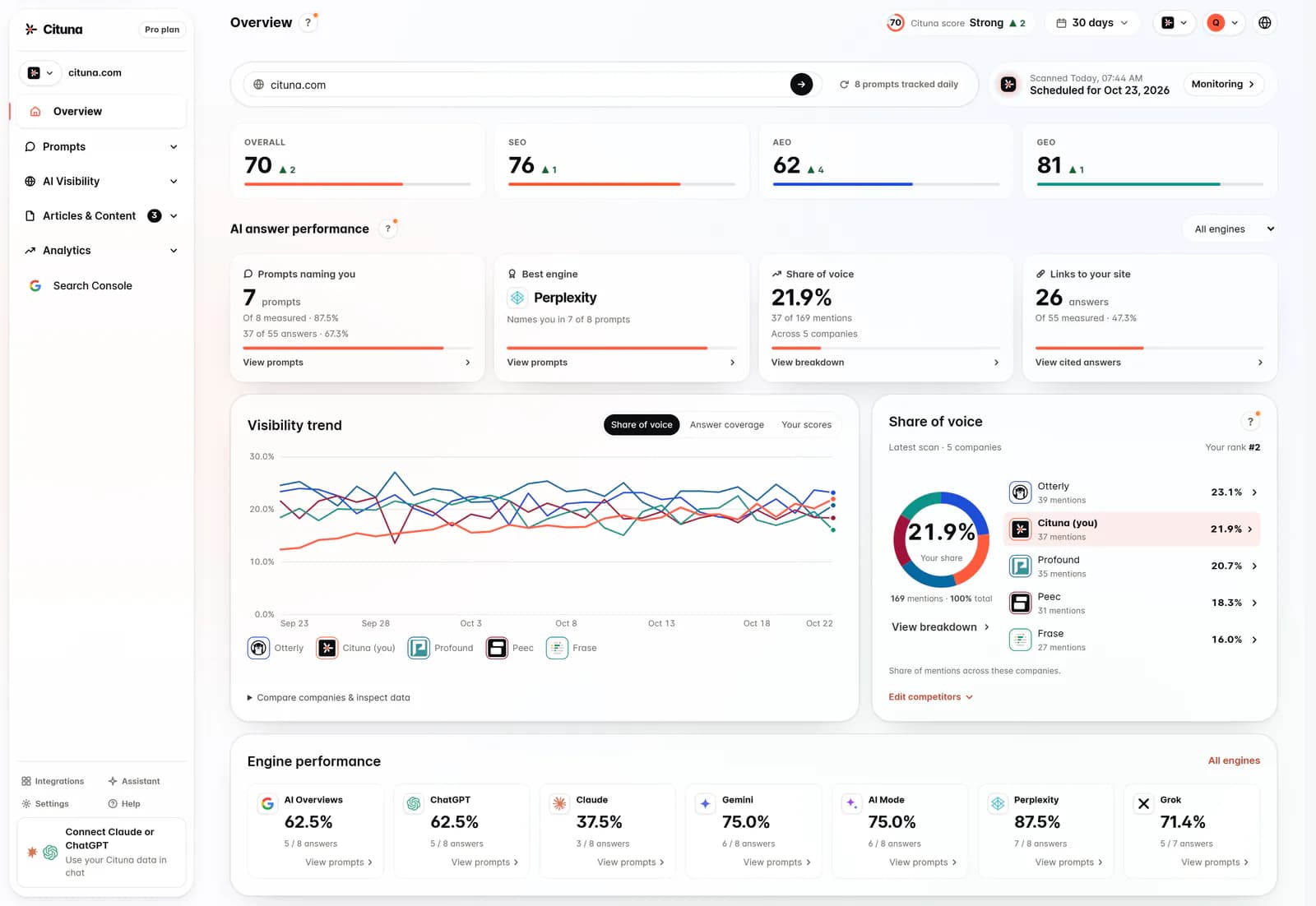
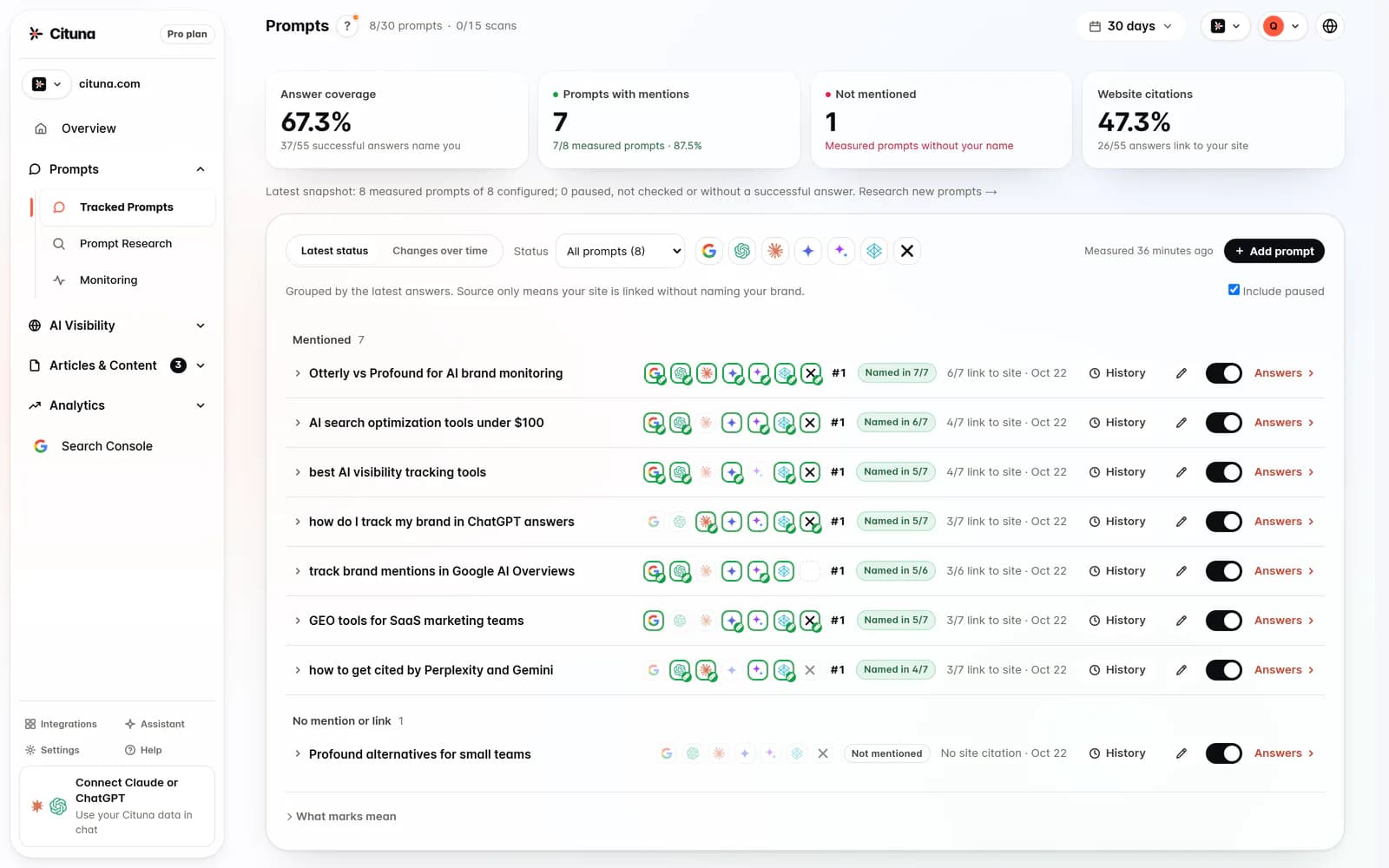
Cituna is an AI visibility platform that asks ChatGPT, Perplexity, Gemini, Claude, Grok, Google AI Overviews and Google AI Mode the questions a brand’s buyers ask, then records which brands and pages each answer names or cites. That makes the five pros measurable rather than merely aspirational.
Use this mapping before changing content:
-
Faster work: measure the time from a buyer question to a useful, reviewable answer.
-
Wider assistance: measure how often engines answer the question and whether your brand appears.
-
Consistent decisions: compare whether the same prompt produces a stable description of your company.
-
Personalisation: check whether different buyer contexts produce relevant pages, not just a generic mention.
-
Continuous improvement: compare citations, positions and competitor appearances after each change.
A common failure is to celebrate an AI-written article without checking whether answer engines cite it. The output is an internal efficiency gain; the citation is an external visibility outcome.
For more context, read AI Visibility Services for Small Businesses: A Guide.
Faster routine work gives small teams more capacity
AI can reduce the manual time required for repetitive research, drafting, classification and summarisation, giving a small team more capacity for judgement-heavy work. The benefit is strongest when the task has a clear input, a repeatable process and a human check before publication.
Marketing teams can use AI to turn recurring buyer questions into draft briefs, group similar search queries, summarise support themes and identify missing explanations. AI should not be allowed to decide whether a claim is accurate or whether a page reflects the company’s actual offer without review.
For visibility work, faster production creates a risk as well as an advantage. Publishing more pages does not solve a missing entity, weak evidence or unclear positioning. A useful workflow is to identify a question, create the smallest credible page that answers it, check the facts, publish it and then watch whether answer engines begin naming or citing the page.
Illustrative example: if a buyer asks which implementation approach suits a small team, use AI to group related questions and draft an outline. A subject expert checks the recommendations and examples, then the team tests that prompt across the seven engines. The result to check is not only whether the page was published, but whether the answers now describe the company accurately.
Broader access to help improves availability and reach
AI can make useful guidance available to more people and in more situations, especially when a team cannot answer every routine question immediately. The advantage is reach, not permission to remove human support from complex or sensitive decisions.
AI First Mindset reports that platforms like Zendesk and Intercom use AI chatbots to handle routine customer inquiries, cutting ticket volume by up to 70%. That figure describes a reported example, not a promise for every company, so teams should measure their own resolution quality, escalation rate and customer satisfaction.
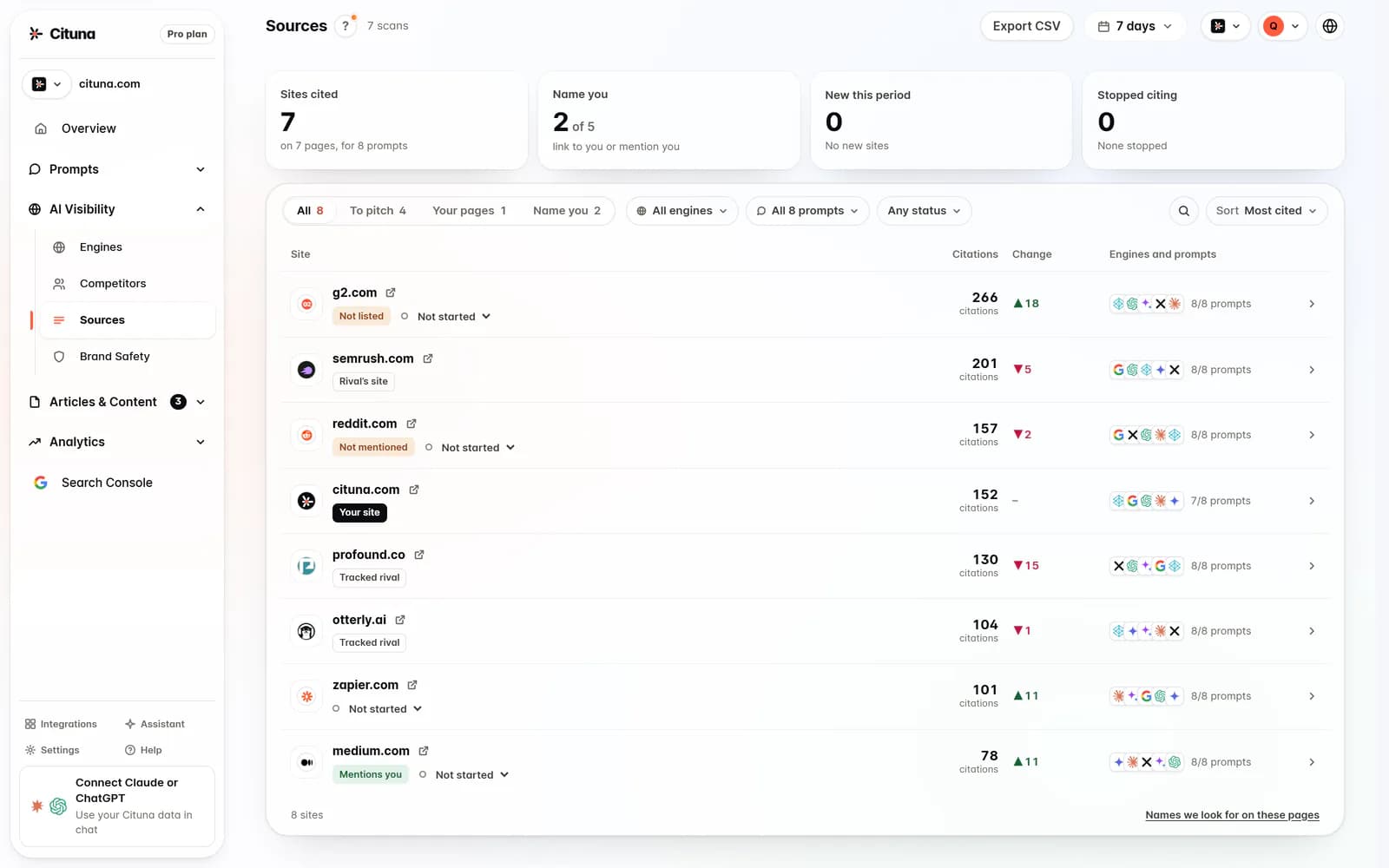
The visibility equivalent is whether answer engines can provide a clear route to your company when a buyer asks a routine category question. Check whether the answer names your brand, cites a relevant page and gives a next step that matches what you actually provide. If the engine gives a generic answer or names a competitor, improve the underlying page, proof and internal links rather than simply adding more chatbot copy.
Accessibility also depends on language, reading level and page structure. Clear definitions, descriptive headings, concise answers and supporting evidence help both people and retrieval systems understand the subject.
Consistent decisions make your company easier to understand
AI can apply the same instructions to recurring tasks, which helps a company produce more consistent classifications, summaries and recommendations. Consistency is valuable when customers encounter the brand across many pages, prompts and channels.
A company becomes easier for answer engines to name when its core facts remain stable. Product category, audience, use cases, limitations and terminology should not change accidentally from one page to another. Human review still matters because a consistently repeated error is more damaging than an isolated mistake.
Test consistency with a small prompt set that represents different buyer stages. Ask what the company does, who it serves, which problem it solves and how it differs from nearby alternatives. Compare the wording, cited pages, position and competitors across ChatGPT, Perplexity, Gemini, Claude, Grok, Google AI Overviews and Google AI Mode.
If answers conflict, check the source pages first. Look for vague home page copy, outdated descriptions, conflicting claims or pages that use different names for the same offer. Fix the clearest source of truth, then test again instead of trying to manipulate individual answers.
Personalised experiences help buyers reach relevant answers
AI can adapt an explanation, recommendation or workflow to a person’s context, which helps buyers move from a broad question to a more relevant next step. Personalisation works when the company has distinct audiences and enough accurate information to explain how the solution fits each one.
Marketing leads should separate useful relevance from invented targeting. A page for founders at small companies may need different examples from a page for enterprise procurement, but both pages should describe the same underlying product truth. Personalisation should clarify fit, not create unsupported promises.
Measure this benefit by testing prompt variations. Change the industry, company size, use case or urgency while keeping the core problem similar. Then check whether the engine chooses an appropriate page, describes the audience correctly and preserves the company’s essential facts.
A failure mode is creating many thin pages that differ only by audience label. If the pages add no new evidence, process detail or decision guidance, they may confuse both readers and retrieval systems. Build a separate page only when the audience has a genuinely different question or evaluation criterion.
Continuous learning turns AI output into a feedback loop
AI creates a useful improvement loop when teams review what it produces, compare outcomes with the original goal and update the instructions or source material. The benefit is not that an AI system automatically becomes correct; the benefit is that repeated review exposes patterns a team can fix.
For an AI visibility programme, the loop has four parts:
-
Record the buyer prompts that matter and the answers each engine gives.
-
Identify the missing citation, inaccurate description, weak page or competitor that appears instead.
-
Make one traceable change, such as clearer wording, FAQ markup, schema or a stronger supporting page.
-
Rerun the same prompt set and check whether the answer, citation and position changed in the intended direction.
Cituna generates suggested fixes for visibility gaps, including schema, FAQ markup, llms.txt and page changes. Its built-in Google Search Console connection helps a team compare content changes with search clicks, so AI visibility and search performance can be reviewed together rather than treated as unrelated reports.
Keep a record of the prompt, date, changed page and observed result. That prevents a team from confusing normal answer variation with a reliable improvement.
Start with one buyer question and a before-and-after check
The practical next step is to test one important buyer question before changing content, then fix the clearest gap revealed by the answer. Start with a question that includes a real decision, such as which solution suits a small company or how to solve a specific category problem.
Run a free AI visibility scan to check whether your site is ready to be crawled. The free check tests crawler readiness, not ongoing brand mentions or citations, so account signup should not be treated as a free tracking plan. Brand and citation tracking requires a Cituna plan.
Use this sequence after the initial check:
-
Write down the exact buyer prompt, audience context and desired answer.
-
Check the relevant page for a clear definition, audience, use case, evidence and next step.
-
Remove conflicting wording and add the missing explanation or markup.
-
Test the prompt across ChatGPT, Perplexity, Gemini, Claude, Grok, Google AI Overviews and Google AI Mode.
-
Record which engine names or cites the brand, which competitor appears and which page supports the answer.
-
Repeat after the change and keep the result only if the answer is more accurate and useful.
The five pros of AI become commercially meaningful when they improve a buyer’s ability to understand, evaluate and choose a company. Measure that path, not just the volume of AI-generated work.
Related reading
Official sources to check
- Karpagam College of Engineering (learn.kce.ac.in)
- Rasmussen University (rasmussen.edu)
- AI First Mindset (aifirstmindset.ai)
Drafted with AI assistance from our own research and Search Console data, and reviewed by Rahul A before publishing. Rules and prices change; check the linked official source before you act.