Is Profound AI worth it for your measurement-to-action gap?
Profound is worth evaluating when your team needs structured visibility data across AI search and has the resources to turn findings into content, technical and brand actions. Public reviews generally present it as a platform for tracking what AI answers say, which brands they name and how competitors appear.
The important limitation is that a review can confirm features without showing whether a small team can move from an absent citation to a tested fix. Treat Profound as a fit question, not a universal recommendation. Ask whether its coverage, reporting and workflow match the questions your buyers actually ask.
A useful buying rule is simple: choose a platform only when it can connect four things in one workflow:
- The exact buyer question that was tested.
- The engine and answer where your brand was absent.
- The page, competitor or evidence pattern associated with the gap.
- The change and follow-up measurement that will show whether the gap narrowed.
Reviews that stop at dashboards leave the most important business question unanswered: what should the team change first?
Profound is an AI visibility and marketing platform
Profound is positioned as a platform for monitoring how AI search answers represent brands, products and topics, with a broader marketing layer around that visibility data. The public reviews cover tracking, prompts, competitor appearances, agent-oriented workflows and the company's changing product direction.
That description matters because AI visibility is not the same as conventional rank tracking. ChatGPT, Perplexity, Gemini, Claude, Grok, Google AI Overviews and Google AI Mode can produce different answers to similar questions. A useful review therefore examines engine coverage, prompt selection, citation evidence, answer position and the pages that appear instead of yours.
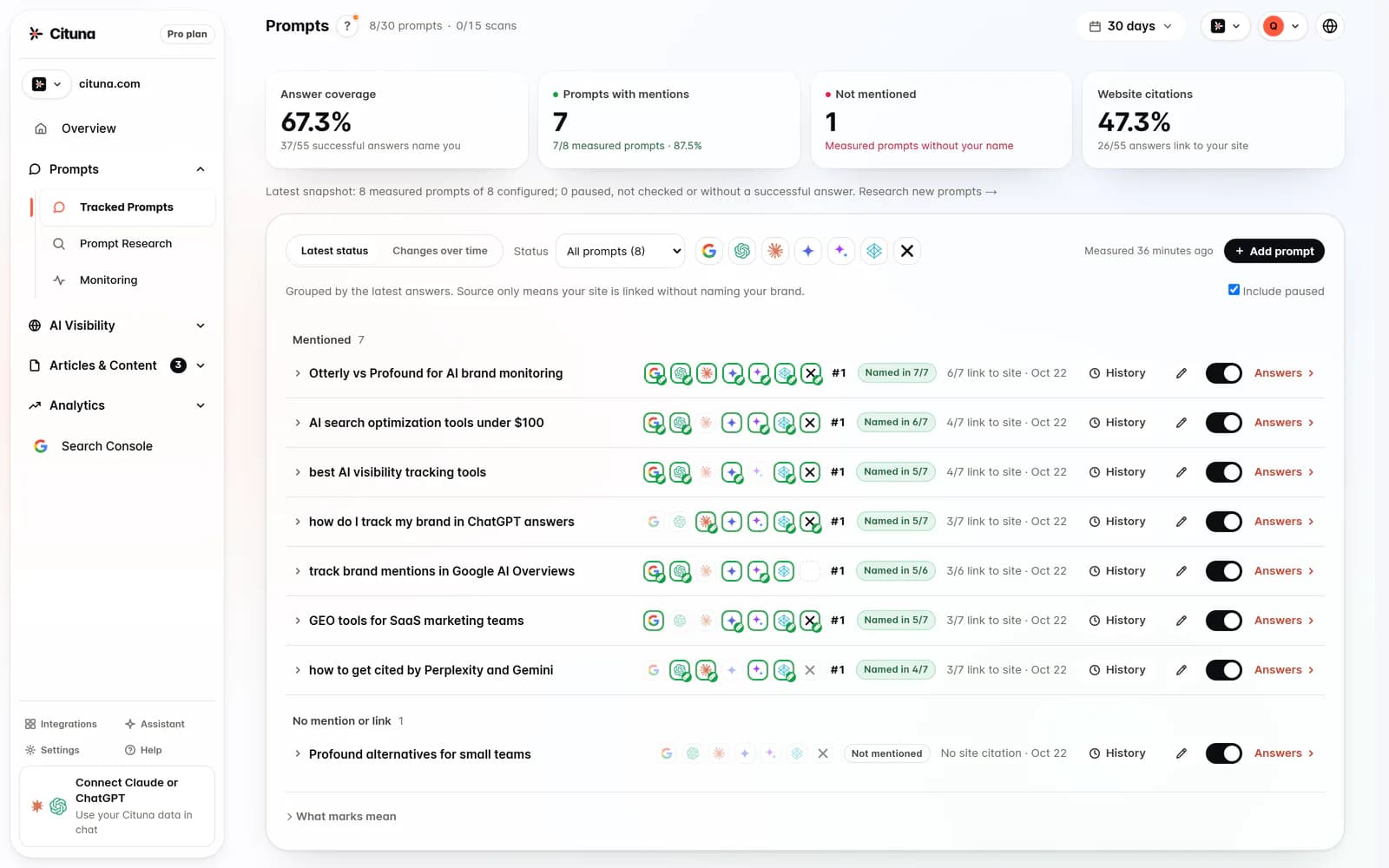
Do not confuse an answer mentioning a brand with a citation that supports the answer. A brand may be named without a relevant source page, or a page may be cited while the brand is described incorrectly. Your review process should record both outcomes and separate presence, position, citation and accuracy.
Public reviews show a changing Profound pricing picture
Profound pricing needs confirmation before purchase because the public review pages describe different snapshots of its plans. Generate More reported that its October 2025 test listed Starter at $99 and Growth at $399, while its September 2026 view showed a free trial and custom Enterprise pricing. Those accounts should be treated as time-stamped reports, not a substitute for a current quote.
Rankability also reported that Profound's Growth plan was limited to three engines and 100 prompts in its October 2, 2026 review. That detail conflicts with the broader engine coverage described in other material, so ask which engines and prompt limits apply to the exact plan offered to your team.
Rankability reported that third-party reviews in early 2026 placed Profound enterprise deployments between $2,000 and $5,000 or more per month, depending on platform count, seats and features. The same source said those figures were not published by Profound, so a buyer should request the scope in writing.
For a separate price audit, compare the details in Profound AI pricing and checks before treating any review figure as current. Check these items in the quote:
- Included engines and whether each engine has separate limits.
- Tracked prompts, brands, workspaces and user seats.
- Refresh frequency and historical data access.
- Exports, API or MCP access and any usage limits.
- Implementation, support and cancellation terms.
Pricing is only comparable after the measurement unit is clear. A low monthly figure can become expensive if the plan cannot test the questions, engines or workspaces your team needs.
A useful review tests evidence, not dashboard breadth
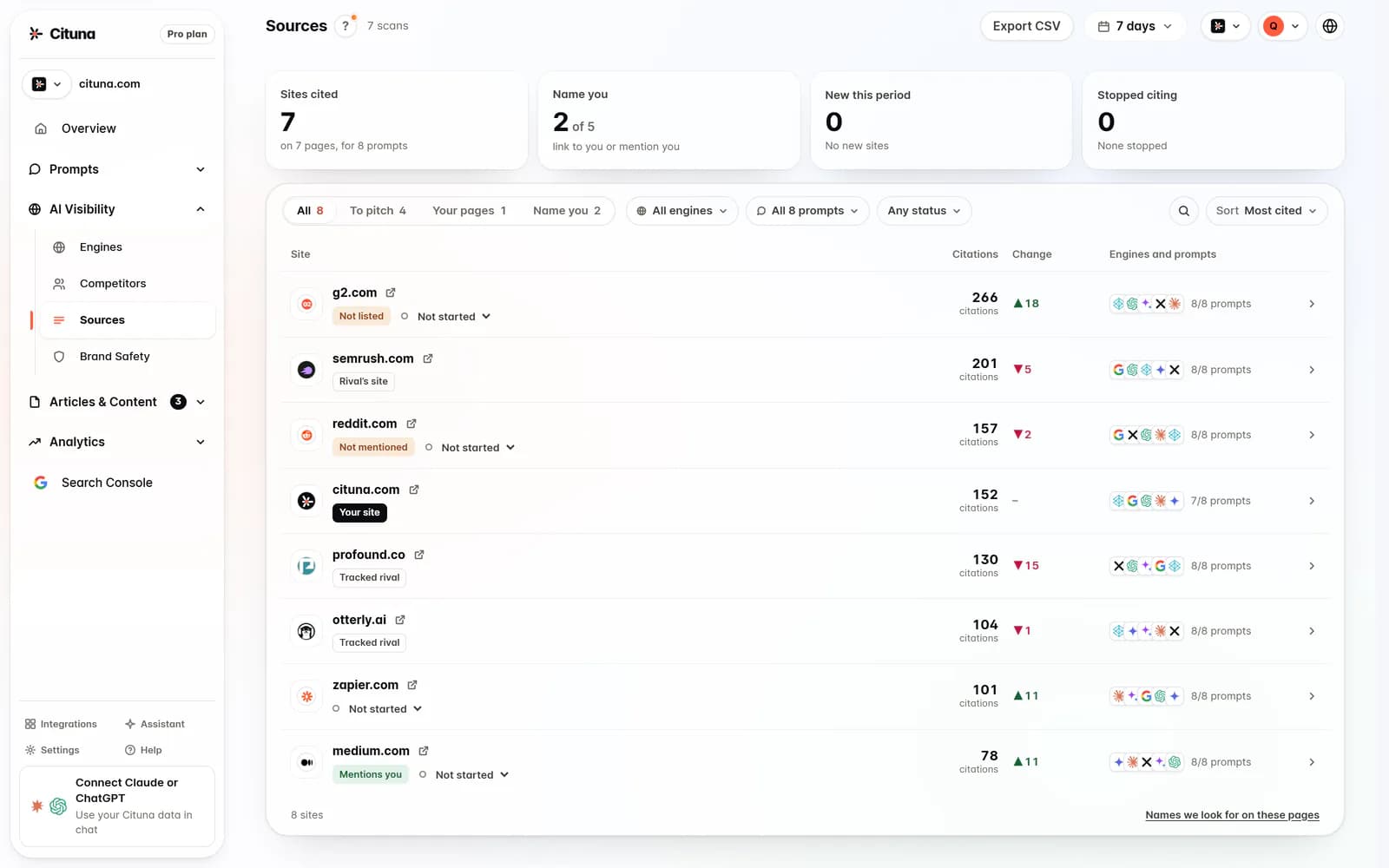
A strong Profound review should test whether the platform gives enough evidence to explain an AI answer, rather than counting dashboards or marketing features. Ask for a sample output using real category questions and inspect whether each result preserves the prompt, engine, answer, cited URL, competitor and collection time.
Use this review checklist before accepting a product demonstration:
- Can the team distinguish a mention from a citation?
- Can each cited page be opened and checked for relevance?
- Can prompts be grouped by buying stage or intent?
- Can the platform show changes by engine rather than only an overall score?
- Can a marketer assign a gap to a page, content brief or technical fix?
- Can the team export evidence for a client, founder or content owner?
A review also needs to test failure cases. Run similar prompts with different wording, inspect answers that cite no source, and check what happens when an engine returns a temporary or incomplete response. If the platform hides the raw answer or cannot preserve the tested prompt, the headline score may be difficult to audit.
The right buyer is the team that can act on findings
Profound is most relevant to teams that already have defined buyer questions, enough content or technical capacity to respond, and a need to monitor AI answers as a separate channel. Agencies and larger marketing groups may value workspaces, reporting and broader operational controls, while a small company may need a narrower prompt set and a clearer path from finding to fix.
Use a simple fit test:
- Choose a broad platform when several teams need shared visibility evidence and recurring reporting.
- Choose a focused workflow when one team owns a small set of commercial questions and needs fast changes.
- Delay buying when nobody owns the response to a missing citation.
- Request a narrower evaluation when your category has specialised terminology or several similar entities.
The common advice to buy more monitoring can fail when the real constraint is approval time. If publishing, technical changes or legal review take weeks, a larger prompt library will create more backlog without improving visibility. Measure the time from detected gap to approved change as part of the review.
Cituna fits teams that want fixes attached to visibility data
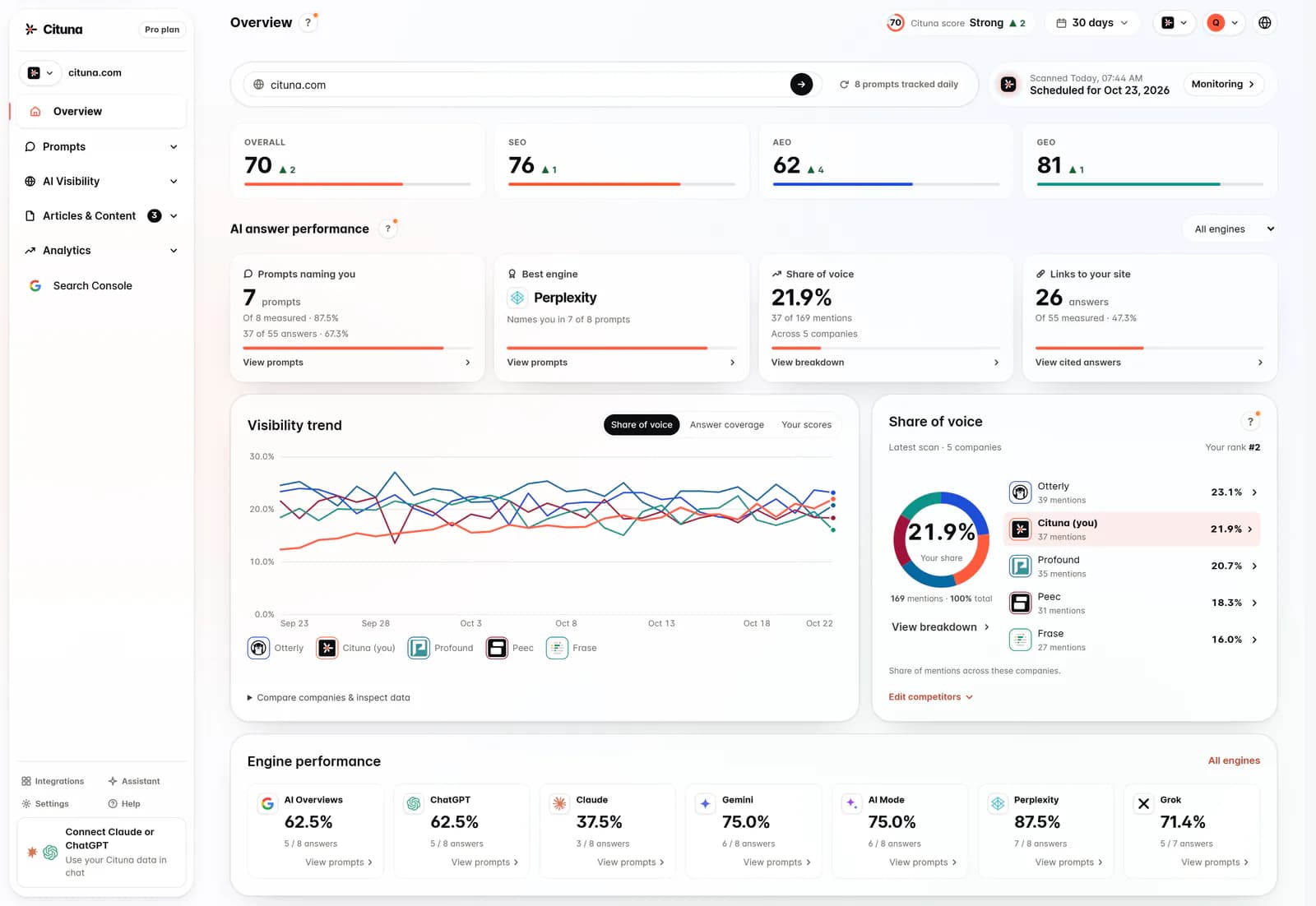
Cituna, which publishes this guide, asks ChatGPT, Perplexity, Gemini, Claude, Grok, Google AI Overviews and Google AI Mode the questions a brand's buyers ask, then records which answers name or cite the brand, at what position, and which competitors and pages appear instead. Cituna is designed for teams that want the platform to generate the next fix, not only report the gap.
For every identified gap, Cituna can generate schema, FAQ markup, llms.txt and page changes. Its AutoSEO can write articles from visibility gaps and Search Console demand, then send them to WordPress, Shopify, a GitHub repository or another CMS by webhook, with approval or automatic publishing workflows.
The choice is therefore about operating model. Profound may suit a team assessing a broader AI marketing platform and its commercial fit. Cituna suits a small or mid-size team that wants seven-engine monitoring connected to proposed changes, Search Console feedback and publishing steps. Review both against the same buyer questions rather than comparing brand claims in isolation.
A side-by-side comparison of another option is available in Peec AI vs Profound. Use the same prompts, engines and evidence requirements for every platform you assess.
A worked review starts with one buyer question
An illustrative review can begin with the question, “Which project management tool should a 40-person remote agency use?” The action is to run that prompt, plus close variations, across the engines your team needs and record whether the answer names your company, cites a relevant page, recommends a competitor or gives an inaccurate description.
Do not judge the result from one response. Group the observations by intent, such as category discovery, comparison, implementation and problem solving. Then check whether the cited pages contain clear definitions, evidence, usable examples and language that matches the question.
Use the following review sequence:
- Save the exact prompt and the engine response.
- Mark brand mention, citation, position, competitor appearance and factual accuracy separately.
- Identify the page or evidence type that appears in answers where your brand is absent.
- Make one controlled change to the relevant page or supporting content.
- Rerun the same prompt set and compare the answer evidence, not only a composite score.
- Check Search Console and page analytics for related demand before deciding whether to expand the change.
The test passes when the team can explain what changed, why it changed and which answer evidence moved. If the result changes but the cited page remains irrelevant, treat the experiment as incomplete rather than calling it a visibility win.
Run a visibility check before committing to a platform
The practical next step is to run a free AI visibility scan, then turn the result into a small, reviewable test set. Start with the questions that influence revenue or product consideration, not generic questions about your industry. Keep the initial set small enough that someone can inspect every answer and cited page.
Before a sales call or trial, prepare:
- The brand name, product names and common alternate spellings.
- The competitors buyers mention most often.
- The pages that should support category, comparison and problem-solving questions.
- The engines that matter to your audience.
- One person responsible for approving and checking changes.
Remember that a free crawler-readiness check is not the same as ongoing brand mention and citation tracking. Cituna account creation starts the product relationship, while brand and citation tracking requires a plan. A scan is useful for deciding what to investigate first, but it should not be presented as proof that a platform will improve an answer.
The best review outcome is a decision with a testable boundary: which questions will be monitored, which changes will be made first, who will approve them and what evidence will count as progress. That standard protects a small team from buying a dashboard without an operating process.
Related reading
- AI Visibility Platform Buyer Comparison Checklist
- SE Ranking AI Visibility Tracker Review: What It Tracks
Official sources to check
- Rankability (rankability.com)
- Generate More (generatemore.ai)
Drafted with AI assistance from our own research and Search Console data, and reviewed by Rahul A before publishing. Rules and prices change; check the linked official source before you act.