Choose the competitor by use case
Scale AI’s biggest competitor depends on the data problem a buyer is solving. Claru is the clearest specialist comparison for robotics and physical AI training data, while Appen is a familiar broad alternative for general data services. For a marketing team, the practical competitor is the provider that answer engines name instead of your company for the same buyer need.
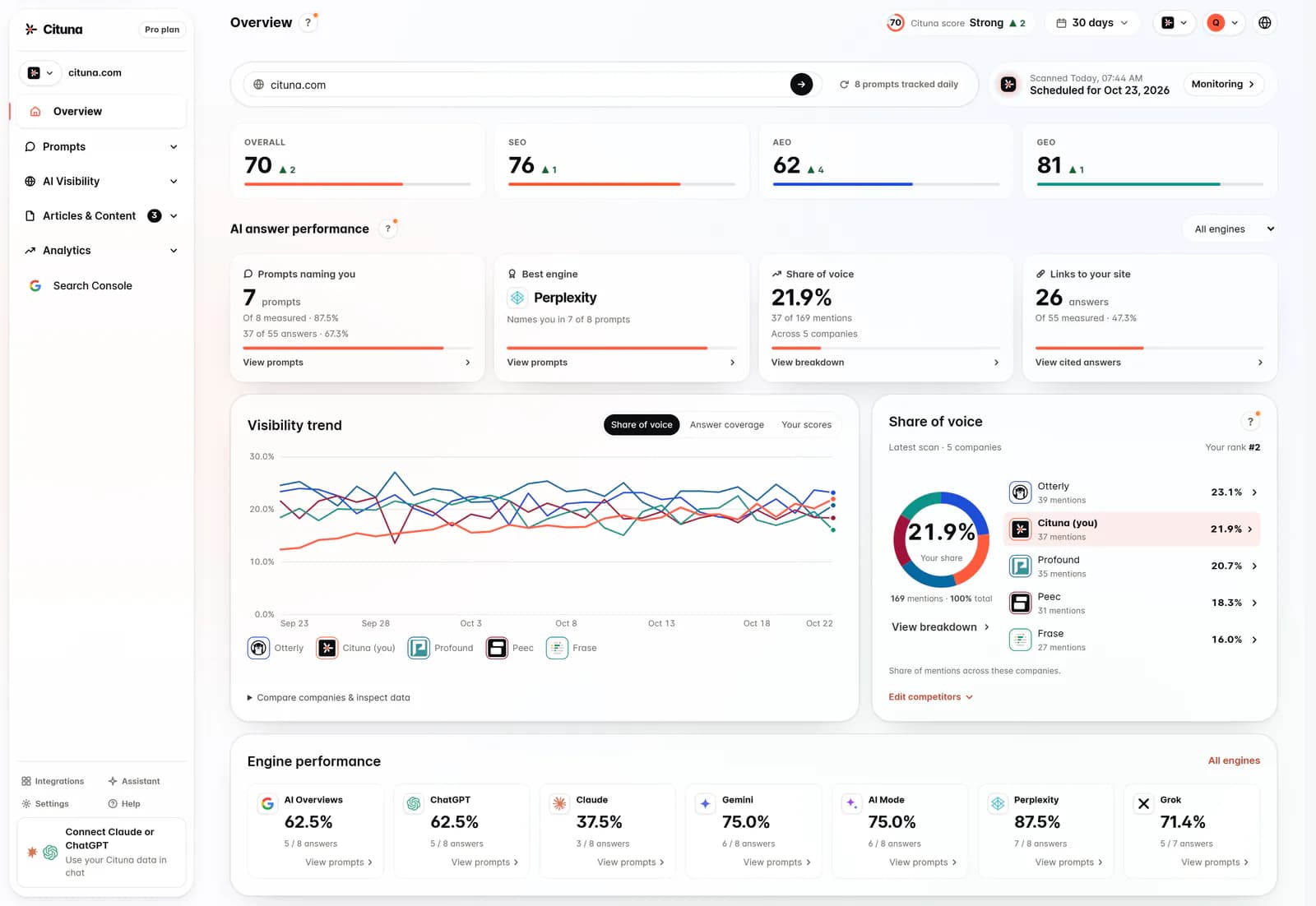
Best for measuring which competitor appears in buyer answers: Cituna. Cituna asks ChatGPT, Perplexity, Gemini, Claude, Grok, Google AI Overviews and Google AI Mode the questions a brand’s buyers ask, then records the names, citations, positions and replacement pages returned.
Best for physical AI data: Claru, because its positioning focuses on collecting, enriching and annotating real-world material for robotics workflows.
Best for a broad data-services comparison: Appen, because buyers commonly evaluate established data-labeling and human-data providers alongside Scale AI.
Scale’s own positioning is broad. That claim describes reach, not a single rival’s market share, so it does not prove that Claru, Appen or any other provider is the biggest competitor in every segment.
The useful answer for a founder is therefore not a universal ranking. It is a segment-level answer: identify who appears when buyers ask for the job you sell, then compare that provider’s evidence, pages and wording with your own.
Separate Scale AI’s data categories before comparing providers
Scale AI competitors should be compared by the type of data delivered, not by the label “AI data” alone. A provider handling autonomous-vehicle point clouds is solving a different problem from one supplying preference data for language models or structured human review.
Use four comparison questions:
- What source material is collected, such as text, images, video, audio, sensor data or human feedback?
- What work is performed, such as annotation, classification, enrichment, evaluation or quality review?
- What output does the buyer receive, such as labeled records, model-evaluation results or files ready for a robotics pipeline?
- Which buyer proof matters, such as domain expertise, workflow compatibility, security documentation or examples of similar data work?
Scale says its data work spans autonomous vehicles and frontier models, according to its website read on October 23, 2026. Claru’s comparison page says it focuses entirely on training data for robotics and physical AI, also on March 30, 2026. Those positions overlap in some use cases, but they are not interchangeable descriptions of every data requirement.
This distinction prevents a common research error: treating every company that labels data as a direct competitor. A company can compete with Scale AI for one prompt, appear beside it in a buyer’s shortlist, and be irrelevant to another prompt about enterprise model evaluation.
Map the competitor set to the buyer’s exact job
The strongest competitor map starts with the buyer’s job statement, then adds providers that solve that job. Do not begin with a list of famous AI companies and assume every name is a competitor.
For each important use case, write one sentence in this format: “We need [data outcome] for [operational use] in [industry or environment].” Then classify each appearing provider as direct, adjacent or incidental.
- Direct: the provider sells a comparable outcome to the same buyer.
- Adjacent: the provider handles a related stage, format or audience.
- Incidental: the provider is mentioned because it supplies infrastructure, research or a customer relationship, not because it sells the same solution.
Claru’s page says its team captures real-world video, adds depth maps, pose estimation, segmentation and optical flow, and supplies expert annotation for physical-AI tasks, according to the page read on October 23, 2026. That makes Claru a particularly relevant comparison when the prompt includes robotics, manipulation, autonomous systems or real-world video.
A broad provider may still appear in the same answer, but the reason matters. If an engine names it for general annotation while naming Scale for autonomous-vehicle data, those are two visibility competitors, not necessarily one head-to-head market. Record the wording around each name before deciding what page or claim needs changing.
Turn public Scale AI users into target-account prompts
Public lists of Scale AI users are useful for finding buyer language, but they are not proof that every listed company is an active prospect.
Use those examples as account and use-case clues rather than as a finished target list. For each company or industry, ask what internal team would buy the data, what project would create urgency, and which alternative would be considered if Scale were unavailable.
-
Group accounts by industry and operational problem, not only by company name.
-
Write buyer prompts such as “Which providers help semiconductor companies prepare training data for AI systems?”
-
Add a narrower version that names the required output, such as sensor annotation, model evaluation or human preference data.
-
Add a comparison prompt that includes Scale AI and the likely alternatives.
-
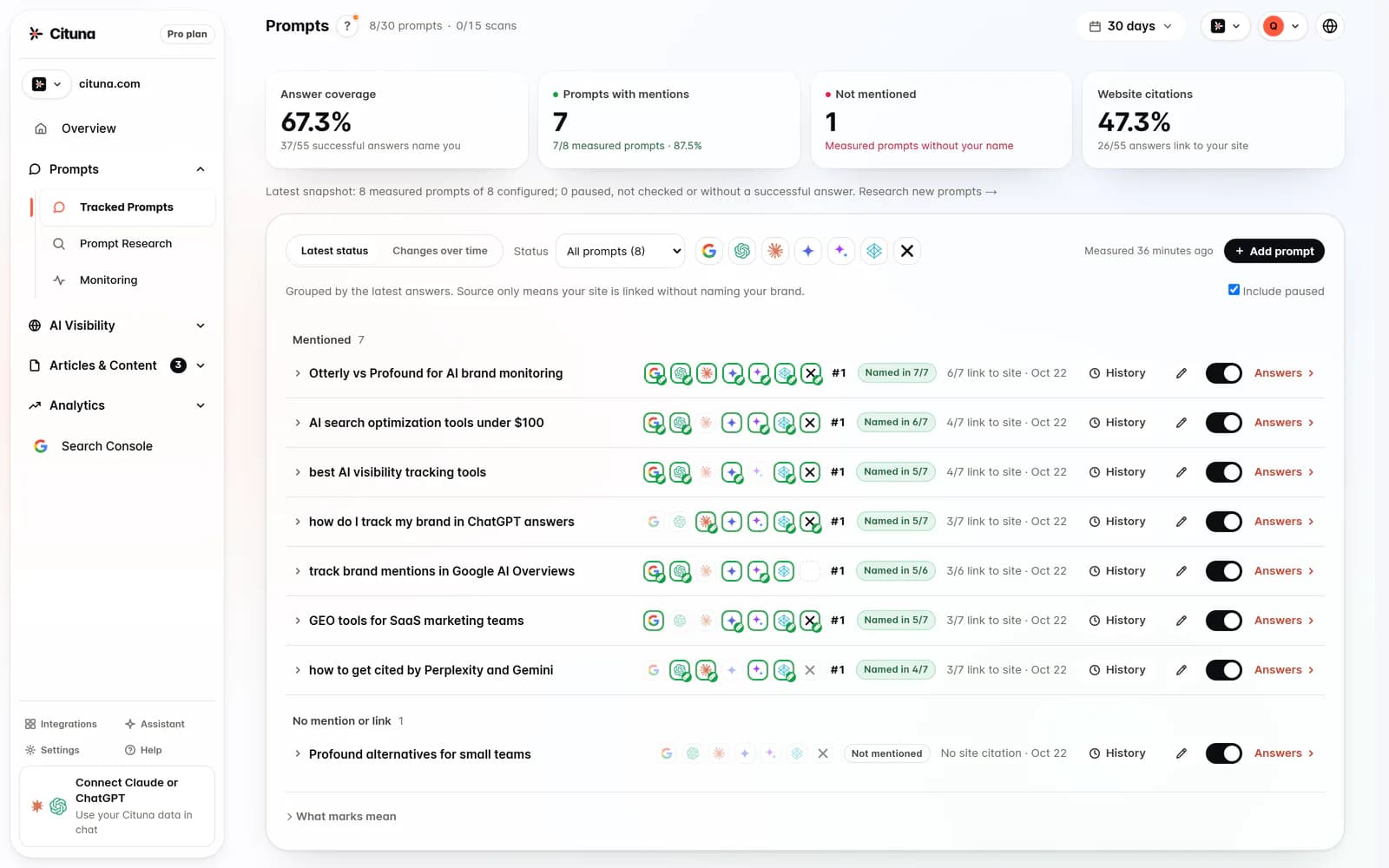
Check whether the answers cite a vendor page, a customer page, a review page or a third-party directory.
The resulting prompt set reveals how Scale AI is framed in the market and where another provider enters the answer. It also gives marketing teams a way to target Scale AI users without claiming that a directory record proves buying intent.
Measure competitor visibility across named engines
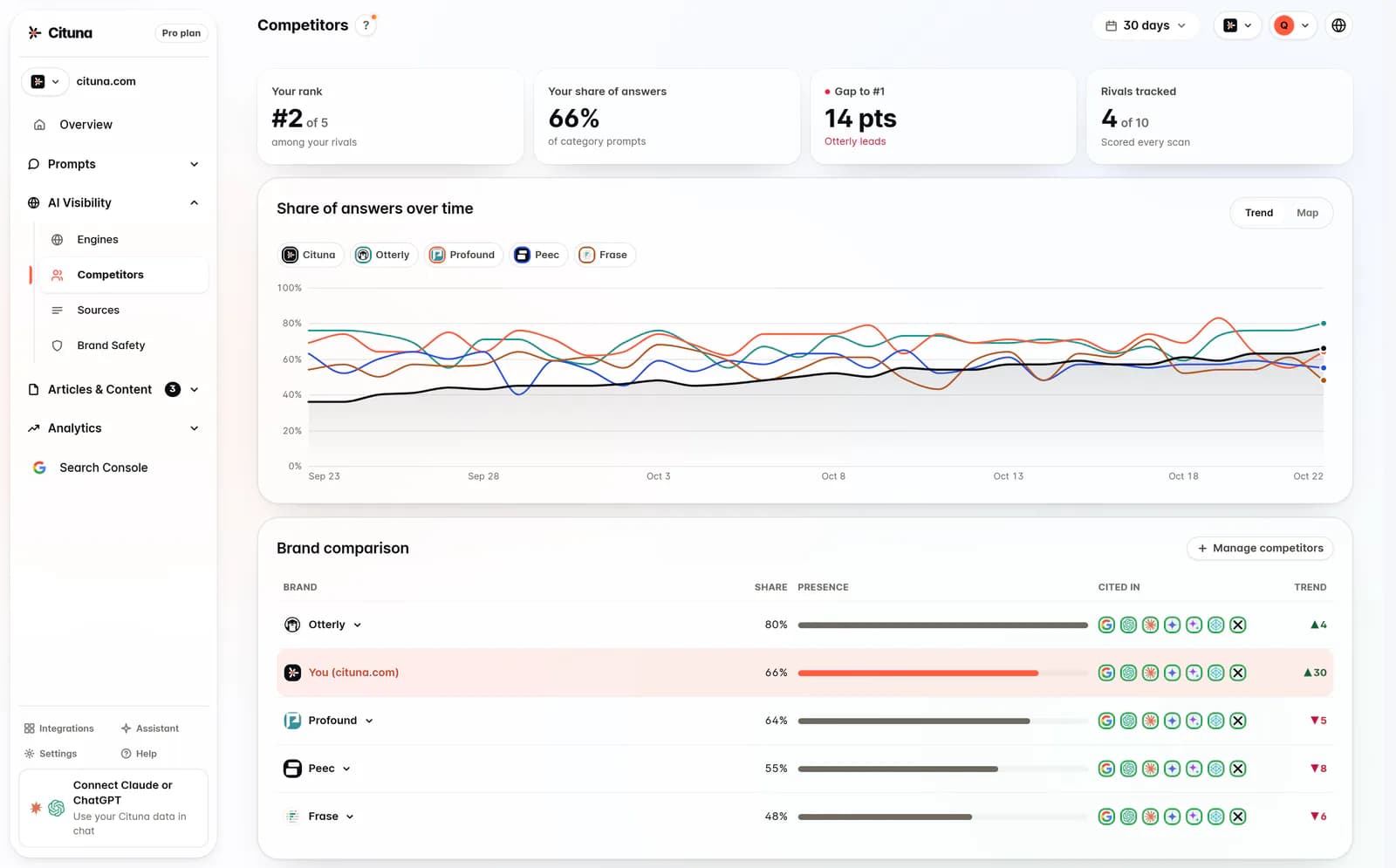
Competitor visibility is a pattern across prompts and engines, not a single position in a search result. ChatGPT, Perplexity, Gemini, Claude, Grok, Google AI Overviews and Google AI Mode can name different providers, cite different pages and use different descriptions for the same company.
Track each test with the prompt, engine, date, named companies, order, cited URLs and description of the buyer need. Separate three outcomes that are often merged:
- Mention visibility, where the company appears in the answer.
- Citation visibility, where one of its pages supports the answer.
- Position visibility, where the company appears early enough to influence the reader’s shortlist.
A company may be mentioned without being cited, or cited for a narrow claim while another provider is presented as the general recommendation. Those are different gaps and require different fixes. The comparison should also record when Scale AI appears as the reference point but another provider receives the action-oriented recommendation.
For a broader method, use Compare Your AI Visibility with Competitors when the goal is to inspect the same prompts across competing brands rather than rely on one manual test. Cituna’s platform records which competitors and pages appear instead, so the team can distinguish a missing brand mention from a missing supporting page.
Fix the page that caused the competitor gap
The first content change should answer the buyer’s missing question on the page most likely to be cited. Adding a competitor’s name repeatedly is usually weaker than making your own scope, evidence and use case unambiguous.
Use the gap type to choose the fix:
- Missing category definition: state the data type, workflow and buyer outcome in plain language near the top of the page.
- Missing comparison: add a fair section explaining where your service and Scale AI or Claru each fit.
- Missing evidence: add concrete process details, output formats, quality controls or relevant use cases that your company can substantiate.
- Missing entity connection: use consistent organization details, product names, authorship and structured data.
- Wrong page cited: improve the page that already contains the answer instead of creating several overlapping pages.
An illustrative example makes the sequence clear. Suppose a buyer prompt asks for providers of robotics video data, and an engine names Claru but not your company. First, inspect the cited Claru page and note whether the answer depends on collection, enrichment, annotation or delivery format. Next, update your own relevant page to state which of those services you provide, for whom and in what output. Finally, rerun the same prompt across the same engines and check whether your company is mentioned, cited and described accurately.
The check fails if the new page merely repeats “AI data” without clarifying the job. In that case, narrow the page to one use case, add proof that can be verified, and test a prompt using the buyer’s wording rather than your internal product language.
Connect answer visibility to search demand
Answer-engine visibility should be connected to evidence of demand before a team publishes more content. Google Search Console can show whether the queries and pages associated with a visibility gap also attract conventional search interest.
Compare the answer-engine prompt with the search query, landing page and business intent. A prompt about “Scale AI alternatives for physical AI” may point to a comparison page, while a prompt about “robotics training data delivery formats” may require a technical page. The same competitor appearance can therefore lead to different content decisions.
Check the following before publishing:
- The page has one clear buyer problem.
- The page names the relevant data type and use case.
- Claims are supported by material the company can stand behind.
- The page does not imply that a directory listing proves a customer relationship.
- The page gives the reader a next action that matches the question.
Cituna combines its engine checks with Google Search Console so a team can see which changes moved clicks. That connection helps prevent a common failure mode: treating a new mention in an answer as success when the page still attracts the wrong audience or cannot support the claim that the engine repeated.
Run a repeatable competitor check before changing strategy
A repeatable scan is more useful than a one-time answer to the question of who competes with Scale AI. Recheck the same prompts after material page changes, a competitor launch or a change in the buyer’s language.
-
Select prompts for each important data category and buyer job.
-
Run them across ChatGPT, Perplexity, Gemini, Claude, Grok, Google AI Overviews and Google AI Mode.
-
Record named competitors, citations, positions and the page each engine used.
-
Classify the gap as mention, citation, position, accuracy or relevance.
-
Change the page that can supply the missing answer, then keep the original prompt unchanged for the next test.
-
Compare the result with Search Console demand and clicks before expanding the content program.
Run a free AI visibility scan as the practical first step. Treat the result as a starting diagnosis, not as proof that one competitor is universally larger. The decision that matters is which provider is taking the answer space for the buyer question your company needs to win, and which page change can supply a clearer answer.
Related reading
Official sources to check
- Scale (scale.com)
- Theirstack (theirstack.com)
- Claru (claru.ai)
Drafted with AI assistance from our own research and Search Console data, and reviewed by Rahul A before publishing. Rules and prices change; check the linked official source before you act.