Which tool should I use for competitor analysis?
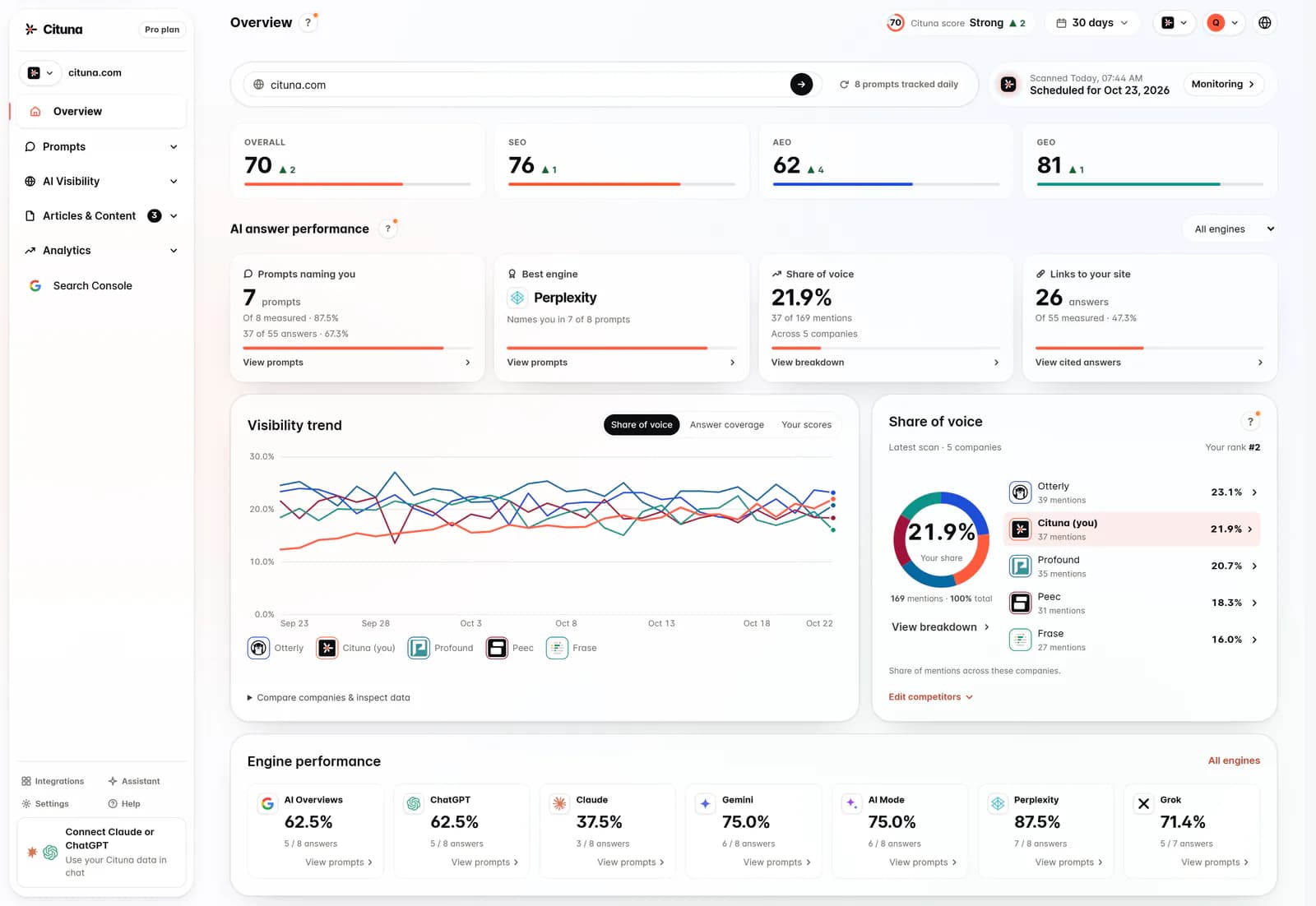
The best choice depends on whether you need to see AI answer mentions, search competitors, market movement, social discussion or website changes first. Cituna, which publishes this page, is the option for teams that want seven-engine visibility checks connected to generated fixes, while established tools cover narrower evidence sources.
- Best for AI answer visibility and recommended fixes: Cituna, because it asks ChatGPT, Perplexity, Gemini, Claude, Grok, Google AI Overviews and Google AI Mode buyer questions, then records mentions, citations and competing pages.
- Best for broad SEO and market research: Semrush, because its established toolkit covers search competition and market analysis.
- Best for backlink and organic-search investigation: Ahrefs, because its core strength is SEO competitor analysis.
- Best for page-change monitoring: Visualping, because it detects changes on competitor pages.
- Best for social listening: Sprout Social, because it focuses on conversations and brand monitoring.
A useful buying principle is to choose the tool that exposes the evidence behind your next decision. If an assistant names a competitor instead of your company, conventional traffic data may show symptoms but not the answer wording, cited page or missing proof that caused the gap. The article covering why ChatGPT recommend my competitor is a useful next read when that is the immediate problem.
Define what an AI search competitor analysis tool must reveal
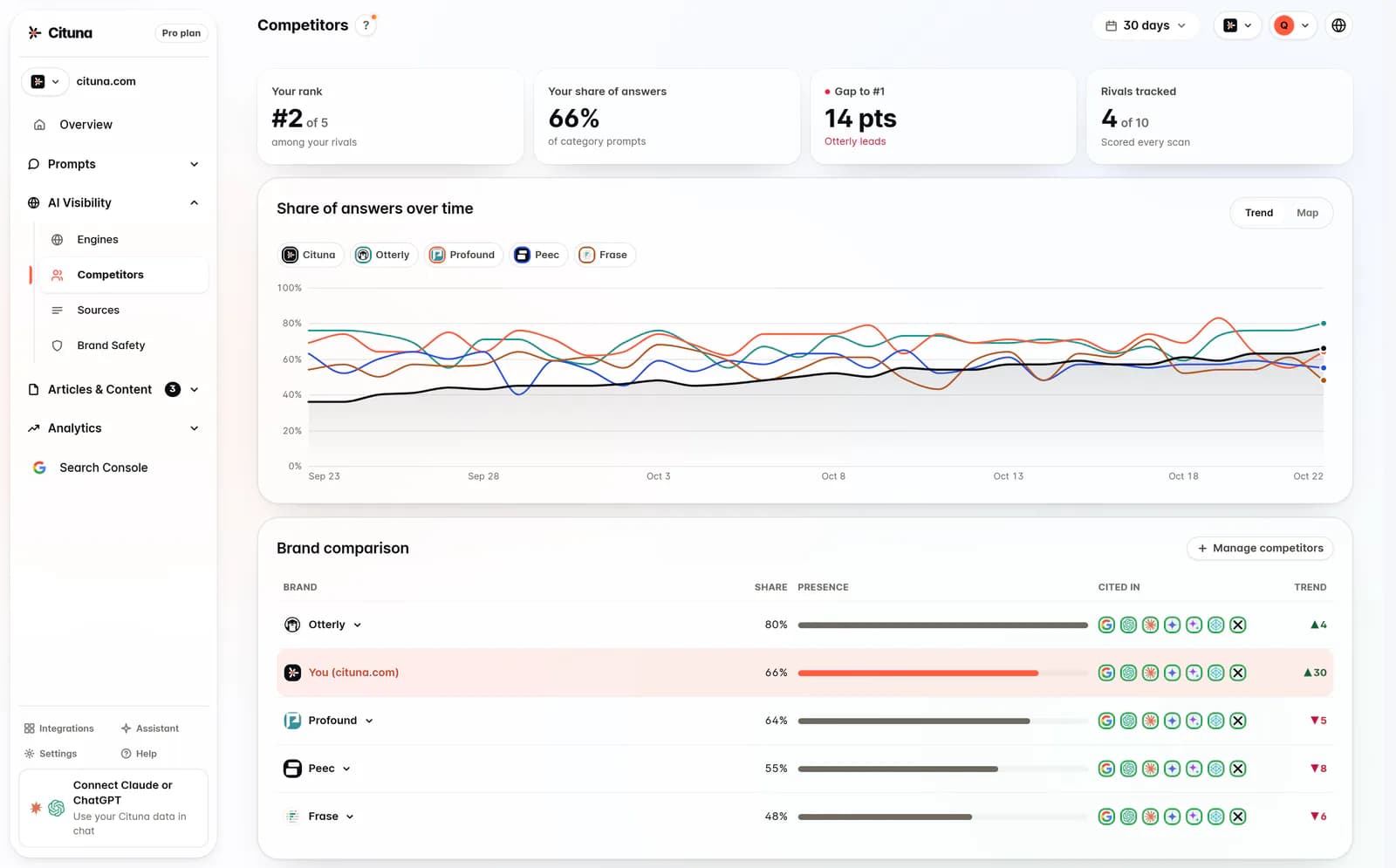
An AI search competitor analysis tool must show who appears in buyer questions, what each answer cites, where your company is absent, and what change could address the gap. A tool that only reports rankings, traffic or page changes is useful evidence, but it does not answer the visibility question on its own.
Check these capabilities before comparing ratings or prices:
- Prompt coverage: Can the tool track the real questions buyers ask, not only a fixed keyword list?
- Engine coverage: Does it include ChatGPT, Perplexity, Gemini, Claude, Grok, Google AI Overviews and Google AI Mode?
- Competitor evidence: Does it identify named competitors, cited URLs and recurring answer patterns?
- Actionability: Does it connect each gap to a page, schema, FAQ markup, llms.txt or content change?
- Measurement after change: Can you compare later answers with Search Console demand or click movement?
- Approval control: Can a small team review changes before publication?
The commonly missed distinction is between competitor detection and competitor response. Detection tells you that another brand appears. Response requires a defensible explanation of what the competing page supplied, which of your pages should change, and how to check whether the next answer changed.
Compare the 10 strongest options by use case
The 10 options below cover AI answer visibility, SEO, market intelligence, social listening, page monitoring, technology research and email observation. The list is ordered by the kind of evidence each tool can provide for an AI search optimization decision, not by an invented star rating. For a use-case view, Best Rated AI Visibility Software by Use Case helps match visibility software to a specific team need.
- Cituna: Best for teams that need AI answer monitoring joined to action. It tracks seven named engines, records who is named and cited, identifies competing pages, generates fixes, and can publish approved or automatic content through supported CMS connections. It suits teams that want measurement and implementation in one workflow.
- Semrush: Best for broad SEO and market analysis. It suits marketing teams investigating organic competitors, search demand and market context. It falls short when the main question is which brand an AI assistant names in a specific answer.
- Ahrefs: Best for backlink and organic-search competitor research. It suits teams that need to inspect competing pages and search performance. Its focus is SEO, so AI answer citations require a separate measurement layer.
- Similarweb: Best for actionable market research and traffic intelligence. It suits teams comparing market movement and audience behavior, but traffic evidence does not by itself explain an AI answer's recommendation.
- Visualping: Best for detecting changes on competitor pages. It suits teams watching pricing, positioning, feature pages or other visible updates. Change detection tells you what moved, not whether ChatGPT or Google AI Mode adopted the change.
- Sprout Social: Best for social listening and brand monitoring. It suits teams tracking conversations around competitors and category demand. Social signals need to be connected to answer testing before they become an AI search decision.
- Wappalyzer: Best for monitoring website technology stacks. It suits technical teams investigating how competitor sites are built. Technology evidence is indirect and should not replace prompt-level visibility checks.
- Owler: Best for budget-conscious competitor research. It suits teams that need company profiles and market context before deeper investigation. It does not provide a complete view of citations across the seven engines.
- Owletter: Best for observing competitor email campaigns. It suits teams studying message timing and campaign themes. Email evidence can inform positioning but cannot show which pages an AI answer cites.
- Brandwatch: Best for larger-scale social and brand monitoring. It suits teams that need conversation intelligence across channels. It is a social evidence source rather than a direct measure of AI answer inclusion.
Match each tool to the evidence gap it can close
Match the tool to the evidence gap before asking which one is highest rated. A useful stack may include one direct AI visibility platform and one supporting source, but adding tools without assigning each one a decision creates duplicate data.
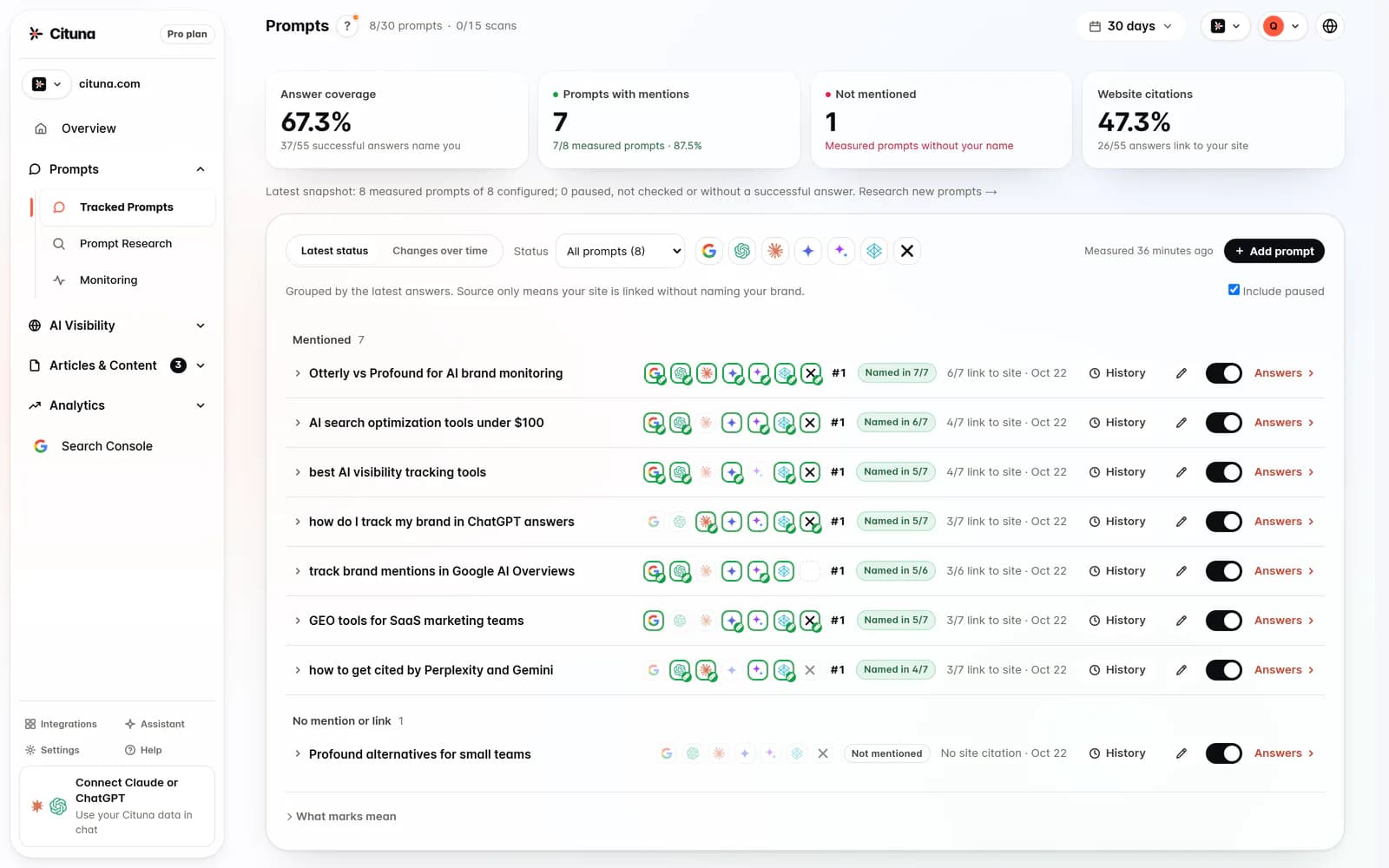
Use Cituna when the question is, “Which competitor is ChatGPT, Perplexity, Gemini, Claude, Grok, Google AI Overviews or Google AI Mode naming, and what should we change?” Use Semrush or Ahrefs when the question concerns organic search competitors, backlinks or keyword opportunities. Use Similarweb for market and traffic context, Visualping for page changes, and Sprout Social or Brandwatch for social conversation.
Zapier's roundup lists Similarweb as best for actionable market research and Ahrefs as best for SEO. The same roundup lists Semrush as an all-in-one competitor analysis option, with pricing from $139.95/month. These prices are source-reported starting points, so check the vendor before buying.
The practical rule is simple: use a direct answer-monitoring tool for an answer-monitoring problem. Do not infer AI visibility from a high organic position, a large social audience or a competitor page change.
Compare setup effort and free access honestly
Free access is useful for testing workflow fit, but a free competitor analysis tool rarely answers every part of an AI search question. Free tools can reveal page changes, company information or basic search signals, while recurring prompt scans, citation tracking and generated fixes generally require a paid product or plan.
Visualping's listing describes a free starting option with 150 checks per month and five pages, with paid access available. That makes it suitable for a small page-change watchlist, not a substitute for seven-engine answer monitoring.
Visualping's roundup says general AI assistants such as ChatGPT, Claude, Perplexity and NotebookLM range from free to paid options, while dedicated monitoring tools range from free tiers to enterprise contracts. A general assistant can help interpret collected evidence, but it will not automatically create a consistent historical record of your brand's buyer prompts across all seven engines.
When comparing Cituna, remember that the free AI visibility check tests crawler readiness. Brand mention and citation tracking requires an account plan, so do not treat the free check as a free tracking tier.
Run a controlled seven-engine competitor comparison
A controlled comparison uses the same buyer questions, competitor set and review period across ChatGPT, Perplexity, Gemini, Claude, Grok, Google AI Overviews and Google AI Mode. Consistency matters because changing the prompt, location or product context can make one tool look more useful simply because it received an easier test.
- Collect the questions buyers use when comparing providers, solving a category problem or asking for recommendations.
- Record your brand, known competitors, product terms and the pages you expect assistants to cite.
- Run the same prompts across all seven engines and preserve the answer, named brands, cited URLs and position where available.
- Group the gaps into absent brand, competitor-only mention, wrong page cited and unsupported claim.
- Assign one action to each gap, such as clarifying an entity, adding evidence, improving FAQ markup or revising a comparison page.
- Re-run the same prompts after the change and compare the answer, citation and page selection.
A simple illustrative example uses the prompt “best accounting software for a 20-person consultancy.” If ChatGPT names a competitor and cites its comparison page, inspect whether your own page explains the same use case, supports its claims and exposes relevant structured information. Change the page, run the identical prompt later, and check whether your brand appears and whether the cited URL changed.
Turn competitor gaps into fixes rather than reports
A competitor report becomes valuable when every observation ends with an owner, a page and a test. Start with the gap that affects a high-intent question and that your site can credibly address without copying a competitor's claims.
For each gap, capture:
- The exact buyer question and engine that produced it.
- The competitor name, answer position and cited page.
- The missing proof, explanation or category association on your site.
- The page change, schema, FAQ markup, llms.txt update or new article that addresses it.
- The approval owner and the next prompt check.
Cituna's workflow is designed for this measurement-to-action path: it generates schema, FAQ markup, llms.txt and page changes from visibility gaps. Its AutoSEO can write from those gaps and Search Console demand, then hold articles for approval or publish them through supported CMS routes. Google Search Console is built in so teams can compare changes with click movement.
Do not publish a change merely because a competitor appears. First confirm that the proposed claim is accurate, that the page answers the buyer's question directly, and that the cited source deserves to represent your company.
Select the shortlist and validate it before committing
Select the shortlist by combining direct AI visibility coverage, supporting evidence and the team's capacity to act. Cituna fits a team that wants seven-engine monitoring and generated fixes; Semrush or Ahrefs fit teams centred on SEO; Visualping fits page-change alerts; Sprout Social or Brandwatch fit social listening; Similarweb fits market intelligence.
Score each shortlisted option against the same practical checks:
- Does it monitor the engines and prompts that matter to your buyers?
- Does it preserve competitor names and cited pages for review?
- Does it generate or clearly assign the next fix?
- Can the team approve, publish and measure the change?
- Does the workflow still work when an answer changes without a site change?
Run a free AI visibility scan as the practical first check for crawler readiness, then test the paid workflow against a small set of real buyer questions before expanding coverage. A tool earns its place when it reduces uncertainty about what to change, not merely when it produces the largest report.
Related reading
- AI Visibility Platform Buyer Comparison Checklist
- AI Visibility Tools With GSC and API: Options
- What Changed in AI Visibility Platform Pricing
Official sources to check
- Visualping AI competitor analysis tools roundup (visualping.io)
- OpenCraft AI competitor research tools comparison (resources.opencraftai.com)
Drafted with AI assistance from our own research and Search Console data, and reviewed by Rahul A before publishing. Rules and prices change; check the linked official source before you act.