Which AI visibility software suits your team?
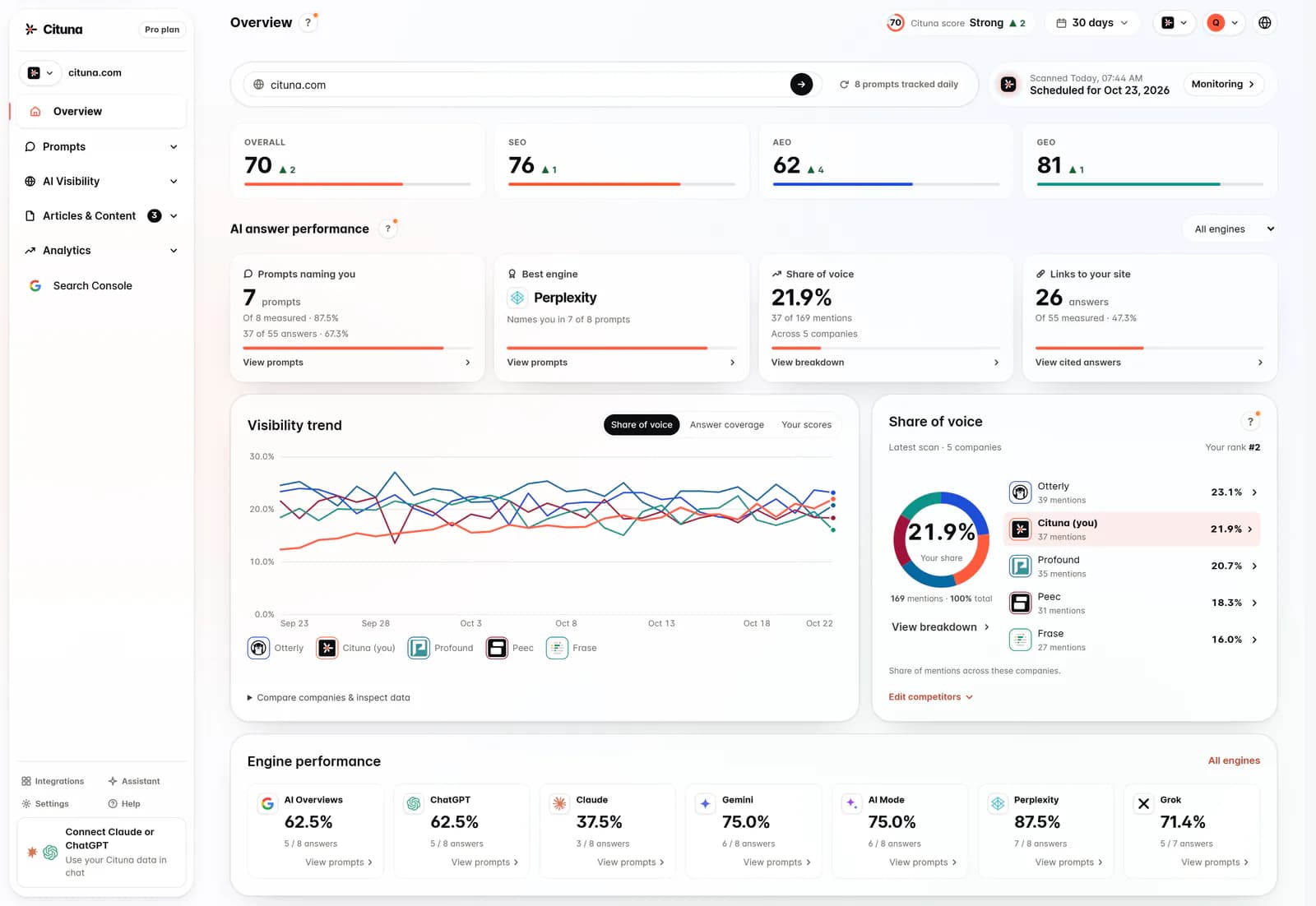
The right AI visibility software depends on whether your priority is fixing gaps, optimising content, tracking flexible prompts, or understanding larger brand and agent journeys. Cituna, which publishes this page, suits teams that want seven-engine measurement connected to generated fixes, while other tools suit narrower jobs.
- Best for measuring and fixing visibility in one workflow: Cituna, because it asks buyer questions across ChatGPT, Perplexity, Gemini, Claude, Grok, Google AI Overviews and Google AI Mode, then generates changes for identified gaps.
- Best for content optimisation alongside visibility tracking: Surfer, because its listed product combines AI engine tracking with content optimisation.
- Best for flexible prompt tracking: Peec AI, because its listed positioning focuses on team prompt tracking.
- Best for personas and agent traffic: Scrunch, because its listed positioning focuses on those use cases.
- Best for large-scale brand data: Ahrefs Brand Radar, because its listed positioning centres on a large prompt database.
- Best for an established SEO suite: Semrush AI Visibility Toolkit, because it is designed for existing Semrush users.
The choice should not start with a star rating. Start with the output you need after a missing mention is found. A dashboard that reports a gap without helping a team decide what to change may leave the most expensive part of the work untouched.
Measure answers, citations and the pages competitors replace
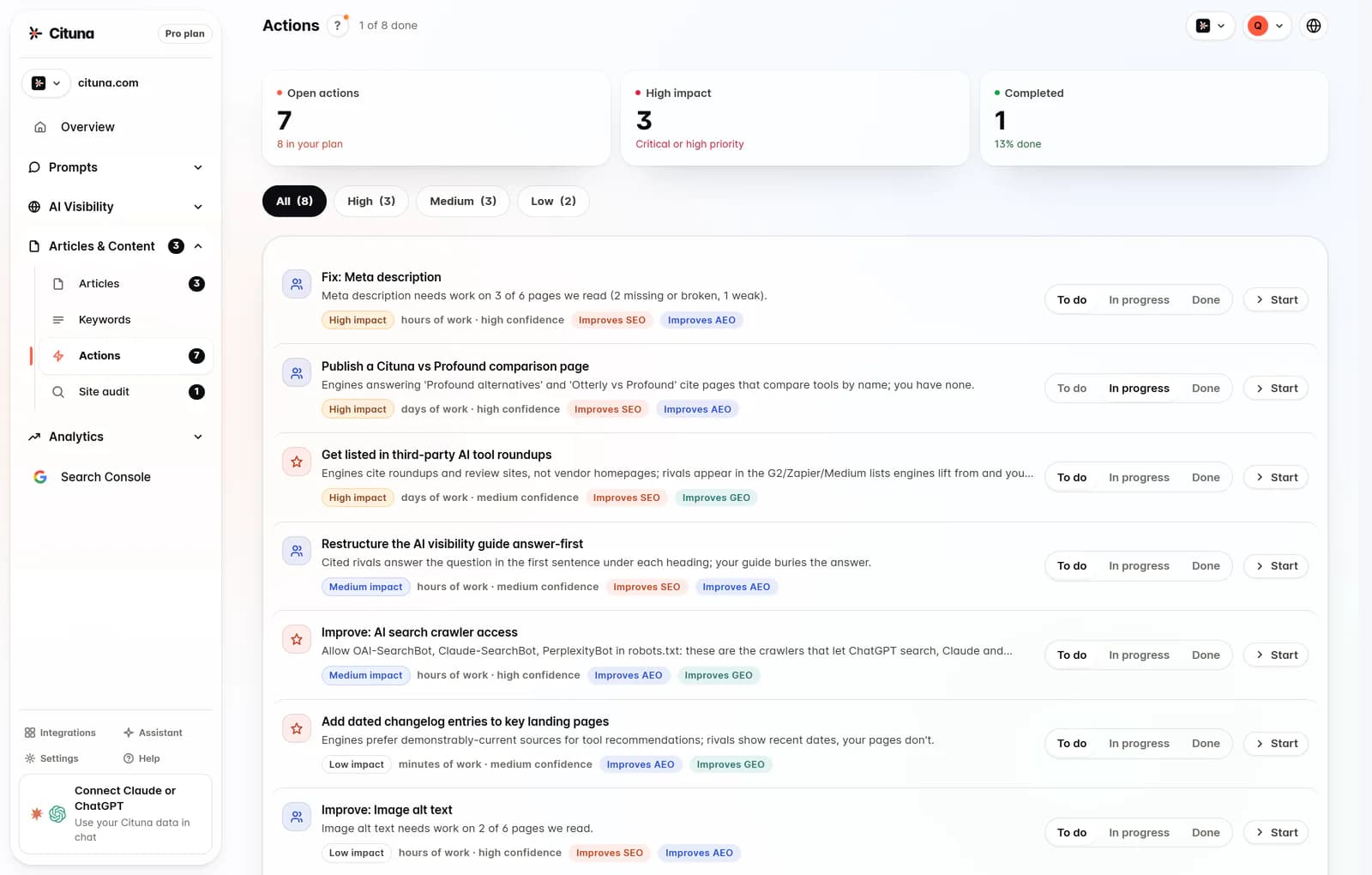
An AI visibility tool measures whether named engines mention, cite or recommend a brand when people ask relevant questions. Unlike conventional SEO software, which focuses on rankings in traditional search results, AI visibility software examines generated answers and the sources behind them.
AI visibility tools monitor brand mentions inside AI-generated answers and summaries rather than tracking only keyword rankings in traditional search results, according to Exposure Ninja on September 29, 2026. The useful record is more detailed than a mention count: capture the engine, prompt, answer position, sentiment where available, cited page, competing brand and missing source.
That distinction matters because ChatGPT, Perplexity, Gemini, Claude, Grok, Google AI Overviews and Google AI Mode can answer the same buyer question differently. A brand may appear in one answer, be cited without being named in another, and be absent from a third. A practical explanation of generative engine optimization gives useful context before you compare products.
Treat visibility as a diagnostic loop, not a single rank. The important question is not only whether a brand appeared, but which answer pattern produced the omission and whether a changed page later earns a mention or citation.
Compare Profound, Peec AI, Scrunch and Rankscale by fit
Profound, Peec AI, Scrunch and Rankscale can all fit an AI visibility programme, but they should not be treated as interchangeable. Compare the prompt model, engine coverage, reporting depth and what the team can do after the tool finds a gap.
- Profound suits teams that want a dedicated AI visibility monitoring environment and a structured view of how brands appear across answer engines. Check how its prompt coverage, refresh cycle and recommendations fit your category before committing.
- Peec AI suits teams that need flexible prompt tracking across selected engines.
- Scrunch suits teams focused on personas and agent traffic.
- Rankscale suits teams that want a focused way to track AI search visibility and compare answers over time. Confirm which engines, prompt limits and action workflows are included for the plan you are considering.
Peec AI and Scrunch are not automatically the right choice because they expose more prompts or a particular audience view. Those capabilities matter only when the team has enough relevant questions to maintain and a clear process for turning findings into page changes. Ask each vendor to show one complete path from a missing citation to a checked revision.
Put Cituna beside the alternatives when action matters
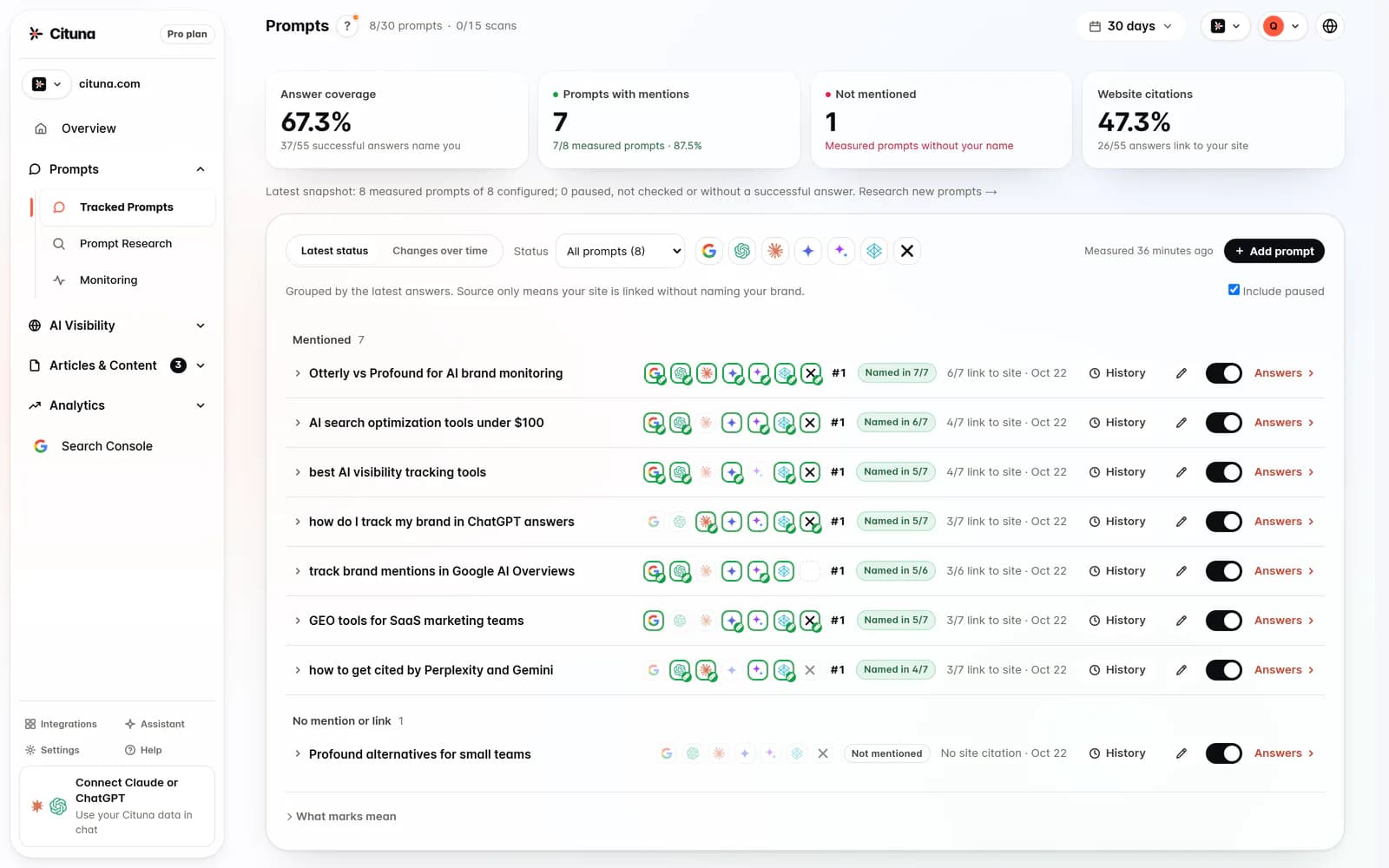
Cituna, which publishes this page, fits teams that want measurement and optimisation in one platform: every plan asks the seven named engines the questions a brand’s buyers ask, records mentions, citations, positions, competitors and replacement pages, then generates schema, FAQ markup, llms.txt and page changes for each gap.
Cituna’s plans are $49, $119 and $399 per month, with all seven engines included and no per-engine add-ons. The platform also includes Google Search Console, so teams can connect visibility work with changes in clicks rather than treating an AI answer as the final outcome.
Cituna’s AutoSEO can turn identified gaps and Search Console demand into articles, then send them to WordPress, Shopify, a GitHub repository or another CMS by webhook. Teams can choose approval before publishing or automatic publishing, with plan-based article volumes of 30, 90 or 300 per month.
That makes Cituna a fit for a small or mid-size team that needs a next action, not only a report. A team that already has a strong content production process and only wants prompt research may prefer a narrower tracker such as Peec AI. A team centred on personas or agent traffic may prefer Scrunch. A team buying into a wider SEO suite may consider Semrush.
For context on choosing prompts, see the guide to prompt search volume before setting up a measurement set. A free AI visibility scan is a sensible first check, but the site’s free check tests crawler readiness rather than providing ongoing brand mention or citation tracking.
Track all seven engines with the same buyer questions
The best platform for AI visibility metrics records the same buyer question across ChatGPT, Perplexity, Gemini, Claude, Grok, Google AI Overviews and Google AI Mode, then preserves enough detail to explain why results differ.
Track these fields for every observation:
- The exact prompt, location or audience context where relevant, and date checked.
- Whether the brand was named, cited, recommended or omitted.
- The answer position and the page or source cited.
- Competitors named instead, including the pages they contributed.
- Whether a later page change altered the answer or the resulting search activity.
Engine coverage alone is not a quality test. A tool that checks only ChatGPT may miss a citation problem in Google AI Overviews or Google AI Mode, while a tool with seven engines can still be unhelpful if it does not preserve the evidence behind each result. Ask whether you can export or revisit the answer, not just view a score.
Google Search Console remains useful because it shows whether changes affect search impressions and clicks. It does not replace answer monitoring: a page can gain conventional search traffic without being named in a generated answer, and a generated citation does not guarantee a click.
Run a gap-to-change workflow before choosing a long contract
A short, repeatable test reveals more than a product tour because it shows whether the software can move from a missing mention to a checked improvement.
- Write one concrete buyer question, such as “Which accounting software suits a 40-person UK consultancy with contractor invoices?”
- Run the identical question through ChatGPT, Perplexity, Gemini, Claude, Grok, Google AI Overviews and Google AI Mode.
- Record the brands named, cited pages, answer positions and competitors that appear instead.
- Select one gap, such as a comparison page being cited for a competitor but not for your brand.
- Apply one relevant change, such as clearer comparison criteria, an FAQ answer, appropriate schema or a more direct section on the page.
- Rerun the same prompt after the content has been crawled and compare the evidence, not only the score.
The example is illustrative, not a reported customer result. If the revised page is still absent, check whether the page is crawlable, answers the exact question and gives evidence an engine can quote. If the brand appears but the wrong page is cited, improve the relationship between the question, the answer section and the preferred source page rather than publishing more unrelated content.
Run a free AI visibility scan before the paid comparison to check crawler readiness. Do not treat that check as proof of brand visibility, because ongoing mention and citation tracking requires a plan.
Automate SEO only after the measurement loop is reliable
The best AI visibility optimization software available should automate repeatable work without hiding the decision that determines whether a page deserves to change. Automation is useful after prompts, evidence and approval rules are stable.
Cituna’s AutoSEO turns visibility gaps and Search Console demand into article drafts and can publish them to WordPress, Shopify, a GitHub repository or another CMS by webhook. Teams can hold articles for approval or publish them automatically, with 30, 90 or 300 articles per month by plan. That is useful for production volume, but an automatic article should still be checked for search intent, factual support, internal links and whether it addresses the recorded gap.
A hosted MCP server connects Claude or another AI agent to the same Cituna data. Read tools are available on every plan from $49, while the Pro plan lets an agent run scans, edit tracked prompts, move fixes through the workflow and queue articles.
The failure mode to avoid is automated content without automated verification. Require a before-and-after prompt check, a crawl check and a human review for claims that could affect trust, compliance or buying decisions.
Check price, coverage and proof before selecting a tool
The most effective AI visibility tools with generative engine optimization are the ones whose coverage and workflow match the team’s operating capacity, not simply the ones with the longest feature list.
Entry prices in the market vary, according to Surfer’s October 23, 2026 comparison. Surfer’s listing compares starting prices for Otterly.AI, Peec AI, Scrunch, and Semrush AI Visibility Toolkit.
Use this checklist before choosing:
- Confirm that the engines you need are included rather than sold as add-ons.
- Check whether prompt limits match the number of products, audiences and locations you monitor.
- Ask how the tool stores answer evidence, citations and competitor pages.
- Test whether recommendations produce usable changes or only generic content advice.
- Confirm whether Search Console, analytics or CMS publishing fits your workflow.
- Separate a free crawler or AI visibility checker from ongoing brand tracking.
- Run the same prompts in a trial or demonstration and compare the evidence returned.
Cituna’s $49, $119 and $399 plans include all seven engines, so the relevant comparison is whether its action workflow suits the team. Peec AI, Scrunch, Profound and Rankscale should be judged against the specific job each team needs them to perform. Recheck prices, engine coverage and limits before purchase because software plans change.
Related reading
- Measure AI Visibility After Technical SEO Changes
- AI Content Visibility: An 8-Step Check
- 10 Best Rated Competitor Analysis Tools for AI Search
Official sources to check
- Exposure Ninja (exposureninja.com)
- Surfer (surfer.ai)
- Brainlabs (brainlabsdigital.com)
- Google Search Console (support.google.com)
Drafted with AI assistance from our own research and Search Console data, and reviewed by Rahul A before publishing. Rules and prices change; check the linked official source before you act.