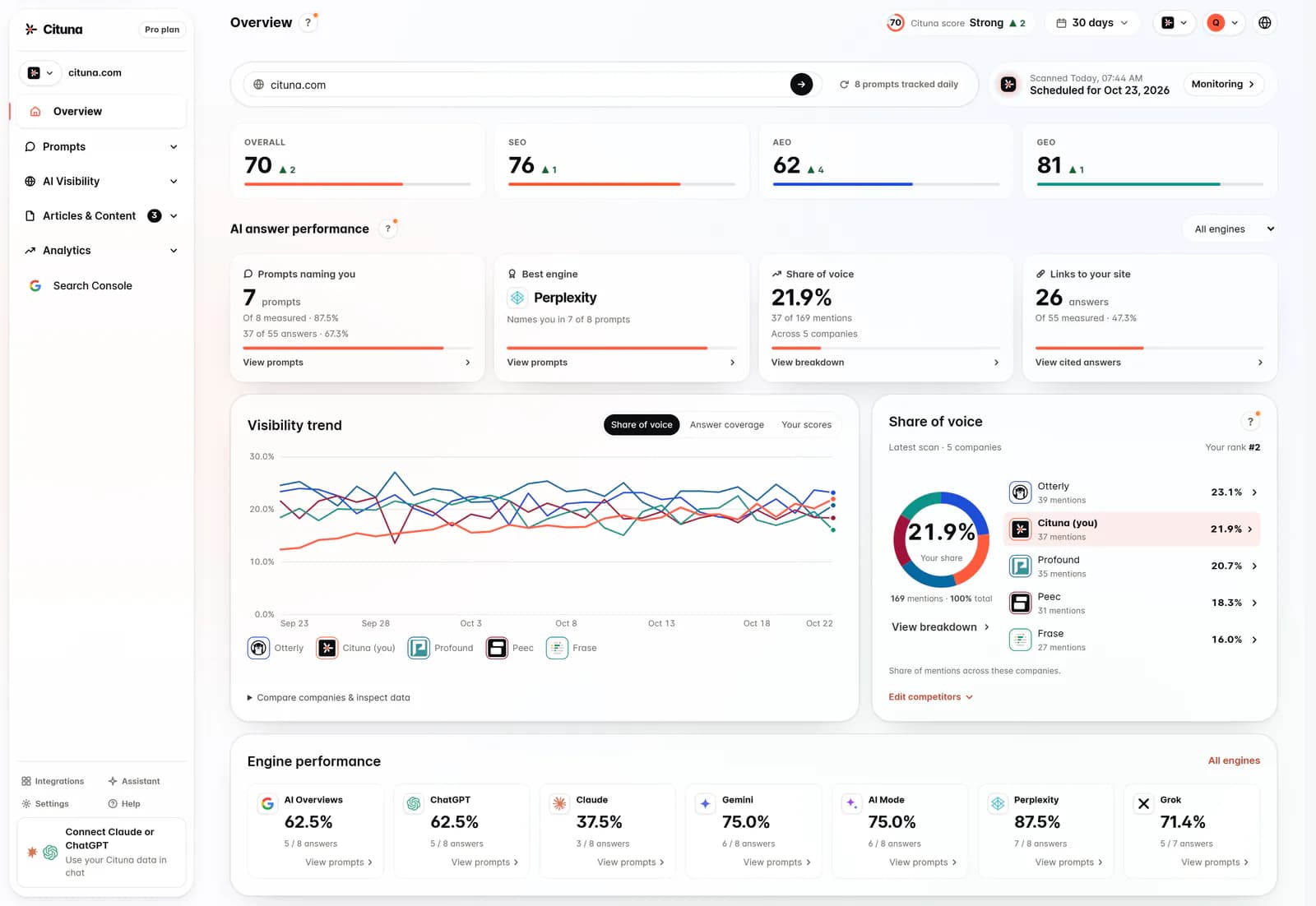
What is the Grok search engine?
Grok is xAI's conversational assistant and search interface, designed to answer questions in a dialogue rather than return only a ranked list of pages. Depending on the query and available mode, it can combine model knowledge with web results and present an answer with supporting sources.
For a marketing team, Grok search means more than whether a page ranks for a keyword. The useful question is whether Grok names your company, describes it accurately, cites your page, and includes it when a buyer asks for options in your category.
Grok should therefore be measured as an answer surface. A strong Google ranking can help discovery, but it does not guarantee that Grok will select the same company, page, or evidence.
Trace how Grok turns a prompt into an answer
Grok can turn one buyer prompt into several retrieval and selection decisions before showing an answer. The process matters because a brand may be present in the available sources yet absent from the final response.
-
Grok interprets the request, including the category, location, audience, and implied buying criteria.
-
Grok may retrieve current web material or use information already available to the model, depending on the search mode and query.
-
Grok evaluates candidate pages for relevance, clarity, recency, and evidence that supports the answer.
-
Grok writes a response, then may name companies, cite pages, or leave both out.
-
The reader may ask a follow-up, changing the criteria and the sources Grok uses.
A useful distinction is presence versus selection. Your page can be crawled and even cited for one prompt while a competitor is named for another. Record the exact prompt, answer wording, cited URLs, named brands, and position rather than treating a single successful response as proof of visibility.
A related concept is query fan-out, where one conversational request becomes several narrower searches. Understanding query fan-out helps explain why a broad category prompt and a specific comparison prompt can produce different Grok results.
Separate Grok visibility from Google rankings
Grok visibility and Google ranking are related signals, not interchangeable outcomes. Google primarily helps a searcher choose a result, while Grok may choose evidence and compose a recommendation inside the answer.
Measure these separately:
- Mention rate: how often Grok names the brand for a defined prompt set.
- Citation rate: how often Grok links to or cites a company page.
- Citation position: where the page or brand appears in the answer.
- Competitor substitution: which companies appear when the brand does not.
- Source fit: whether Grok cites the page that actually supports the claim.
- Accuracy: whether the description, audience, product category, and limitations are correct.
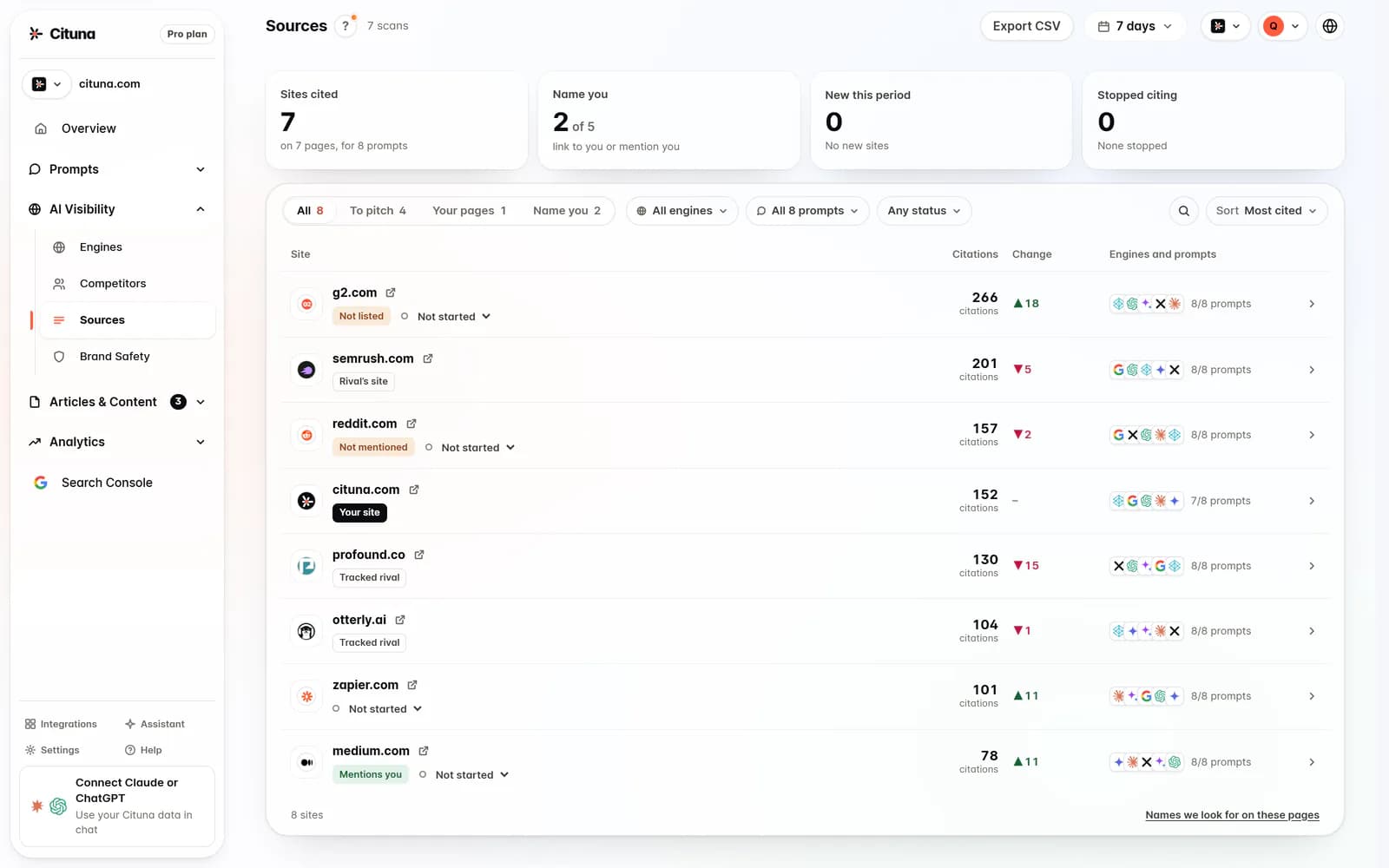
Google AI Overviews and Google AI Mode should also be recorded separately from Grok. ChatGPT, Perplexity, Gemini, and Claude may retrieve or summarize different evidence, so a combined score can hide a platform-specific weakness. Zero-click search and AI answers create the same measurement problem: impressions may continue while the buyer never visits your site.
Measure Grok with a repeatable prompt set
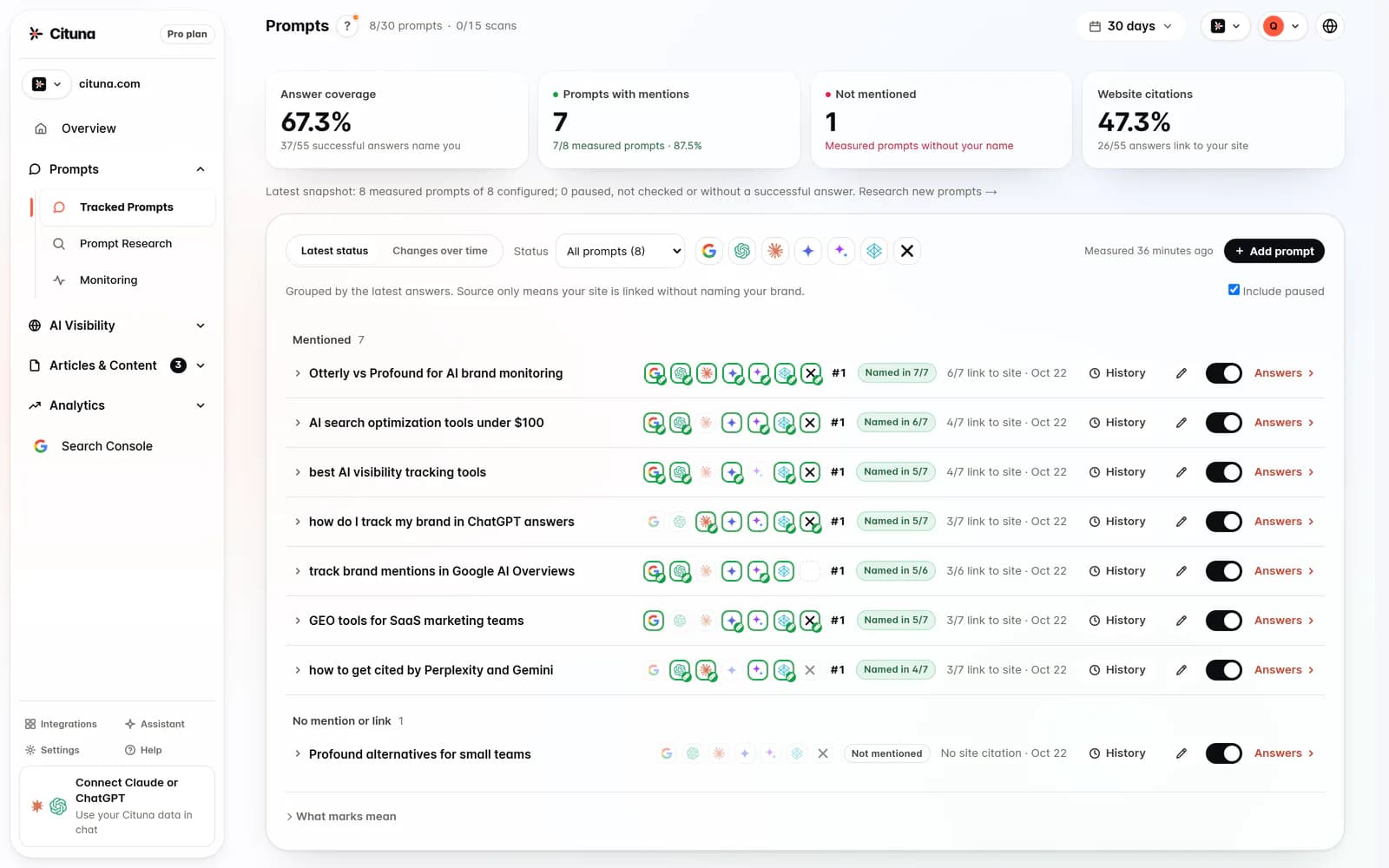
A repeatable prompt set reveals Grok visibility more reliably than occasional manual searches. Start with the questions buyers ask before they know your company, then add prompts that test comparison, suitability, proof, and objections.
Cituna, which publishes this guide, is an AI visibility platform that asks ChatGPT, Perplexity, Gemini, Claude, Grok, Google AI Overviews, and Google AI Mode buyer questions every day, recording the names, citations, positions, competitors, and pages that appear.
Build your own prompt set around four groups:
- Category prompts, such as a request for providers or tools in the market.
- Use-case prompts, such as a request for a solution for a particular team or constraint.
- Comparison prompts, naming your company and a competitor together.
- Evidence prompts, asking for pricing, implementation details, integrations, or proof.
Keep prompts stable long enough to compare changes, but refresh them when your product, market, or buyer language changes. Save the full answer because a mention without a citation, or a citation that supports a different claim, is a different outcome.
Diagnose why Grok names another company
Grok usually names another company when the competing source makes the requested decision easier to support, not simply because that company has more pages. Diagnosis should begin with the answer and work backward to the missing evidence.
Check these failure points:
- The page answers a product question but does not state who the product suits.
- Important facts are hidden in scripts, images, tabs, or vague marketing language.
- The page covers a broad category but not the specific use case in the prompt.
- Several pages make conflicting claims about the same product.
- A competitor has clearer comparisons, definitions, or first-party evidence.
- The cited page exists, but its wording does not support the statement Grok made.
If the page is present but the brand is missing, improve the decision signal first. Add a direct definition, intended audience, limitations, comparison criteria, and evidence near the relevant claim. If Grok cites a third-party page instead, determine whether your own page lacks the fact or whether the third-party page is simply easier to retrieve.
Change the page Grok should retrieve and cite
The first content change should make one important buyer answer explicit on one authoritative page. Do not begin by publishing many generic articles when the existing page cannot clearly support the claim you want Grok to repeat.
Use this sequence:
-
Choose one missing answer from a recorded Grok response.
-
Match the answer to the page with the strongest first-party evidence.
-
Add a concise answer near the top, followed by context, limitations, examples, and supporting detail.
-
Use descriptive headings, structured FAQ content, and schema where they accurately describe the page.
-
Link related pages so definitions, comparisons, and proof reinforce one another.
-
Re-run the same prompt and inspect both the answer and the citation.
For example, an illustrative payroll software page might be absent when the prompt asks for payroll for a distributed team. Add a clear statement about the supported team, explain the relevant workflow, and link to the evidence page. Then check whether Grok names the company, cites the revised page, and describes the limitation correctly. If the answer changes but the citation does not, improve the source page rather than adding another article.
Technical files can help discovery, but they cannot replace a page that states and supports the answer. The same principle applies to FAQ markup, schema, and llms.txt.
Compare Grok with the other answer engines
Grok should be tested alongside the other engines because a visibility problem may belong to one retrieval system rather than the whole category. Cituna tracks all seven named engines on every plan, so a team can compare whether a change affects Grok alone or also affects ChatGPT, Perplexity, Gemini, Claude, Google AI Overviews, and Google AI Mode.
Interpret the patterns carefully:
- Grok alone omits the brand: inspect Grok's retrieved sources, answer style, and prompt wording.
- Grok and Perplexity omit it: inspect web retrieval, citations, and page accessibility.
- Google AI Overviews and Google AI Mode omit it: inspect search visibility and the page's direct answer.
- Every engine omits it: check whether the relevant buyer question has a clear first-party answer at all.
- Engines mention the brand but describe it differently: resolve conflicting claims across the site.
Claude web search is another useful comparison because a change that improves one answer engine may not transfer to another. Compare the same prompt, date range, evidence page, and success definition rather than comparing screenshots from unrelated searches.
Turn the next Grok check into an action
The practical next step is to run a visibility check, identify one missing buyer answer, and change the page that should support it. Start with a prompt that matters commercially, not a vague search for your company name.
Before making a change, record:
- The exact Grok prompt.
- The brand and competitors named.
- The cited pages and their positions.
- The claim that is missing or inaccurate.
- The page you will change.
- The result you expect to see on the next run.
Cituna connects this workflow to its AI visibility platform, where tracked prompts show which engines name or cite a brand and generated fixes can cover schema, FAQ markup, llms.txt, and page changes. Its built-in Google Search Console connection also lets a team compare visibility work with changes in clicks. Run the free AI visibility scan first, then use a paid plan if you need ongoing brand mention and citation tracking.
The goal is not to make Grok repeat a preferred description. The goal is to publish clear, supportable answers that Grok and the other named engines can retrieve, cite, and represent accurately.
Official sources to check
- Grok AI app listing (play.google.com)
Drafted with AI assistance from our own research and Search Console data, and reviewed by Rahul A before publishing. Rules and prices change; check the linked official source before you act.