Otterly.ai is an easy on-ramp into AI search monitoring: a public $29/mo entry price, a polished product and a genuinely useful set of free tools. It is also built around a Lite tier that caps prompts and engines tightly, with the features many teams actually want, Claude tracking, an API, MCP access and uncapped recommendations, waiting behind a much larger $189/mo plan. If you have hit those ceilings, here are the Otterly.ai alternatives worth testing, compared honestly on the things that matter: engine coverage at your price, Claude and Grok, Search Console proof, and what you actually pay. All competitor facts were compiled from public pricing pages on the date shown beside each figure (July 16 to October 7, 2026).
A note on fairness:
Why people look for an Otterly AI alternative
Otterly.ai, which most people search for as Otterly AI, is a good tool, and none of the reasons below make it a bad one, they are simply where its published plans stop matching what a growing team needs. Teams evaluating Otterly and then shopping around usually cite a consistent set of triggers (all from otterly.ai/pricing, as of October 7, 2026):
- The 15-prompt cap runs out fast, and the next real tier is $189. Otterly Lite covers 15 prompts across four engines at $29/mo; the jump to more prompts, an API and MCP is the $189/mo Standard tier, with little in between.
- Claude is a paid add-on. Claude tracking is sold separately, listed from $29 up to $439/mo depending on tier, rather than being included in the base plan.
- Grok is unavailable at any price. Otterly does not offer Grok tracking on any tier, so if your buyers ask Grok, you cannot monitor it there.
- API, MCP and Looker access are gated to $189+. Programmatic access and reporting connectors begin at the Standard tier (2,000 requests/mo), not at entry.
- There is no Google Search Console integration. Otterly does not connect Search Console, so it is harder to tie AI citations back to real clicks and impressions.
If one or more of those is the reason you are here, the table below sets seven alternatives side by side on price and engines, and the matrix after it checks Otterly.ai against three of them on exactly those points.
How we chose these seven alternatives
Otterly.ai is the yardstick here, not an entry, and every tool below had to clear three tests against it:
- It does the job Otterly does. Each one tracks whether assistants such as ChatGPT, Perplexity, Gemini and Google AI Overviews mention or cite a brand for the prompts you pick. Writing tools and keyword tools with no AI tracker are left out, however often they turn up in rival lists.
- It matches Otterly’s easy start. Part of Otterly’s appeal is that you can begin without talking to anyone, so each replacement offers a start without a sales call: a standing free tier, a free trial or a published plan. Profound qualifies only through its free 7-day trial; its paid plan is a custom Enterprise contract, and its entry says so plainly.
- Its figures are the vendor’s own, with a date. Prices, prompt allowances, engine lists and trial terms come from each vendor’s pricing page and carry the date we read it: Peec AI, AthenaHQ and Promptwatch on October 1, 2026, Profound on September 25, Rankability on October 9, and LLMrefs on July 16 (its trial on October 1). Otterly’s own plans, add-ons and trial wording were re-read on otterly.ai/pricing on October 7, 2026. Where a page does not state something, our tables show a dash rather than a guess.
Cituna comes first because it is our product, and its entry names where it falls short in the same way as the others. After it, the numbers help you find your way and are not a ranking. Under each entry, the “best for” line names the need its published plan serves, and the “where it falls short” line names the gap a former Otterly user is most likely to hit.
All seven Otterly AI alternatives at a glance
Seven tools teams actually move to, each one you can start without a sales call (Profound through its free 7-day trial), Cituna first and the rest in no ranked order. Every figure comes from that vendor’s own pricing page on the date shown; where a vendor does not publish a number we leave the cell blank rather than guess.
| Tool | Best for | Engines at entry | Listed entry price |
|---|---|---|---|
| Cituna | All seven engines checked daily, plus the fixes and 30 articles a month written and published | 7 | $39/mo (Starter) |
| LLMrefs | Breadth of engines and countries on one flat fee | 11 | $79/mo (500 prompts) |
| Peec AI | Marketing-team analytics and multi-country tracking, with MCP | 3 of 6* | $95/mo ($80 billed annually) |
| Promptwatch | A flat mid-market platform without an enterprise contract | 4 you pick | $95/mo |
| Profound | Enterprise demand-level prompt data and agent analytics | 3 on the trial, up to 9 on Enterprise | Enterprise, unpublished |
| Rankability | Agencies wanting AI visibility bundled with content optimization | 11 | $97/mo ($970 billed annually) |
| AthenaHQ | A standing free tier, then eleven engines on one paid plan | 5 free / 11 paid | $0 → $295/mo |
Figures compiled from each vendor’s public pricing page on July 16, 2026, except Peec AI, AthenaHQ and Promptwatch (promptwatch.com/pricing), re-verified October 1, 2026, and Rankability (rankability.com/pricing), re-verified October 9, 2026, and Profound (tryprofound.com/pricing), read September 25, 2026. ‘*’ Peec’s Starter is $95/mo, or $80/mo billed annually, and covers three models you pick (peec.ai/pricing, verified October 1, 2026). A dash in a cell means the figure is not specified in our source data for that tool. Pricing in this category changes fast, verify before you buy, and tell us if anything here is out of date.
The side-by-side matrix
Everything below reflects each vendor’s entry paid tier as published on their own pricing page on the date shown beside each figure (July 16 to October 7, 2026), not the maximum an enterprise contract can unlock.
| What you get | CitunaThat’s us | Otterly.ai | Peec AI | AthenaHQ |
|---|---|---|---|---|
| Entry price / month | $39 | $29 | $95* | $0 → $295* |
| AI engines included | 7 | 4* | — | 11 paid* |
| Claude tracked | Add-on | Enterprise | Paid tier | |
| Grok tracked | Enterprise | Paid tier | ||
| Microsoft Copilot | — | — | ||
| Google AI Overviews | — | — | ||
| Search Console integration | — | |||
| MCP access at entry | $189+ tier | — | ||
| Generated fixes | 3 / week | Analytics-first | — | |
| Free trial | 3 days (card) | Yes, length not stated | Yes, length not stated | Free tier |
Compiled from each vendor’s public pricing page between July 16 and October 7, 2026, on the dates given below (Otterly figures from otterly.ai/pricing, re-read October 7, 2026; Peec and AthenaHQ links in the detail sections below). Prices change often, verify before buying. ‘*’ = varies by tier, region or add-on: Otterly’s four engines (AI Overviews, ChatGPT, Perplexity, Copilot) come with 15 prompts, with Gemini, AI Mode and Claude sold as add-ons, and its pricing page offers a free trial without stating the length or card terms; AthenaHQ’s eleven engines are on its $295 Starter (athenahq.ai/plans, October 1, 2026); Peec’s Starter is $95/mo, or $80/mo billed annually, and covers three models you pick, with Claude and Grok only on its custom Enterprise plan (peec.ai/pricing, verified October 1, 2026). A dash in a cell means the figure is not specified in our source data for that tool. Note: Cituna checks all seven engines daily; MCP read tools are included from $39, write tools from Pro ($119). Spot an error? Tell us and we will correct it. Peec AI’s pricing page, read October 9, 2026, offers a free trial without stating its length or whether a card is needed.
Read the matrix by the row that matters most to you. Cituna is the column that includes both Claude and Grok at $39, checks all seven engines daily, and pairs Search Console with MCP at entry; Otterly is the one that tracks Microsoft Copilot. No column wins every row, which is exactly why the right alternative depends on the one you are buying for.
What Otterly.ai does well
Give Otterly its due, because it should shape your decision. Otterly is a polished, GEO-native monitor with a large user base (it claims more than 30,000 marketing professionals), a strong G2 rating of 4.8/5, and a genuinely impressive suite of free tools, a visibility checker, prompt research and a GEO content audit, that make it easy to start. Otterly’s $29/mo Lite tier (annual $25) covers 15 prompts across four engines, AI Overviews, ChatGPT, Perplexity and Microsoft Copilot, and Copilot at entry is something Cituna does not match. The trade-offs on Otterly are the ones above: Gemini, AI Mode and Claude are per-month add-ons (Claude from $29 to $439/mo depending on tier), Grok is not offered at any tier, generated recommendations are capped at three per week on Lite, and API/MCP access begins at the $189 Standard tier. Otterly is a fair pick for solo marketers who want a low line item, a small prompt set and Copilot coverage, and who do not need Claude, Grok or Search Console.
The 7 best Otterly AI alternatives in detail
How this list works: every entry clears the three tests in how we chose. Cituna comes first because it is our product; after that the numbers help you find your way and are not a ranking.
1. Cituna (best for seven engines daily and the work done, from $39)
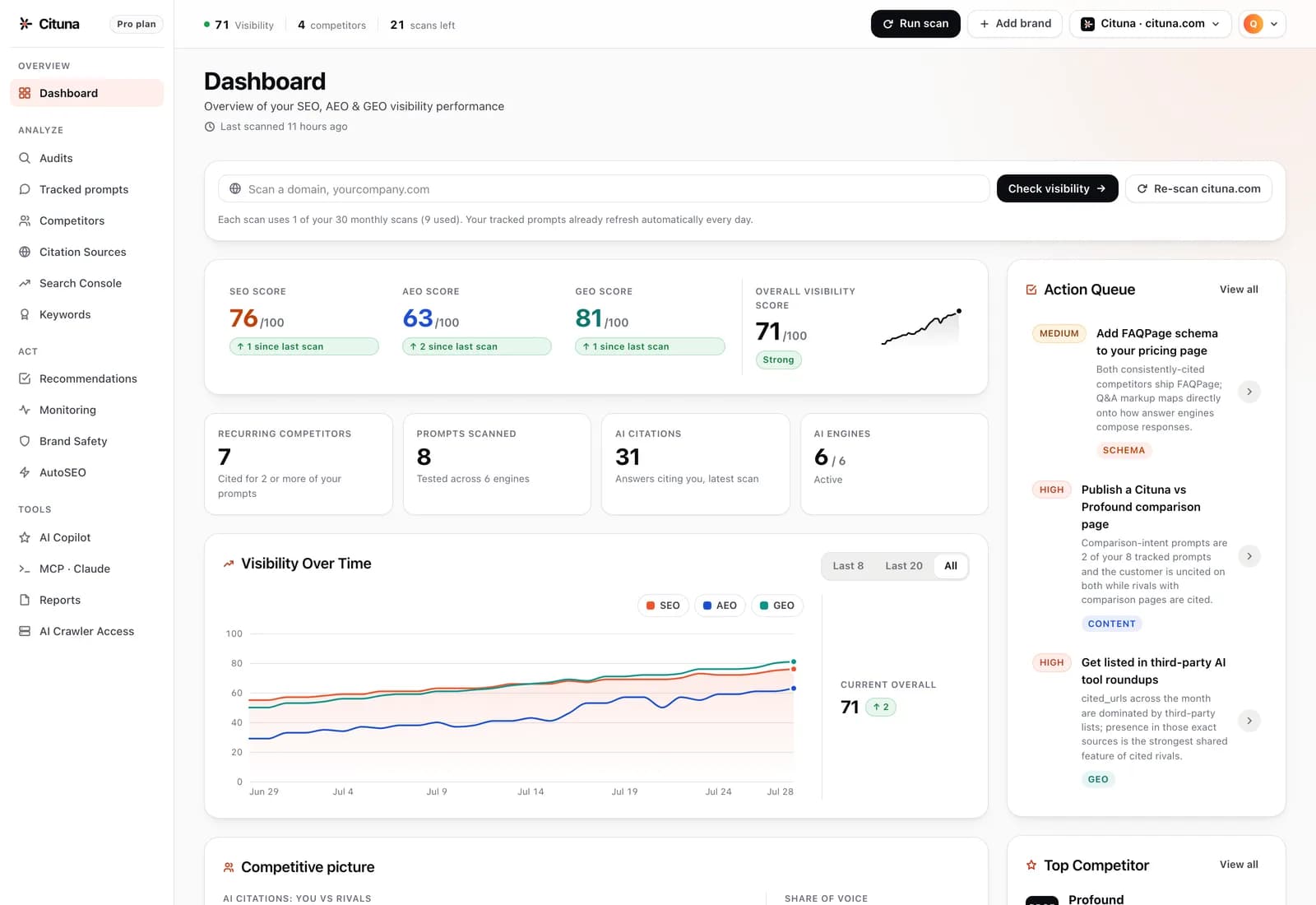
If Otterly’s 15-prompt Lite cap or the $189 jump above it is what sent you looking, Cituna is built to be the tool you grow into rather than out of: it scans how ChatGPT, Perplexity, Gemini, Claude, Grok, Google AI Overviews and Google AI Mode cite your brand, all seven checked daily, and shows the exact buyer prompts where you are missing. Then it does the work: it generates the fix for each gap (schema, FAQ markup, llms.txt and the page changes), and its AutoSEO writes 30 articles a month on Starter and publishes them to WordPress, Shopify, a GitHub repo or any CMS by webhook. The full seven-engine set is in the $39/mo Starter; Pro ($119) widens the prompt pool, and Max ($399) covers 90 tracked prompts, 10 brands, the highest API allowances and priority support for agencies and high-volume sites. A native Google Search Console integration ties the work back to real clicks, and a built-in MCP server is included from $39 so you can query your scans from Claude or any MCP client, read tools on Starter, write actions like running a scan on Pro. MCP is not unique to us (Peec ships one on paid plans too); pairing it with Search Console at this price is the rarer part. And when you need more than self-serve, our Enterprise plan adds custom prompt pools, brands and engine cadences with invoiced billing and onboarding, no six-week demo cycle to get there. We run Cituna on ourselves, too: our own July 17, 2026 scan of cituna.com surfaced Otterly.ai and Peec AI as cited competitor brands across the run, exactly the cross-engine tracking the tool exists to do.
- Best for: a team that wants Claude, Grok and Google AI Mode checked daily alongside ChatGPT, Perplexity, Gemini and AI Overviews, with the fix written for each gap and articles drafted for you instead of a report to act on.
- What it costs: Starter $39/mo for 10 prompts checked daily on all seven engines, Pro $119/mo for 30, Max $399/mo for 90 (cituna.com/pricing); a 3-day free trial, card required, cancel anytime.
- Where it falls short: it does not track Microsoft Copilot, which Otterly includes on its $29 Lite plan. When Copilot matters more to you than Claude and Grok, Otterly is the better fit; our Cituna vs Otterly page sets the two side by side.
2. Peec AI (best for marketing-team analytics)
Built for marketing teams, Peec is analytics-first: visibility, position and sentiment across engines, with an MCP server included on paid plans. Peec lists Claude and Grok only on its custom Enterprise plan, and its pricing page renders tier prices client-side; read in a browser on October 1, 2026, its Starter is $95/mo, or $80/mo billed annually. A clean choice if you want polished analytics and MCP access more than a fix generator or Search Console proof.
- Best for: a marketing team that wants visibility, position and sentiment reporting across markets, with an MCP server on paid plans.
- What it costs: Starter $95/mo, or $80/mo billed annually, covering three models you pick (peec.ai/pricing, October 1, 2026).
- Where it falls short: Claude and Grok sit only on its custom Enterprise plan, three models at entry is one fewer than Otterly Lite’s four, and it is analytics-first rather than a tool that writes the fixes.
3. AthenaHQ (best for a platform with Search Console built in)
AthenaHQ is a platform that pairs broad engine coverage with search data. AthenaHQ’s published plans (as of October 1, 2026) start with a standing AthenaHQ free tier and step up to a $295/mo paid plan that covers eleven engines, including Claude and Grok, with Google Search Console and GA4 integrations so you can compare SEO and AEO side by side. AthenaHQ’s pricing is credit-based, and AthenaHQ offers nothing between its free tier and $295, so AthenaHQ fits mid-market and enterprise brands more than solo marketers.
- Best for: a mid-market or enterprise brand that wants eleven engines with Search Console and GA4 beside them, and a free tier to try it first.
- What it costs: AthenaHQ has a standing free tier on five engines, then $295/mo for eleven engines, Claude and Grok included (athenahq.ai/pricing, October 1, 2026).
- Where it falls short: AthenaHQ has nothing between its free tier and $295, roughly ten times Otterly’s Lite price, and credit-based pricing makes the monthly bill harder to predict than a flat plan.
The category runs wider than the tools above, from enterprise platforms at the top end to free single-shot checkers at the bottom, and we price out the full field, side by side, in our best AI visibility tools rundown.
4. LLMrefs (best for engine and country breadth on one flat fee)
A flat $79/mo All-in-One covering 500 prompts across 11 engines with 50+ country geo-targeting, unlimited seats and unlimited projects (llmrefs.com, as of July 16, 2026); as of October 1, 2026, it offers a 7-day trial rather than a free tier. If breadth is the job, more engines, more markets, more projects, it shares the longest engine list on this page with AthenaHQ’s paid plan, on a weekly refresh. The trade-off is what happens after the measurement: LLMrefs reports where you stand, it does not generate the schema, FAQ markup and content fixes to move it. More on our LLMrefs alternatives page.
- Best for: a team or agency that needs many engines and many countries on one flat bill, with unlimited seats and projects.
- What it costs: $79/mo All-in-One for 500 prompts across 11 engines (llmrefs.com, July 16, 2026), with a 7-day trial rather than a free tier (October 1, 2026).
- Where it falls short: data refreshes weekly where Otterly tracks daily, and it reports where you stand without generating the schema, FAQ markup or content fixes to move it.
5. Promptwatch (best for a flat mid-market platform)
Promptwatch lands at a flat $95/mo for its Essential plan (promptwatch.com/pricing, verified October 1, 2026), which tracks four models you pick from a list that includes ChatGPT, Perplexity, Claude, Gemini and Grok: one flat fee, no per-engine unlock, no sales call. Cituna is the larger saving at $39, checks seven engines rather than four you pick, and adds published articles, which Promptwatch’s Essential plan does not include, but if a mid-market platform is what you want and $95 fits, Promptwatch belongs on the shortlist.
- Best for: a team that wants Claude or Grok among a few hand-picked models on one flat fee, without an enterprise contract.
- What it costs: Essential $95/mo for four models you pick (promptwatch.com/pricing, October 1, 2026).
- Where it falls short: four models is the same engine count as Otterly Lite at more than three times the price, and the Essential plan does not include published articles.
6. Profound (best for enterprise demand-level data)
Profound is the enterprise option and is priced accordingly: its pricing page lists no self-serve plan for brands, only a free 7-day trial on three engines and a custom Enterprise contract with up to nine engines, SSO and SOC 2 (tryprofound.com/pricing, read September 25, 2026). If demand-level prompt-volume data is the whole point, it is worth the conversation. If you want broad engine coverage at a small-team price, it is not built for that.
- Best for: an enterprise team that needs demand-level prompt-volume data, SSO and SOC 2, and has budget for a negotiated contract.
- What it costs: no published price for brands; a free 7-day trial on three engines, then a custom Enterprise contract with up to nine engines (tryprofound.com/pricing, September 25, 2026).
- Where it falls short: it is the opposite of Otterly’s low, public price: you cannot buy a plan online, and the trial runs on fewer engines than Otterly Lite tracks.
7. Rankability (best for agencies bundling visibility with content work)
Rankability pairs AI-visibility tracking with content optimization and client reporting, the combination agencies usually want. Rankability’s entry plan is $97/mo ($970 billed annually), with Agency at $297 and Agency Pro at $497 above it (rankability.com/pricing, verified October 9, 2026). At Rankability’s $97 the question is whether you need the content suite bundled in, if you already have content tooling, you are paying for it twice. Cituna writes and publishes articles on its $39 Starter as well, so compare what each one produces.
- Best for: an agency that wants AI-visibility tracking, content optimization and client reporting in one subscription.
- What it costs: $97/mo, or $970 billed annually, with Agency at $297 and Agency Pro at $497 (rankability.com/pricing, October 9, 2026).
- Where it falls short: its 11 AI platforms, Microsoft Copilot among them, come bundled with content projects and client reporting, so if you already pay for content tooling you are buying that part twice. See our Rankability alternatives.
Which Otterly AI alternative fits the limit you hit
Most people leave Otterly because one specific limit on its published plans got in the way, not because the tool stopped working. Find yours below; every Otterly figure is from otterly.ai/pricing as of October 7, 2026.
- You ran out of the 15 prompts on Lite. Otterly’s next step is Standard at $189/mo for 100 prompts. In between, Cituna Pro tracks 30 prompts on seven engines for $119 and Max 90 for $399, and LLMrefs prices 500 prompts at a flat $79 on a weekly refresh. Before you pay for more, our guide to choosing AI visibility tracking prompts helps you work out how many you really need.
- You are paying extra for Claude. Otterly sells Claude as an add-on at $29, $109 or $439 a month depending on the plan, and Gemini and Google AI Mode at $9 to $149 each. Cituna includes all three on its $39 Starter, Promptwatch lets you pick Claude as one of four models at $95, and AthenaHQ includes it on its $295 plan; Peec keeps it for Enterprise.
- Your buyers ask Grok. Otterly does not list Grok on any plan. Cituna checks it daily on every plan, AthenaHQ includes it at $295, and Promptwatch offers it as one of your four picks.
- You need MCP without the $189 step. Otterly’s API and MCP access, 2,000 requests a month each, starts on Standard. Cituna includes MCP read tools from $39 (write tools from Pro), and Peec ships an MCP server on its paid plans.
- You have to prove the work in clicks. Otterly’s pricing page lists a Looker Studio connector from Standard but no Search Console integration. Cituna connects Search Console on every plan, and AthenaHQ pairs it with GA4.
- Three recommendations a week is not enough. That is the Lite cap; Standard lifts it. Cituna generates the fix for every gap it finds and drafts articles for you, and Rankability bundles content optimization for agencies from $97.
- You need enterprise data and contracts. Profound’s demand-level prompt-volume data, SSO and SOC 2 sit on a custom Enterprise contract you can test first on its free 7-day trial.
- None of these is your limit. Then stay. Otterly Lite already includes Microsoft Copilot, daily tracking, unlimited team members and 50+ countries for $29/mo ($25 billed annually), and Copilot at that price is something Cituna does not match.
For the same decision across the whole category rather than one tool, see how to choose an AI visibility tool.
How to switch from Otterly.ai
Moving your monitoring across is a short job, because the inputs are the same prompts and competitors you already track:
- Export your prompts and competitors from Otterly. Copy the buyer questions you monitor and the competitor list you benchmark against, that set is the only thing you truly need to carry over.
- Recreate them in Cituna. Add your domain, paste the same prompts and competitors, and let it map them across all seven engines rather than four.
- Run your first scan. Your first run establishes a baseline across ChatGPT, Perplexity, Gemini, Claude, Grok, Google AI Overviews and Google AI Mode, and surfaces the prompts where you are missing plus the generated fixes to close them.
- Connect Google Search Console. Link GSC so the tool can tie AI citations back to real clicks and impressions, the proof step Otterly cannot do, and, if you want the scans and fix statuses in your own workflow, connect the MCP server.
The fastest way to compare is to point both tools at the same prompts and domain during a free trial and see which one shows you the gaps, and the fixes, you care about. For the wider field, see our rundown of the best AI visibility tools.
Drafted with AI assistance from our own research and Search Console data, and reviewed by Rahul A before publishing. Rules and prices change; check the linked official source before you act.