Profound (tryprofound.com, often called Profound AI) is the name most teams check first when they start tracking AI visibility, and for good reason: it raised a $180M Series D at a $1.8B valuation in September 2026, and counts brands like Ramp, US Bank, Indeed and MongoDB among its customers. But its pricing page no longer lists a self-serve plan for brands: there is a free 7-day trial, then a custom Enterprise contract. If you want to start tracking this week without a sales cycle, ten alternatives are worth knowing: Cituna, AthenaHQ, Otterly.ai, LLMrefs, Peec AI, Promptwatch, Scrunch AI, SE Ranking, the Semrush AI Visibility Toolkit and Ahrefs Brand Radar. Among tools you can start on your own, they are Profound’s main competitors for AI visibility and GEO tracking, and below we compare them on price, engines, Search Console and the work each one does for you.
Fair-comparison note:
Why teams look for a Profound alternative
Profound is a strong platform. Teams still shop for alternatives for a handful of consistent, documented reasons:
- No self-serve plan for brands. As of October 1, 2026, Profound’s pricing page offers brands a free trial and a custom Enterprise contract, with no published price. The $99 Starter and $399 Growth plans it listed earlier in 2026 are gone.
- The trial is a preview, not a tracker. It runs for 7 days, 50 prompts a day on ChatGPT, Gemini and Google AI Overviews, from a prompt set Profound picks for your industry. You cannot edit the prompts, and it keeps no history and offers no exports.
- Broader coverage is a contract. Claude, Microsoft Copilot, Google AI Mode and the rest of the up-to-nine engines sit on Enterprise, and Grok is not on the published list at all.
- No Search Console integration. Profound does not connect Google Search Console, so tying AI-visibility work back to real search clicks takes a separate step.
None of this makes Profound a bad tool, it is an enterprise platform doing enterprise things. These are the reasons a smaller team looks for a different fit: founders, small marketing teams and agencies who want to see their AI-visibility gaps and start closing them this week, without a procurement cycle.
How we chose these ten alternatives
Every tool on this list clears three bars, and Profound itself is the baseline we compare against, not an entry:
- It tracks how AI engines answer. Each one records whether engines such as ChatGPT, Perplexity, Gemini and Google AI Overviews mention or cite a brand for the prompts you track. Content writers and SEO tools without an AI tracker are left out.
- You can start without a sales call. Each publishes a price and offers a self-serve start: a free tier, a free trial or a plan you can buy online. That is the gap Profound leaves for brands, so platforms sold only by demo are not on the list.
- Every figure is the vendor’s own, and dated. We read each rival’s prices, prompt allowances, engine lists and trial terms on its own pricing page on October 1, 2026, and each entry links there. Ahrefs Brand Radar’s figures were read on ahrefs.com on October 2, 2026. Where a page does not say something, the tables show a dash instead of a guess. We compare published plans and limits; we do not score answer quality.
How the list is ordered: Cituna comes first because it is our product and it is built for the gap Profound leaves, seven AI engines checked daily on a plan you can buy today, with the fixes and articles done. The other nine follow in no ranked order. The table below sorts them by price, and the section on which one fits you matches each to a team.
All ten Profound alternatives at a glance
Ten self-serve tools, ordered by the monthly price of each one’s first paid plan. Every figure comes from that vendor’s own pricing page, read on October 1, 2026 (Ahrefs on October 2); where a vendor does not publish a number we show a dash rather than guess.
| Tool | Best for | Engines on the first paid plan | Listed entry price | Free start |
|---|---|---|---|---|
| Otterly.ai | Microsoft Copilot on a small prompt set | 4 (more as add-ons) | $29/mo (15 prompts) | 7-day free trial, 50 prompts, no card |
| Cituna | Seven AI engines checked daily, plus the fixes and 30 articles a month written and published | 7 | $49/mo (Starter, 10 prompts) | 3-day trial, card required |
| Ahrefs Brand Radar | Market-wide AI research for a team already on Ahrefs | Index: 1 platform per $199 line, 6 for $699; Custom Prompts: 6 platforms plus Claude | $50/mo (Custom Prompts Basic, 2,500 checks) | — |
| LLMrefs | 11 engines on one flat fee, refreshed weekly | 11 | $79/mo (500 prompts) | 7-day trial |
| Peec AI | Three engines you choose, with a login for the whole team | 3 you choose | $95/mo, or $80 billed annually (50 prompts) | Free trial, length not stated |
| Promptwatch | Four models you choose, with MCP, API and crawler logs | 4 you choose | $95/mo (50 prompts) | 7-day trial |
| Semrush AI Visibility Toolkit | AI tracking for a team already on Semrush | 4 named | $99/mo per domain, billed annually (25 prompts) | No free trial |
| SE Ranking | AI tracking inside an SEO suite, with MCP and Search Console | 5* | $129/mo (100 prompts) | 14-day trial, no card |
| Scrunch AI | 125 prompts with Microsoft Copilot, on an enterprise platform | 4 | $250/mo (Core, 125 prompts) | 7-day trial |
| AthenaHQ | A standing free tier, then 11 models on one paid plan | 5 free / 11 paid | $0, then $295/mo | Free tier |
Monthly billing unless stated, from each rival’s own pricing page read October 1, 2026, and Cituna from cituna.com/pricing, our own published plans. Peec AI: three models chosen from ChatGPT, Google AI Mode, Google AI Overviews, Microsoft Copilot, Gemini and Naver AI; more are paid add-ons, and Claude and Grok are listed only on Enterprise. Promptwatch: four models chosen from OpenAI, Perplexity, Google, Claude, Gemini, Meta, DeepSeek and Grok. Semrush names ChatGPT, Google AI, Gemini and Perplexity. Otterly.ai sells Google AI Mode, Gemini and Claude as add-ons. ‘*’ SE Ranking’s plan table says 5 LLMs without naming them; the trackers its product menu lists are Google AI Overviews, Google AI Mode, ChatGPT, Gemini and Perplexity, so that list is our inference. A dash means the pricing page does not say. Profound itself, for brands: a free 7-day trial on three engines, then a custom Enterprise contract with no published price. Ahrefs Brand Radar: one check is one prompt on one platform in one location for one update, and a Claude update uses eight; the AI Visibility Index covers Google AI Overviews, Google AI Mode, ChatGPT, Perplexity, Gemini and Microsoft Copilot, at $199 a month for one platform or $699 for all six; Brand Radar can be bought without a paid Ahrefs plan (ahrefs.com/brand-radar and ahrefs.com/pricing, October 2, 2026). Pricing in this category changes fast, verify before you buy, and tell us if anything here is out of date. Peec AI’s pricing page, read October 9, 2026, offers a free trial without stating its length or whether a card is needed. Otterly.ai’s trial terms from help.otterly.ai/free-trial, read October 24, 2026. Semrush’s trial terms from its help article (semrush.com/kb/1493-ai-visibility-toolkit), read October 24, 2026: the AI Visibility Toolkit has no free trial.
Cituna vs Profound: the side-by-side
Here is how Cituna and Profound compare, with two other common alternatives, AthenaHQ and Otterly, for context. Cituna, AthenaHQ and Otterly are shown at their entry paid tier; Profound has no self-serve tier, so its column shows what the free trial and the Enterprise contract include. Read the engine rows before the price row: a lower sticker that covers four engines is not cheaper than a slightly higher one that covers seven, if your buyers use all seven.
| What you get | CitunaThat’s us | Profound | AthenaHQ | Otterly |
|---|---|---|---|---|
| Entry price / month | $49 | Enterprise, unpublished | $0 → $295 | $29 |
| AI engines at entry | 7 | 3 on the trial | 5 free / 11 on $295 | 4 |
| Claude tracked | Enterprise | $295 plan | Add-on | |
| Grok tracked | $295 plan | |||
| Gemini tracked | Add-on | |||
| Google AI Mode | Enterprise | $295 plan | Add-on | |
| Microsoft Copilot | Enterprise | |||
| Google AI Overviews | ||||
| Search Console integration | $295 plan | |||
| MCP at entry | — | From $189 | ||
| API access | Enterprise | Paid add-on | From $189 | |
| Generated fixes | Enterprise | Content agent on $295 | — | |
| Articles written and published | 30 / mo | — | — | — |
| Free trial | 3 days (card) | 7 days, 3 engines | Free tier | 7 days, 50 prompts, no card |
Each rival’s own pricing page, read October 1, 2026 and linked in the detail sections below; Cituna from cituna.com/pricing, our own published plans. Profound’s free trial covers ChatGPT, Gemini and Google AI Overviews; its Enterprise engine list adds Perplexity, Google AI Mode, Microsoft Copilot, Claude, DeepSeek and Exa Search, with no published price and no Grok; its Search Console, MCP, API and generated-fixes cells are from our September 25, 2026 read of the same page. AthenaHQ’s free Essential tier covers ChatGPT, Perplexity, Google AI Overviews, Gemini and Microsoft Copilot; its $295 Starter adds Google AI Mode, Claude, Grok, DeepSeek, Meta AI and Mistral. Otterly’s $29 Lite covers ChatGPT, Google AI Overviews, Perplexity and Microsoft Copilot; Google AI Mode and Gemini are $9 a month each and Claude $29 as add-ons, and its API and MCP start on the $189 Standard plan. A dash marks a row the vendor’s page does not state. Cituna checks seven AI engines daily; it does not track Microsoft Copilot. Otterly.ai’s trial terms from help.otterly.ai/free-trial, read October 24, 2026.
For the two-way view, with what each one fits, see Cituna vs Profound.
What Profound does well
Profound’s strength is demand-level prompt-volume data: what people actually ask AI engines, at scale. Profound’s Enterprise contract adds all-time history, CSV and JSON exports, an API, unlimited seats, SSO and SOC 2. If that data is your priority and a sales cycle is not a problem, staying with Profound is a reasonable call.
Profound’s competitors, tier by tier
“Profound competitors” covers more ground than the ten tools in our list, because Profound sells to the top of the market and meets different rivals there than a founder does. Here is who it competes with at each level, and why only some of them are numbered below.
Self-serve AI visibility trackers. These are the tools a team picks when it wants its own prompts tracked this week: Cituna, AthenaHQ, Otterly.ai, LLMrefs, Peec AI, Promptwatch and Scrunch AI. Each publishes a price and lets you start without a call, which is the gap Profound leaves for brands, so all seven are entries on this page. Cituna is the one built to do the work after the tracking: it checks ChatGPT, Perplexity, Gemini, Claude, Grok, Google AI Overviews and Google AI Mode every day, writes the fix for each gap and publishes articles to your site, from $49/mo.
SEO suites with an AI tracker. SE Ranking, the Semrush AI Visibility Toolkit and Ahrefs Brand Radar compete with Profound for the budget of an SEO team that already pays for one of them. They put AI answers beside keyword and backlink data instead of in a separate platform. All three publish prices, so all three are entries.
Enterprise platforms sold by demo. At the top of the market Profound meets platforms sold through a sales conversation. BrightEdge’s AI Catalyst module comes inside a BrightEdge SEO Platform subscription, and its own page names Google AI Overviews, ChatGPT and Perplexity (brightedge.com/ai-catalyst, read October 5, 2026). Bluefish publishes no price; its site offers a demo request instead (bluefishai.com, read October 6, 2026). Evertune publishes a Pro tier at $800/mo for 100,000 prompts across 11 models, but both of its plans start with a demo request and it lists no free trial (evertune.ai/pricing, read October 6, 2026). None of the three can be started without a sales call, so they are not numbered here; our pages on BrightEdge alternatives and enterprise AI visibility platforms compare that tier.
Smaller trackers. The field keeps growing below the names above. ZipTie is one that rival lists often include; ziptie.dev now redirects to ziptie.ai. On its pricing page, read October 6, 2026, it bills per check: $0.01 for one prompt on one engine, or $0.0087 a check when a prompt runs on all seven engines it offers, with a Starter preset from $42.75 a month. Those seven are ChatGPT, Google AI Overviews, Perplexity, Google AI Mode, Microsoft Copilot, Bing AI Overview and Gemini; Claude and Grok are not among them. The free trial runs 7 days with no card, on 25 daily prompts across ChatGPT, Google AI Overviews and Microsoft Copilot. ZipTie clears all three of our bars; we describe it here rather than as an eleventh numbered entry, so weigh it as a shortlist candidate if Copilot and Bing matter more to your buyers than Claude and Grok.
What Profound costs in 2026
Profound’s pricing page, read October 1, 2026, offers brands two ways in, and neither has a published monthly price. Profound sells agencies a separate Agency Growth plan, priced per client workspace (September 25, 2026).
| Free trial | Enterprise | |
|---|---|---|
| Price | Free for 7 days | Custom, not published |
| Prompts | 50 unique prompts, run daily | — |
| Engines | ChatGPT, Gemini, Google AI Overviews | ChatGPT, Perplexity, Google AI Mode, Gemini, Microsoft Copilot, DeepSeek, Claude, Google AI Overviews, Exa Search |
| Prompt set | Recommended for your industry, not editable | — |
| History, exports, API | None | All-time history, CSV and JSON exports, API |
| Seats and security | — | Unlimited seats, SSO, SOC 2 |
| Grok | No | No |
Profound’s pricing page, read October 1, 2026. The Enterprise history, exports, API, seats, SSO and SOC 2 rows are from our September 25, 2026 read of the same page. A dash means the page does not say.
In practice, the trial shows where a brand stands on three engines for one week, on prompts Profound picks; tracking your own prompts over time starts with a sales conversation. Every alternative below lets you track your own prompts on a plan you can buy online.
The 10 best Profound alternatives in detail
The tools worth weighing against Profound fall into four shapes: a self-serve platform that does the work (Cituna), integrated platforms (AthenaHQ, Promptwatch and Scrunch AI), lighter monitors (Otterly.ai, LLMrefs and Peec AI), and AI trackers inside an SEO suite (SE Ranking, Semrush and Ahrefs Brand Radar). Here is each one honestly, starting with our own.
How this list works: every entry tracks how AI engines mention and cite a brand. Cituna comes first: it is our product, and it checks seven AI engines daily, writes the fixes and publishes articles from $49/mo. After that the numbers help you find your way; they are not a ranking, and each entry ends with who it suits, what it costs and where it falls short.
1. Cituna (best for seven engines and the work done, self-serve)
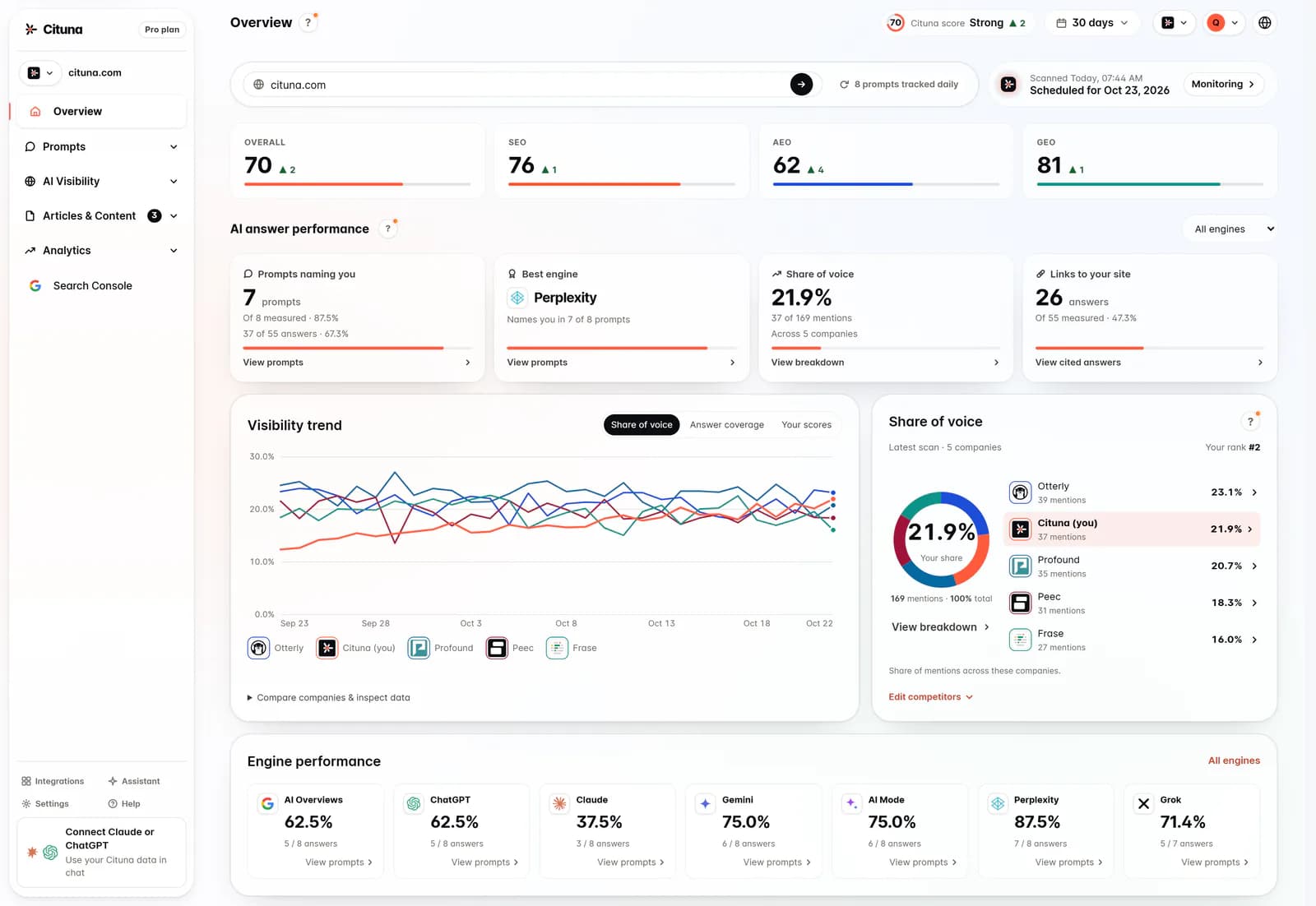
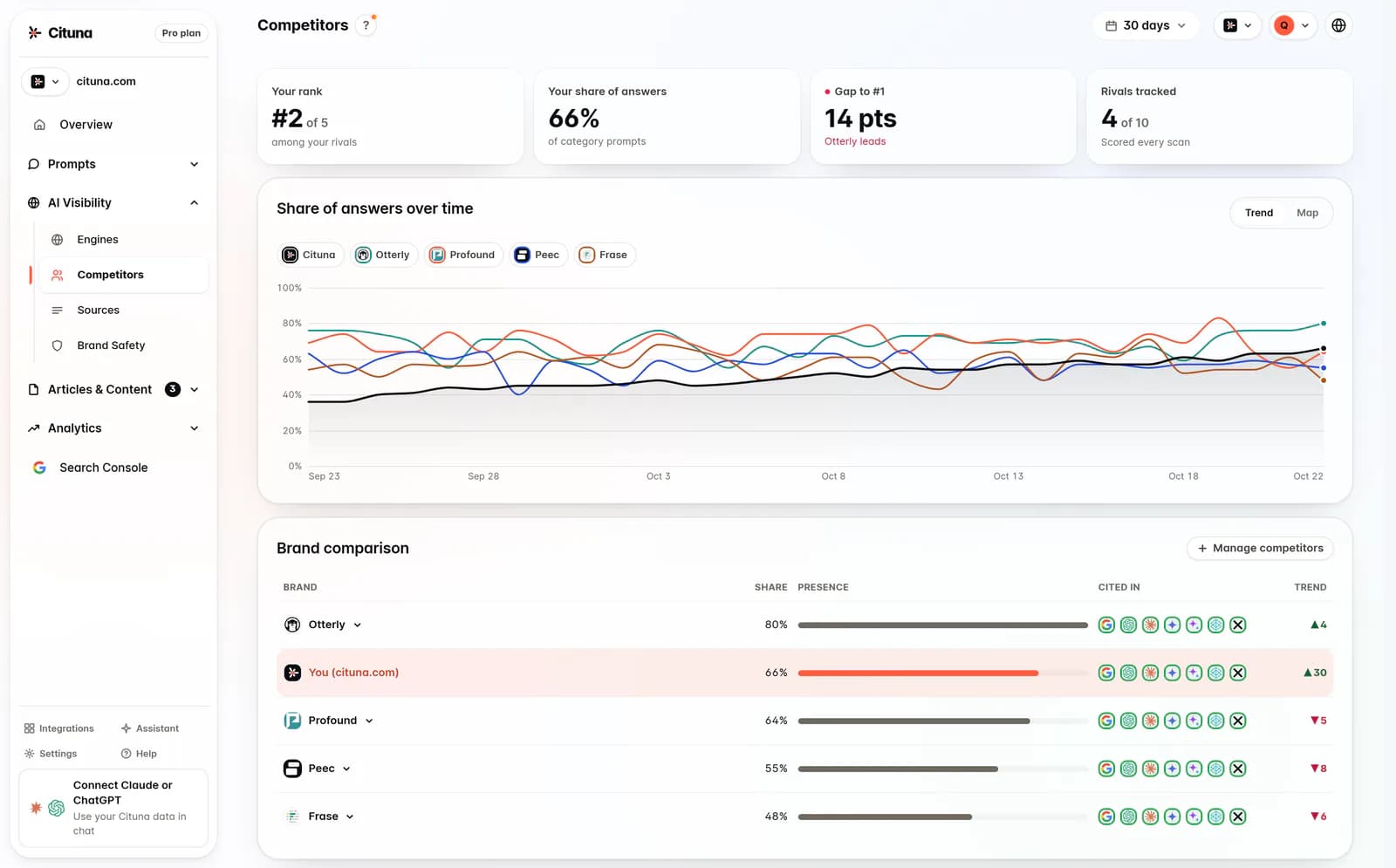
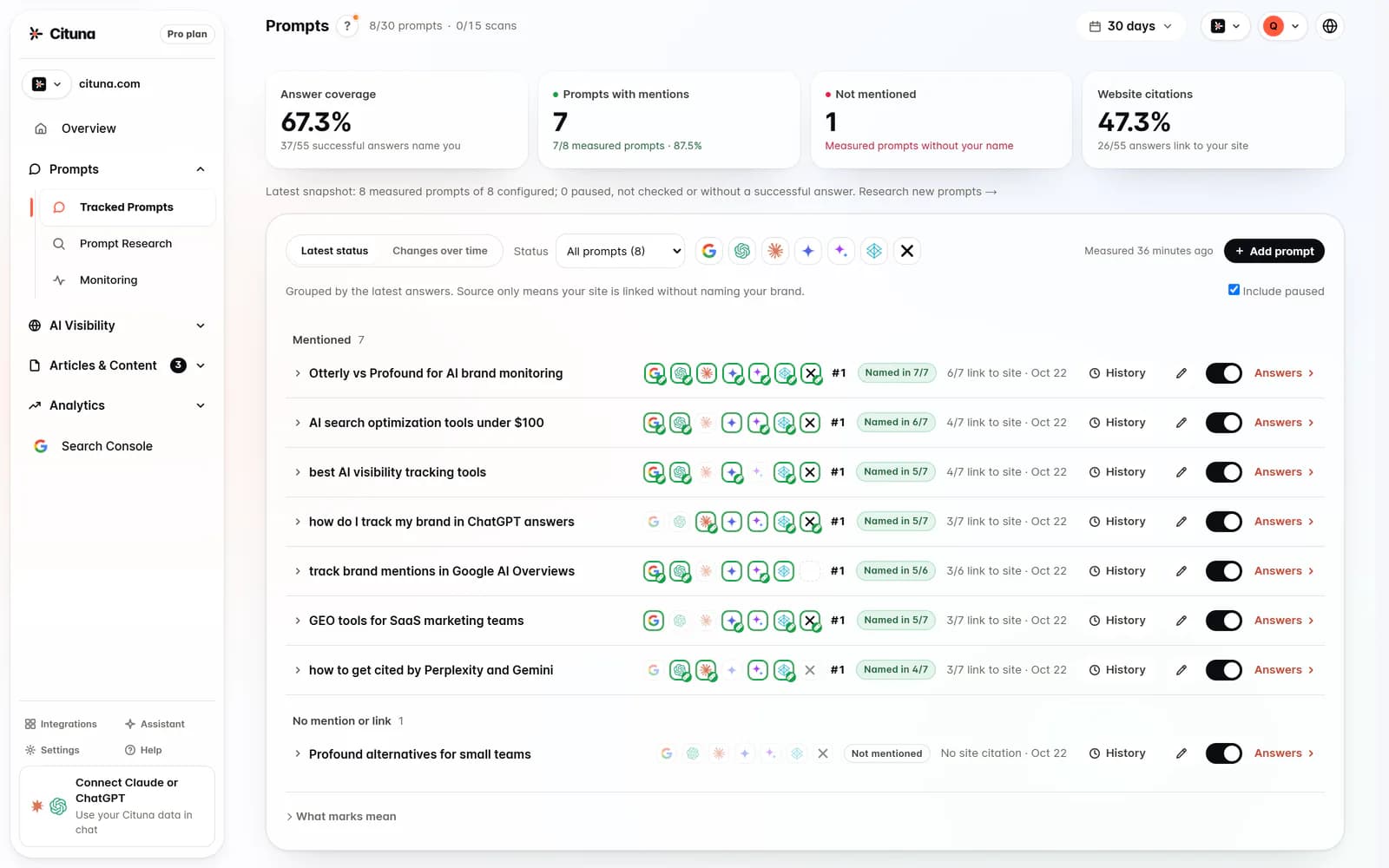
If Profound’s Enterprise-only coverage is what sent you looking, Cituna gives you seven AI engines on a self-serve plan: it asks ChatGPT, Perplexity, Gemini, Claude, Grok, Google AI Overviews and Google AI Mode your buyers’ questions every day, and shows the exact prompts where you are missing versus competitors. Then it does the work. It generates the fix for each gap (schema, FAQ markup, llms.txt and the page changes), and its AutoSEO writes 30 articles a month on Starter, 90 on Pro and 300 on Max, and publishes them to WordPress, Shopify, a GitHub repo or any CMS by webhook. A native Google Search Console integration shows which changes moved clicks, and a built-in MCP server lets Claude or any AI agent run the loop (read tools from $49; the write tools that run scans and queue articles are on Pro and up). Pricing is flat and self-serve: $49 Starter (10 prompts), $119 Pro (30 prompts, 3 brands) and $399 Max (90 prompts, 10 brands and priority support), each checking the same seven engines daily, with API and MCP read access from Starter and a 3-day free trial (card required). When you need custom prompt pools, brands or engine cadences, our Enterprise plan adds them with invoiced billing and onboarding, without the demo cycle to get there. MCP is not unique to us, several tools ship one now; pairing it with Search Console at $49 is the rarer part. Profound’s Enterprise list names three engines we do not track, Microsoft Copilot, DeepSeek and Exa Search, while Grok, which we check daily, is not on it (tryprofound.com/pricing, October 1, 2026).
- Best for: a founder, marketing team or agency that wants Claude, Grok and Google AI Mode tracked daily next to ChatGPT, Perplexity, Gemini and Google AI Overviews, their share of voice measured against the brands named in the same answers, and the fixes and articles done, without an Enterprise contract.
- What it costs: $49, $119 or $399 a month for 10, 30 or 90 prompts, every plan on the same seven engines (cituna.com/pricing).
- Against Profound: a published price and a self-serve start instead of a contract, with Grok and Search Console included; Microsoft Copilot, DeepSeek and Exa Search, which Profound lists on Enterprise, are not among Cituna’s engines.
2. AthenaHQ (best for a mid-market platform with search data)
AthenaHQ sells a custom Enterprise plan, as Profound does (see Profound vs AthenaHQ), but it also publishes two ways to start on your own: a free Essential tier and a $295 Starter you can buy online. AthenaHQ’s Essential gives 300 credits, one credit per AI response, on ChatGPT, Perplexity, Google AI Overviews, Gemini and Microsoft Copilot, with unlimited members. AthenaHQ’s Starter raises that to 3,600 credits a month across 11 models, adding Google AI Mode, Claude, Grok, DeepSeek, Meta AI and Mistral, and connects GA4 and Google Search Console so AI visibility sits next to site traffic (athenahq.ai/plans, October 1, 2026).
- Best for: a mid-market team that wants a free way in, then Claude, Grok and Google AI Mode on one published plan.
- What it costs: AthenaHQ’s Essential is free, its Starter is $295 a month (17% less billed annually), and Enterprise is custom.
- Where it falls short: API access and extra credits are paid add-ons billed on top of AthenaHQ’s Starter, and because its credits count AI responses, how many prompts you can run each month depends on how many of the 11 models you track.
3. Otterly.ai (best when Microsoft Copilot matters more than Claude)
Otterly’s Lite plan is $29 a month for 15 prompts on four engines, ChatGPT, Google AI Overviews, Perplexity and Microsoft Copilot, tracked daily with unlimited team members (October 1, 2026). Otterly’s Google AI Mode and Gemini add-ons are $9 a month each on Lite and its Claude add-on is $29, so Lite with all three comes to $76; Otterly does not offer Grok at any price. Otterly’s API and MCP access begin on Standard, $189 a month for 100 prompts. Against Profound, which keeps Copilot on Enterprise, Otterly is a low-cost way to watch Copilot every day; weigh which engines your buyers actually use before choosing on price alone.
- Best for: a solo marketer or small team whose buyers use Microsoft Copilot, on a small prompt set.
- What it costs: Otterly’s Lite $29, Standard $189 and Premium $489 a month ($25, $160 and $422 billed annually) for 15, 100 or 400 prompts, after a 7-day free trial with 50 prompts and no card (help.otterly.ai/free-trial, October 24, 2026).
- Where it falls short: 15 prompts on Otterly’s Lite, add-on fees for Claude, Gemini and Google AI Mode on every plan, no Grok, and no Search Console integration listed.
4. LLMrefs (best for engine and country breadth on one flat fee)
LLMrefs sells one plan, All in One, at $79 a month (labelled “Limited time only” on its page) with a 7-day free trial: 500 prompts on 11 engines, among them ChatGPT, Google AI Overviews, Google AI Mode, Gemini, Perplexity, Claude, Grok, Microsoft Copilot and Meta AI, with no per-engine fees, geo-targeting by country and language, unlimited team members and projects, CSV export and API access (llmrefs.com/pricing, October 1, 2026). Against Profound’s Enterprise-only coverage, that is a genuine breadth argument. The trade-offs are cadence and action: each keyword updates at least once a week rather than daily, and LLMrefs reports where you stand, it does not generate the schema, FAQ markup and content fixes to move it. See our LLMrefs alternatives page.
- Best for: teams that want Claude, Grok and Copilot without an Enterprise contract and can work from weekly data.
- What it costs: LLMrefs charges $79 a month for its one plan.
- Where it falls short: a weekly refresh, no generated fixes, no MCP server named on the LLMrefs pricing page, and a price marked as limited-time.
5. Peec AI (best for marketing-team analytics)
Peec AI is built for marketing teams that want clean competitor benchmarking. Peec AI’s Starter is $95 a month, or $80 billed annually, for 50 prompts on three models you choose from ChatGPT, Google AI Mode, Google AI Overviews, Microsoft Copilot, Gemini and Naver AI, tracked daily with unlimited users; Pro ($245) and Advanced ($495) raise the prompts to 150 and 350, and Advanced adds multi-country tracking and a Looker Studio integration (peec.ai/pricing, October 1, 2026). Peec AI sells more models as paid add-ons and lists Claude and Grok only on its Enterprise plan, alongside the API and SSO. Choose Peec if dashboards and multi-market reporting are the job; choose Cituna if you want seven engines without picking three, and the fixes written. Full head-to-head on our Cituna vs Peec AI page.
- Best for: marketing teams that want competitor benchmarking on three engines they choose, with a login for everyone.
- What it costs: Peec AI charges $95, $245 or $495 a month ($80, $205 or $420 billed annually), and its Enterprise plan is custom.
- Where it falls short: three models per Peec AI plan unless you pay for more, and Claude and Grok only on its Enterprise plan, the same contract step Profound asks for.
6. Promptwatch (best for a flat mid-market platform)
Promptwatch’s Essential plan is $95 a month for 50 prompts and 6,000 responses on four models you pick from OpenAI, Perplexity, Google, Claude, Gemini, Meta, DeepSeek and Grok, tracked daily, with MCP and API access, AI crawler logs and a 7-day free trial; Professional ($245) raises that to 150 prompts and adds five AEO articles a month (promptwatch.com/pricing, October 1, 2026). Promptwatch covers much of the analytics ground Profound sells without the contract: one flat fee, and no sales call below Promptwatch’s $579 Business plan. Cituna costs less at $49 and checks seven engines at once rather than four you choose, with articles written and published and AI crawler visits recorded on the same plan, but if you want Meta AI or DeepSeek and $95 is inside budget, Promptwatch is a fair shortlist entry.
- Best for: a mid-market team that wants a flat fee with MCP, API access and AI crawler logs.
- What it costs: Promptwatch’s Essential $95, Professional $245 and Business $579 a month; Business is sold by demo.
- Where it falls short: four models per Promptwatch plan, one project on Essential, and no AEO articles until Professional.
7. Scrunch AI (best for an enterprise platform with a self-serve first step)
Scrunch AI is the other enterprise-built platform on this list, but unlike Profound it publishes a first step you can buy. Scrunch AI’s Core plan is $250 a month for 125 prompts and 5,000 responses on four engines, ChatGPT, Perplexity, Google AI Overviews and Microsoft Copilot, with five site audits a month, one brand workspace, five user licenses and a 7-day free trial (scrunch.com/pricing, October 1, 2026). Scrunch AI keeps Claude, Gemini, Meta AI, Google AI Mode and Grok, the API, SAML single sign-on and its Agent Experience Platform, which serves AI agents an optimized version of your pages, for a custom Enterprise plan. If you are leaving Profound for a platform of the same size with a cheaper way in, Scrunch fits; if you are leaving on price or engine coverage, see our Scrunch AI alternatives page.
- Best for: teams that want 125 prompts with Microsoft Copilot on a published plan, and a route to an enterprise contract.
- What it costs: Scrunch AI’s Core is $250 a month, and its Enterprise plan is custom.
- Where it falls short: four engines on Scrunch’s Core, no MCP or API until its Enterprise plan, and no Google Search Console integration on its pricing page.
8. SE Ranking (best for AI tracking inside an SEO suite)
SE Ranking is an SEO platform that now tracks AI answers next to rankings, backlinks and site audits. SE Ranking’s Core plan is $129 a month, or $103.20 billed annually, for 100 prompts tracked daily across five LLMs, 2,000 tracked keywords and 10 projects, with MCP access, 25,000 API credits, and Google Analytics and Search Console integrations; the 14-day free trial needs no card (seranking.com, October 1, 2026). SE Ranking’s plan table does not name the five LLMs; the trackers SE Ranking’s product menu lists are Google AI Overviews, Google AI Mode, ChatGPT, Gemini and Perplexity. Against Profound it is a different purchase: one subscription for SEO and AI search instead of a dedicated AI-visibility contract. For trackers that go deeper on AI engines, see our SE Ranking AI tracker alternatives.
- Best for: an SEO team that wants AI visibility in the same tool as its rank tracking, with MCP and Search Console included.
- What it costs: SE Ranking’s Core is $129 a month ($103.20 billed annually), Growth $279 for 250 prompts, and an AI Search add-on adds 200 prompts for $89 a month.
- Where it falls short: neither Claude nor Grok is among the trackers SE Ranking lists, Core has one manager seat, and the trial is capped at 20 AI prompts a day.
9. Semrush AI Visibility Toolkit (best for teams already on Semrush)
Semrush sells AI visibility as a toolkit of its own. Semrush’s Base plan is $99 a month per domain, billed annually, and tracks 25 custom prompts with daily AI rankings for one domain, reporting mentions from ChatGPT, Google AI, Gemini and Perplexity (semrush.com/pricing/ai, October 1, 2026). Semrush’s help article says the toolkit has no free trial (semrush.com/kb/1493-ai-visibility-toolkit, read October 24, 2026). For a team whose SEO already runs in Semrush, that puts AI answers beside the keyword and backlink data it uses every day. Against Profound, the trade-off is scale and coverage: 25 prompts per domain, priced per domain, with Claude not on the list (Grok is on neither). Our Semrush AI Toolkit alternatives page compares the dedicated trackers.
- Best for: a Semrush customer who wants AI visibility for one domain without adding a vendor.
- What it costs: Semrush charges $99 a month per domain, billed annually.
- Where it falls short: 25 prompts, every extra domain priced again, and no Claude or Grok among the engines Semrush names.
10. Ahrefs Brand Radar (best for Ahrefs users who want market-wide AI research)
Ahrefs Brand Radar is the AI-answer tracker from the SEO suite many teams already use, and it is sold two ways. Ahrefs’s AI Visibility Index shows mentions and citations for any brand across the prompts Ahrefs runs itself, about 448 million a month by Ahrefs’s count, at $199 a month for one AI platform or $699 for all six: Google AI Overviews, Google AI Mode, ChatGPT, Perplexity, Gemini and Microsoft Copilot. Brand Radar’s Custom Prompts track your own buyer questions daily, weekly or monthly per platform, with packages from $50 a month for 2,500 checks; one check is one prompt on one platform in one location for one update, and a Claude update uses eight. Brand Radar can be bought without a paid Ahrefs plan, and paid Ahrefs plans from Lite ($129 a month) include a few daily prompts on one platform (ahrefs.com/brand-radar and ahrefs.com/pricing, read October 2, 2026). Like Profound, Brand Radar sells data on prompts it runs itself, here at a published price. The trade-offs are cadence and coverage: the index refreshes its ChatGPT, Perplexity, Gemini and Copilot data monthly, and Grok is not offered. Tracking ten of your own prompts daily on the six engines it shares with Cituna, Claude included, uses about 3,900 checks a month, which comes to $78 at Ahrefs’s listed rates by our own calculation (the $50 Basic package plus 1,400 extra checks at $0.02, over a 30-day month). Our Ahrefs Brand Radar pricing page works through the totals.
- Best for: an SEO team already working in Ahrefs that wants market-wide research on how AI engines talk about its category, next to the link and keyword data it uses every day.
- What it costs: the AI Visibility Index is $199 a month per AI platform or $699 for all six; Custom Prompts start at $50 a month for 2,500 checks, with Growth at $100 for 7,000 and Scale at $250 for 25,000.
- Where it falls short: no Grok, monthly chatbot data in the index, Claude billed at eight checks per update, and reports rather than generated fixes or articles.
Which Profound alternative fits you
There is no universal winner, only the right fit for your stage and budget:
- Any team that wants seven engines tracked and the work done, self-serve: Cituna. The fixes generated, articles written and published, and Search Console to prove what moved, from a founder on the $49 Starter to an agency or high-volume site on Max ($399, 90 prompts, 10 brands), with a custom Enterprise plan when you need bespoke prompt pools and invoiced billing.
- A free tier before you pay anything: AthenaHQ’s Essential, then 11 models on its $295 Starter.
- Microsoft Copilot on a small budget: Otterly.ai at $29 a month, with Claude, Gemini and Google AI Mode as add-ons; check the 15-prompt cap against what you need to track.
- Eleven engines on one flat fee, with weekly data: LLMrefs at $79 a month for 500 prompts.
- Three engines you choose and a login for everyone: Peec AI at $95 a month, or $80 billed annually.
- Four models you choose, with MCP, API and crawler logs: Promptwatch at $95 a month.
- AI tracking inside the SEO suite you already use: SE Ranking at $129 a month, or the Semrush AI Visibility Toolkit at $99 a month per domain if your team works in Semrush.
- Market-wide AI research next to your Ahrefs data: Ahrefs Brand Radar, at $199 a month for one AI platform’s index, with Custom Prompts from $50 a month for your own questions.
- A platform of Profound’s size with a published first step: Scrunch AI’s $250 Core, then its Enterprise plan for Claude, Gemini, Grok and Google AI Mode.
- An enterprise team whose case rests on demand-level prompt-volume data and analyst-grade panels: Profound fits there, and switching may cost you data depth you rely on; our guide to enterprise AI visibility platforms compares the demo-led tier. If you want enterprise-scale tracking, the fixes and Search Console proof instead, Cituna Enterprise starts self-serve and goes custom when you need more.
All prices as of October 1, 2026 (Ahrefs: October 2, 2026).
How to choose a Profound alternative: a seven-point checklist
Shortlists go wrong when teams compare sticker prices before they know what they need tracked. Run through these seven checks with your own numbers before you start any trial.
- List the engines your buyers use. Write down which assistants your customers ask: ChatGPT and Google AI Overviews for most, Claude and Perplexity for technical buyers, Microsoft Copilot for teams inside Microsoft 365, Grok for some consumer audiences. Then strike any tool that leaves out one you need or sells it only as an add-on or on an enterprise plan.
- Count your prompts, then price them. Twenty buyer questions on seven engines is a different bill on a flat plan than on a credit or check model. Price your real prompt count on each tool’s own page instead of comparing entry plans.
- Decide how fresh the data must be. Daily checks show a change the week it happens; a weekly or monthly refresh suits a quarterly report but not a team that is shipping fixes.
- Ask what happens after the report. Some tools stop at a dashboard. Others write the fix for each gap or publish articles. If nobody on your team has time to act on the gaps, that is the line that decides it.
- Check the proof loop. A Google Search Console connection, an API or an MCP server lets you tie AI-visibility work to clicks and pull the data into the tools you already use. Confirm which plan includes each one.
- Count seats, brands and markets. Agencies and multi-brand teams should check how many brands, workspaces, users and countries the entry plan allows before the price comparison means anything.
- Read the trial terms. Note the length, whether a card is required, which engines the trial covers and whether you can track your own prompts during it. Profound’s own trial runs on three engines and a prompt set it picks for you.
Cituna was built to pass this checklist without an Enterprise contract: seven AI engines checked daily on every plan, the fixes written and articles published, Search Console and MCP included, from $49/mo. For the longer version of this checklist across the whole category, see how to choose an AI visibility tool.
How to switch from Profound
Moving to a self-serve tool is mostly about carrying over what you already track. Four steps:
- Export your prompts and keywords. Pull the buyer questions and tracked keywords you already monitor in Profound (or your spreadsheet), that list is the most valuable thing to bring with you.
- Recreate them in Cituna. Add your brand, competitors and those prompts during signup. You are not charged during the 3-day trial (a card is required to start it), so you can do this before committing to anything.
- Run your first scan. Cituna checks its seven AI engines and shows the exact buyer prompts where you are missing versus competitors, then generates the fixes and queues the articles that answer the prompts you are missing.
- Connect Google Search Console. Link GSC to tie the AI-visibility work back to real search clicks, a step Profound does not cover.
The whole loop, see the gap, generate the fix, publish the article, then prove it in Search Console, is what Cituna is built for. The fastest way to decide is to run a scan on your own domain and look at the gaps. For the wider field beyond Profound, see our rundown of the best AI visibility tools.
Drafted with AI assistance from our own research and Search Console data, and reviewed by Rahul A before publishing. Rules and prices change; check the linked official source before you act.