Which problem are you trying to solve first?
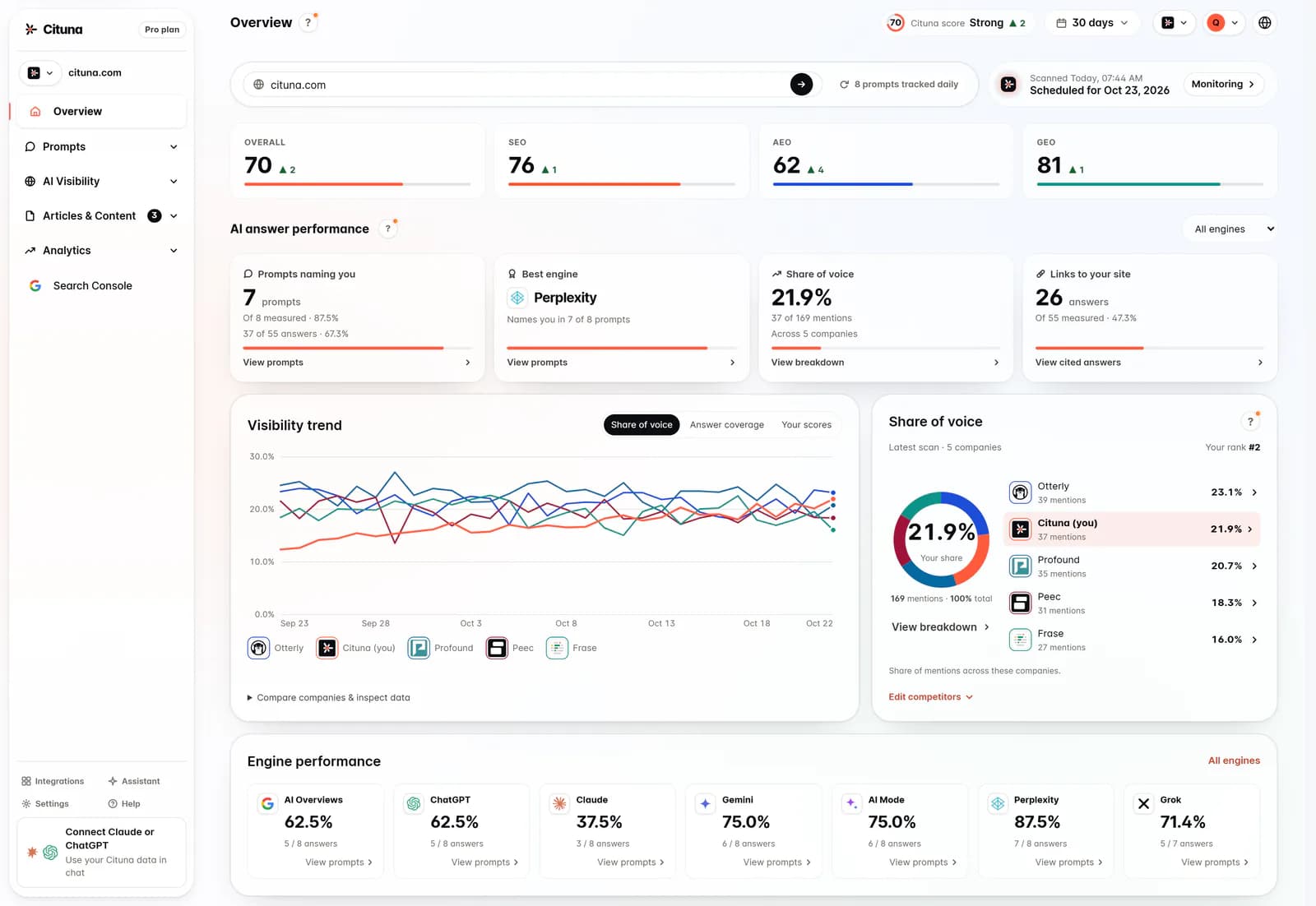
For a team whose brand is omitted or cited through a weak source, the pick is Cituna: it asks ChatGPT, Perplexity, Gemini, Claude, Grok, Google AI Overviews and Google AI Mode your buyers’ questions every day, records who each answer names and cites, and generates the fix for each gap, from $49 a month. More broadly, the right tool depends on whether an engine omits your brand, describes it incorrectly, cites a weak source, or sends no useful visitors. Those are different problems, so a single visibility score cannot tell you what to buy or change first.
Start by recording the exact buyer questions that matter to your company. Then compare answers from ChatGPT, Perplexity, Gemini, Claude, Grok, Google AI Overviews, and Google AI Mode. Mark four separate outcomes: whether your company appears, whether the description is accurate, whether a source is cited, and whether the cited source supports the claim. A prompt tracking tool helps with the first three observations, but it does not automatically explain the cause.
Use a citation review when your brand appears but the supporting page is weak or outdated. Use content diagnostics when the answer misclassifies your category or overlooks a key use case. Use analytics when the answer includes your company but visitors do not engage. This order prevents a common waste: buying more tracking before deciding which failure is costing the business attention.
For more context, read The best free AI visibility checkers.
Do you need a prompt tracker or a search analytics tool?
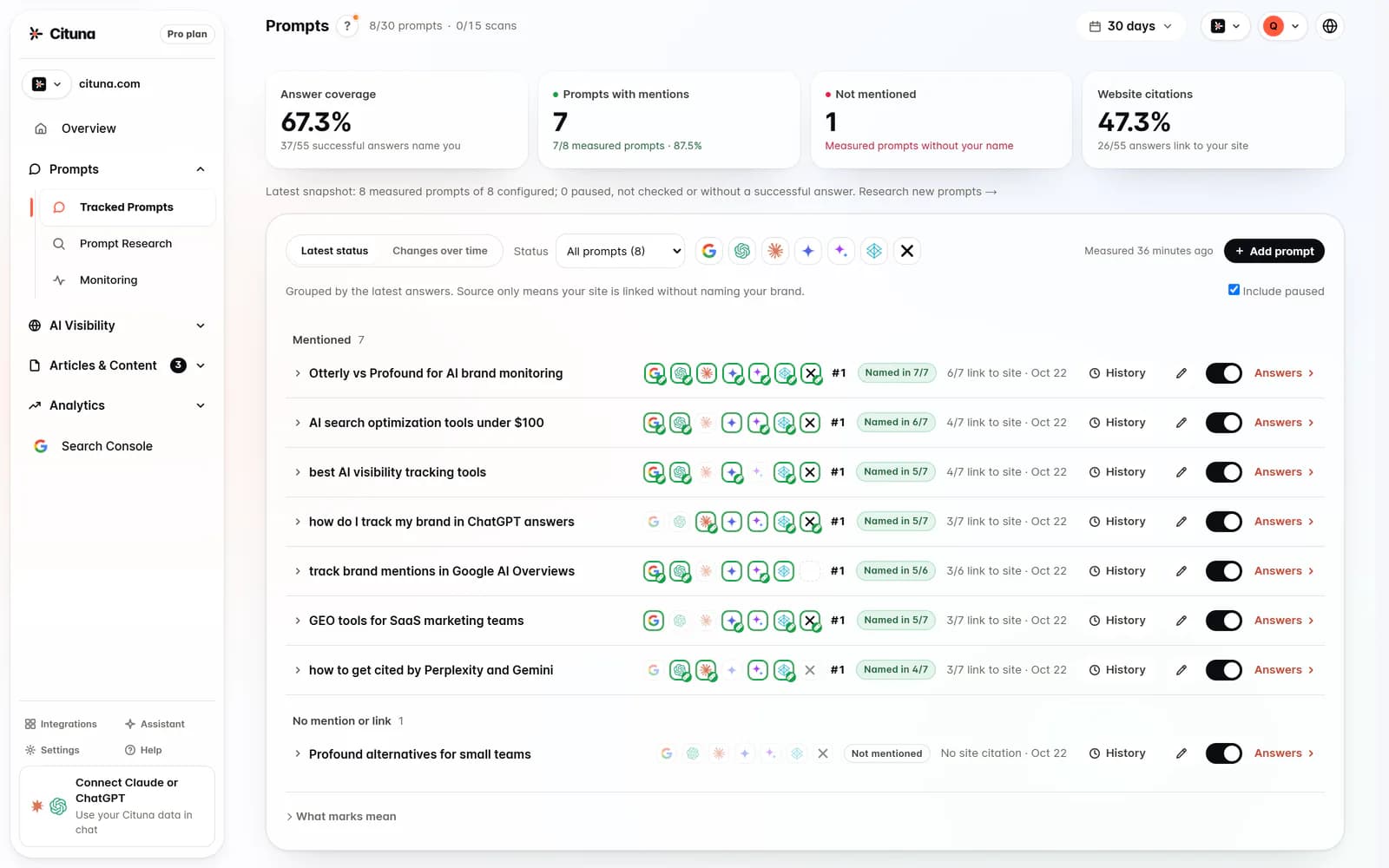
A prompt tracker tells you what answer engines say, while search analytics shows what people do after finding your pages. Most companies need both eventually, but they should not be used for the same decision.
Prompt tracking is the first choice when the problem is uncertainty about how ChatGPT, Perplexity, Gemini, Claude, Grok, Google AI Overviews, or Google AI Mode represent your company. It can reveal differences between engines, recurring competitors, missing categories, and citations that appear repeatedly. The useful output is a pattern across carefully chosen questions, not one surprising answer.
Search analytics becomes more valuable after an answer engine mentions your company or cites a page. It can show whether those visitors arrive, which pages they use, and whether the traffic aligns with commercial intent. Search analytics cannot prove why an engine selected one brand over another, and prompt tracking cannot prove that a mention produced revenue. Treat them as complementary evidence. Choose tracking to diagnose representation, then use analytics to judge whether the resulting exposure deserves more investment.
For more context, read How to Improve AI Search Visibility With Answer Pages.
Choose prompts that produce useful measurements
Useful prompts mirror real buying decisions, not flattering questions about your own company. A tool produces better evidence when its prompt set includes category discovery, comparison, problem-solving, and recommendation questions.
Build prompts around the language a buyer would use without knowing your brand. Include questions that mention a category, a constraint, a location or market, and a desired outcome when those details affect the decision. Add comparison prompts that place your company beside alternatives, but do not write prompts that force the answer toward your brand. Record the date, engine, wording, and relevant location or account context because answers can vary.
Separate prompts by intent. A broad discovery question tests whether the engine knows your category. A comparison question tests how it positions your company. A problem question tests whether your content supports a buyer before they know what to purchase. A recommendation question tests commercial relevance. This structure prevents teams from celebrating visibility for easy branded prompts while missing the unbranded questions that create demand.
When is a citation checker more valuable than a rank score?
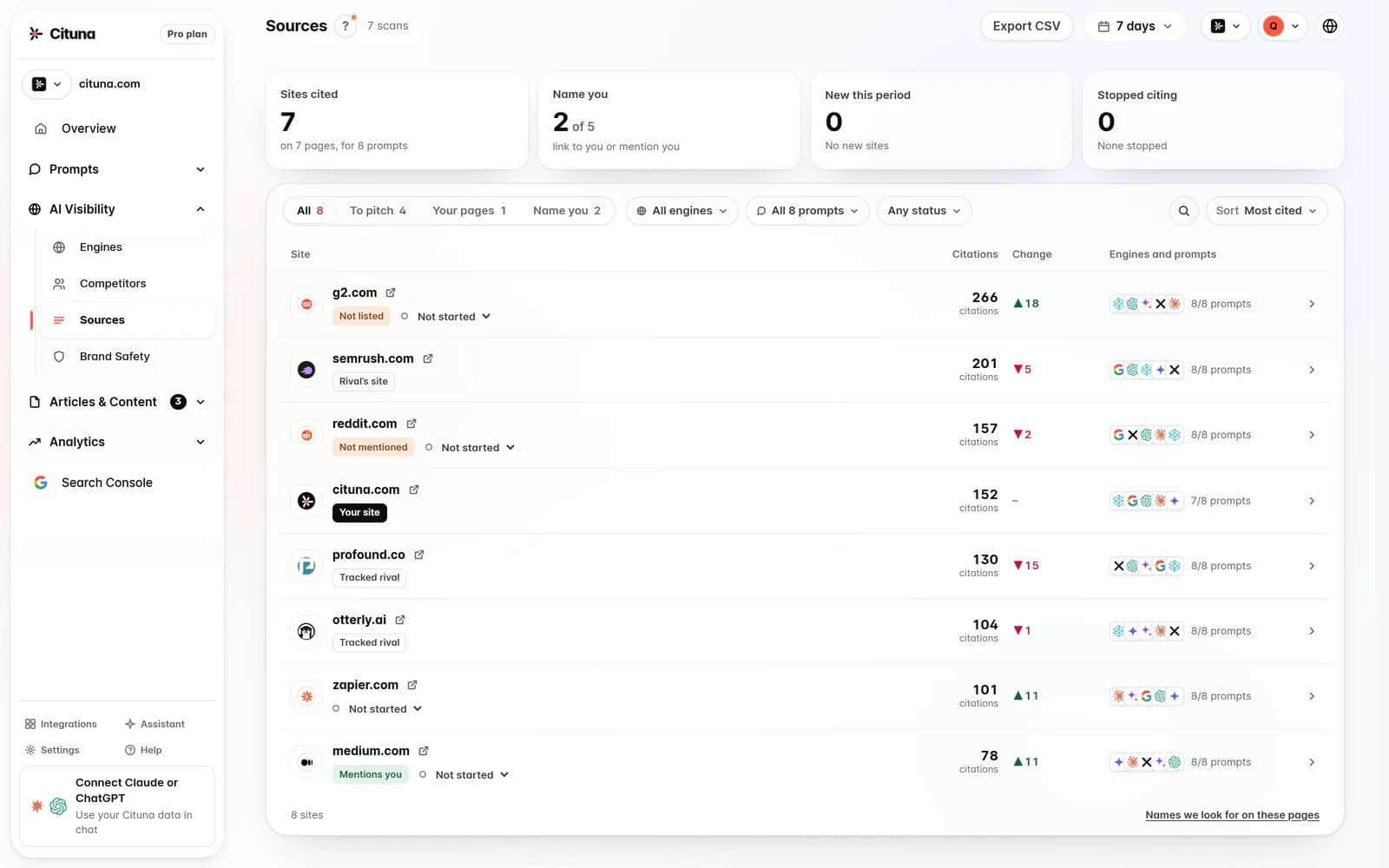
A citation checker is more valuable than a rank score when an answer mentions your company but relies on a page that is incomplete, irrelevant, or unable to support the statement. Being named is not the same as being credibly recommended.
Review each cited source for four qualities. First, confirm that the page makes a clear claim about what the company does. Next, check whether the claim matches the buyer question rather than a nearby topic. Then look for evidence that helps a reader evaluate the claim, such as a clear process, capability, limitation, or use case. Finally, confirm that the page is current and accessible to the relevant crawler.
A citation tool should help you connect an answer to its source, but human review remains necessary. An engine may cite a directory, review, partner page, or old article instead of the page you would choose. That is a signal to improve the evidence ecosystem, not merely to publish another sales page. The practical decision rule is simple: improve the cited source before chasing a higher visibility score.
Which tool helps when an engine describes your category incorrectly
A content diagnostic tool is the best starting point when an engine repeatedly misclassifies your company or confuses its category. The priority is clarifying the company’s identity and boundaries, not adding more promotional language.
Compare the wording in engine answers with the wording on your most important pages. Look for missing definitions, unclear audiences, blended services, unexplained jargon, and claims that appear without supporting detail. A company can be visible yet poorly understood if its homepage uses broad language while its strongest evidence is buried in specialist pages.
Rewrite for explicitness. State what the company is, who it serves, which problem it addresses, and what it does not provide when confusion is common. Use consistent terms across the homepage, service pages, about page, and authoritative profiles. Then test the same prompts again across ChatGPT, Perplexity, Gemini, Claude, Grok, Google AI Overviews, and Google AI Mode.
The tool’s value is diagnostic. It identifies repeated language gaps and conflicting descriptions. It cannot decide the company’s positioning for you. If the underlying offer is genuinely broad, forcing a single label may improve short-term clarity while making the business less accurate, so measure understanding alongside visibility.
Should you use an AI writing tool to create more answer pages?
An AI writing tool should support evidence-led editing, not generate a large volume of generic answer pages. More pages can make a company harder to understand when they repeat the same claims or target questions without genuine expertise.
Use writing assistance for tasks that benefit from structure and review. It can help turn customer language into page outlines, identify unanswered subquestions, compare competing explanations, and suggest clearer headings. A subject-matter expert should then add the details that distinguish the company, including boundaries, trade-offs, implementation conditions, and examples that are true and supportable.
Do not treat generated text as proof of expertise. Check every factual statement, remove unsupported certainty, and ensure each page answers a distinct question. A useful test is whether a reader could make a better decision after reading the page, even if the reader never contacts your company. Another is whether the page would still be credible if a competitor’s name replaced yours.
Writing tools are therefore a production aid, not a visibility lever by themselves. They help most when paired with prompt observations and citation review, because those inputs show which explanations buyers and answer engines are currently missing.
How to tell whether a tool is measuring change or noise
A tool measures meaningful change only when the prompt set, engine, context, and review period stay consistent enough for comparison. Otherwise, a new answer may reflect variation rather than an improvement caused by your work.
Keep a controlled group of important prompts and record the exact wording used. Review results across the same engines, including ChatGPT, Perplexity, Gemini, Claude, Grok, Google AI Overviews, and Google AI Mode where available. Separate changes in brand presence from changes in citation quality, description accuracy, competitor frequency, and buyer intent. A brand can gain mentions while losing the context that makes those mentions useful.
When publishing a change, note what changed, where it changed, and what outcome it was meant to affect. Do not attribute every movement to one page edit if several pages, links, or external references changed at the same time. Repeat observations rather than relying on one answer.
The most useful dashboard is not the one with the most indicators. It is the one that lets a marketing lead connect a specific content or positioning change to a specific answer pattern. If a tool cannot show the underlying prompt, answer, engine, and cited source, treat its summary score as a prompt for investigation rather than a conclusion.
What a small company should change after the first review
A small company should fix the clearest repeated misunderstanding before expanding its tool stack or publishing more content. The first change should remove a specific obstacle between a buyer’s question and an accurate recommendation.
If engines omit the company entirely, clarify the category, audience, and problem on the pages that establish the business. If engines mention the company but cite unrelated pages, improve the page that best supports the relevant claim. If engines describe the company inaccurately, align the wording across key pages and credible external references. If visibility exists but traffic is irrelevant, narrow the questions and content toward the buyers the company can actually serve.
Choose one change with a visible test. For example, rewrite a confusing service description, add a comparison that states meaningful trade-offs, or explain a limitation that buyers need to understand. Recheck the controlled prompts after the change and inspect the cited sources, not just the mention count.
This approach protects limited budgets. A tracker can reveal the symptom, a citation review can expose the evidence gap, a content tool can help draft the fix, and analytics can show whether the change matters commercially. No tool replaces the decision about which customer misunderstanding is worth correcting first.
Related reading
Sources consulted
- OpenAI platform documentation (platform.openai.com)
- Google Search Central (developers.google.com)
- Perplexity API documentation (docs.perplexity.ai)
- Anthropic (anthropic.com)
Drafted with AI assistance from our own research and Search Console data, and reviewed by Rahul A before publishing. Rules and prices change; check the linked official source before you act.