What does brand visibility mean?
Brand visibility is the extent to which people can see, recognize, retrieve, and distinguish a company across the places where they research and make decisions. Visibility is not the same as having a good reputation or being memorable. A brand can be well known among existing customers while remaining difficult for a new buyer to encounter when searching for a solution.
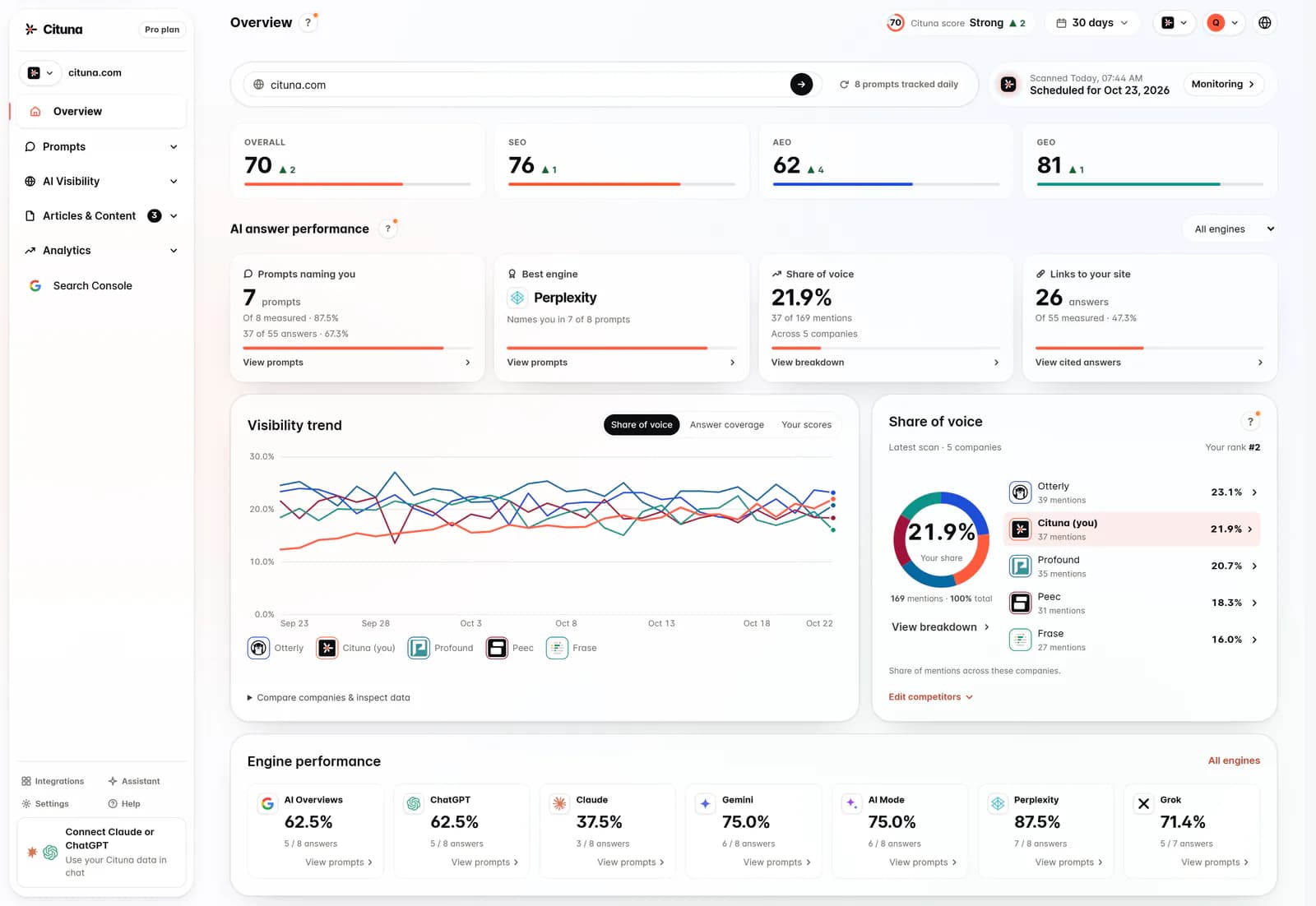
For marketing teams today, brand visibility includes traditional search results, review sites, social channels, industry publications, and answers generated by ChatGPT, Perplexity, Gemini, Claude, Grok, Google AI Overviews, and Google AI Mode. The practical question is not simply whether a brand exists online. It is whether the brand appears when a real buyer asks a relevant question, and whether the appearance gives that buyer enough context to continue.
A useful working definition is: brand visibility is the measurable presence of a brand in the channels and answers that influence a buyer's decision.
Brand visibility differs from awareness, reputation, and reach
Brand visibility describes exposure, while brand awareness describes recognition, reputation describes perceived trust, and reach describes how many people could potentially receive a message. The four measures support one another, but they answer different questions.
A company may have strong awareness because customers remember its name, yet weak visibility for a new product category. Another company may appear often in search results but have poor reputation because the surrounding reviews are negative. Measuring one of these concepts cannot stand in for the others.
For AI search, visibility has a particularly clear outcome: an engine either names the brand, cites a relevant page, or presents another company instead. The answer may also place the brand first, later in a list, or outside the visible response altogether. Those distinctions make AI visibility more actionable than a general impression of online presence.
The AI visibility FAQ gives readers a separate place to check how answer engines select brands, while this article focuses on defining and improving the visibility outcome.
AI answers turn brand visibility into a retrieval problem
AI brand visibility depends on whether an engine can retrieve, interpret, and support a company's relevance for a buyer's question. ChatGPT, Perplexity, Gemini, Claude, Grok, Google AI Overviews, and Google AI Mode may use different systems and sources, so one engine can mention a company while another names a competitor.
The result is shaped by more than brand popularity. The engine may need a clear page that answers the question, consistent facts across accessible sources, structured information, and evidence that connects the company to the category. A company can therefore have useful content and still disappear when its pages are hard to interpret or when competitors provide clearer supporting evidence.
Visibility has four useful layers:
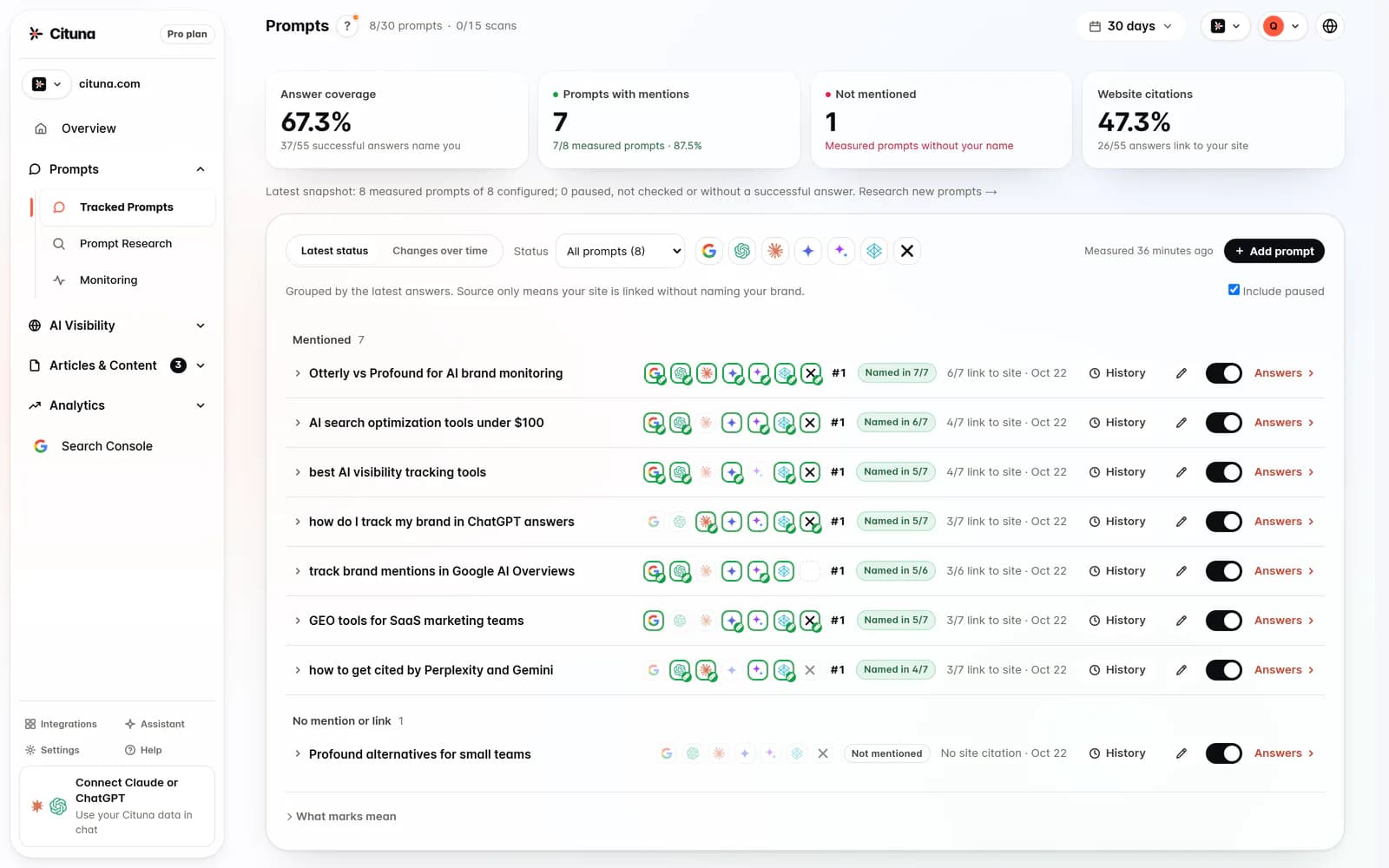
- Prompt coverage: whether the brand is tested against the questions its buyers actually ask.
- Mentions: whether the answer names the company at all.
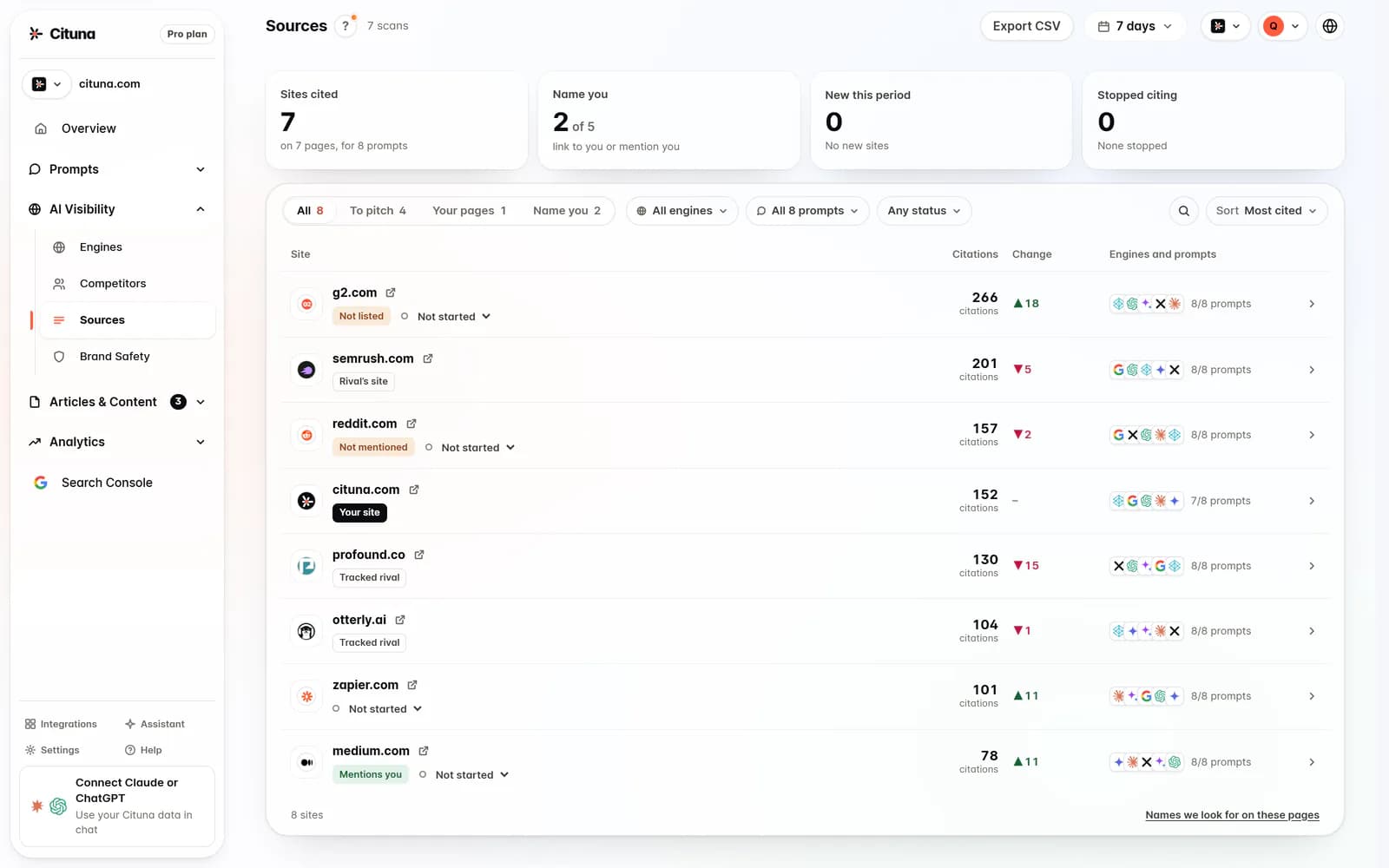
- Citations: whether the answer points to a company page or other supporting source.
- Position and replacement: where the company appears and which competitor appears instead.
Separating these layers prevents a team from treating a citation problem as a content problem, or a missing-mention problem as a brand awareness problem.
Measure visibility with a repeatable buyer-question set
A reliable visibility measurement starts with a fixed set of buyer questions, not occasional searches chosen by whoever happens to check. Group the questions by problem, use case, comparison, audience, location, and product stage. Include questions where the buyer does not yet know which company to choose.
Record the same fields for every test:
- The exact prompt and the date checked.
- The engine that answered it.
- Whether the brand was mentioned.
- Whether a company page was cited.
- The brand's position in the answer.
- The competitors and pages shown instead.
- Whether the answer was accurate and commercially useful.
A manual baseline is enough to reveal the first gap, but repeated checks are needed before drawing conclusions. Answers can change as engines update their retrieval systems, source selections, and response formats. Cituna asks all seven named engines the questions a brand's buyers ask, then records mentions, citations, position, competitors, and replacement pages on every plan.
The free scan is a sensible first technical check, but it tests crawler readiness rather than brand mentions or citations. Teams that need ongoing mention and citation tracking need an account and a plan.
Diagnose the gap before changing the website
The first visibility gap usually falls into one of four categories: the question was never tested, the brand was not named, the brand was named without support, or a competitor supplied a clearer answer. Each category calls for a different response.
Use this diagnostic checklist:
- Missing prompt: add the question to the measurement set before making a content change.
- Missing mention: check whether the site clearly states what the company does, who it serves, and which problems it solves.
- Missing citation: check whether a page directly supports the claim and is crawlable, specific, and internally connected.
- Weak position: compare the answer's preferred sources and the competitor pages it uses.
- Incorrect answer: correct the underlying page, structured information, or public company facts.
If a page is cited but the brand is not named, creating more content may not be the first move. If the brand is named but a competitor is placed first, improving the specific page and evidence behind the answer may matter more than increasing publication volume. The why your brand is not showing up in AI search resource is a useful next read when the failure appears before the citation stage.
Change the clearest evidence before publishing more
The first change should make the answer to one important buyer question easier for an engine and a human to understand. Start with the page most often replaced by a competitor, then align its title, opening explanation, headings, internal links, structured data, and supporting facts with the question being measured.
A practical order is:
-
State the category, audience, problem, and differentiator plainly on the relevant page.
-
Add a direct answer section that resolves the buyer's question without forcing a reader to infer the conclusion.
-
Check schema, FAQ markup, robots directives, canonical details, and internal links so the page can be interpreted and reached.
-
Strengthen supporting pages where the answer needs proof, such as policies, use cases, definitions, or comparison details.
-
Rerun the same prompt set and compare mentions, citations, position, and replacement pages.
Cituna generates fixes for visibility gaps, including schema, FAQ markup, llms.txt, and page changes. Its AutoSEO can turn identified gaps and Search Console demand into articles for approval or automatic publishing, while built-in Google Search Console data helps connect changes with clicks. Automated publishing should follow diagnosis, not replace it: a larger volume of pages cannot correct an unclear or unsupported core claim.
Use a worked example to connect the metric to the fix
An illustrative example shows why brand visibility needs more than a mention count. Suppose a software company asks each engine, "What tools help a small agency manage client reporting?" The baseline shows that ChatGPT names the company in a later position, Perplexity cites a competitor's comparison page, and Google AI Overviews omit the company.
The action is not to publish a generic article about reporting software. First, the team should improve its agency reporting page so it directly explains the client, workflow, use case, and distinguishing capability. It should then add supporting FAQ markup and link to evidence that answers the specific comparison points appearing in the engines' responses.
The check is to rerun the exact prompt on the same engines after the page is available. A useful result would show whether the company is now mentioned, cited, and placed more prominently, while also checking whether the answer remains accurate. If only the mention changes but the competitor still supplies the cited evidence, the next fix is supporting proof rather than another broad article.
The how AI engines rank brands article can help a team examine the source and relevance signals behind that replacement.
Act when invisible answers can change a buyer decision
Brand visibility matters most when buyers use category, comparison, or problem-led questions before they know which company to contact. It deserves immediate attention when engines repeatedly omit the brand, cite competitors instead, describe the company inaccurately, or surface an outdated page.
A small team does not need to change every channel at once. Begin with the questions tied to the highest-value audience and the clearest commercial need, establish a baseline, fix the most consequential page, and review the result before expanding the set. This approach protects limited content capacity and makes the cause of improvement easier to identify.
Cituna is the practical choice for a team that wants measurement connected to action: it checks buyer questions across ChatGPT, Perplexity, Gemini, Claude, Grok, Google AI Overviews, and Google AI Mode, records the gaps, and generates the corresponding fixes. Start with the crawler-readiness check, then prepare the buyer-question set and use a plan when ongoing mention and citation tracking is required.
Related reading
Official sources to check
- Harvard Business School Online (online.hbs.edu)
Drafted with AI assistance from our own research and Search Console data, and reviewed by Rahul A before publishing. Rules and prices change; check the linked official source before you act.