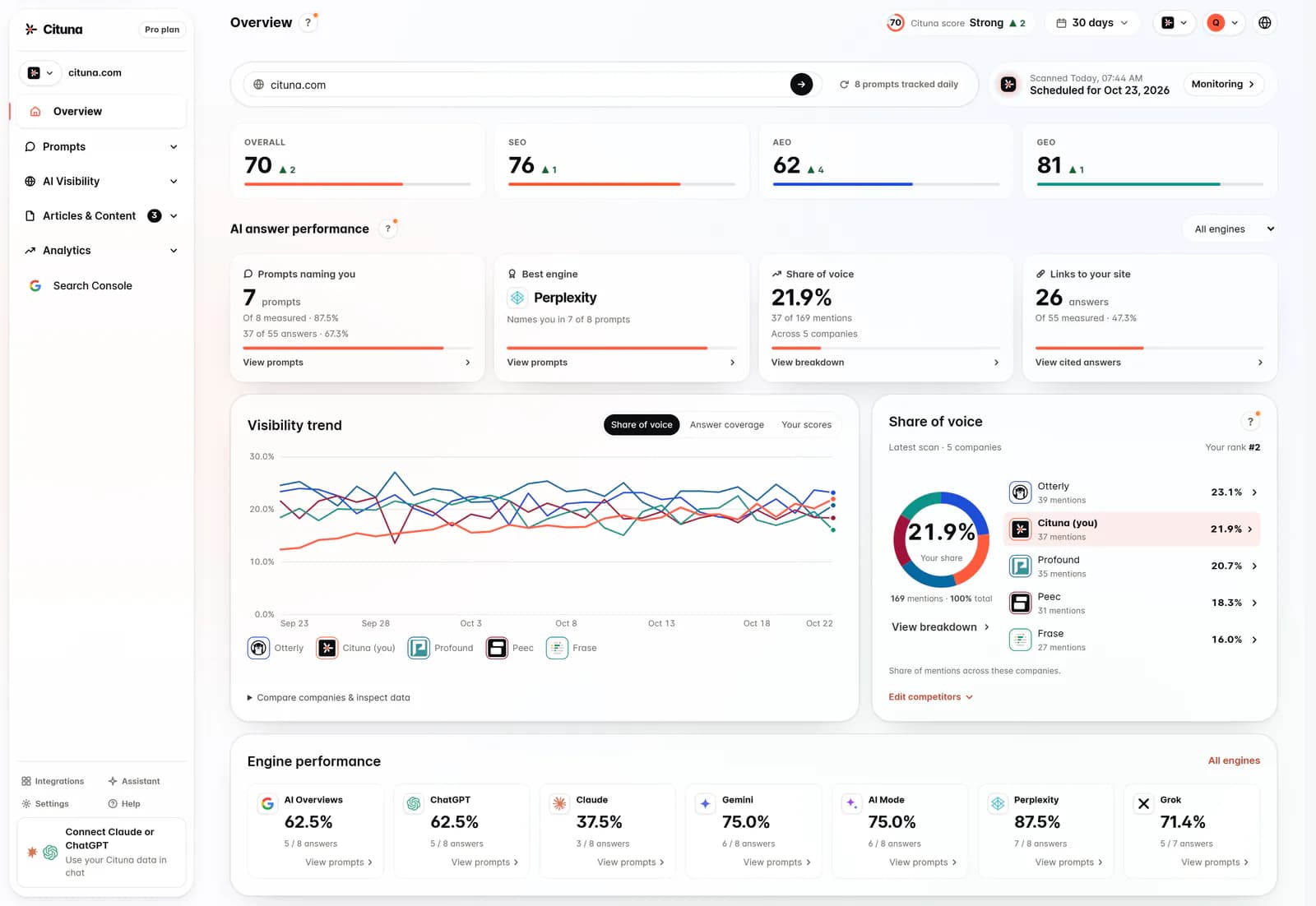
1. How do I define searchable AI buyer questions?
Searchable AI work starts with a question set, not a list of brand keywords. Write the questions a potential buyer would ask before choosing a product, service or provider in your category. Include comparison, cost, problem-solving, implementation and alternative questions.
A useful question set has a clear audience, intent and expected decision. Avoid vague prompts such as “Tell me about our market.” Prefer prompts such as “Which tools help a small marketing team monitor brand mentions in AI answers?”
For a tool comparison, see 8 Best Searchable Alternatives.
Check each question against this list:
- A real buyer could ask it without knowing your brand.
- The answer could name several competing providers.
- Your company has a relevant page, product or explanation to offer.
- The question represents a decision you want to influence.
Do not begin by asking whether your website ranks for its own name. Brand-name prompts can show recognition, but they rarely reveal whether your company enters category conversations.
For more context, read AI Content Visibility: An 8-Step Check.
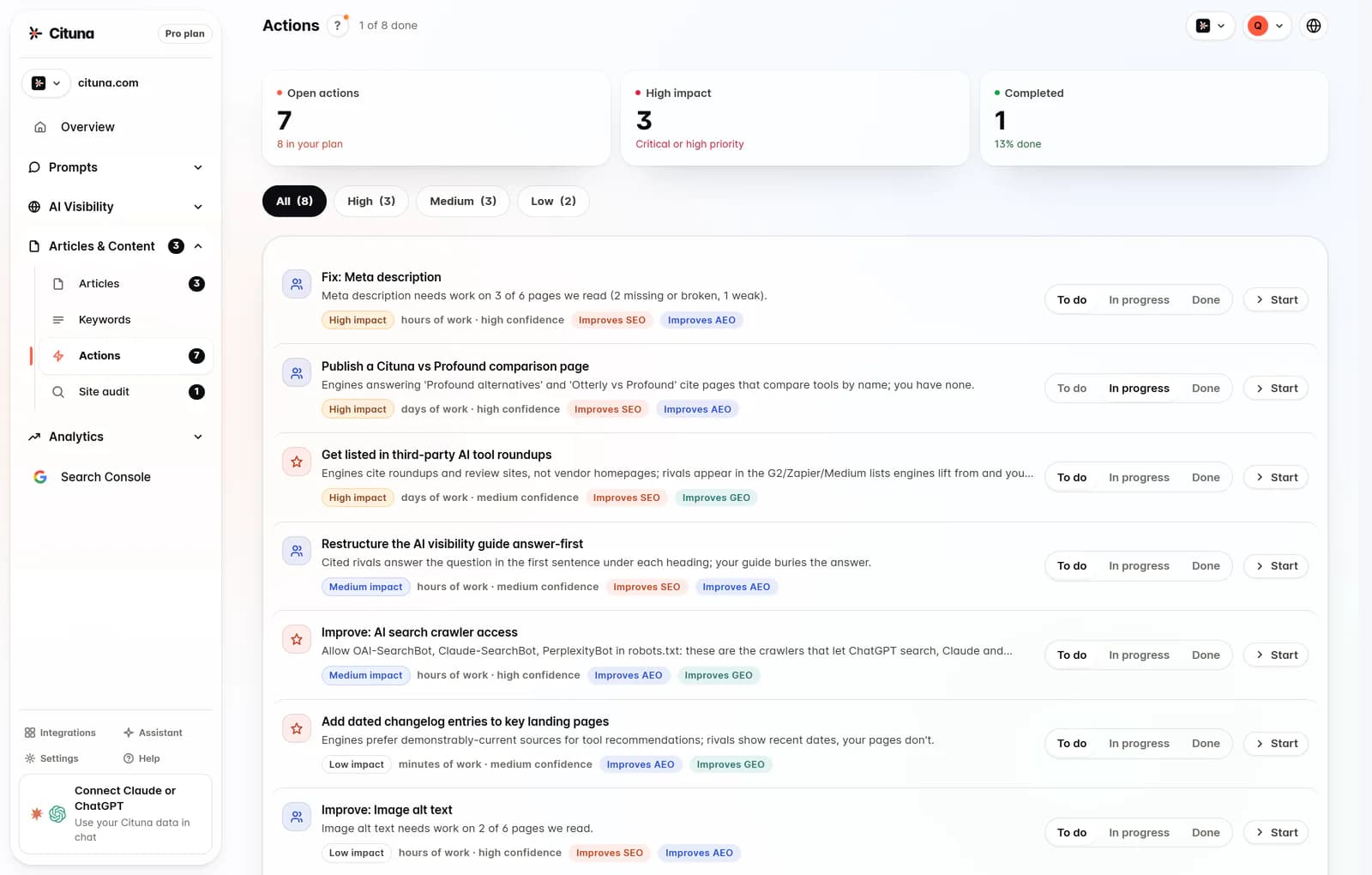
2. Run the same prompts across all seven engines
A searchable AI measurement process must compare ChatGPT, Perplexity, Gemini, Claude, Grok, Google AI Overviews and Google AI Mode using the same buyer questions. A brand can appear in one answer and disappear from another because each engine retrieves, selects and presents information differently.
Record more than whether your company appears. Capture the name of the engine, the exact prompt, the date, the answer position, whether the answer cites your page, the cited URL, and which competitors appear instead. A mention without a citation may help recognition, but it gives you a different optimization problem from a cited source.
Cituna asks the buyer questions every day across all seven engines and records who each answer names and cites, at what position, and which competitors and pages appear instead. A manual check can validate a small set of prompts, while a platform is more suitable when the question set needs repeated measurement.
Check for consistency before drawing a conclusion:
- Use the same wording when comparing engines.
- Separate brand mentions from citations.
- Save the full answer, not only a yes or no result.
- Repeat important prompts because answers can change.
3. Separate crawler readiness from answer visibility
Crawler readiness tells you whether systems can access and interpret a website; answer visibility tells you whether an engine actually uses that information in a buyer response. The two checks are related, but passing the first does not prove the second.
Start with access and interpretation checks. Review robots rules, indexability, canonical signals, page status, structured data and the clarity of the main content. Then check whether the relevant page is actually named or cited for the questions that matter.
A free AI visibility scan can check crawler readiness, but it should not be treated as proof of brand mentions or citations. Cituna account signup creates an account, while ongoing brand mention and citation tracking requires a plan.
Treat a failed check according to its type:
- If crawlers cannot access a page, fix access or indexing before rewriting the copy.
- If crawlers can access the page but engines ignore it, inspect relevance, evidence and answer structure.
- If the page is cited but the brand is missing from the answer, improve the connection between the problem, the solution and the company.
- If the brand is named but the wrong page is cited, strengthen the page that should support the claim.
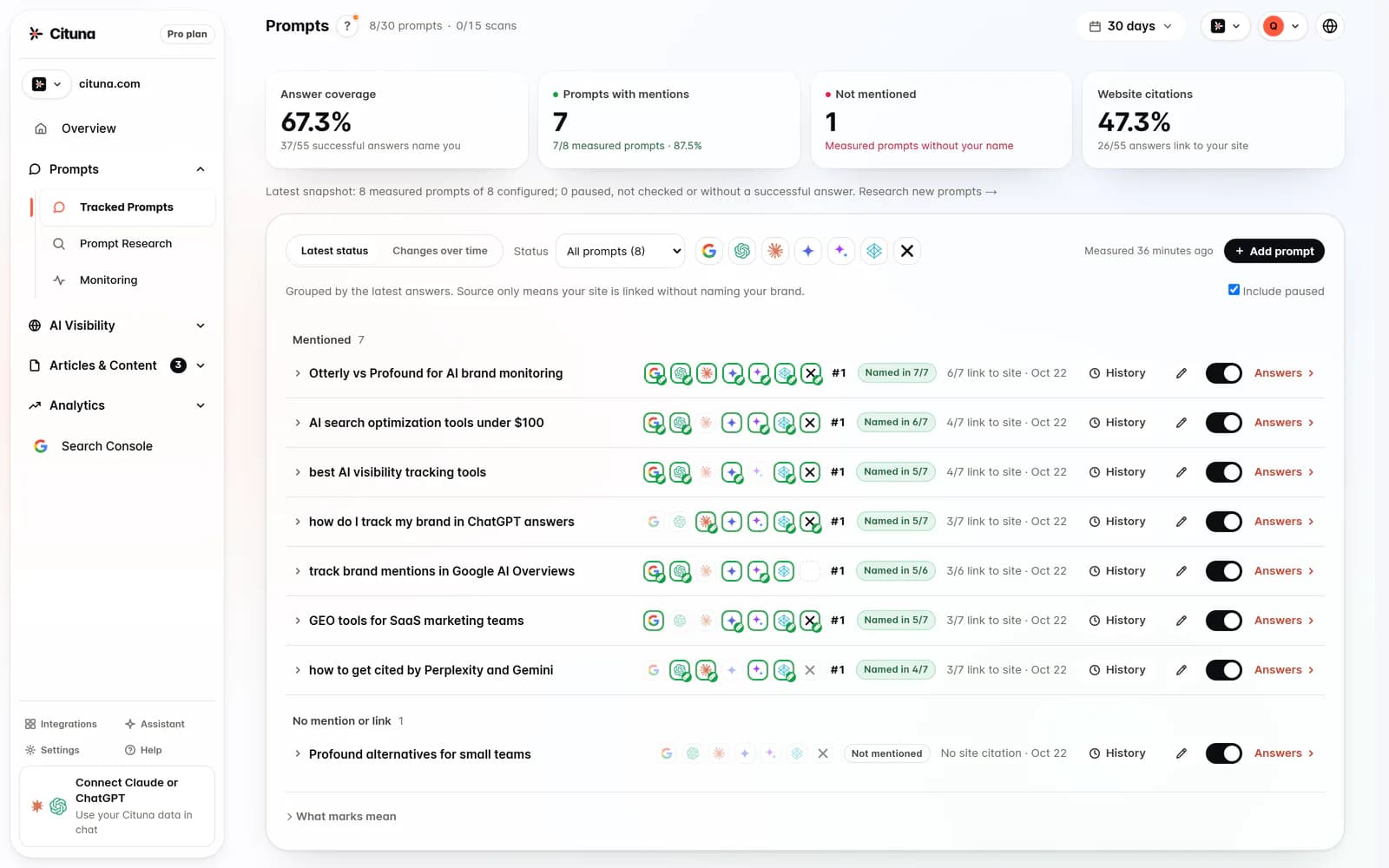
4. Diagnose the missing evidence behind each gap
A missing AI mention usually points to a missing connection between the buyer question, the page and the evidence supporting your answer. Do not respond to every gap by publishing another generic article.
Classify each result before changing anything:
- Relevance gap: the site does not directly answer the buyer's question.
- Evidence gap: the page makes a claim without showing examples, process details or supporting proof.
- Entity gap: the page does not clearly explain what the company does, who it serves or how it differs.
- Technical gap: important content is difficult to crawl, parse or associate with the right entity.
- Competition gap: another page gives a clearer, more specific answer.
The diagnosis determines the smallest useful fix. A relevance gap may need a focused section on an existing page. An entity gap may require clearer organisation and service descriptions. A technical gap may call for schema, FAQ markup, llms.txt or changes to page structure.
Check the proposed diagnosis against the answer itself. If an engine cites a competitor page for a question your page also addresses, compare the two pages for directness, definitions, examples, limitations and internal links instead of assuming the competitor won because of publishing volume.
5. Choose between manual fixes, content automation and agent support
The right solution depends on how many prompts, engines and pages your team must manage, not on whether a tool calls itself an AI visibility platform. Manual work suits a small question set with an owner who can inspect every answer. Automation becomes useful when repeated checks, fixes and publishing would otherwise compete with core marketing work.
A sensible choice looks like this:
- Choose manual review when the question set is small and the business needs careful editorial judgment.
- Choose measurement software when the main problem is knowing which engines, prompts, pages and competitors are changing.
- Choose an integrated visibility platform when the team needs measurement connected to generated fixes and publishing.
- Choose agent access when a technical team wants an AI agent to read the same visibility data or move approved work forward.
Cituna is an AI visibility platform that measures the seven engines and generates fixes such as schema, FAQ markup, llms.txt and page changes. Its AutoSEO can turn identified gaps and Search Console demand into articles for approval or automatic publication through supported CMS connections. A hosted MCP server gives Claude or another AI agent access to the same data, with the available actions depending on the plan.
A practical comparison should ask where the work ends. A dashboard that reports a gap leaves research, writing and implementation to your team. A connected workflow can reduce handoffs, but still needs approval rules for claims, tone, internal links and pages that affect conversion.
6. Apply the smallest fix that can change the answer
The first content change should make one important answer more complete, specific and easy to attribute. Start with the page that should be cited for the prompt, then add the missing explanation rather than scattering the same claim across unrelated pages.
Use this order when a page is relevant but absent from an answer:
- State the buyer's problem in the language used by the prompt.
- Give a direct answer before adding background.
- Explain the method, limits and situations where the solution does not fit.
- Add concrete evidence, examples or process details that support the answer.
- Use clear headings, relevant internal links and suitable structured data.
- Check that the page names the organisation and its role without ambiguity.
Illustrative example: suppose the prompt is “How can a small company track whether ChatGPT and Google AI Overviews mention its brand?” Your action might be to revise an existing measurement page so it distinguishes mentions from citations, names the seven engines being monitored and explains what a reader should record. Check the result by rerunning the exact prompt, comparing the cited page and recording whether the answer now names the company, cites the revised page or still selects a competitor.
A failed result does not automatically justify another article. If the answer still cites a different page, compare the remaining gap and revise the source page, internal links or technical signals before expanding the content library.
7. Measure movement with traffic and answer evidence
A successful change should improve answer visibility and produce a useful business signal, but those signals should be measured separately. Track whether the company is named, whether the intended page is cited, where the company appears, which competitors replace it and how often the result changes.
Then connect the change to owned-site evidence. Google Search Console can show whether relevant queries, pages and clicks moved after publication or revision. Referral and analytics data may add context, but a citation does not guarantee a visit, and a visit does not prove that one wording change caused the result.
Use a change log with these fields:
- Prompt and engine.
- Page changed and change type.
- Publication or revision date.
- Previous answer and new answer.
- Mention, citation and position status.
- Relevant Search Console movement.
- Decision to keep, revise or reverse the change.
Cituna includes Google Search Console so teams can connect visibility changes with movement in clicks. The useful question is not simply “Did the score rise?” It is “Which buyer question improved, which page supported the change, and did the resulting traffic or engagement justify keeping the fix?”
8. Start with a readiness check, then build the measurement loop
The practical next step is to check crawler readiness, define a small buyer-question set and then measure mentions and citations across all seven engines before committing to broad content production. That order prevents a technical access problem from being mistaken for a content problem.
Run a free AI visibility scan to check whether the site is ready to be crawled. Treat the result as a starting point, not as brand-tracking evidence. If the site is accessible, choose the prompts that represent real buying decisions and record the answers across ChatGPT, Perplexity, Gemini, Claude, Grok, Google AI Overviews and Google AI Mode.
Cituna connects that measurement with generated technical and content fixes, publishing workflows and Search Console feedback. The next decision is whether your team wants to inspect and implement each fix manually or use an integrated workflow that keeps the prompt, page, change and result connected.
Before expanding the programme, confirm that every tracked prompt has an owner, every proposed change has an approval rule and every result can be compared with the original answer. Searchable AI becomes manageable when each gap leads to one testable change rather than an undefined goal to “do more AI SEO.”
Related reading
- AI Agent Referral Measurement Across Seven Engines
- AI Search Ranking Issues: A Fix-First Guide
- AI Search Technical SEO Checklist and Fix Order
Official sources to check
- Google Search Central (developers.google.com)
- Google Search Console Help (support.google.com)
- OpenAI platform documentation (platform.openai.com)
- Anthropic (anthropic.com)
Drafted with AI assistance from our own research and Search Console data, and reviewed by Rahul A before publishing. Rules and prices change; check the linked official source before you act.