Choose the prompts your audit must test
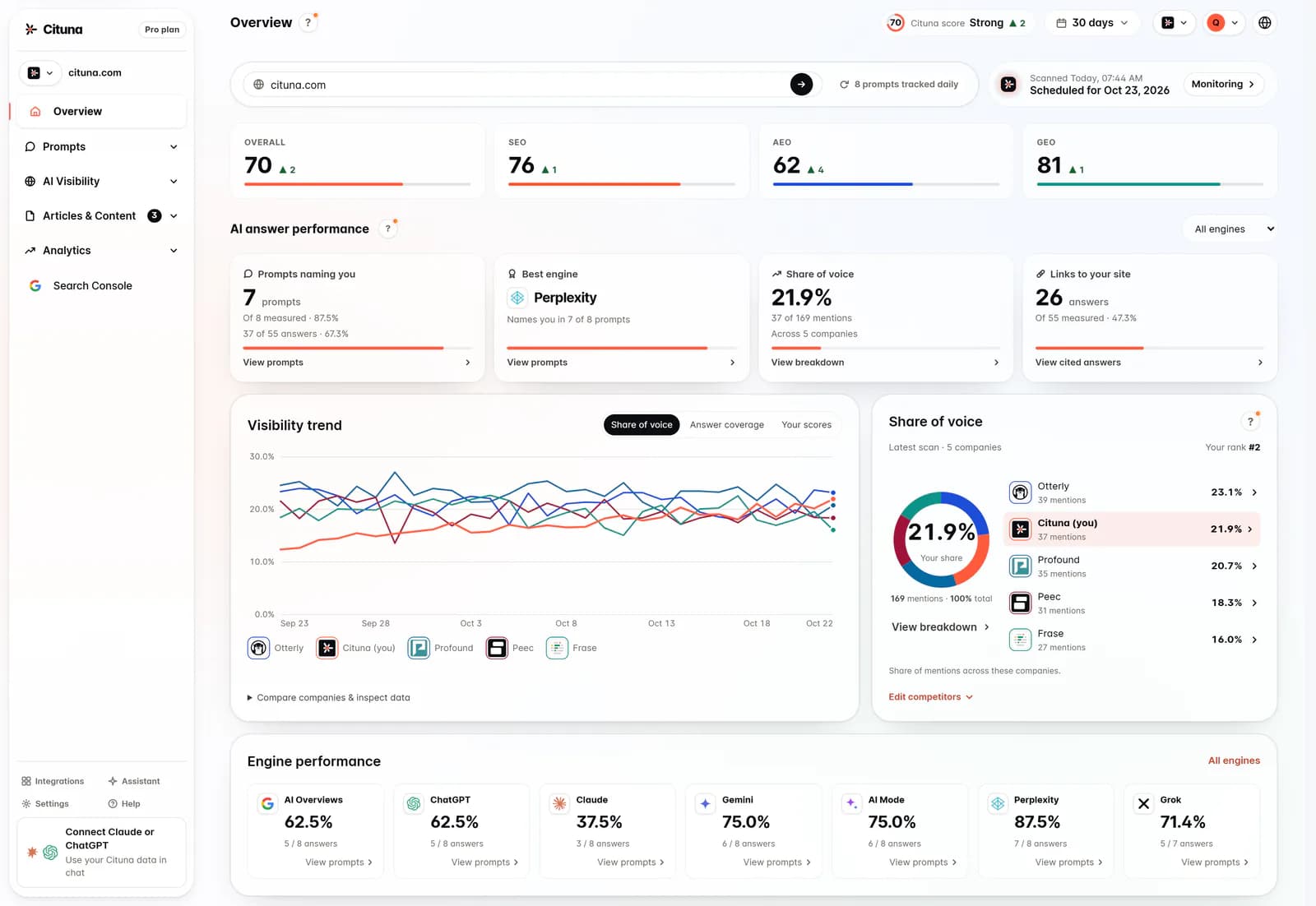
Start with a prompt set that represents buying decisions, not a random collection of questions about your category. Check one is coverage: include questions about the problem, solution types, alternatives, suppliers, pricing, implementation, and common objections. Check two is intent: label each prompt as informational, comparative, transactional, or navigational so a weak result is not confused with a missing opportunity.
Build the set from your sales calls, support questions, search queries, product pages, and competitor comparisons. Include the exact wording customers use, along with natural variations and prompts that mention your category without naming your company. Keep a record of the date, engine, model or mode where visible, location, language, and account context.
A useful audit also contains a small set of deliberately difficult prompts. Ask for the best fit for a specific situation, the drawbacks of each option, and what evidence supports a recommendation. Those prompts reveal whether an engine can connect your company with a relevant answer, rather than merely repeat your name. Freeze the prompt set before reviewing results so changing questions does not create a false improvement.
For more context, read How to Check AI Content Visibility Across Seven Engines.
Is your brand entity clear enough for an engine to identify?
A brand entity is ready for publication review when its name, category, audience, offer, and distinguishing facts are consistent across its public sources. Check three is identity: compare the homepage, about page, product pages, company profiles, and major directory entries for the same description, spelling, ownership details, and locations. Check four is disambiguation: look for names, acronyms, products, or people that could be confused with another entity.
Write one plain sentence that answers, “What does this company do, for whom, and in what context?” Then compare that sentence with the page title, opening paragraph, structured headings, author information, and visible contact details. Remove clever language that hides the category or makes a product sound broader than it is. Separate the company name from product names, editorial properties, and similarly named organisations.
The audit should flag contradictions rather than average them away. A homepage calling the business a consultancy while a product page calls it software creates an interpretation problem. Resolve the primary description first, then check whether supporting pages reinforce it. Clear identity does not guarantee a mention in ChatGPT, Perplexity, Gemini, Claude, Grok, Google AI Overviews, or Google AI Mode, but unclear identity makes relevant recognition harder to diagnose.
For more context, read The best free AI visibility checkers.
Can a reader extract the answer without guessing?
Publish only when the page answers its target question directly, early, and in language that can stand alone. Check five is answerability: write a one- or two-sentence answer near the top, then explain qualifications, process, examples, and exceptions below it. A reader, crawler, or answer system should not need to infer the conclusion from promotional copy.
Review every important page for a clear subject, verb, object, audience, and scope. Replace phrases such as “powerful solutions for modern teams” with a concrete description of the task, user, and outcome. Define specialist terms before relying on them. State who the product is not for when that boundary prevents a misleading recommendation.
Use headings that mirror real questions, but do not turn every heading into a keyword variation. Give each section one job. Put the qualification next to the claim it limits, rather than hiding it in a footer or a separate disclaimer. Test the draft with someone who did not write it and ask them to summarise the answer in one sentence. If their summary changes the category, audience, or limitation, revise the page before measuring engine responses.
Which claims need evidence before the page goes live
Every important claim should have a visible source, a responsible owner, and a date or context that explains when the claim applies. Check six is evidence: mark claims about performance, compatibility, security, pricing, availability, results, or market position, then attach first-party documentation or a credible external source. Check seven is proof quality: distinguish a measured result from an internal opinion, a customer example from a general promise, and a current capability from a planned one.
Create a claim register while editing. For each claim, record the exact wording, supporting source, review owner, last verification date, and the condition that could make it stale. Remove unsupported superlatives such as “best” or “leading” unless the page explains a defensible basis. Do not turn one customer outcome into a universal promise.
Evidence should be easy to inspect from the page itself. Link to the relevant documentation or identify the methodology instead of sending readers to a generic resources page. If a claim cannot be proven, narrow it, qualify it, or remove it. Strong evidence helps engines produce a grounded answer, but it also protects the human reader from a polished page whose central recommendation cannot be checked.
Will the page give engines a clean citation path?
A clean citation path lets a reader verify the exact statement without searching the whole site. Check eight is citation readiness: match each material claim with a stable page that states the claim plainly, uses descriptive headings, and remains accessible without a required interaction or unexplained file. The page being audited can cite the source, or it can be the source itself when the facts are first-party.
Keep the strongest evidence close to the claim. A recommendation supported only by a vague homepage, an image, or a downloadable document with no text explanation is harder to verify. Name the product, use case, limitation, and relevant version in prose. Add author or organisation context where expertise affects interpretation, and show the publication or update date when freshness matters.
Audit the destination as well as the link. Confirm that redirects, consent barriers, broken pages, contradictory titles, and missing sections do not interrupt verification. A citation is not a trophy; it is a route from an answer to a source a reader can understand. Record whether ChatGPT, Perplexity, Gemini, Claude, Grok, Google AI Overviews, or Google AI Mode can expose a useful source path, but do not treat one engine’s citation style as a universal rule.
Could outdated or contradictory information change the answer?
A page is not ready when an older public statement can reasonably change the recommendation. Check nine is contradiction control: compare current claims with archived pages, help content, pricing or feature pages, social profiles, partner listings, and downloadable materials. Check ten is freshness: identify facts that expire, assign a review trigger, and show a meaningful update date when the reader needs to judge currency.
Search for conflicts in names, product availability, integrations, geographic coverage, customer eligibility, and operating details. A current page saying a feature is available does not resolve an older page saying it is planned if both remain publicly discoverable. Redirect, update, or clearly retire the weaker source. Keep an internal record of the change so future editors know why the wording moved.
Use a stricter rule for claims that affect a purchase or compliance decision. If the organisation cannot verify a changing fact at publication time, describe the uncertainty and point readers to the current authority. Do not imply that a single crawl or prompt result proves the conflict is gone. Engines may retrieve different pages or retain different context, so the release decision should be based on the public source landscape, not just one response.
Do the seven engines produce the same useful interpretation?
Do not publish on the strength of one favourable answer; compare interpretation across ChatGPT, Perplexity, Gemini, Claude, Grok, Google AI Overviews, and Google AI Mode. Check eleven is cross-engine consistency: run the same prompt set under comparable conditions, save the answer and sources, and label whether each result is accurate, incomplete, unsupported, or wrong. The goal is not identical wording, but a stable understanding of the company and its fit.
Separate three findings that are often mixed together. A missing mention may indicate weak association with the category. A mention with the wrong category or audience indicates an identity problem. A relevant mention without a source indicates an evidence or citation-path problem. Each finding needs a different edit, so a single visibility score can conceal the wrong next step.
Repeat only the prompts that failed after making a page change, while preserving the original run for comparison. Note location, language, account state, search mode, and date because outputs can vary. Treat results as directional evidence rather than a permanent ranking. An engine may answer from sources you did not expect, and a page can be useful to one engine without being surfaced by another.
The release decision after all twelve checks
Publish only when the audit shows a clear answer, supportable claims, a consistent entity, and a documented plan for unresolved issues. Check twelve is the release gate: classify each check as ready, revise, or monitor, then require every “revise” item to have an owner and a specific next action before publication.
Use the results to choose one first change. If the company is hard to classify, fix the core description and page structure. If the company is named but misunderstood, correct the audience, use case, or limitation. If the answer is accurate but unsupported, strengthen the evidence and citation path. If only freshness fails, add a review trigger rather than rewriting the entire page.
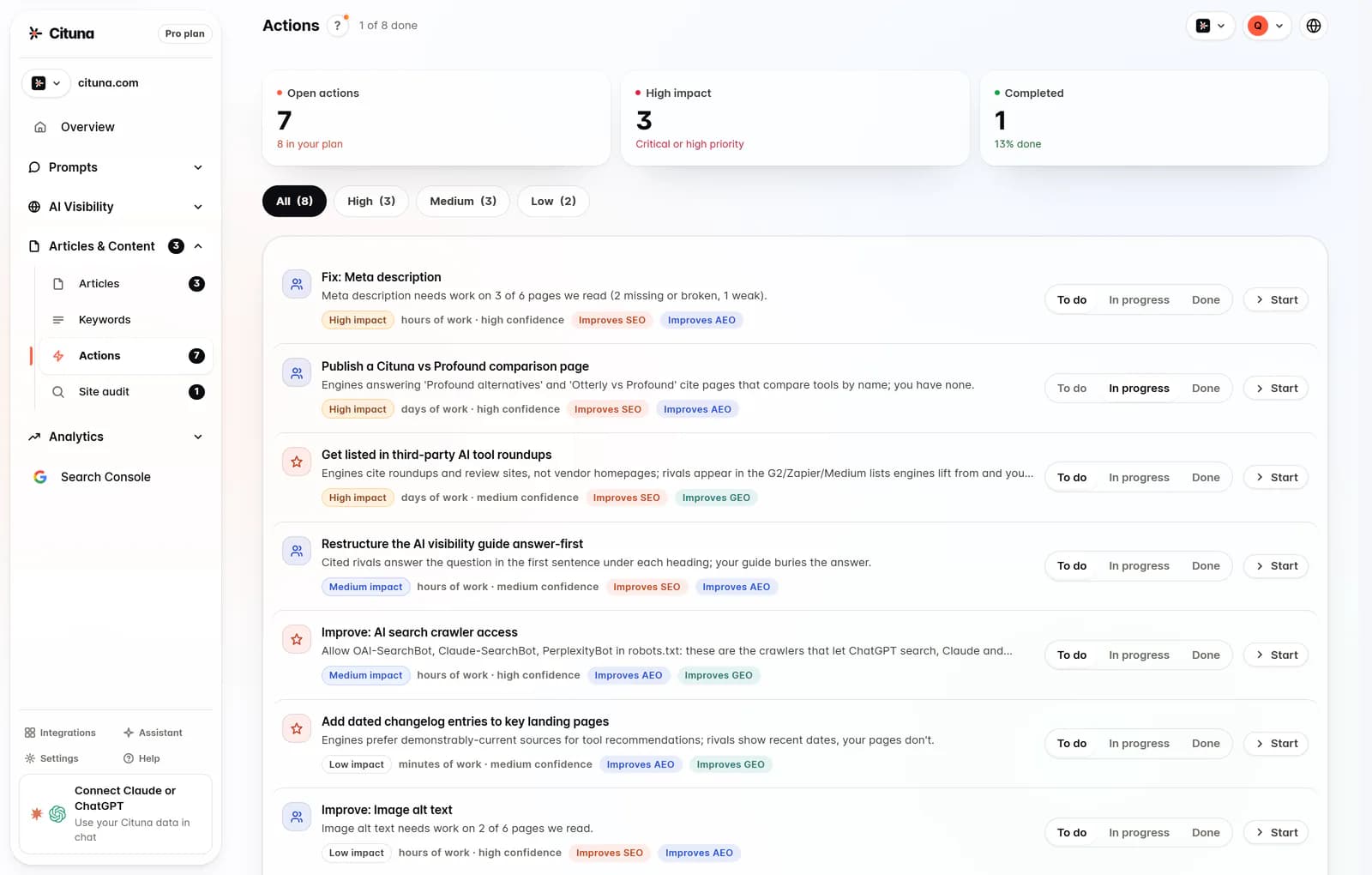
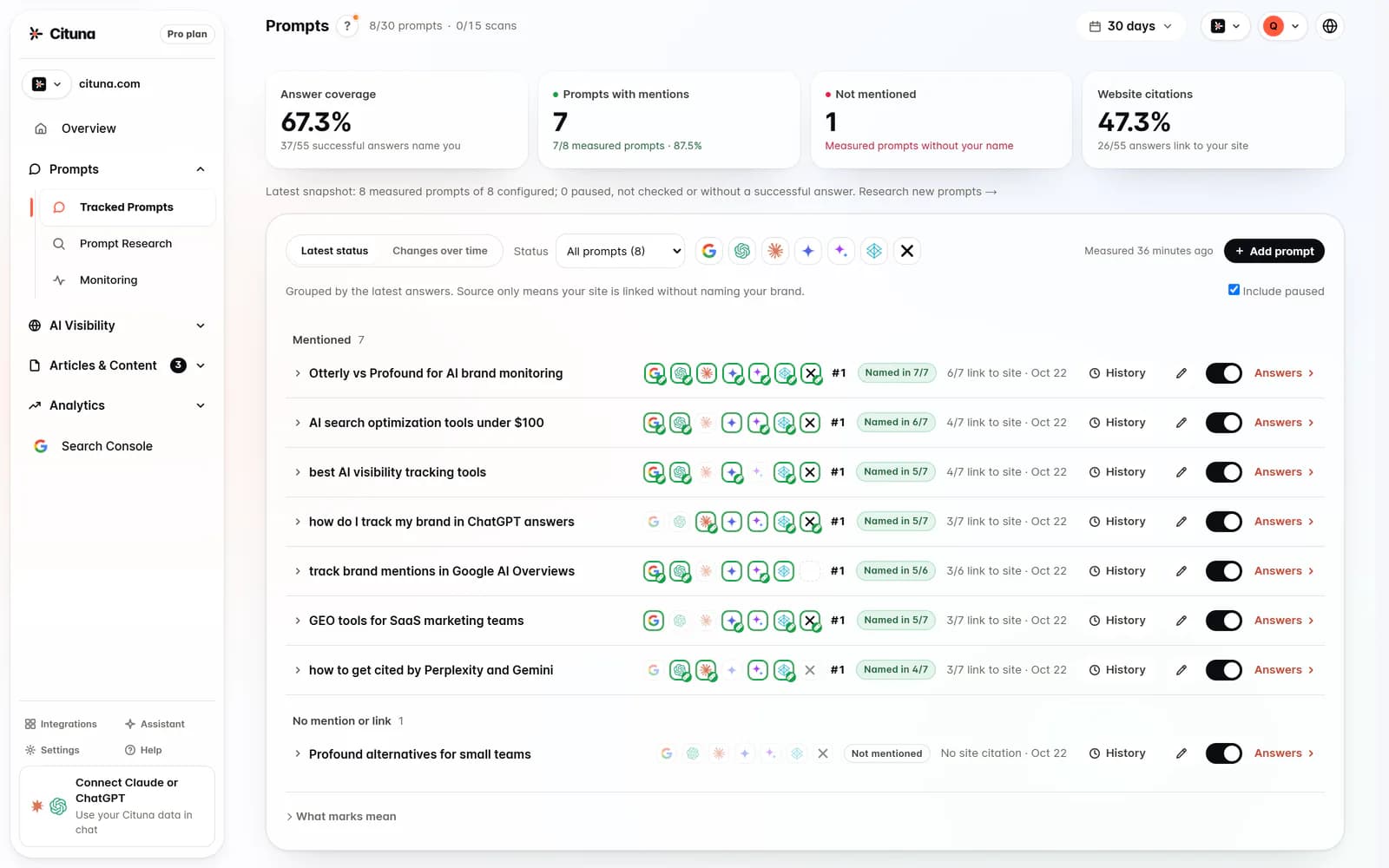
Keep the audit packet with the final URL, prompt set, captured responses, source links, claim register, decision, and review date. A short before-and-after record makes later testing more meaningful than an unrepeatable screenshot. A release gate like this turns AI visibility from a vague concern into an editorial decision: publish, revise, or monitor. Cituna covers the monitor step and what follows it: every day it asks ChatGPT, Perplexity, Gemini, Claude, Grok, Google AI Overviews, and Google AI Mode buyer questions, then generates the fix for each gap, writes and publishes articles through its AutoSEO, and lets Claude or any other AI agent work with the data over MCP. The same record also gives marketing and content teams a shared explanation for what changed and why.
Related reading
Sources consulted
- Google Search Central (developers.google.com)
- OpenAI Platform Documentation (platform.openai.com)
- Perplexity API Documentation (docs.perplexity.ai)
- Anthropic (anthropic.com)
Drafted with AI assistance from our own research and Search Console data, and reviewed by Rahul A before publishing. Rules and prices change; check the linked official source before you act.