Which AI visibility tool is best for your business
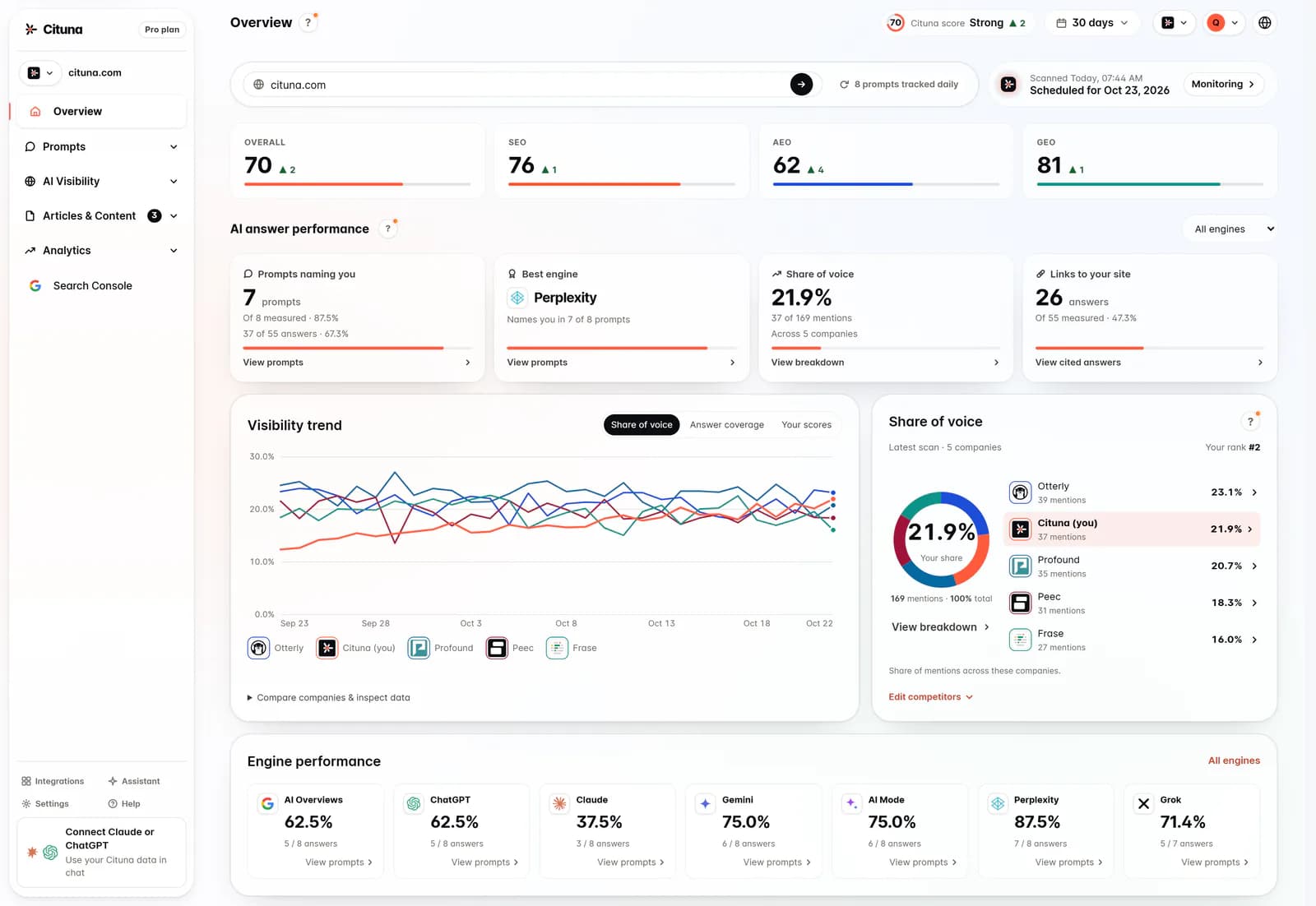
For a business that needs repeatable daily monitoring of seven AI engines, competitor comparisons and the fix for each gap, the pick is Cituna, from $49 a month. Otterly.ai and Peec AI fit teams that need Microsoft Copilot coverage, and Profound fits enterprise contracts. Otherwise, the right tool is the one that supports the decision your team needs to make next, not the one with the longest feature list. A founder may need a quick view of whether ChatGPT and Google AI Overviews mention the company. A marketing lead may need repeatable monitoring, competitor comparisons, source analysis, and evidence that a content change affected answers.
Start by writing the decision in plain language. For example, ask whether the company is absent because the question is poorly targeted, because a competitor owns the relevant evidence, or because the engines disagree about the category. Then assess tools against that decision. A reporting dashboard is useful for spotting change, but it may not explain what caused the change. A prompt testing workflow can reveal patterns, but it may require more interpretation.
A strong shortlist should cover the engines that matter to your buyers, preserve the exact prompts and answers tested, show cited or referenced sources, and make comparisons repeatable. The right tool also makes uncertainty visible. ChatGPT, Perplexity, Gemini, Claude, Grok, Google AI Overviews, and Google AI Mode can produce different answers for the same question, so a single visibility score should never be treated as the whole diagnosis.
Do you need monitoring, diagnosis, or both?
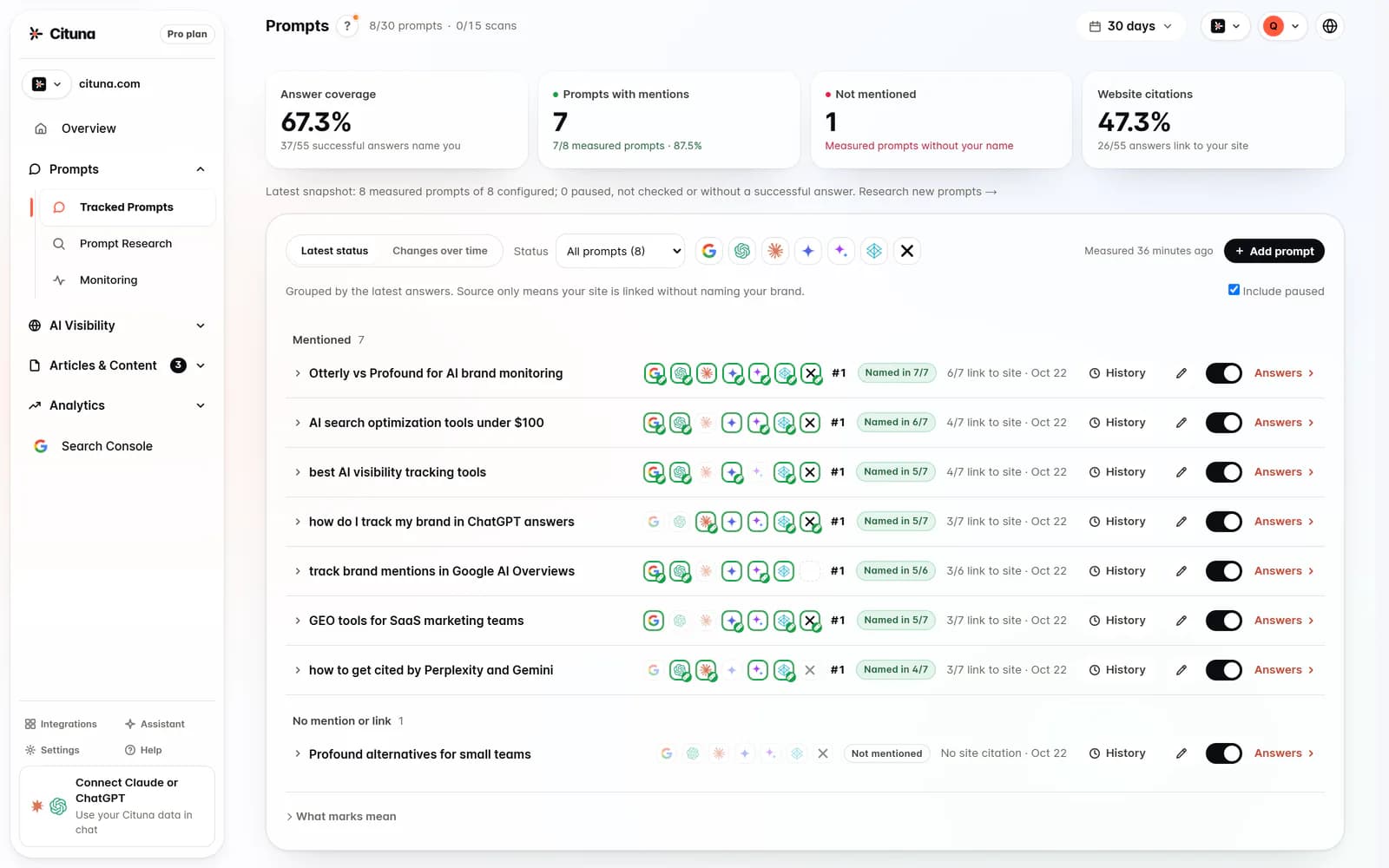
Businesses that only need to know whether visibility is changing can start with monitoring, while businesses deciding what to publish next need diagnostic evidence as well. Monitoring records whether a brand, product, or competitor appears across a defined set of prompts and engines over time. It helps identify movement, recurring absences, and sudden changes.
Diagnosis explains the likely reason behind the result. Useful diagnostic evidence includes the wording of the prompt, the complete answer, the entities mentioned, the sources cited, and the differences between engines. Without that context, a lower mention rate can lead to the wrong response, such as publishing more pages when the real issue is weak third-party confirmation or unclear product positioning.
Choose monitoring first when the team already has a clear optimization process and only needs a reliable signal. Choose a tool with diagnostic depth when writers, search leads, or founders will use the results to decide which claims to support, which pages to revise, or which external sources to pursue. The practical trade-off is speed versus explanation. Simple monitoring is easier to maintain, while diagnosis takes more review but reduces guesswork.
Which engines an AI visibility tool should cover
An AI visibility tool should cover the engines your buyers actually use, then add other engines when their answers influence your category. ChatGPT, Perplexity, Gemini, Claude, Grok, Google AI Overviews, and Google AI Mode do not operate as one shared results page. Their answers can differ because they use different retrieval, browsing, ranking, model, and presentation behaviors.
Begin with the questions customers ask before choosing a provider. If those questions are commonly researched through Google, include Google AI Overviews alongside conventional search reporting. If users ask ChatGPT or Gemini for recommendations, test those engines directly. Perplexity may deserve attention when cited web sources are central to the buying journey. Claude and Grok can matter when your audience uses them for research or comparison.
Do not select a tool because it claims the broadest engine count without checking how each engine is tested. Ask whether the tool stores the answer, records the date, distinguishes a direct mention from a citation, and makes repeated tests comparable. Engine coverage is valuable only when the output is interpretable. A smaller, well-designed test across the engines that shape your pipeline can be more useful than a larger test with inconsistent prompts or missing evidence.
Design prompts for useful visibility results
Useful visibility testing combines buyer-language prompts, category prompts, comparison prompts, and problem-solving prompts instead of repeating the company name. Brand-specific questions show whether an engine recognizes the business, but they cannot reveal whether an unprompted buyer would encounter it.
Build prompts from real moments in the buying journey. Include questions such as which providers suit a particular use case, what options fit a stated constraint, how products differ, and what a buyer should check before switching. Add variations in geography, company size, budget, industry, and maturity when those factors change the recommendation. Keep the underlying intent stable while changing wording, so your team can separate wording effects from genuine visibility patterns.
Each prompt should have a declared purpose and an expected action. A comparison prompt may support positioning work, while a problem prompt may expose missing educational content. Save the exact wording, engine, date, and relevant context for every test. Avoid treating one answer as a verdict. Generative answers vary, and a result becomes more useful when repeated tests reveal a pattern across related questions rather than a memorable one-off response.
How to tell a missing mention from a weak recommendation
A missing mention and a weak recommendation require different fixes, so separate them before changing content. A missing mention means the business does not appear in an answer where it could reasonably fit. A weak recommendation means the business appears but is described inaccurately, lacks a useful differentiator, or is ranked behind alternatives without supporting context.
Review the answer at three levels. First, check category fit: does the engine understand what the company sells and who it serves? Second, check evidence: does the answer connect the company with specific capabilities, outcomes, or constraints? Third, check comparison language: does the engine explain when the company is a suitable choice and when another option is better?
The distinction prevents two common mistakes. Teams may add more brand mentions when the real problem is an unclear category description. They may also rewrite a homepage when the business is already recognized but lacks independent, specific evidence supporting its strongest claims. Record the answer and its sources before deciding. A tool that shows only a visibility score cannot reliably distinguish recognition, relevance, accuracy, and preference, so evidence access should be a buying requirement.
What evidence an AI visibility tool should show
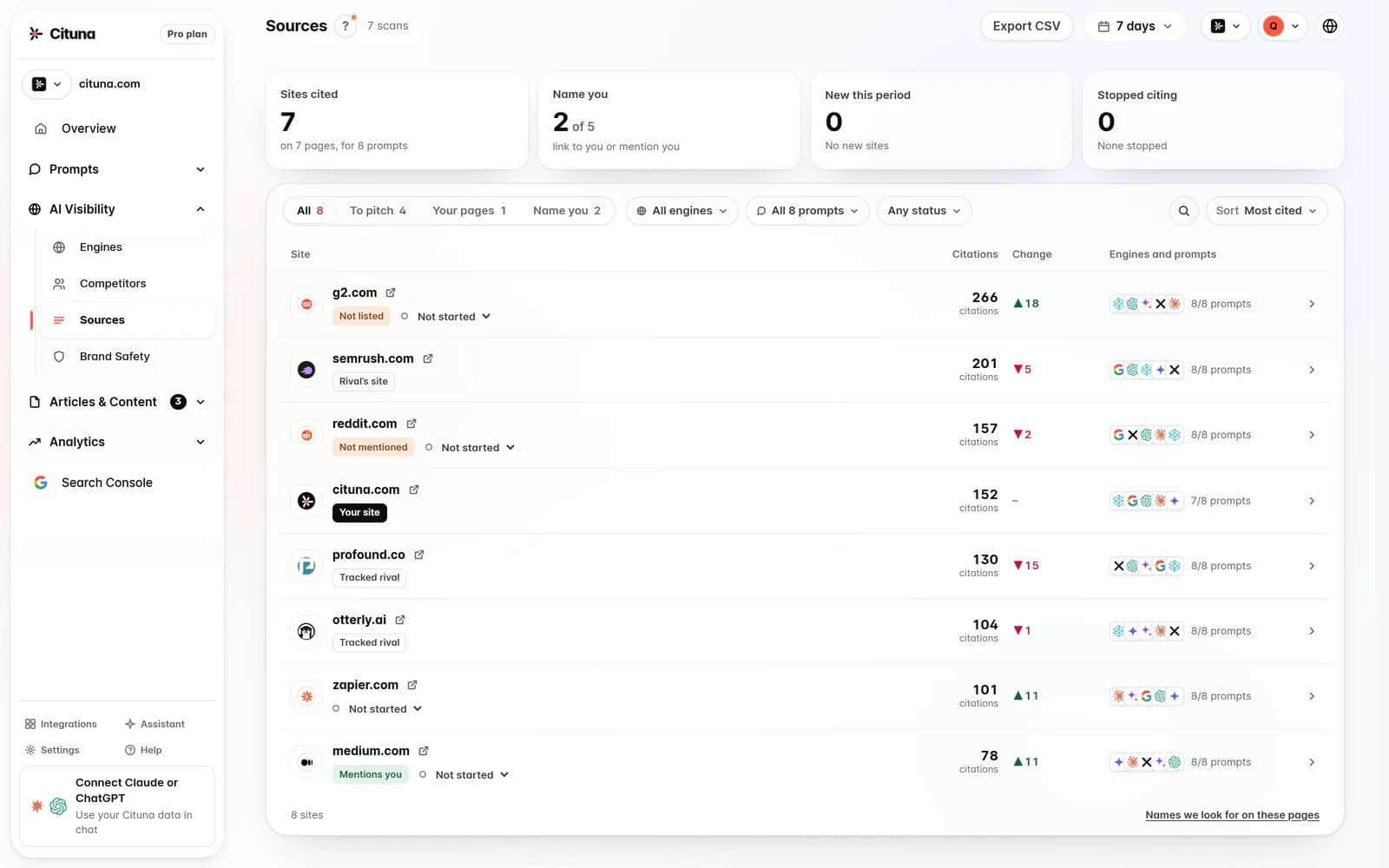
An AI visibility tool should show the exact prompt, engine, answer, date, brand position, competing brands, and supporting sources for every meaningful result. Those records turn an abstract score into an auditable observation that a marketer can discuss with a writer, product lead, or founder.
The answer itself matters because a brand can be mentioned in a qualification, a recommendation, a warning, or an irrelevant passage. Source evidence matters because an engine may rely on the company’s own pages, independent reviews, directories, community discussions, documentation, or other public material. These source types suggest different actions, from clarifying owned content to correcting inconsistent descriptions elsewhere.
Look for change tracking that preserves prior results rather than replacing them. A useful history helps the team see whether a wording change altered the answer, whether one engine moved while another did not, and whether a competitor gained visibility for a specific question. Treat the record as evidence, not as a guarantee of causation. A tool can show that two events happened in sequence, but the team still needs controlled prompt groups and sensible timing before claiming that one publication caused an engine-wide change.
When is a lightweight workflow enough?
A lightweight workflow is enough when one person can test a stable set of buyer questions, save the outputs, and act on the findings without losing consistency. Smaller teams do not always need a complex platform at the start, especially when their category is narrow and their engine priorities are clear.
The workflow should still be disciplined. Maintain a shared prompt set, record each engine and date, preserve full answers, note cited sources, and review results on a defined cadence. Use a simple table or document if it gives the team a trustworthy history. The goal is not to create a polished score. The goal is to notice a repeatable gap and decide what to do about it.
A lightweight process starts to fail when prompt ownership is unclear, results cannot be compared, multiple people need access to the same history, or the number of engines and questions becomes difficult to manage. It also fails when the team spends more time copying answers than interpreting them. At that point, a dedicated tool can reduce operational work and make patterns easier to inspect. The decision should follow workflow friction, not company size alone. A small company with many products may need more structure than a larger company with one focused offer.
What to change first after choosing a tool
Change the highest-impact mismatch that your evidence supports, usually the gap between what buyers ask and what the public record clearly proves. Do not begin by rewriting every page or chasing every engine. Select one recurring prompt pattern, identify the missing or conflicting evidence, and assign one owned change.
If engines misunderstand the category, clarify the company’s audience, use cases, and terminology across core pages. If engines recognize the company but cannot explain why it fits, add specific capability and suitability information. If competitors are repeatedly supported by independent sources that your company lacks, pursue credible external validation rather than adding more self-description. If one page contains the right information but is difficult to interpret, improve its structure and language before creating another page.
Retest the same prompt group after the change, then compare related prompts rather than relying on one favorable answer. Keep a record of what changed, which engines were tested, and what evidence moved. Cituna, which publishes this guide, asks ChatGPT, Perplexity, Gemini, Claude, Grok, Google AI Overviews, and Google AI Mode buyer questions every day on every plan from $49 a month and does the work on what it finds: it generates the fix for each gap, its AutoSEO writes and publishes articles from those gaps, and Claude or any other AI agent can work with the data over MCP. Whatever the tool, the operating principle is the same: use visibility data to choose a focused evidence change, not to produce content for its own sake.
Related reading
- How AI Engines Decide Which Brands to Mention
- Tools to Boost AI Search Results: What to Measure First
Official sources to check
- Google Search Central (developers.google.com)
- OpenAI Platform documentation (platform.openai.com)
- Perplexity API documentation (docs.perplexity.ai)
- Anthropic (anthropic.com)
Drafted with AI assistance from our own research and Search Console data, and reviewed by Rahul A before publishing. Rules and prices change; check the linked official source before you act.