What makes an AI visibility tracking tool the best choice
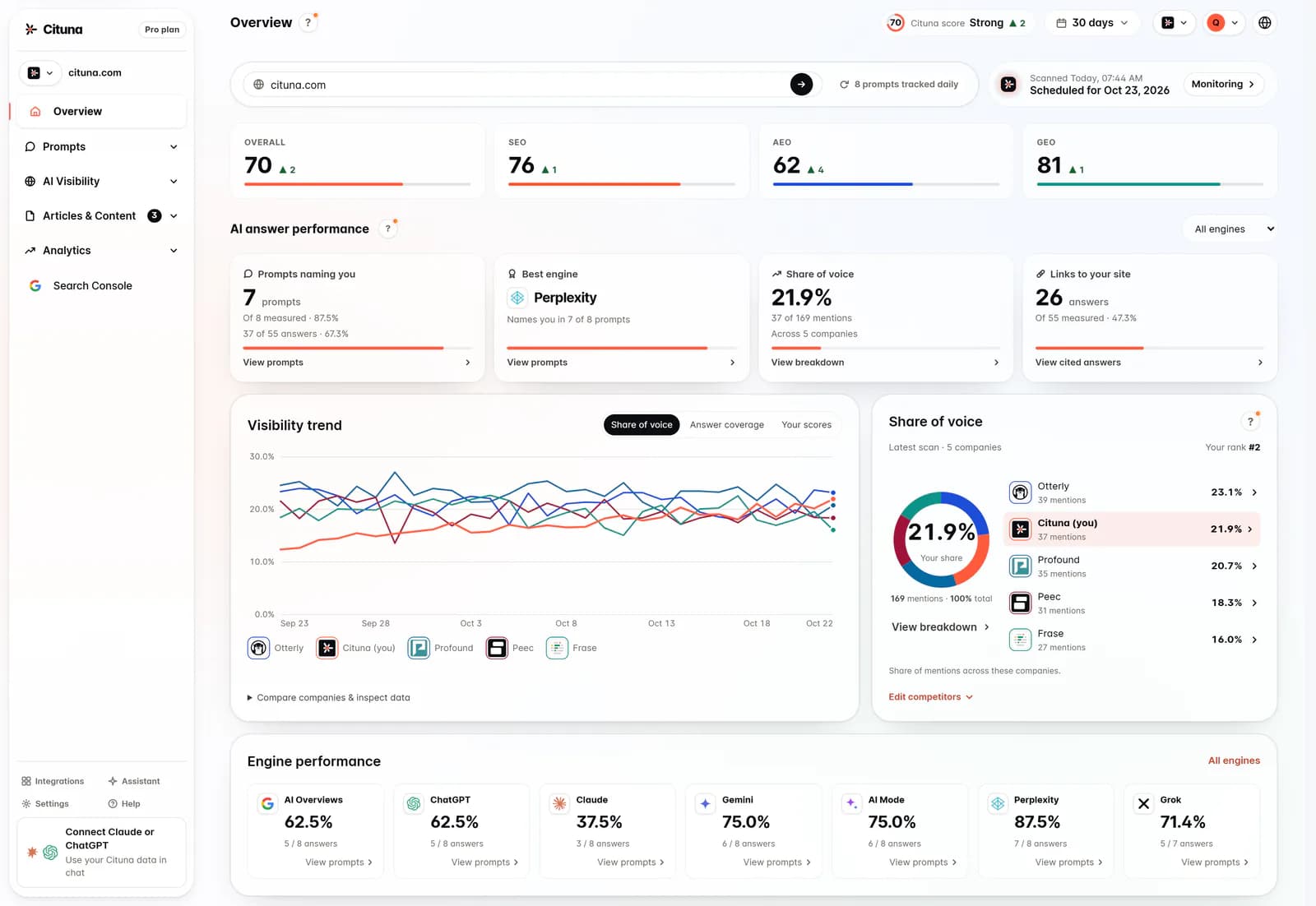
The best AI visibility tracking tool connects four things: the prompt asked, the engine response, your brand's presence, and the action that could change the result. A simple mention checker can tell you whether a brand appeared. A useful tracking system shows whether the mention was accurate, prominent, cited, and consistent across repeated checks.
The distinction matters because ChatGPT, Perplexity, Gemini, Claude, Grok, Google AI Overviews, and Google AI Mode do not necessarily produce the same response to the same question. A brand may appear in one engine, be omitted by another, and receive a weak or outdated description in a third. Treating those outcomes as one overall visibility score hides the decision a marketing lead needs to make.
Choose a tool that lets you organise prompts by buyer need, compare results over time, preserve the surrounding answer, and inspect cited sources. The strongest option for a small or mid-size company is not automatically the tool with the largest dashboard. It is the one that turns an omission into a testable explanation, such as weak category association, missing third-party evidence, unclear product language, or insufficiently specific pages.
For more context, read How Often Should I Check Ai Visibility.
Build the prompt set before comparing tools
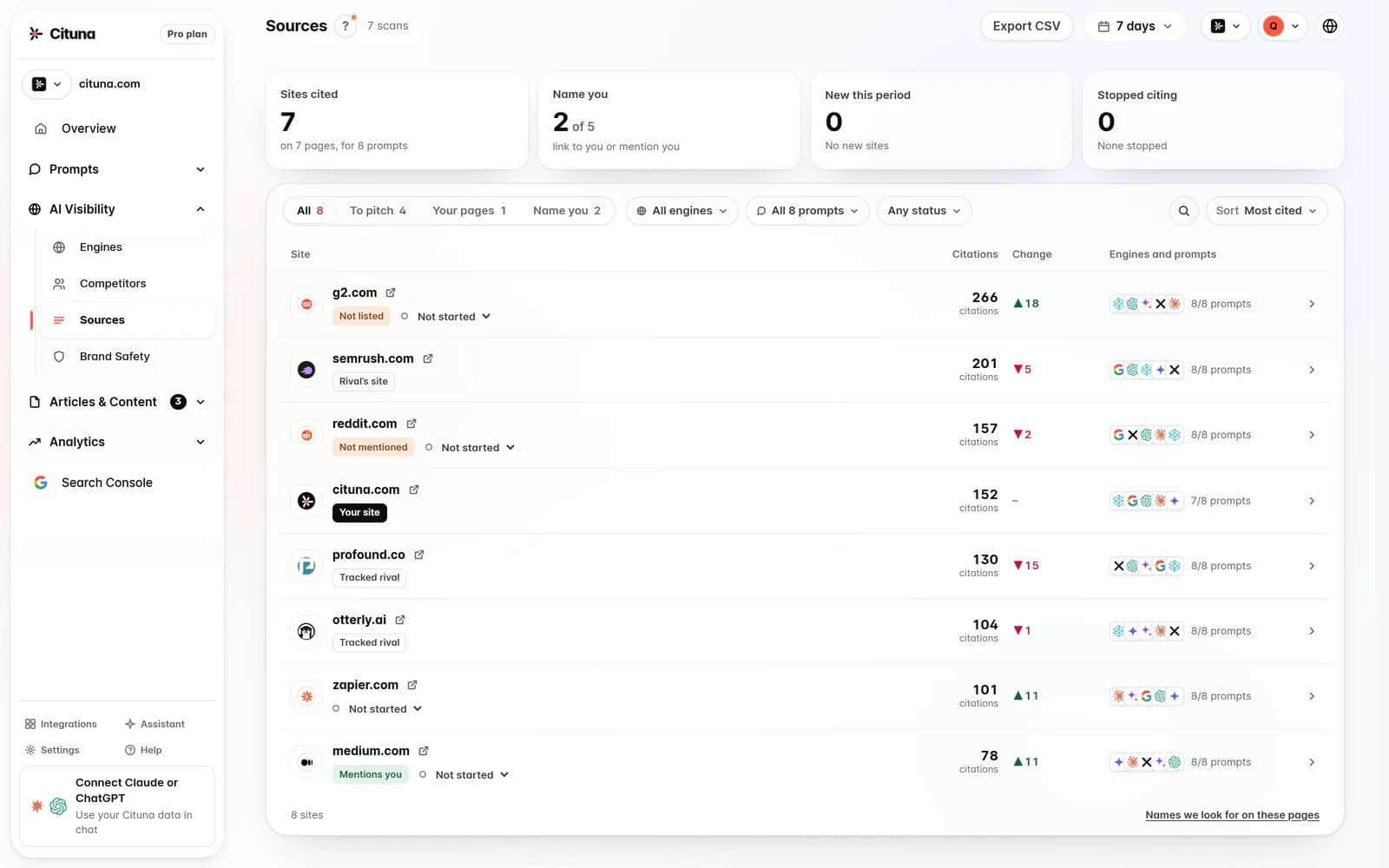
Build the prompt set around real buying questions, not only prompts containing your company name. Brand-name prompts test recognition, while category, comparison, problem, and recommendation prompts test whether an assistant connects your company with a need before being told what to think.
A practical set includes questions a buyer might ask at different stages. For example, a payroll software company could track prompts about choosing payroll software, comparing payroll providers for a growing team, switching from a current process, and handling a specific compliance problem. The prompts should include the company category, buyer situation, alternatives, and relevant location or industry where those details affect the answer.
Keep wording stable when measuring change, but maintain a separate set of natural variations. Stable prompts help identify movement over time. Variations reveal whether a result depends on one unusually favorable phrase. Record the exact wording, date, engine, location setting, and any relevant model or search mode. Without that context, a tool may show different answers while making the difference look like a brand trend.
For more context, read How to Choose the Best AI Visibility Checking Tool.
Which visibility signals a tracking tool should record
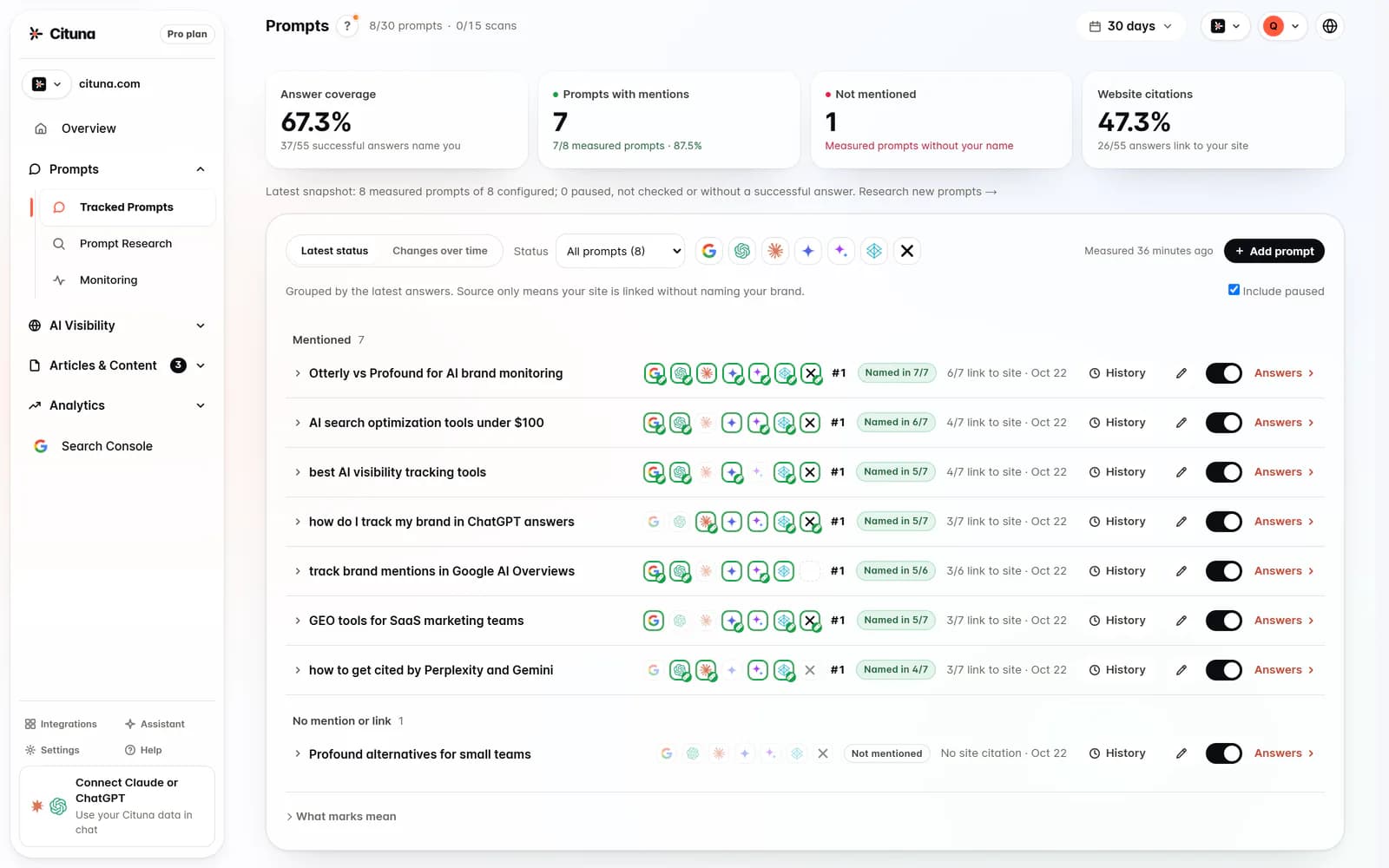
A tracking tool should record more than whether your brand name appeared. The useful signal set includes mention status, recommendation strength, position in the answer, description accuracy, cited sources, competing brands, and the user's prompt category.
Mention status separates several outcomes that are often collapsed together. An assistant may name a company as a recommendation, mention it only as an alternative, describe it incorrectly, or omit it entirely. Citation data adds another layer. A response can name a brand without citing a page that supports the claim, or cite a page while failing to connect that page clearly to the brand.
The surrounding text is essential. A score without the answer makes it difficult to diagnose whether the issue is authority, relevance, factual coverage, or prompt interpretation. Save the response and cited URLs where available, then compare the claim with the page a buyer would actually read. A strong tracker therefore works as an evidence log, not just a rank monitor. It preserves enough context for someone else on the team to reproduce the finding and approve a change.
Should one visibility score cover every AI engine?
One combined score should not replace engine-level results because ChatGPT, Perplexity, Gemini, Claude, Grok, Google AI Overviews, and Google AI Mode can use different retrieval, ranking, and response behaviours. An overall view is useful for direction, but it should always be traceable to separate engine outcomes.
Engine-level reporting helps explain apparent contradictions. Perplexity may cite a page that another assistant never retrieves. Google AI Overviews may reflect search results and local context differently from a conversational model. ChatGPT, Gemini, Claude, or Grok may answer the same category question with different levels of detail or different preferences among alternatives. These differences are not automatically errors in the tracking tool or evidence that one engine is more valuable for every buyer.
Use the combined view to spot a broad omission, then inspect each engine before changing content. A change that improves one result may have no effect elsewhere because the systems rely on different sources and update on different schedules. Engine-specific records also prevent a temporary response change from being mistaken for a lasting improvement in market visibility.
How often AI visibility results should be checked
Check AI visibility on a repeatable schedule and treat individual responses as observations, not definitive rankings. AI assistants can change answers as models, retrieval systems, search indexes, sources, and product interfaces change, so a single check cannot establish a durable trend.
The schedule should match the decision being made. A company investigating a major omission may run a controlled baseline, make one clearly defined change, and recheck the same prompts after enough time for relevant sources to update. A team monitoring an active category can check more regularly, while a business with limited content resources may learn more from a smaller, carefully maintained panel than from constant unstructured testing.
Record the prompt, engine, date, location, model or search mode when visible, response, citations, and any material answer change. Rules and product behaviour change, so verify current details in official documentation from OpenAI, Perplexity, Anthropic, and Google rather than assuming a past result describes current operation. Reproducibility matters more than an arbitrary checking frequency. A consistent panel makes change interpretable; random checks create noise.
What to fix when assistants omit my brand
Fix the evidence gap before trying to force more brand mentions. An omission usually means the available information does not make your company a clear answer for that particular buyer question, or the assistant cannot confidently connect your company to the category, use case, or comparison.
Start by classifying the missing link. If the assistant misunderstands what you sell, improve plain-language category and product descriptions. If it understands the category but selects competitors, examine whether independent, relevant sources describe your company in the same buying context. If it cites your site but does not recommend you, check whether the pages answer the buyer's question directly and support specific claims. If the brand appears only for branded prompts, strengthen non-branded topic coverage and external corroboration.
Do not rewrite every page after one omission. Choose one prompt cluster, state the intended change, and identify the source or page that should make the relationship clearer. Then recheck the same prompt and nearby variations. The goal is not to manufacture a favorable answer. The goal is to make accurate inclusion easier when an assistant answers a legitimate category question.
Separate a real visibility change from answer noise
A real visibility change is more credible when the same prompt cluster shifts across repeated checks and the underlying evidence has also changed. One different answer is a lead for investigation, not proof that visibility improved or declined.
Compare like with like. Keep the wording, engine, location, and relevant settings stable where possible. Preserve the prior response so reviewers can see whether the change affected mention, recommendation, wording, citation, or only the order of an answer. A new citation may indicate improved retrieval without a stronger recommendation, while a stronger recommendation may still rely on an outdated description.
Use nearby prompts to test whether the result generalises. For a software company, compare the exact category question with versions that add company size, industry, budget constraints, or a competitor. If only one phrasing changes, the result may reflect prompt sensitivity rather than broader visibility. Also separate content changes from platform changes. When several unrelated brands move at once, or an engine changes response style, record the event rather than attributing every movement to your own work.
Which tool a small or mid-size company should buy
A small or mid-size company that needs reproducible evidence and a clear next action for each missing mention should pick Cituna: it asks seven AI engines your buyers’ questions every day, records who each answer names and cites instead, and generates the fix for each gap, from $49 a month. A team that must also track Microsoft Copilot should look at Otterly.ai or Peec AI. The right choice depends on whether the immediate need is diagnosis, ongoing monitoring, reporting, or coordination with content and public relations work.
Before buying, ask each provider to show how a user would inspect one omitted answer across ChatGPT, Perplexity, Gemini, Claude, Grok, Google AI Overviews, and Google AI Mode. Check whether the workflow preserves prompt wording, response context, citations, competitor appearances, dates, and engine-specific results. Ask how the system handles repeated checks and whether a user can distinguish an answer change from a source or model change. These are practical tests of usefulness, not requests for a larger feature list.
Avoid selecting a tool solely because it produces a single visibility percentage. A percentage can simplify reporting, but it cannot explain why an assistant omitted the brand or which page deserves attention. The best buying decision is the one that lets a lean team move from a credible observation to one prioritised content or evidence change without requiring a separate investigation system.
Related reading
- How AI Engines Decide Which Brands to Mention
- How to Check AI Content Visibility Across Seven Engines
Sources consulted
- OpenAI platform documentation (platform.openai.com)
- Perplexity documentation (docs.perplexity.ai)
- Anthropic documentation (anthropic.com)
- Google Search documentation (developers.google.com)
Drafted with AI assistance from our own research and Search Console data, and reviewed by Rahul A before publishing. Rules and prices change; check the linked official source before you act.