How do I check whether AEO is legitimate?
Answer Engine Optimization, or AEO, is a legitimate marketing practice because it addresses a real change in how people get information: ChatGPT, Perplexity, Gemini, Claude, Grok, Google AI Overviews and Google AI Mode can answer without sending a visitor to a search results page. The practice becomes weak when it is sold as a secret formula, a guaranteed citation or a replacement for useful content and sound technical SEO.
For teams asking whether the work is real, use a simple test. Can you name the buyer questions being monitored? Can you see which brands and pages each engine mentions? Can you connect a change on your site to a later change in answers, citations, clicks or conversions? If the answer is yes, you are measuring a marketing outcome. If the answer is only a vague visibility score, you are probably measuring a proxy.
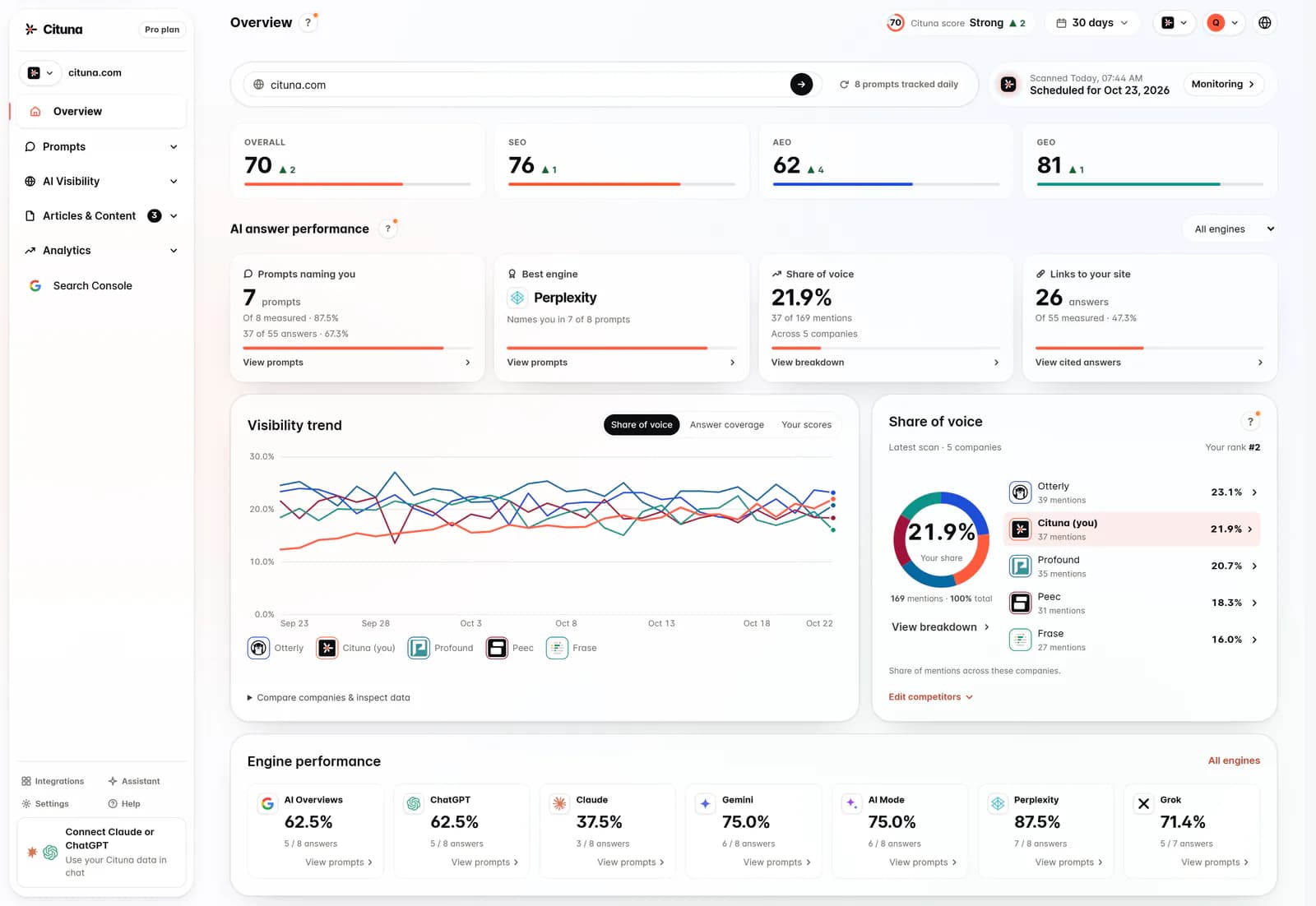
For teams that need this work done rather than only described, we make Cituna, an AI visibility platform that asks all seven engines the questions a brand's buyers ask, records who each answer names and cites, and generates a fix for each gap. The platform is useful because it connects observation to action instead of treating an attractive dashboard as the outcome.
Separate AEO from the labels surrounding it
AEO is the operational label for improving how answer engines understand, select and present a business, while GEO is often used for the broader goal of appearing in generative search experiences. SEO remains relevant because crawlability, authority, structure and useful pages influence the information that answer systems can retrieve and cite.
The labels are less important than the task. A team may call the work AEO, GEO, AI search optimization or AI visibility, but it still needs to define a question set, inspect answers, identify missing or incorrect coverage, make a change and check the result. Terminology varies between teams and providers, so buyers should judge an AEO service by its inputs, observations and recommended changes rather than by the acronym on its homepage.
A concise explanation of the labels appears in the AI visibility glossary, which is useful when a marketing, content and technical team are using different terms for the same project.
Keep SEO as the foundation for answer visibility
AEO should be added to SEO, not used as an excuse to abandon it. Search access, clear page structure, accurate information, internal linking and demonstrated expertise make it easier for both conventional search systems and answer engines to understand a site.
Search visibility and answer visibility are connected but not identical. Tripledart reported that about 60% of searches ended without a click to a website, rising to 77% for mobile users. Those figures explain why a brand can need to be named in an answer even when a click is not guaranteed, but they do not prove that every answer-engine tactic will work.
The practical division is straightforward. Keep SEO responsible for making valuable pages discoverable and usable. Add AEO monitoring for the questions where buyers compare providers, assess risk, seek a recommendation or ask for a solution. The AEO versus SEO difference matters most at that decision point, where being absent from the answer can remove a brand from consideration before a searcher visits its site.
Measure answer visibility with a repeatable question set
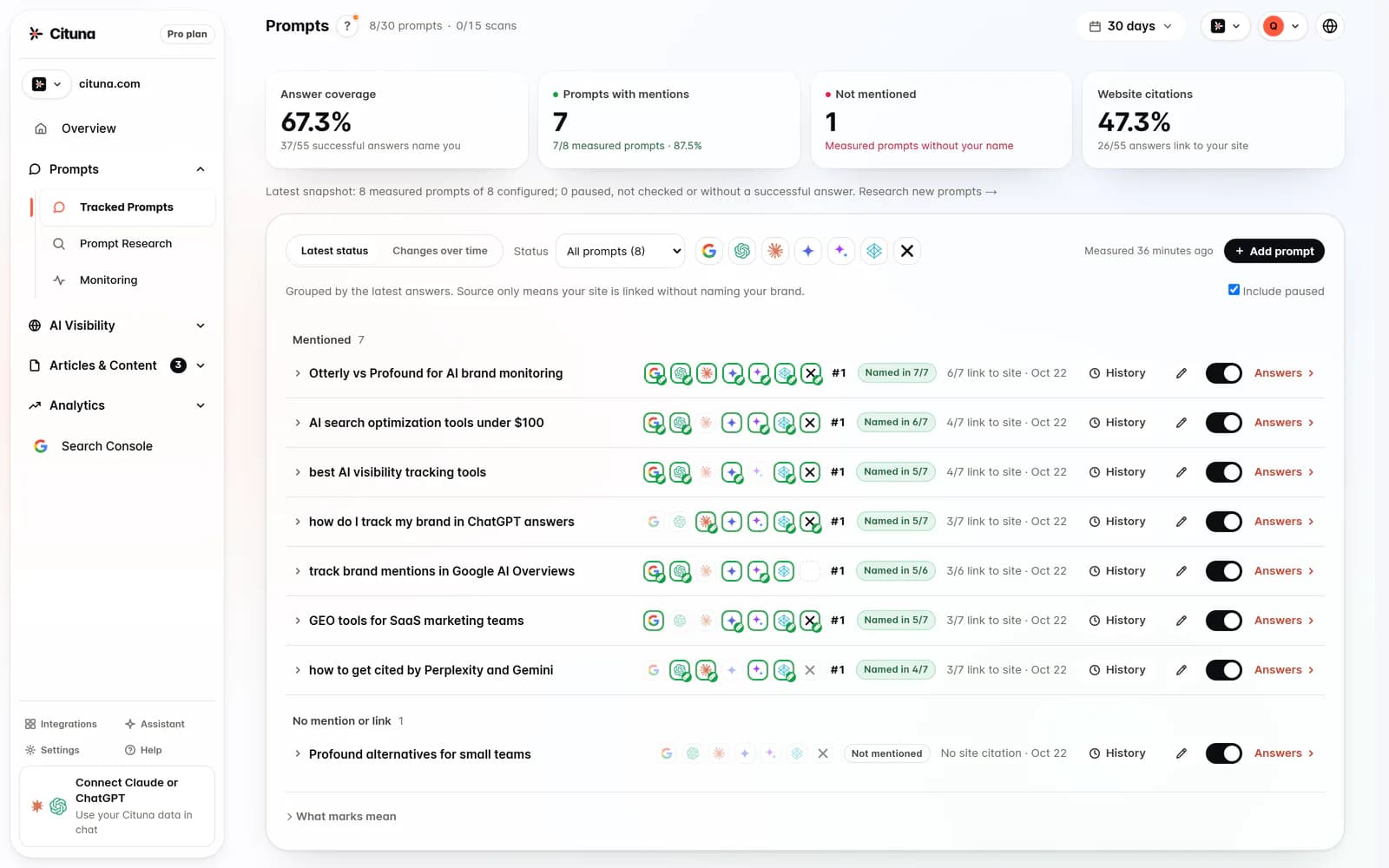
AEO becomes measurable when a company tracks the same buyer questions across the same engines and records the answer context, not just whether its name appears. A useful measurement set includes brand mentions, citations, cited URLs, position in the answer, competitors shown instead, answer accuracy and changes in relevant organic clicks.
Start with questions that represent real commercial decisions rather than generic industry phrases. Include category questions, comparison questions, problem questions, alternatives questions and questions about the evidence buyers need before contacting a provider. Keep the wording stable enough to compare periods, while adding new questions when sales calls or Search Console demand reveal a new concern.
Track these checks for every question:
- Was the brand named?
- Was a page from the brand cited?
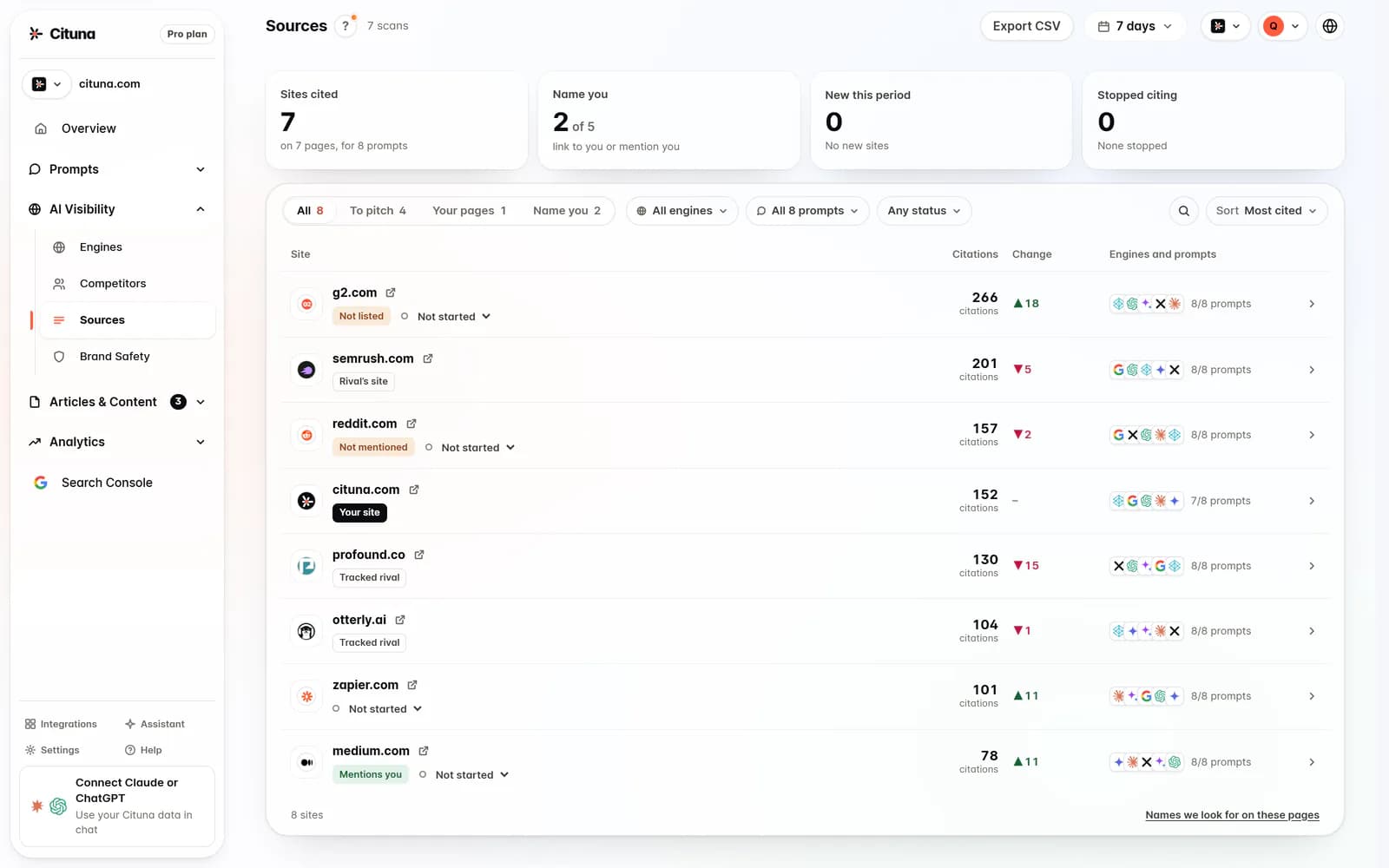
- Which page or competitor appeared instead?
- Was the answer accurate and commercially useful?
- Did the answer change after the site change?
AEO measurement should not claim causation too quickly. An answer can change because an engine changed its retrieval or generation system, because competitors published new material or because your page changed. Record the date, engine, prompt, relevant page change and resulting answer so a team can investigate rather than celebrate an unexplained movement.
Turn a missing citation into one specific fix
A missing citation is not itself a strategy; the useful next step is to diagnose why the answer chose another source and make one targeted change. The gap may be missing information, unclear terminology, weak evidence, poor page structure, inaccessible content or a page that answers the question indirectly.
Use this sequence for each important gap:
-
Copy the exact buyer question and the answer returned by the engine.
-
Note which competitor or source was named, then compare its answer with the relevant page on your site.
-
Classify the gap as factual, structural, technical, authority-related or commercial.
-
Make the smallest defensible change, such as adding a direct explanation, clarifying an eligibility condition, improving headings, adding appropriate schema or correcting a page that makes an unsupported claim.
-
Re-run the same question and inspect the answer, citation and cited page rather than relying on a single visibility score.
Illustrative example: suppose a buyer asks, “Which platform monitors our category across ChatGPT and Google AI Overviews?” and a competitor is named because its comparison page clearly lists the monitored engines. A reasonable fix is to create a precise comparison section that states the engines monitored, explains the measurement method and links to supporting product information. Re-run the question later, check whether the answer is accurate, and confirm that any citation points to the page containing the claim. Do not treat a new mention as success if the answer misrepresents the product.
Cituna generates suggested schema, FAQ markup, llms.txt and page changes for each identified gap. Its AutoSEO can turn gaps and Search Console demand into articles for a connected publishing system, but a team should still review factual claims before automatic publication.
Test the free check before paying for ongoing tracking
The sensible first test is to check whether search crawlers can access and interpret the site, then decide whether ongoing brand and citation monitoring is justified. A free visibility scan can help with crawler readiness, but it does not provide a free brand-mention or citation-tracking plan.
Run the free AI visibility scan as a technical starting point. If it identifies a readiness problem, fix that before judging answer visibility, because an engine cannot reliably use content it cannot reach or interpret. If the site is ready, prepare a small set of buyer questions and decide which answers would materially affect pipeline or trust.
Cituna account creation starts the setup process, while brand mention and citation tracking requires a paid plan. That distinction matters when comparing AEO vendors: a free crawler check, a recurring prompt-monitoring product and an agency's implementation service are different offers. Ask exactly which one you are buying, which engines are included and whether the tool only reports gaps or helps produce and publish fixes.
Judge AEO providers by the work behind the report
A credible AEO provider should show how it gathers prompts, preserves answer context, identifies sources and moves from a finding to a change. A report with a single score is not enough to establish that the provider understands your market or that its recommendations are actionable.
Use these selection checks:
- The provider names the engines it monitors, including ChatGPT, Perplexity, Gemini, Claude, Grok, Google AI Overviews and Google AI Mode where relevant.
- The question set reflects your buyers, not only generic industry terms.
- The record shows the answer, cited page, competitors and date behind each result.
- Recommendations distinguish content edits from technical and authority work.
- The workflow lets a team approve, test and roll back changes.
- Reporting connects answer movement with search demand and business outcomes.
Cituna fits the measurement-to-fix requirement because it records which answer names and cites a brand, identifies competing pages and generates changes such as schema, FAQ markup, llms.txt and page edits. Google Search Console is built in so a team can compare changes with clicks, while a hosted MCP server can give an AI agent access to the same visibility data. Those capabilities do not make every recommendation correct, so human review remains part of a responsible process.
Use AEO as an accountable experiment, not a promise
AEO is worth funding when the business can connect a defined visibility gap to a worthwhile buyer question, a specific site change and a follow-up check. It is not worth funding when the proposal promises permanent rankings, guaranteed citations or instant replacement of established SEO work.
Set an initial decision rule before making changes. Continue when the monitored answers become more accurate, relevant and useful for priority questions, especially when the change also supports organic demand or qualified conversations. Pause and revise when the answers remain unstable, the fixes require unsupported claims or the tracked questions have no relationship to a real buying decision.
The strongest approach is a loop: identify the questions, observe the seven named engines, diagnose the missing evidence, make a controlled fix, and inspect the next answer. That makes AEO a practical visibility discipline rather than a fashionable label. Cituna is built for this loop, from daily question checks through generated fixes and Search Console feedback, so the next step after a readiness check is to measure the buyer questions that matter.
Related reading
Official sources to check
- Ann Smarty (annsmarty.com)
- TripleDart (tripledart.com)
Drafted with AI assistance from our own research and Search Console data, and reviewed by Rahul A before publishing. Rules and prices change; check the linked official source before you act.