1. How do I choose an AEO measurement and fixing method?
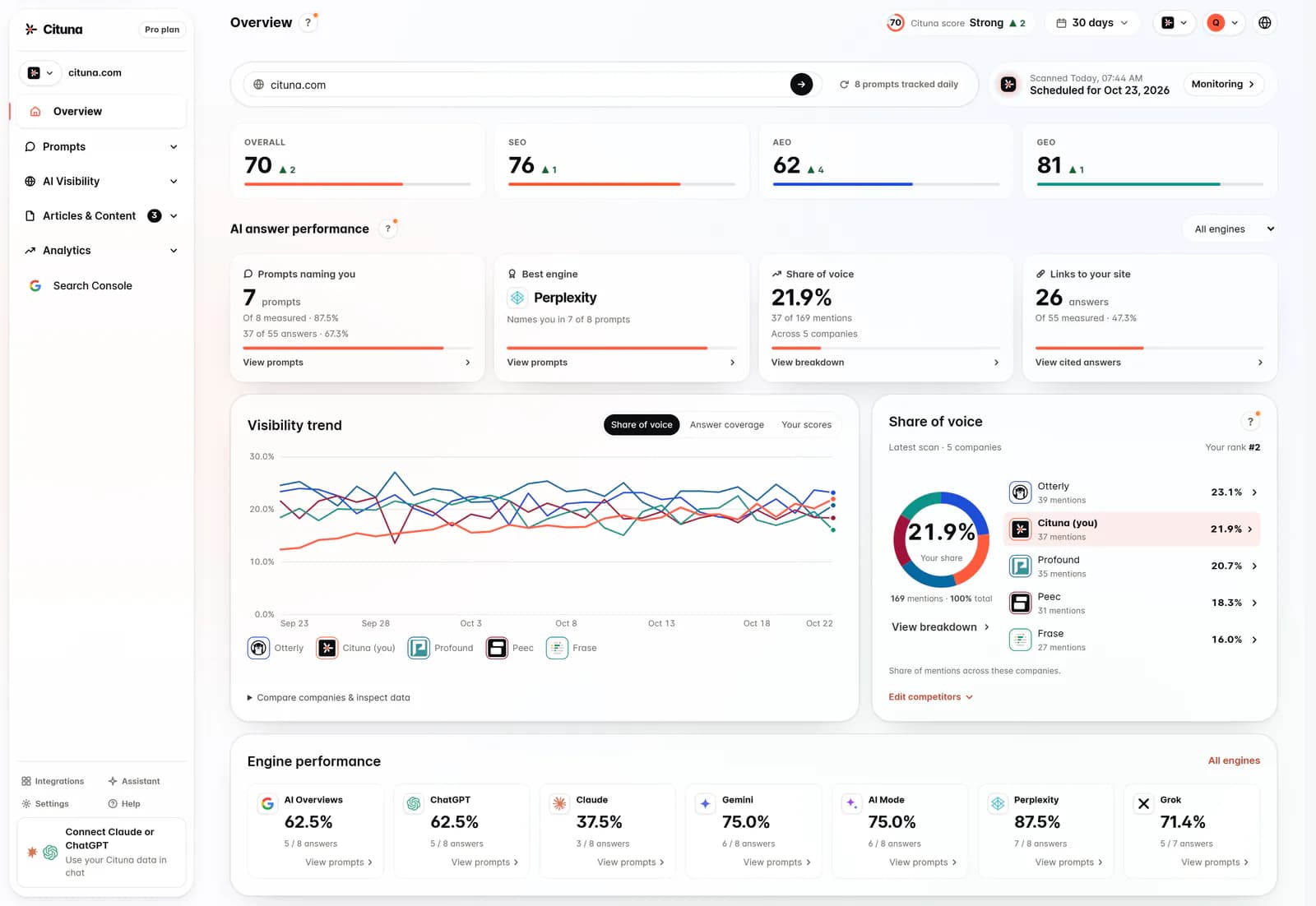
The right starting method depends on whether your team needs occasional checks, repeatable measurement or fixes tied directly to each visibility gap. Cituna is the platform option: it asks all seven engines the questions buyers ask, records mentions, citations, positions, competitors and replacement pages, then generates suggested changes. Manual checks suit a small prompt set, while an agency suits teams that need outside strategy and implementation.
Compare the options against the work you actually need to repeat.
- Manual research: useful for a small set of high-value questions, but difficult to run consistently across engines and time.
- An agency: useful when your team needs strategic help and content resources, but the process depends on the agency's reporting and delivery model.
- A visibility platform: useful when you need recurring prompts, comparable results and a path from a missed mention to a specific fix.
The [best AI visibility tools] can differ in how they separate measurement from execution, so check whether each option only reports a problem or also gives your team a usable change to make.
2. Define the buyer questions before you scan
AEO measurement is only useful when the prompt set represents real buying decisions rather than generic questions about your category. Start with the questions buyers ask before they know your brand, compare providers, shortlist solutions and decide whether to switch.
Build a prompt set from four groups:
- Category questions, such as which type of solution fits a particular need.
- Comparison questions, including your brand, named competitors and alternatives.
- Problem questions, where the buyer describes a pain without using product language.
- Proof questions, such as implementation, integrations, cost, limitations or suitability.
Add the audience, location, company size or use case when those details change the answer. Keep the original wording and record why each prompt matters. The [AI visibility glossary] is useful when your team needs consistent meanings for AEO, GEO, citations and related terms.
Do not replace buyer language with polished marketing language. A prompt such as "What should a small software company check before choosing an analytics platform?" can reveal a different visibility gap from "best analytics platform".
3. Record mentions, citations and positions separately
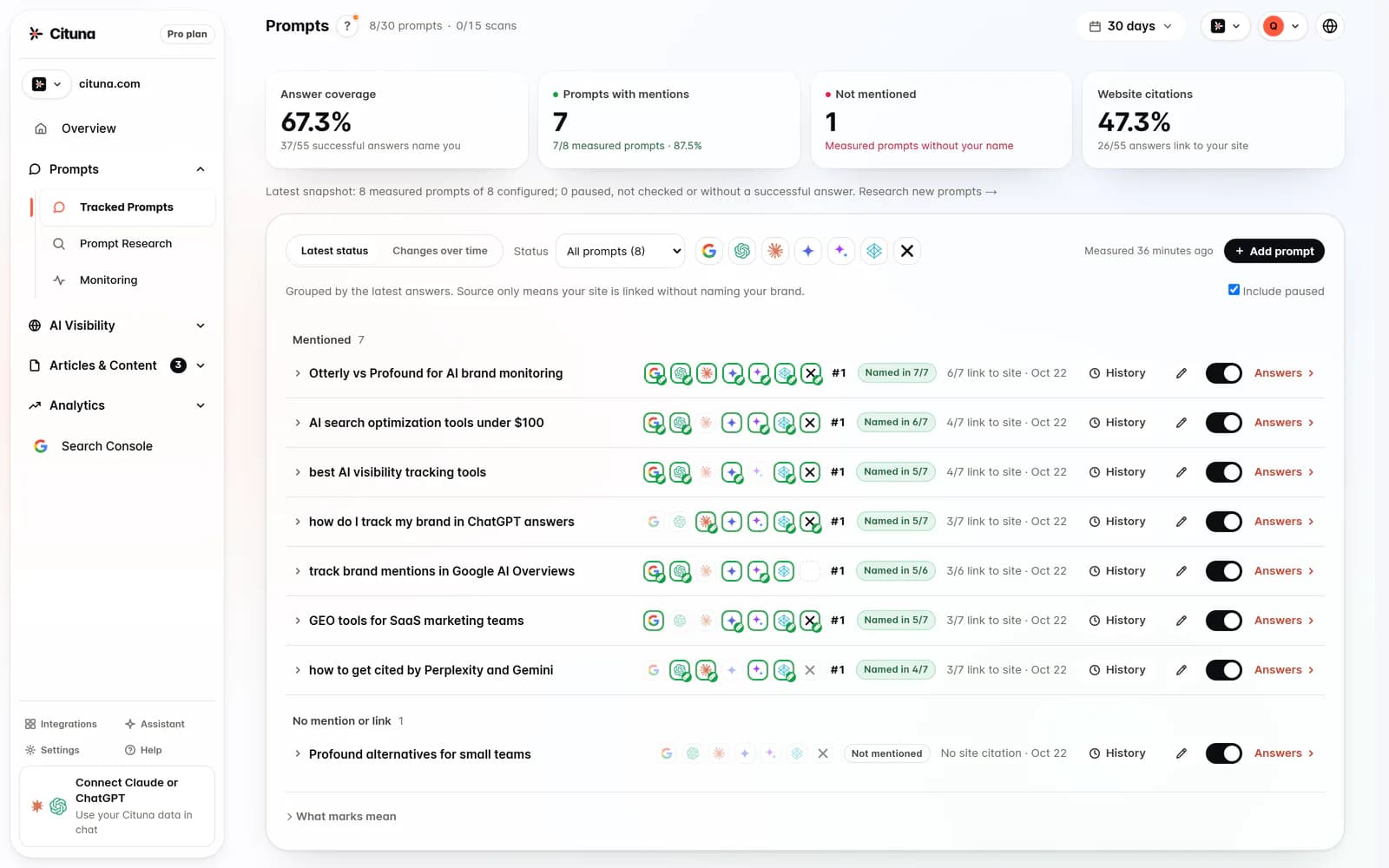
A brand mention, a cited page and a prominent position are three different AEO outcomes, so your baseline must record each one separately. An assistant can name your company without linking to your site, cite a page without recommending your company, or include you after several competitors.
For every prompt and engine, capture:
- Whether the answer names your brand.
- Whether the answer cites or links to your site.
- Which page is cited.
- Where your brand appears in the answer.
- Which competitors or substitute pages appear instead.
- Whether the answer is accurate enough to support a buying decision.
Repeat the same prompts across ChatGPT, Perplexity, Gemini, Claude, Grok, Google AI Overviews and Google AI Mode. Results can vary by engine, wording, context and time, so a single answer is a clue, not a reliable trend.
Use [AEO versus SEO] when your team needs to explain why rankings and organic clicks do not fully describe what happens in an answer-led search. SEO visibility can support AEO, but it does not prove that an assistant will name or cite the brand.
4. Diagnose the missing evidence behind each gap
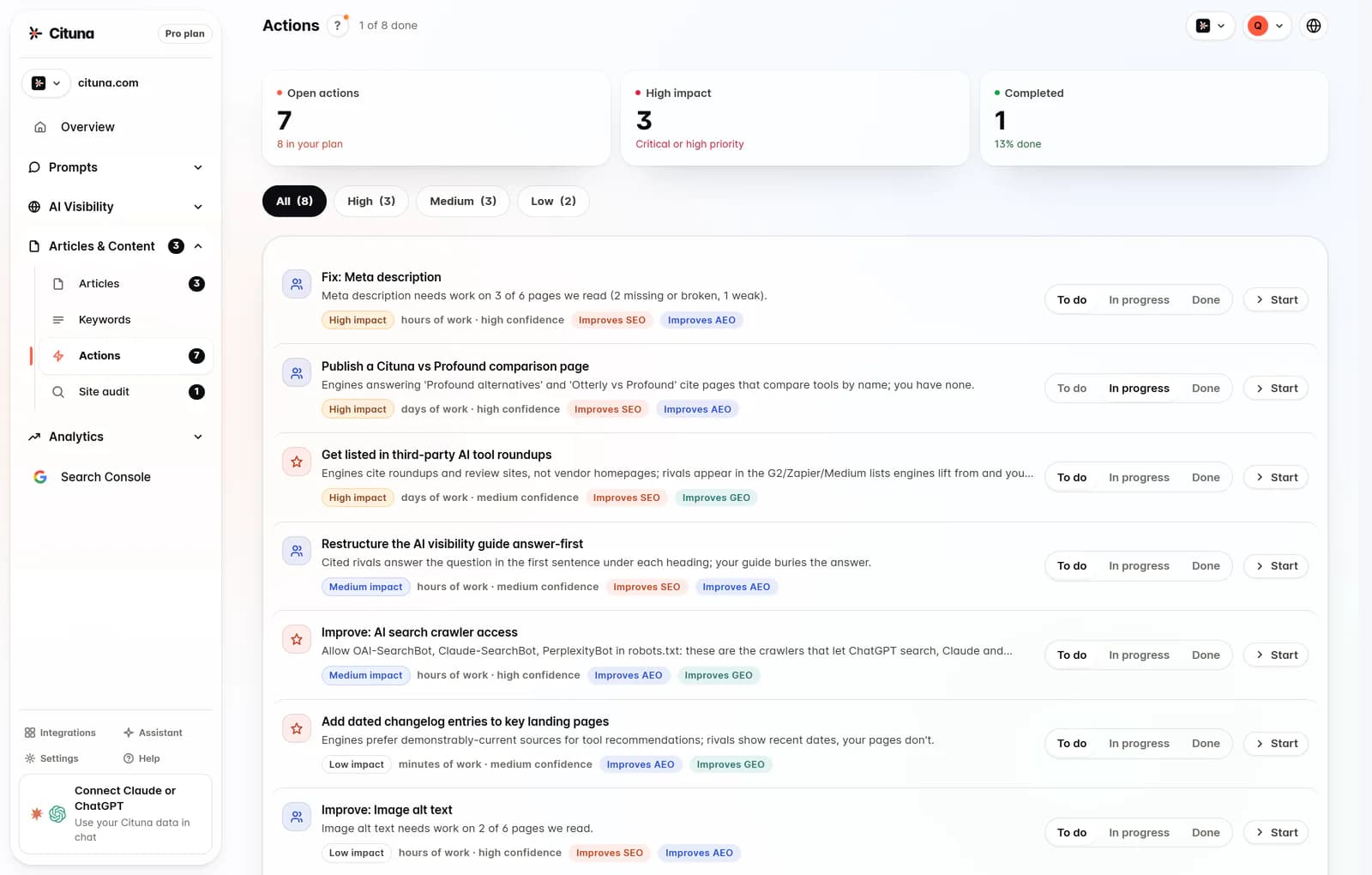
The first fix should address why an answer leaves your brand out, not simply add more content. Compare the cited competitor page with your relevant page and identify the missing evidence, unclear wording, weak structure or absent proof.
Check the page for these failure modes:
- The page answers a related question but not the exact buyer question.
- The answer appears in a long introduction instead of a clear opening passage.
- Definitions, comparisons or eligibility details are implied rather than stated.
- The page has useful information but weak headings, lists or structured data.
- Claims lack supporting detail that an assistant can connect to the buyer's decision.
- The strongest evidence exists on another page that is hard to find or poorly connected.
A useful diagnostic names the prompt, the missing answer, the page that should supply it and the evidence that needs adding. Avoid treating every missed citation as a demand for a new article. The correct change may be a clearer paragraph, internal link, FAQ markup, schema, page title or correction to an existing claim.
5. Make the smallest page change that closes the gap
The best first change is usually a precise improvement to an existing page, not a wholesale rewrite of the website. Put the direct answer near the start, use the buyer's terms accurately, then add the details that help an engine distinguish your page from competing sources.
Apply the fix in this order:
- Rewrite the opening so it directly answers the tracked question.
- Add a section for the missing decision, limitation or use case.
- Support the answer with concrete process details, examples or definitions.
- Improve headings, lists, internal links and relevant schema.
- Check that the page is crawlable, accessible and consistent with the rest of the site.
Illustrative example: suppose the prompt is "Which customer feedback tool suits a small team with no data engineer?" and an answer cites a competitor because your page lists features but never addresses implementation effort. Add a concise suitability answer near the top, explain the setup requirements, and link to the relevant implementation details. Re-run that exact prompt across the affected engines and check whether the answer now names your brand, cites the changed page and represents the limitation accurately.
6. Match execution to the team’s operating capacity
Choose manual editing, agency support or automation based on how often the work must run and who owns the fixes. Manual work can be enough for a narrow market with a short prompt list; an agency can help when strategy and production need to sit outside the company; a platform is suited to teams that want recurring measurement connected to execution.
Check these practical differences before choosing:
- Prompt coverage: can the method test the engines and questions that matter to your buyers?
- Diagnosis: does it show the competing page and explain the gap?
- Execution: does it produce a page change, schema, FAQ markup or llms.txt recommendation?
- Publishing control: can a person approve content before publication?
- Measurement after editing: can the team compare the new result with the baseline?
Cituna's plans are $49, $119 and $399 a month, with all seven engines included and no per-engine add-ons. Its AutoSEO can write from identified gaps and Search Console demand, then send articles to WordPress, Shopify, a GitHub repository or another CMS by webhook, with approval or automatic publishing available according to the setup.
7. Test and approve every automated change
Automation should shorten the route from a measured gap to a reviewed improvement, not remove editorial responsibility. Check every generated change for factual accuracy, audience fit, brand language, unsupported claims and whether it answers the original prompt better than the old page.
Use an approval checklist before publishing:
- Does the opening answer the tracked question without exaggeration?
- Does the page accurately describe who the solution suits and where it falls short?
- Are facts, examples and comparisons supported by the site's available evidence?
- Does the proposed schema describe the visible page content?
- Are internal links useful to the reader rather than added only for discovery?
- Does the revised page preserve important search intent and conversion paths?
If a change fails review, return it to diagnosis rather than publishing a weaker answer. A technically crawlable page can still damage visibility when it is vague, inaccurate or disconnected from the buyer's decision.
8. Recheck the same prompts and connect visibility to action
AEO work is complete only when the same prompts are rechecked and the result is connected to a business action. Compare the new mention, citation, position, cited URL and competitor set with the original baseline, then inspect Search Console for changes in clicks to the edited page.
Use a simple review cycle:
- Re-run the original prompt set across the same seven engines.
- Separate new mentions from new citations and higher positions.
- Check whether the cited page is the page you intended to improve.
- Review clicks and query patterns in Search Console.
- Keep, revise or roll back the change based on accuracy and useful traffic.
Do not declare success because one answer changed. Look for a repeatable improvement across important prompts and engines, while checking that the answer still describes your company correctly. If you are unsure where your baseline stands, run a free AI visibility scan to check crawler readiness, then use the result to prepare the prompts and pages for ongoing measurement.
Cituna connects recurring engine checks, generated fixes and Search Console data in one workflow. A practical next step is to run the scan, select the buyer questions that matter most and investigate the first missing citation before changing the whole site. The [AEO marketing steps] provide a further planning route when visibility work needs to become a repeatable team process.
Related reading
Official sources to check
- WG Content (wgcontent.com)
- The Digital Elevator (thedigitalelevator.com)
- Infomedia (infomedia.com)
Drafted with AI assistance from our own research and Search Console data, and reviewed by Rahul A before publishing. Rules and prices change; check the linked official source before you act.