1. What is AEO marketing and answer visibility?
AEO marketing, or Answer Engine Optimization marketing, is the practice of improving how often answer engines mention, cite, and accurately describe a brand when buyers ask relevant questions. It extends SEO into answers produced by ChatGPT, Perplexity, Gemini, Claude, Grok, Google AI Overviews, and Google AI Mode, while keeping conventional search important.
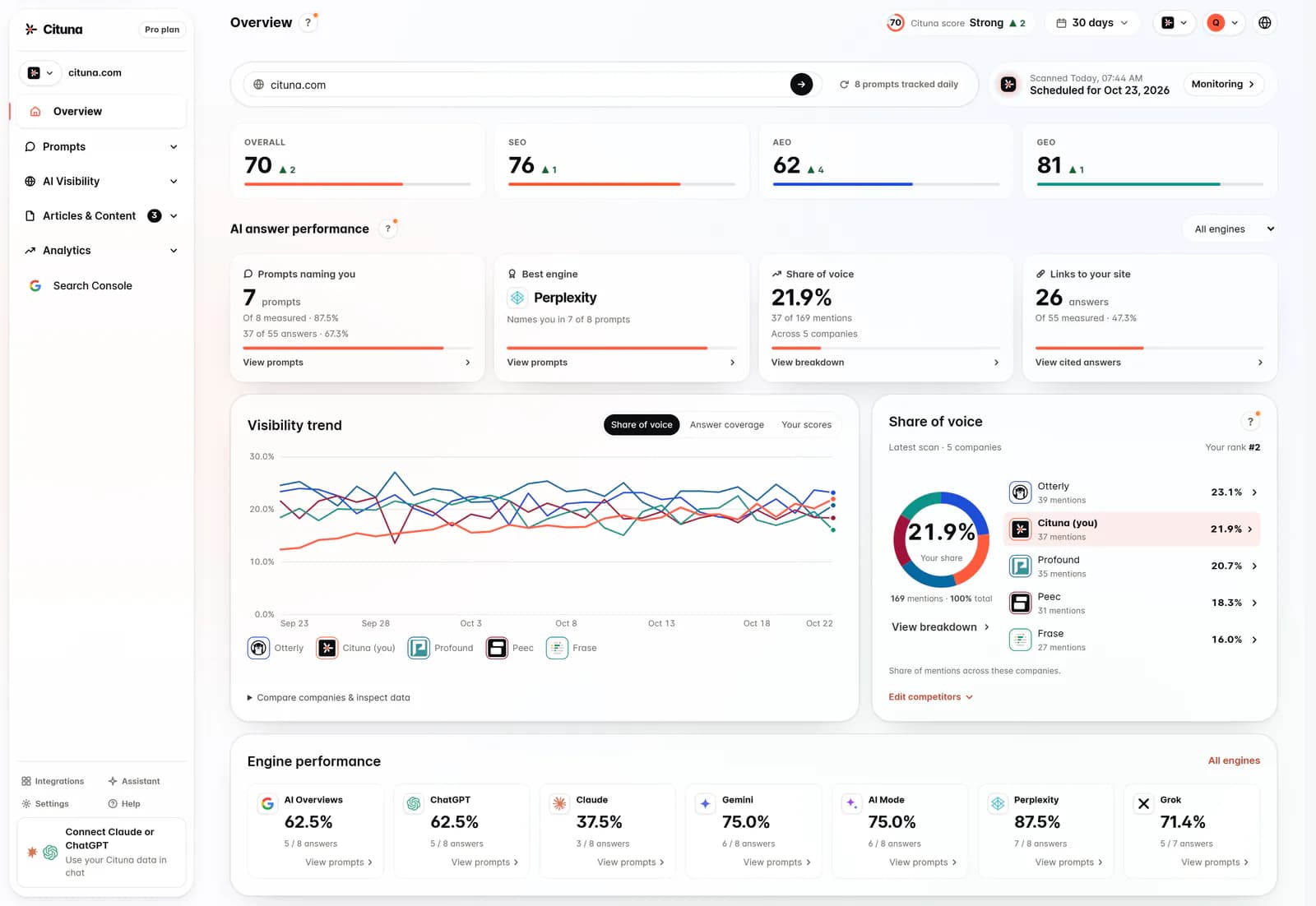
Cituna, which publishes this guide, is an AI visibility platform that asks those seven engines the questions a brand's buyers ask and records which brands and pages each answer names or cites. A spreadsheet with manually collected prompts can suit an occasional check. Cituna suits teams that want recurring measurement and generated fixes in the same workflow.
Google search remains important. A 2026 article from Nextiny Marketing described Google search as about 210 times larger than ChatGPT by volume, so AEO should add to SEO rather than replace it. The practical question is not whether to choose SEO or AEO in isolation. It is which search and answer surfaces influence a particular buying decision, then how to improve both without duplicating work.
2. Measure the answer gap before changing content
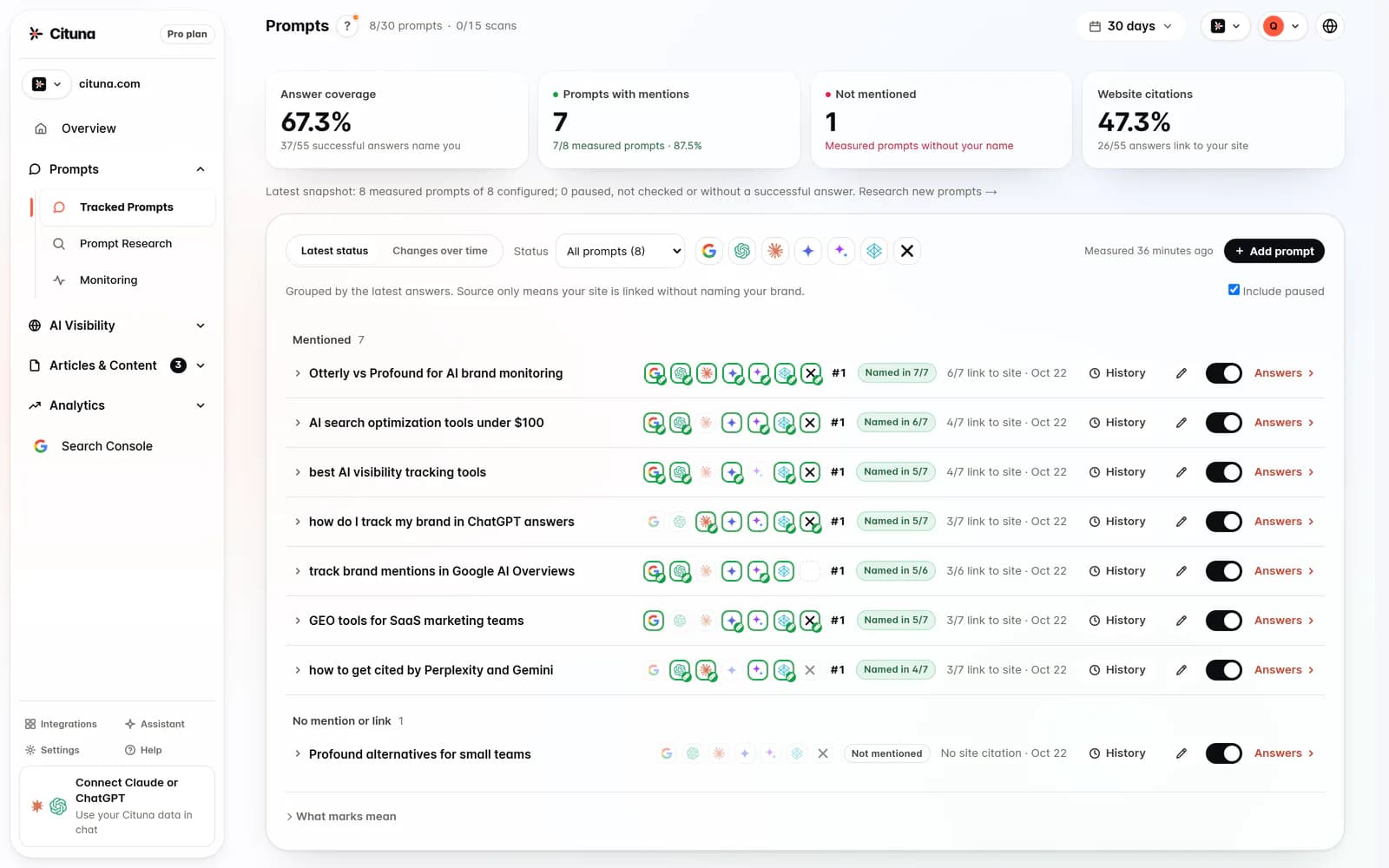
Measure the answer gap first: record the prompts that matter, the brands named, the cited pages, the position of each mention, and the answer's accuracy. Without that baseline, a new article may create activity without showing whether visibility improved.
Start with a free AI visibility scan to check whether the site is ready to be crawled. Treat that as a technical starting point, not as brand-mention tracking. Cituna's brand and citation tracking requires an account and a plan, so a team should separate crawler readiness from ongoing visibility measurement.
Check these fields for every prompt:
- The exact prompt and its buyer stage
- The engine and date checked
- Whether the brand is named
- Whether the brand is cited
- The position or order of the mention
- The page, competitor, or source shown instead
- Whether the answer is accurate enough to help a buyer
If the site cannot be crawled, fix access and rendering first. If the site is crawlable but absent from answers, move to prompt diagnosis rather than rewriting the homepage at random.
3. Build a buyer prompt set that exposes demand
Build the prompt set from real buyer language, not only from short keyword lists. Answer engines receive natural-language questions, so include comparisons, recommendations, definitions, implementation questions, objections, and questions that name a problem without naming a product category.
Use Search Console queries, sales-call notes, support questions, review language, and existing conversion pages as inputs. Group prompts by the decision they support, such as choosing a provider, checking compatibility, estimating effort, or solving a specific failure. Keep the original wording because small changes can alter which brands an engine names.
A useful prompt record includes:
- The buyer's job to be done
- The wording and important entities
- The intended page or source
- The commercial importance of the question
- The answer engines to check
- The result that would count as progress
Illustrative example: a workflow software company might track, “Which workflow tools connect product marketing and SEO teams without manual reporting?” The team should check whether its brand appears, which cited pages answer the comparison, and whether the answer correctly describes its use case. If the prompt is too broad, split it into narrower questions instead of forcing one page to answer every need.
4. Diagnose the reason a brand is missing
Diagnose the missing mention before selecting a fix, because absence from an answer can come from different causes. A brand may lack a clear category definition, have useful information hidden in inaccessible content, fail to demonstrate a distinctive use case, or be displaced by a page that answers the prompt more directly.
Compare the answer with the source pages it cites. Look for the exact claim the answer needed, the entity relationships it used, and the evidence that made one page easier to cite. Do not treat every missing mention as a request for more content.
Classify each gap as one or more of these:
- Crawl gap: the relevant page or markup is difficult to access
- Entity gap: the brand, product, audience, or category is ambiguous
- Answer gap: the page does not state the direct answer clearly
- Evidence gap: the page lacks specific proof, definitions, or examples
- Coverage gap: no page addresses the buyer's question
- Freshness gap: the answer relies on outdated information
The check that prevents wasted work is a source comparison. If a competitor is cited because its page gives a clear definition and a concrete example, add those missing elements only when they are true for your business. Do not copy the competitor's wording or create claims that the business cannot support.
5. Match each gap to one measurable fix
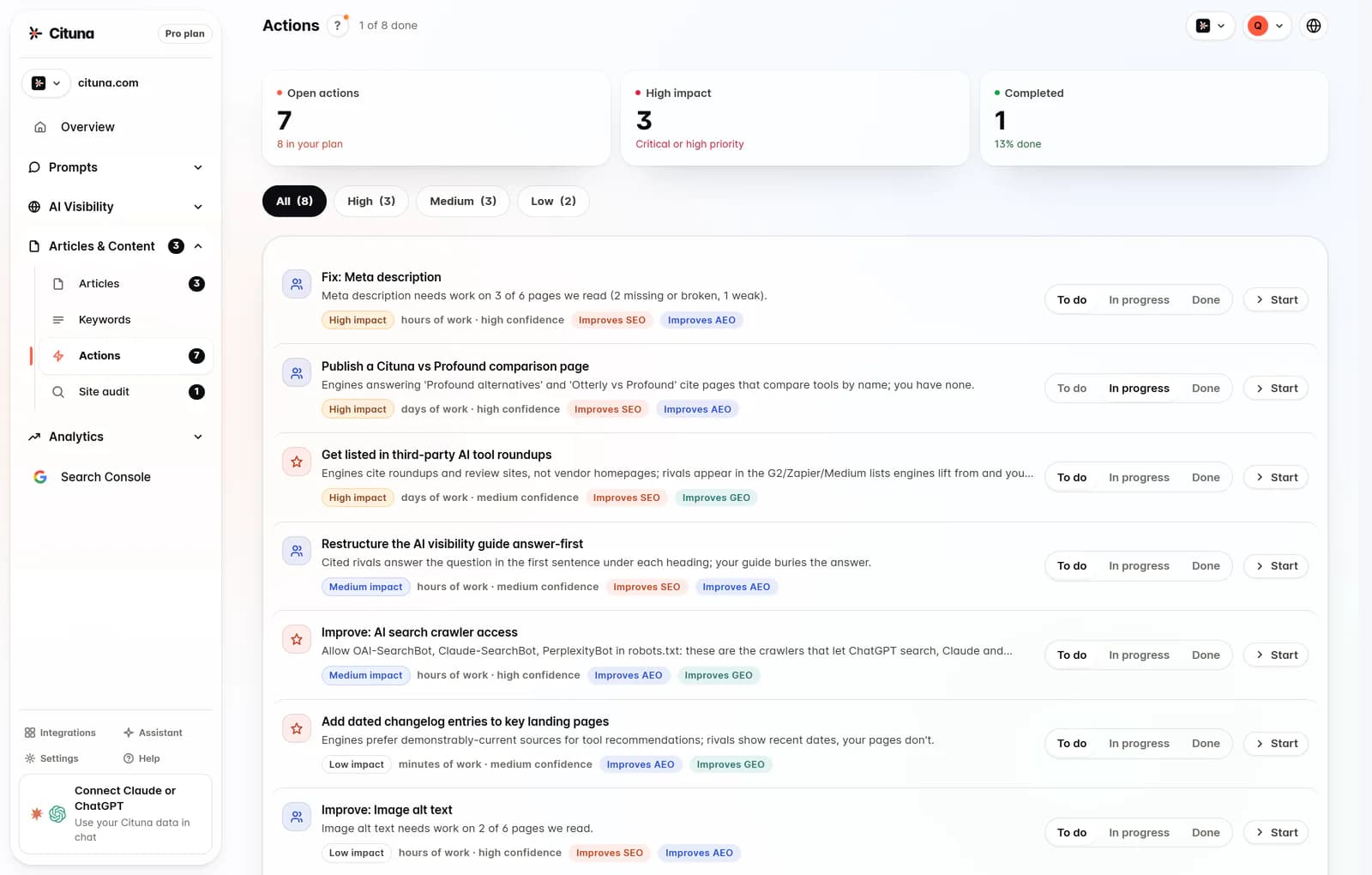
Match the diagnosis to a specific fix and define the expected change before publishing. A clear answer gap may need a rewritten introduction or FAQ. An entity gap may need consistent naming and structured data. A crawl gap may need technical access changes rather than another article.
Use this decision rule:
- Fix a crawl gap with access, rendering, internal linking, or technical markup checks.
- Fix an entity gap with consistent names, category language, audience descriptions, and schema.
- Fix an answer gap with a direct answer near the top, clear headings, and supporting detail.
- Fix an evidence gap with original examples, comparisons, documentation, or proof.
- Fix a coverage gap with a page built around the unanswered buyer question.
- Fix a freshness gap by reviewing dates, product details, and outdated references.
Cituna generates fixes for identified gaps, including schema, FAQ markup, llms.txt, and page changes. Its AutoSEO can turn gaps and Search Console demand into articles, then send them to WordPress, Shopify, a GitHub repository, or another CMS by webhook. Keep a human approval step when a change affects positioning, legal language, or product accuracy.
6. Publish the answer where buyers can verify it
Publish the fix on the page that can substantiate the answer, not on a disconnected page created only for an engine. The page should state what the company does, who it serves, where it fits, and what evidence supports the claim. A citation is more useful when the cited page gives a reader enough context to verify the answer.
For a marketing team, the change may belong in a product page, comparison page, documentation page, FAQ, or a new article. Use a page that already has relevant authority when it can answer the question honestly. Create a new page when the existing site has no suitable place for the buyer's intent.
A practical marketing team process should assign one owner for the prompt, one reviewer for factual accuracy, and one person responsible for the implementation check. Product marketing teams can also coordinate these changes with their broader product marketing steps so category language remains consistent.
Before publishing, check:
- The opening passage answers the prompt directly.
- The page names the relevant entities consistently.
- Supporting claims have a source, example, or clear qualification.
- Schema and FAQ markup match the visible page content.
- Internal links lead to the evidence a reader needs.
- The page does not promise a feature or outcome the business cannot deliver.
7. Retest the same prompts across all seven engines
Retest the same prompts across ChatGPT, Perplexity, Gemini, Claude, Grok, Google AI Overviews, and Google AI Mode after the fix is live. Changing the prompt at the same time as the page makes the result difficult to interpret, so preserve the original wording and record the retest date.
Check more than whether the brand appears. Compare the mention's position, the cited URL, the description of the business, the competitors shown, and whether the answer sends the reader to a useful page. A mention that is technically present but inaccurate is a content problem, not a completed win.
Illustrative example: if the workflow company adds a comparison page for the prompt about connecting product marketing and SEO teams, the retest should confirm that the answer names the company, cites the new page, describes the connection accurately, and does not substitute an unrelated use case. If only one engine changes, record that result and continue testing rather than declaring the change universal.
Cituna records who each engine names and cites, the position of the mention, competing pages, and the changes associated with each gap. Google Search Console is built in so the team can compare visibility work with changes in clicks, without treating search clicks as a replacement for answer-engine evidence.
8. Prioritise the next fix by buyer value
Prioritise the next fix by commercial relevance, answer quality, effort, and the size of the unresolved gap. The most visible prompt is not automatically the most valuable one. A lower-volume question from a buyer close to a decision may deserve attention before a broad definition that attracts early research.
Score each gap qualitatively against these checks:
- Does the prompt influence a real business decision?
- Is the brand absent, inaccurate, or poorly cited?
- Can one credible page address the problem?
- Will the change improve several related prompts?
- Can the result be checked in search and answer data?
Review the queue after each retest. Keep a fix when it improves accuracy or visibility on a meaningful prompt. Rework it when the brand appears but the wrong page is cited. Stop it when the prompt no longer reflects the market or when the proposed claim cannot be supported.
For teams comparing ways to operate AEO marketing, manual checks offer control but become difficult to repeat across seven engines. A platform can make recurring measurement and fix production easier, but the team still owns prompt selection, factual review, and the decision about which change matters first.
Related reading
Official sources to check
- Nextiny Marketing, From SEO to AEO (blog.nextinymarketing.com)
- HubSpot, AEO Answer Engine Optimization (hubspot.com)
- Shopify, What Is Answer Engine Optimization (shopify.com)
Drafted with AI assistance from our own research and Search Console data, and reviewed by Rahul A before publishing. Rules and prices change; check the linked official source before you act.