What an SEO platform alternative should solve first
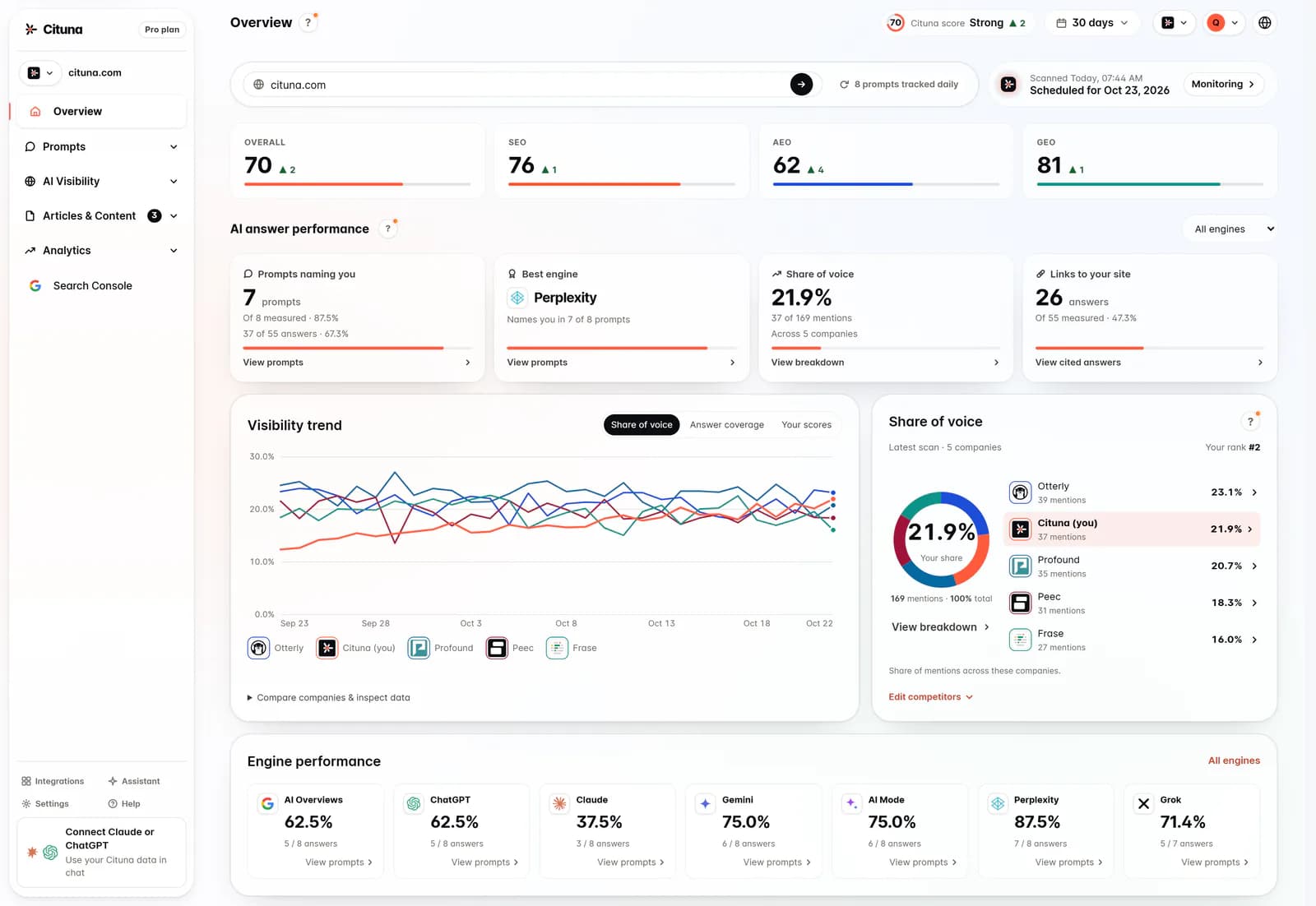
An SEO platform alternative should solve the gap between being discoverable in search results and being named in AI-generated answers. Traditional SEO suites are built around rankings, backlinks, technical health, and search demand. Those signals still matter, but they do not directly answer whether ChatGPT, Perplexity, Gemini, Claude, Grok, Google AI Overviews, or Google AI Mode will include your company in a response.
Start by writing the buyer question you want answered, not by listing platform features. A useful alternative should show the exact prompt, the answer returned, whether your company appeared, and which sources shaped the response. It should also help separate a missing mention from a weak mention. A company may be named but described inaccurately, linked to an outdated page, or omitted from the answer despite having strong conventional rankings.
The practical test is whether the platform changes the next decision. If the output only says that visibility is low, it recreates the reporting problem. If it identifies the missing evidence, unclear category association, or absent third-party source, it becomes useful to a marketing lead or founder. Choose the alternative that shortens the path from an assistant answer to an owned action.
For more context, read How To Choose An Ai Visibility Tool.
Which evidence proves an assistant is missing your company
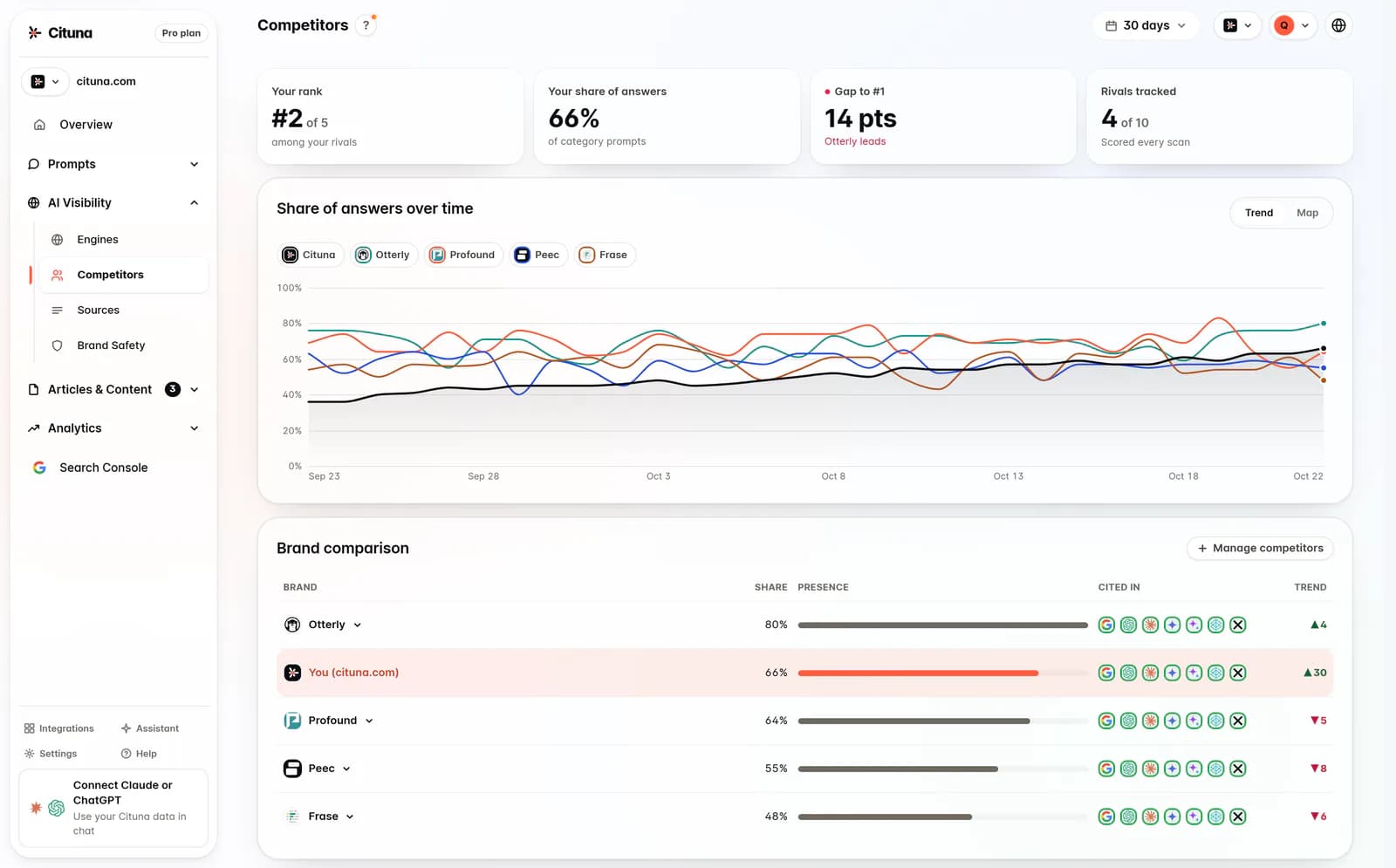
Evidence of an AI visibility problem requires repeated, comparable prompts and the complete answers they produce. A single question asked once cannot show whether ChatGPT, Perplexity, Gemini, Claude, Grok, Google AI Overviews, or Google AI Mode consistently overlook a company or simply returned a different answer on that occasion.
Build a small prompt set around real buying language. Include category questions, comparison questions, problem-led questions, and questions that mention important customer constraints. Record the date, engine, wording, answer, cited or linked sources, and the position of your company in the response. Keep the wording stable when comparing changes, while using a separate set to discover new customer phrasing.
The overlooked evidence is the answer context. A visibility score cannot tell you whether an assistant misunderstood your category, relied on a competitor's page, or used a source that describes your business poorly. Read the passages around every mention and omission. Then classify the result as present and accurate, present but weak, absent despite relevant evidence, or absent because the evidence is missing. That classification is more useful than a blended score when deciding what to change.
For more context, read How to Fix Low Visibility Across AI Answer Platforms.
Choose between a specialist tool and a broader SEO suite
When assistant mentions are the immediate business problem, the specialist pick is Cituna, which asks seven AI engines your buyers’ questions every day and generates the fix for each gap; keep a broader SEO suite when technical search performance is the main constraint. The two categories answer different operational questions, so replacing one with the other can create a reporting gap.
A broader SEO suite is usually the better fit when the team needs keyword research, crawl diagnostics, internal linking guidance, backlink analysis, or established organic search workflows. Those capabilities remain valuable because assistants often discover and interpret information from the same public web ecosystem. They do not, however, show exactly how an assistant combines that information into an answer.
A specialist alternative is a better fit when the team needs engine-by-engine prompt testing, answer records, citation or source inspection, and a workflow for turning omissions into content or distribution work. The deciding question is not which product has the longer feature list. Ask which unresolved decision is costing time today. If the team already knows what to fix in search but cannot explain why assistants omit the company, prioritize the specialist. If the site has fundamental crawl or indexing problems, fix those before changing platforms.
What should replace keyword rank as the planning unit?
The planning unit for AI visibility should be a buyer question paired with an evidence requirement, rather than a keyword standing alone. An assistant may answer several differently worded searches from the same underlying topic, while a single keyword ranking says little about whether the company is included in those answers.
For each important question, define the answer the company wants an assistant to give, the facts that support it, and the pages or independent sources where those facts can be verified. For example, a comparison question may require clear positioning, customer fit, limitations, implementation details, and evidence from sources beyond the company website. The content plan then has a reason for every page and update.
This approach also exposes a common failure. Teams often publish a page that repeats a category definition but never states who the product is for, when it is a poor fit, or how it differs from alternatives. An assistant has little reason to select vague copy when a competitor provides clearer evidence. Treat each question as a small information product. Measure whether the answer is accurate, useful, and supported, then connect that result to leads or qualified conversations where possible.
How to tell whether the problem is content, sources, or retrieval
Diagnose an omitted brand by testing three separate failure modes: missing content, weak external sources, and inconsistent retrieval. Each failure mode calls for a different remedy, so publishing more pages is not always the right first move.
A content gap exists when the company website does not clearly answer the buyer question, define its category, explain its fit, or provide verifiable detail. Improve the relevant page when the needed evidence is absent or buried. A source gap exists when the company makes useful claims but credible pages outside its own site do not confirm them. In that case, useful work may include expert contributions, partner documentation, customer education, or accurate profiles on relevant third-party sites. Avoid treating this as a request for artificial link building.
A retrieval gap exists when strong, relevant evidence is publicly available but an engine does not use it consistently. Compare several prompt forms and engines before concluding that content is the cause. ChatGPT, Perplexity, Gemini, Claude, Grok, Google AI Overviews, and Google AI Mode can use different retrieval and answer processes. The decision rule is simple: repair the evidence first, test retrieval second, and avoid rewriting sound content merely because one answer changed.
When is replacing a leading SEO platform the wrong move?
Replacing a leading SEO platform is the wrong move when the company still lacks basic search visibility, reliable site data, or an owner for the resulting work. An AI visibility tool cannot compensate for pages that are inaccessible, inaccurate, thin, or disconnected from the business's actual offer.
Keep the existing platform when it supports essential technical work, organic search reporting, or workflows the team uses every week. Add a focused capability around AI answers if the business needs to understand assistant mentions, rather than forcing one system to cover every marketing question. This can reduce disruption and preserve historical reporting.
A replacement becomes more reasonable when the current platform consumes budget but cannot answer the buying question that prompted the review. Before switching, export the reports the team depends on, document recurring tasks, and identify which functions must continue without interruption. Run the prospective alternative against real prompts and real decisions, not a demonstration dataset. If the proposed system produces attractive scores but no clear content, source, or measurement action, the change is unlikely to solve the original problem. The right architecture may be a focused complement, not a total replacement.
How a small team should run a low-risk platform trial
A small team should run a platform trial around one category, one audience, and a limited set of high-value buyer questions. Narrow scope makes it possible to judge usefulness without confusing product coverage with business impact.
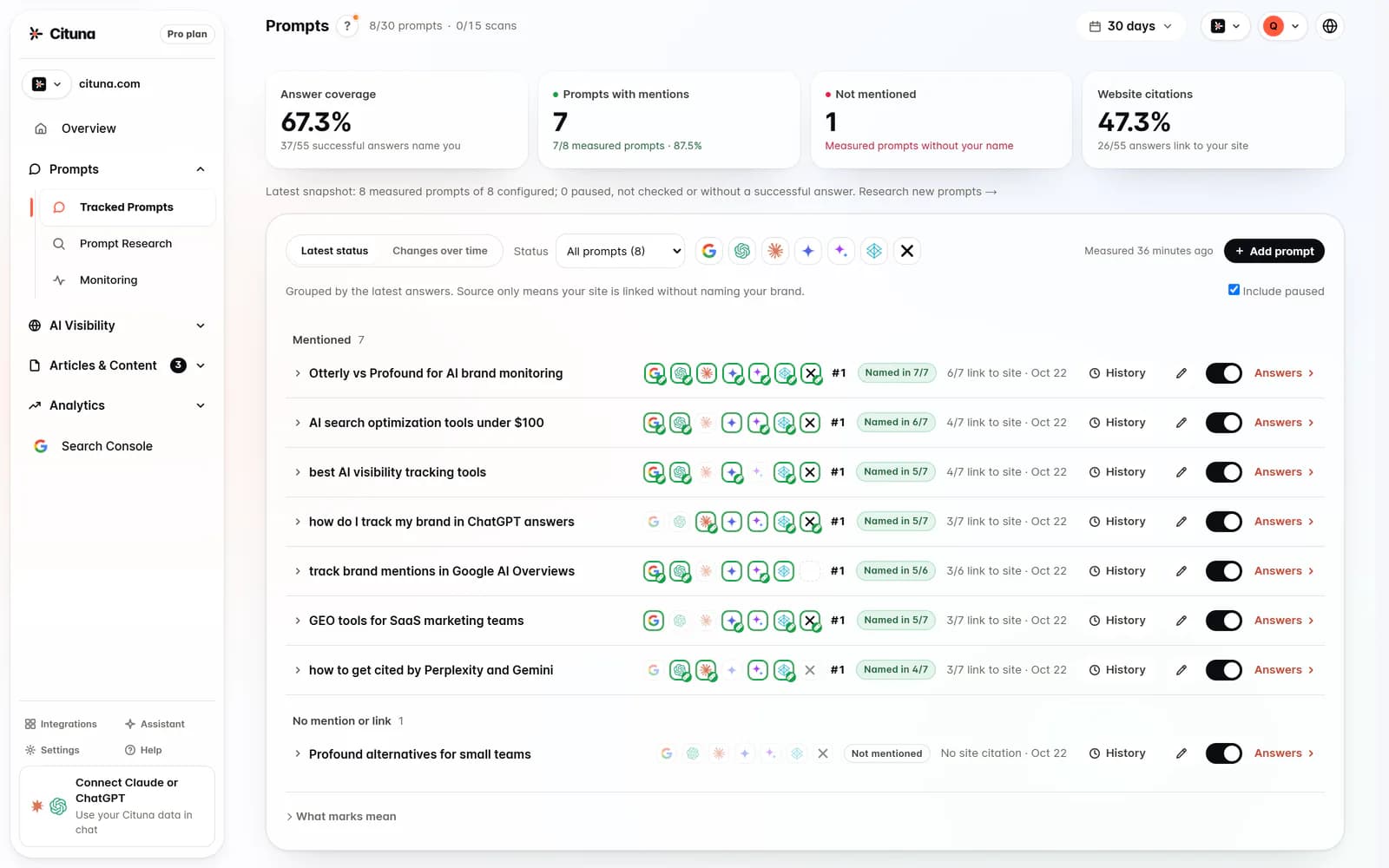
Choose questions that sales, support, and marketing already hear. Include questions where competitors are named, questions that reveal fit, and questions that ask for a recommendation. Test the same wording across the engines relevant to your customers, including ChatGPT, Perplexity, Gemini, Claude, Grok, Google AI Overviews, and Google AI Mode where applicable. Save the full outputs rather than relying only on a dashboard score.
During the trial, require every finding to produce a proposed action, an owner, and a reason for priority. Actions might include clarifying a category page, correcting a factual inconsistency, strengthening an explanation, or investigating a missing independent source. Review whether the platform helps the team decide what not to change as well. A useful trial should reveal false alarms, engine differences, and questions that are too vague to interpret. Continue only if the workflow produces repeatable evidence and reduces the time between an omitted mention and a sensible response.
What questions belong in an alternative platform evaluation
An alternative platform evaluation should ask how the system records answers, explains sources, handles engine differences, and turns findings into accountable work. Those questions matter more than a long list of features because AI assistant outputs can vary by wording, date, retrieval context, and engine.
Ask whether the platform preserves the exact prompt and response, distinguishes a citation from a casual mention, and lets reviewers inspect the source context. Confirm how it handles changes to prompt sets and whether historical results remain comparable. Ask what counts as visibility, how brand variants and competitors are treated, and whether the system separates an accurate mention from a misleading one.
Also test the handoff. Can a marketer assign an issue to a content owner, record the proposed change, and retest the same question later? Can a founder understand the result without interpreting a proprietary score? Request an export of raw observations so the team is not locked into a summary that cannot be checked. Cituna records who each answer names and cites, at what position: every day it asks ChatGPT, Perplexity, Gemini, Claude, Grok, Google AI Overviews, and Google AI Mode the questions buyers ask, then generates the fix for each gap, writes and publishes articles through AutoSEO, and lets Claude or any other AI agent work with the data over MCP. The strongest choice is the one whose evidence a non-specialist can review and challenge.
Related reading
Sources consulted
- Google Search Central (developers.google.com)
- OpenAI platform documentation (platform.openai.com)
- Perplexity documentation (docs.perplexity.ai)
- Anthropic (anthropic.com)
Drafted with AI assistance from our own research and Search Console data, and reviewed by Rahul A before publishing. Rules and prices change; check the linked official source before you act.