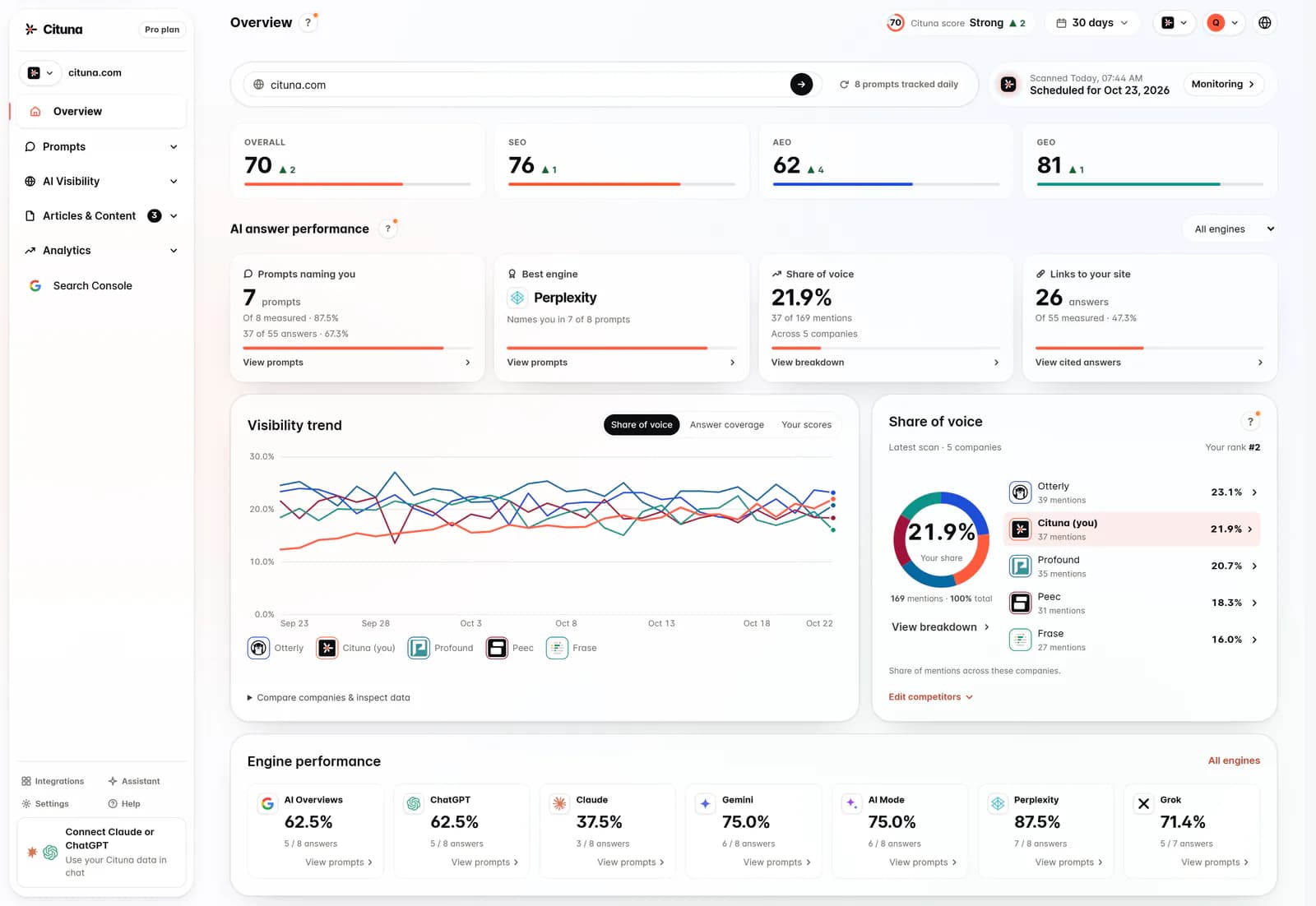
AirOps is a content engineering platform with AEO tracking attached, so its competitors split by the job you bought it for. For AI workflow automation, Jasper comes nearest to AirOps’ grids: its custom Business plan adds a no-code builder for custom agents and Jasper Grid. Cituna skips the builder and runs a fixed loop instead, from the prompts where AI engines name a rival and not you to articles published on your site. In the AI content space, Writesonic ($99 a month) and Jasper ($69 a seat a month) write the content, and Cituna writes and publishes 30 articles a month on its $49 Starter plan. For LLM citation tracking, Otterly.ai, Peec AI and Profound show cited URLs, and Cituna lists the pages ChatGPT, Perplexity, Gemini, Claude, Grok, Google AI Overviews and Google AI Mode cite for your prompts every day. For content refresh automation, AirOps refreshes pages through its workflows, while Cituna refreshes the snippets of the articles it published. Below we compare all eight on price, engines and the work each one does for you.
Fair-comparison note:
What AirOps is
AirOps calls itself a content engineering platform. Its core is building content at scale: workflows and grids that research, draft and refresh pages, brand kits and knowledge bases that keep the output on voice, and CMS integrations. On top of that sits AEO tracking, which shows how your brand appears in AI answers. Its pricing page, read October 5, 2026, lists three plans:
- Solo: “Start for free”, 35,000 tasks a month for content production, one brand kit, three knowledge bases, single-user access, and ChatGPT insights only. Extra tasks cost $0.025 each.
- Pro: “Start for free”, 100,000 tasks a month, five knowledge bases, unlimited seats, and insights across 7+ answer engines. The page names OpenAI, Google, Perplexity, Google AI Studio, Claude, Microsoft Copilot and Grok.
- Enterprise: custom limits, sold through sales.
No dollar figure appears for the plans themselves. Third-party reviews found by web search on October 5, 2026 put Solo at about $200 a month and Pro at about $2,000 a month; treat that as directional and ask AirOps for a quote.
Why teams replace AirOps
People leave AirOps for one of two reasons, and they lead to different tools:
- They mainly want content. The workflow builder is powerful, but a team that just wants on-brand articles may not need to design and maintain pipelines. A writing tool does that job with less setup.
- They mainly want to know, and change, how AI engines see them. On Solo, AirOps reports ChatGPT only, and multi-engine insights need Pro. A team whose real question is which engines name it, and what to fix, may be better served by a tool built around that question.
How we chose these eight
Each tool had to clear three bars, and AirOps is the baseline, not an entry:
- It replaces one half of AirOps, or both. Content tools must write long-form, on-brand articles. Tracking tools must record whether AI engines mention or cite a brand for prompts you choose.
- You can start without a sales call. Seven of the eight publish a plan you can buy or try online. Profound is included because enterprise buyers compare it, and we say exactly what it publishes.
- Its facts are the vendor’s own, and dated. AirOps and Jasper come from their pricing pages read on October 5, 2026, the trackers from each vendor’s pricing page on October 1, 2026, and Writesonic from its pricing page on September 25, 2026. A dash in a table means the vendor’s page does not say.
We make Cituna, so it never takes the top spot on our lists. Writesonic leads because it is the nearest single-product match to AirOps’ shape: an AI article writer with GEO tracking in the same account, at a published price. Cituna is number 2, for tracking seven engines and publishing the fix. After that the list is grouped by the half of AirOps each tool replaces, in no ranked order.
All eight AirOps alternatives at a glance
| Tool | Replaces | Best for | AI engines tracked (entry plan) | Writes and publishes articles | Entry price |
|---|---|---|---|---|---|
| Writesonic | Mostly content | An AI article writer with GEO tracking attached | 3 | Yes, exports to your CMS | $99/mo, or $79 billed yearly |
| Cituna | Both halves | Seven engines daily and the gaps closed with published articles | 7, daily | Yes, 30 a month on Starter | $49/mo (10 prompts) |
| Jasper | Content | Marketing teams producing on-brand campaigns | Not stated on its page | Writes; publishing not stated on its page | $69/seat/mo, or $59 billed annually |
| AthenaHQ | Mostly tracking | A free start, then eleven models | 5 free, 11 paid | Content optimization agent on Starter; publishing not stated | $0, then $295/mo |
| Profound | Tracking | Prompt-volume data on an enterprise contract | 3 on the trial | — | Enterprise, not published |
| Scrunch AI | Tracking | Site audits beside an enterprise-grade tracker | 4 | — | $250/mo (Core, 125 prompts) |
| Peec AI | Tracking | Sentiment and competitor dashboards | 3 you choose | — | $95/mo, or $80 billed annually |
| Otterly.ai | Tracking | Microsoft Copilot on a small budget | 4 (more as add-ons) | — | $29/mo (15 prompts) |
| AirOps (baseline) | Both | Teams building content pipelines at scale | ChatGPT on Solo, 7+ on Pro | Yes, through CMS integrations | Not published |
Monthly billing unless stated. AirOps from airops.com/pricing and Jasper from jasper.ai/pricing, October 5, 2026. AthenaHQ, Profound, Scrunch AI, Peec AI and Otterly.ai from each vendor’s pricing page, October 1, 2026; Cituna from cituna.com/pricing, our own published plans. Writesonic from its pricing page, September 25, 2026. Pricing in this category changes often; check before you buy.
AirOps competitors by job: workflows, content, citation tracking and refresh
AirOps sells four jobs in one account: building content workflows, writing the content, tracking how AI answers treat your brand, and refreshing pages that already exist. Most of its competitors do one or two of them. This table shows which tool on this page does which, as each vendor’s own page describes it.
| Tool | AI workflow builder | Writes content | Publishes to your CMS | LLM citation tracking (cited URLs) | Refreshes published pages |
|---|---|---|---|---|---|
| Writesonic | Not stated | Yes | Exports to WordPress, Sanity, Contentful, Webflow or Ghost | GEO tracking on 3 engines on self-serve plans; cited URLs not stated | Not stated |
| Cituna | No builder; a fixed loop, and MCP write tools on Pro for an agent to run scans and queue articles | Yes, 30, 90 or 300 articles a month by plan | Yes: WordPress, Shopify, Webflow, Wix, Ghost, Sanity, Contentful, GitHub, webhook or Zapier | Yes: cited pages per engine and prompt, 7 engines daily | Its own articles: SEO title, meta description and up to two new FAQs |
| Jasper | Business plan: no-code builder for custom agents, Jasper Grid, API | Yes | Not stated | Not stated | Not stated |
| AthenaHQ | Not stated | Content optimization agent on Starter | Not stated | Not stated | Not stated |
| Profound | Not stated | Not stated | Not stated | Yes: every cited URL per prompt, by platform, topic and prompt | Not stated |
| Scrunch AI | Not stated | No | Not stated | Citation and source tracking on Core; cited URLs not stated | Not stated |
| Peec AI | Not stated | No | Not stated | Yes: Sources section with Domains and URLs pages | Not stated |
| Otterly.ai | Not stated | No | Not stated | Yes: Citations Report lists cited URLs, with the engine for each citation | Not stated |
| AirOps (baseline) | Yes: workflows and grids, 35,000 tasks a month on Solo, 100,000 on Pro | Yes | Yes, through CMS integrations | Answer-engine insights: ChatGPT on Solo; on Pro, models named include OpenAI, Google, Perplexity, Claude, Microsoft Copilot and Grok | Yes, through its workflows |
“Not stated” means the vendor page we read does not say either way, not that the tool lacks it. Writesonic from its pricing page, September 25, 2026; Jasper and AirOps from their pricing pages, October 5, 2026; AthenaHQ, Scrunch AI and the plans of the other trackers from each vendor’s pricing page, October 1, 2026; the cited-URL features of Otterly.ai, Peec AI and Profound from each vendor’s product, documentation or blog page, October 13, 2026. Cituna from cituna.com/pricing and the product. Cituna does not track Microsoft Copilot.
For AI workflow automation
AirOps’ core is its workflow builder: workflows and grids that research, draft and refresh pages, kept on voice by brand kits and knowledge bases. Solo includes 35,000 tasks a month and Pro 100,000, according to AirOps’ pricing page on October 5, 2026. Of the tools on this page, Jasper is the only one whose pricing page lists something comparable: Jasper’s Business plan, custom-priced on a 12-month minimum, adds agents for complex workflows including GEO, a no-code builder for custom agents, Jasper Grid and API access.
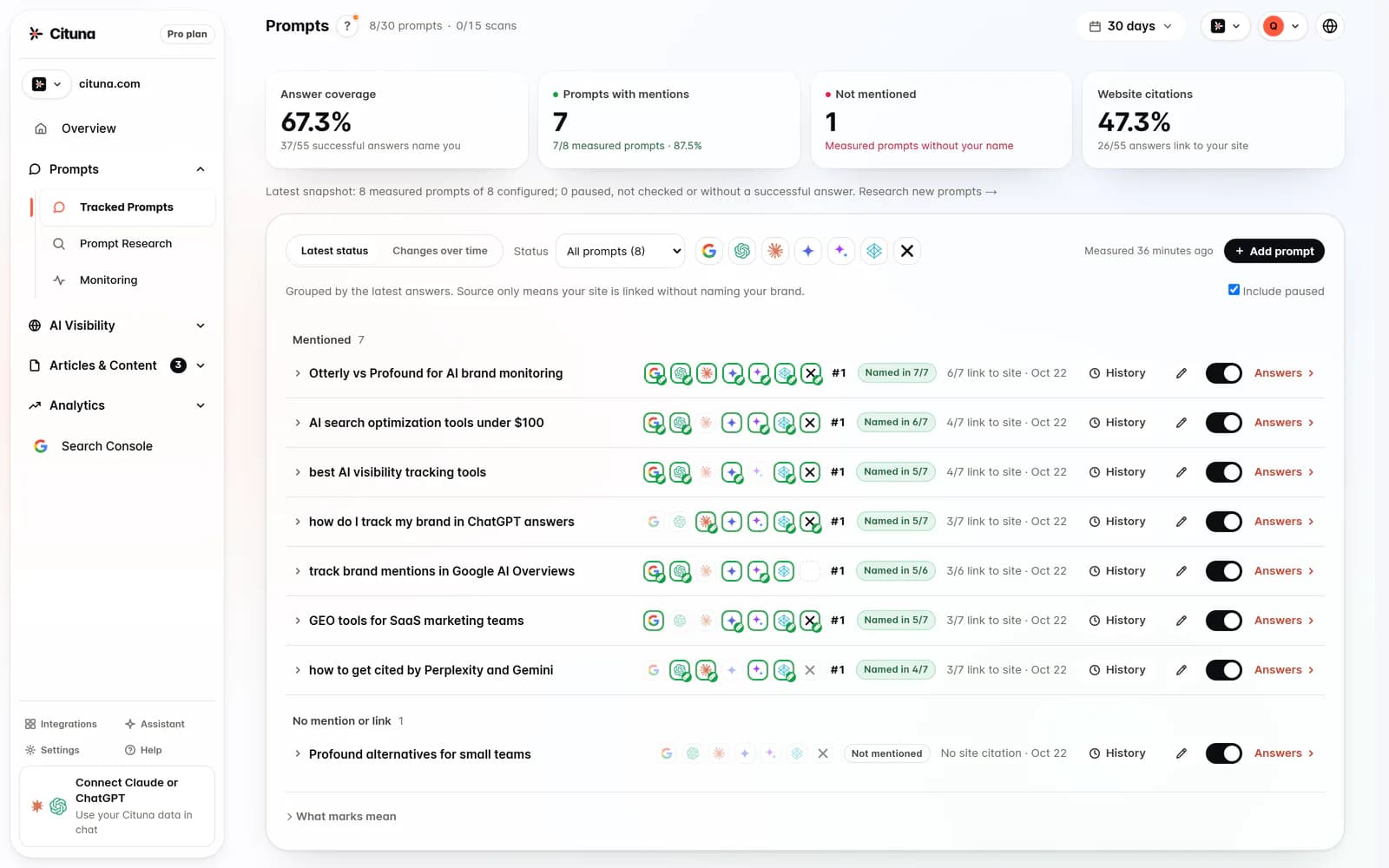
Cituna takes the opposite approach. There is nothing to build: every day it checks your prompts on seven engines, finds the ones where a rival is named and you are not, adds the searches in your Search Console that your site has no page for, and its AutoSEO turns them into articles that link to your real pages and publish to your CMS, or wait for your review. If you want an agent to drive it, Cituna’s MCP write tools on Pro let an agent run scans, edit prompts and queue articles. A 2026 roundup of AirOps alternatives found by web search also names general-purpose builders such as Writer, Metaflow AI and Zapier; they are outside this comparison, which only includes tools whose own pages we could date for writing content or tracking AI answers.
In the AI content space
If content is the half of AirOps you use, three tools here write it. Writesonic’s writer researches from your files and the web, writes in your brand voice and exports to WordPress, Sanity, Contentful, Webflow or Ghost, from $99 a month on Writesonic’s Starter plan. Jasper is a marketing platform rather than an SEO tool, at $69 a seat a month on Jasper’s Pro plan, with brand voices, knowledge assets and audiences. Cituna writes from a different starting point, the buyer questions AI engines answer without you, and publishes the result: 30 articles a month on Starter ($49), 90 on Pro ($119) and 300 on Max ($399). AthenaHQ’s Starter lists a content optimization agent, and its page does not state publishing to a CMS. Peec AI, Scrunch AI and Otterly.ai track AI answers and do not write articles.
For LLM citation tracking
AirOps’ pricing page sells answer-engine insights: ChatGPT only on Solo, and on Pro a wider set, with OpenAI, Google, Perplexity, Google AI Studio, Claude, Microsoft Copilot and Grok named on the page. If tracking which pages AI engines cite is what you need, the tracking tools here show the cited pages themselves.
- Otterly.ai’s Citations Report lists the URLs cited for your prompts, filters them by domain and domain category, and shows each URL’s citations over time with the engine each one appeared on. Otterly.ai’s Lite plan is $29 a month for 15 prompts on four engines, Microsoft Copilot among them.
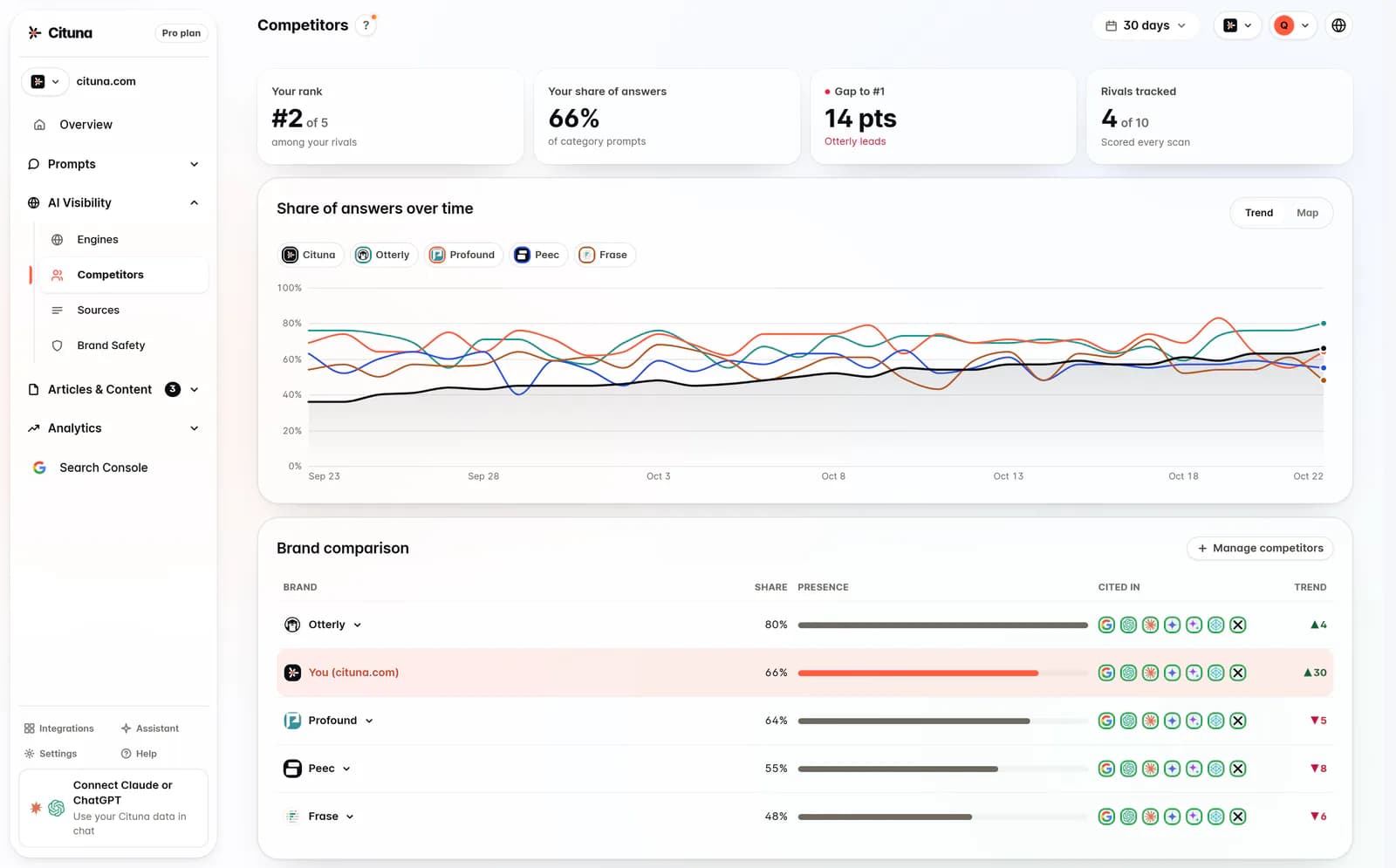
- Cituna lists the pages the engines cited for your prompts, how often each was cited, which engines cited it and which competitors it was cited for, and checks each cited page for whether you are linked, mentioned without a link or absent. It runs daily on ChatGPT, Perplexity, Gemini, Claude, Grok, Google AI Overviews and Google AI Mode, with 10 prompts on Starter at $49 a month, 30 on Pro and 90 on Max.
- Peec AI’s Sources section has Domains and URLs pages and separates the sources a model reads from the citations its final answer references. Peec AI’s Starter is $95 a month for 50 prompts on three models you pick.
- Profound shows every cited URL for each prompt it monitors, sorts the sources into categories and breaks citation share down by platform, topic and prompt. Profound’s pricing page offers a 7-day trial on three engines, then an Enterprise contract with no published price.
- Scrunch AI’s Core plan, $250 a month, includes citation and source tracking on ChatGPT, Perplexity, Google AI Overviews and Microsoft Copilot; the page we read does not say whether it lists cited URLs.
For more tools that show cited domains and URLs, see our AI citation tracking tools roundup, or compare Otterly.ai alternatives and Peec AI alternatives. To see which pages the seven engines cite for your own buyer questions, and which of them name a competitor but not you, start a free trial: three days, card required, cancel anytime.
For content refresh automation
AirOps refreshes existing pages through its workflows and grids, including pages your team wrote. Cituna’s refresh is narrower and automatic. When an article AutoSEO published has impressions in Search Console but is not earning the click, Cituna reads that page’s own search queries, writes a better SEO title and meta description, adds up to two FAQ answers, and sends the article back to your site as an update on the same URL with the same publication date. Cituna never rewrites the H1 or the body, refreshes at most three pages a site a day by default, waits 21 days before refreshing a page again, and does not auto-refresh a site that has asked to review every change first. AutoSEO does not refresh pages it did not write. The vendor pages we read for Writesonic, Jasper, AthenaHQ and the trackers do not describe refreshing live pages automatically.
Cituna vs AirOps: the side-by-side
Here is how Cituna and AirOps compare, with Writesonic and AthenaHQ for context, since each covers part of both halves. Read the engine rows first: the right tool is the one that covers the engines your buyers use.
| What you get | CitunaThat’s us | AirOps | Writesonic | AthenaHQ |
|---|---|---|---|---|
| Published entry price | $49 / mo | $99 / mo | $0, then $295 / mo | |
| Claude tracked | Pro | Enterprise | $295 plan | |
| Grok tracked | Pro | — | $295 plan | |
| Microsoft Copilot | Pro | — | ||
| Checked daily on every engine | — | — | — | |
| Articles written and published | 30 / mo | — | ||
| Custom workflow builder and grids | — | — | ||
| Generated technical fixes (schema, FAQ markup, llms.txt) | — | Site audit fixes | — | |
| Search Console integration | — | $295 plan |
AirOps from airops.com/pricing, October 5, 2026: Pro lists insights across 7+ answer engines, and the page names OpenAI, Google, Perplexity, Google AI Studio, Claude, Microsoft Copilot and Grok. Writesonic from its pricing page, September 25, 2026: its self-serve plans track ChatGPT, Gemini and Google AI Overviews, with Claude and Perplexity on Enterprise. AthenaHQ from its pricing page, October 1, 2026; Cituna from cituna.com/pricing, our own published plans. A dash means the vendor’s page does not say. Cituna checks seven AI engines daily and does not track Microsoft Copilot.
The picks that cover both halves
1. Writesonic (best for an article writer with GEO tracking)
Writesonic is an AI article writer with GEO tracking in the same account, the nearest single-product match to AirOps’ shape. Writesonic’s writer researches from your own files and the web, writes in your brand voice and exports to WordPress, Sanity, Contentful, Webflow or Ghost. On September 25, 2026 Writesonic’s self-serve plans were Starter at $99 a month ($79 billed yearly), Basic at $249 and Growth at $499, each with a free start and no card. Those plans track ChatGPT, Gemini and Google AI Overviews; Claude, Perplexity and the rest of its ten platforms are on Enterprise.
- Best for: a content team whose main output is long-form articles, with a light view of AI visibility.
- What it costs: Writesonic charges $99, $249 or $499 a month, and Enterprise is on request.
- Where it falls short: three engines on self-serve plans, so Perplexity and Claude need a contract. See our Writesonic GEO alternatives.
2. Cituna (best for tracking seven engines and publishing the fix)
Cituna starts from measurement and finishes with publishing, the same loop AirOps sells, without a workflow to build. Every day it asks ChatGPT, Perplexity, Gemini, Claude, Grok, Google AI Overviews and Google AI Mode the questions your buyers ask and shows which prompts name a rival and not you. Its AutoSEO turns those gaps, plus the searches in your Google Search Console that your site has no page for, into answer-first articles: 30 a month on Starter, 90 on Pro and 300 on Max. It reads your sitemap so it links to your real pages and does not write a second page for a topic you already cover, and it publishes to WordPress, Shopify, Sanity, a GitHub repository or any CMS by signed webhook, or holds each article for your review. It also writes the technical fix for each gap: schema, FAQ markup, llms.txt and page edits.
- Best for: a brand or agency that wants to be named in AI answers and wants the articles that get it there written and published, without designing pipelines.
- What it costs: $49, $119 or $399 a month for 10, 30 or 90 prompts, every plan on the same seven engines (cituna.com/pricing).
- Where it falls short against AirOps: no custom workflow builder, grids or bulk refresh of pages you wrote yourself, and it does not track Microsoft Copilot.
Alternatives for the content half
3. Jasper (best for on-brand marketing content across formats)
Jasper is an AI marketing platform rather than an SEO tool. Jasper’s pricing page, read October 5, 2026, lists Pro at $69 a seat a month, or $59 billed annually, with one seat, its Canvas, agents for core marketing workflows, two brand voices, five knowledge assets and three audiences. Business is custom on a 12-month minimum and adds agents for complex workflows including GEO, a no-code builder for custom agents, Jasper Grid and API access.
- Best for: a marketing team that wants governed, on-brand content across many formats, not only SEO pages.
- What it costs: $69 a seat a month on Pro; Business is custom.
- Where it falls short: Jasper’s pricing page does not state AI answer tracking on either plan, and its GEO agent is on Business, so you would pair Pro with a tracker.
Alternatives for the tracking half
4. AthenaHQ (best for a free start, then eleven models)
AthenaHQ sits nearest the middle. AthenaHQ’s free Essential tier gives 300 credits, one per AI response, on ChatGPT, Perplexity, Google AI Overviews, Gemini and Microsoft Copilot. AthenaHQ’s Starter, at $295 a month, gives 3,600 credits across eleven models, adding Google AI Mode, Claude, Grok, DeepSeek, Meta AI and Mistral, connects GA4 and Google Search Console, and lists a content optimization agent (athenahq.ai/plans, October 1, 2026; the agent re-checked October 5, 2026). The page does not state publishing to a CMS.
- Best for: a mid-market team that wants to test free, then track many models with some content help.
- What it costs: AthenaHQ’s Essential is free, its Starter is $295 a month (17% less billed annually), and Enterprise is custom.
- Where it falls short: credits count responses, so adding models cuts your prompt budget, and the API is a paid extra.
5. Profound (best for prompt-volume data on a contract)
Profound is a tracker for large brands. Profound’s pricing page, read October 1, 2026, gives a free 7-day trial of 50 prompts a day on ChatGPT, Gemini and Google AI Overviews from a prompt set chosen for your industry, then a custom Enterprise contract. Profound’s Enterprise list adds Perplexity, Google AI Mode, Microsoft Copilot, Claude, DeepSeek and Exa Search; Grok is not on it. Profound’s distinctive data is prompt volume, an estimate of how often each question is asked.
- Best for: an enterprise team on AirOps Enterprise that wants deeper demand data.
- What it costs: Profound’s Enterprise pricing is on request.
- Where it falls short: another sales-led contract, and no Grok. See our Profound alternatives.
6. Scrunch AI (best for site audits beside tracking)
Scrunch AI publishes a first plan for an enterprise-grade tracker. Scrunch AI’s Core is $250 a month for 125 prompts and 5,000 responses on ChatGPT, Perplexity, Google AI Overviews and Microsoft Copilot, with five site audits a month, one brand, five users and a 7-day trial. Claude, Gemini, Meta AI, Google AI Mode, Grok and the API are on Scrunch AI’s Enterprise plan (scrunch.com/pricing, October 1, 2026).
- Best for: a team that wants site audits next to AI tracking and can grow into an enterprise plan.
- What it costs: Scrunch AI’s Core is $250 a month, and Enterprise is custom.
- Where it falls short: most engines past the first four need Enterprise, and it does not write articles.
7. Peec AI (best for sentiment and competitor dashboards)
Peec AI is a reporting tool. Peec AI’s Starter is $95 a month, or $80 billed annually, for 50 prompts on three models you pick from ChatGPT, Google AI Mode, Google AI Overviews, Microsoft Copilot, Gemini and Naver AI, with unlimited users and sentiment on how each answer describes you. Pro ($245) and Advanced ($495) raise the prompts to 150 and 350, and Claude and Grok are on Enterprise (peec.ai/pricing, October 1, 2026).
- Best for: a brand team that reports share of voice and tone and has writers of its own.
- What it costs: Peec AI charges $95, $245 or $495 a month.
- Where it falls short: three engines per plan, Claude and Grok only on Enterprise, and no content production. See Cituna vs Peec AI.
8. Otterly.ai (best for Microsoft Copilot on a small budget)
Otterly.ai is a light monitor with a $29 entry plan. Otterly’s Lite is $29 a month for 15 prompts checked daily on ChatGPT, Google AI Overviews, Perplexity and Microsoft Copilot. Otterly sells Gemini and Google AI Mode as $9 add-ons each and Claude as a $29 add-on, and does not offer Grok (otterly.ai/pricing, October 1, 2026).
- Best for: a solo marketer who wants a Copilot-inclusive monitor and will write the content separately.
- What it costs: Otterly charges $29, $189 or $489 a month.
- Where it falls short: a small prompt set, paid add-ons for three engines, and no fixes or articles.
Which AirOps alternative fits you
- You mainly used AirOps to write articles: Writesonic, or Jasper if your content goes well beyond SEO.
- You want all seven engines, Claude and Grok included, tracked daily and the articles that improve it published for you, at a published price: Cituna, from $49 a month.
- You want a free start and many models: AthenaHQ.
- You need enterprise demand data: Profound.
- You report sentiment to leadership: Peec AI.
- Your buyers use Microsoft Copilot and the budget is small: Otterly.ai, or Scrunch AI on Core.
- You build custom content pipelines and need grids and bulk refreshes: staying on AirOps is reasonable.
For more tools side by side, see our rundown of the best AI visibility tools.
Drafted with AI assistance from our own research and Search Console data, and reviewed by Rahul A before publishing. Rules and prices change; check the linked official source before you act.