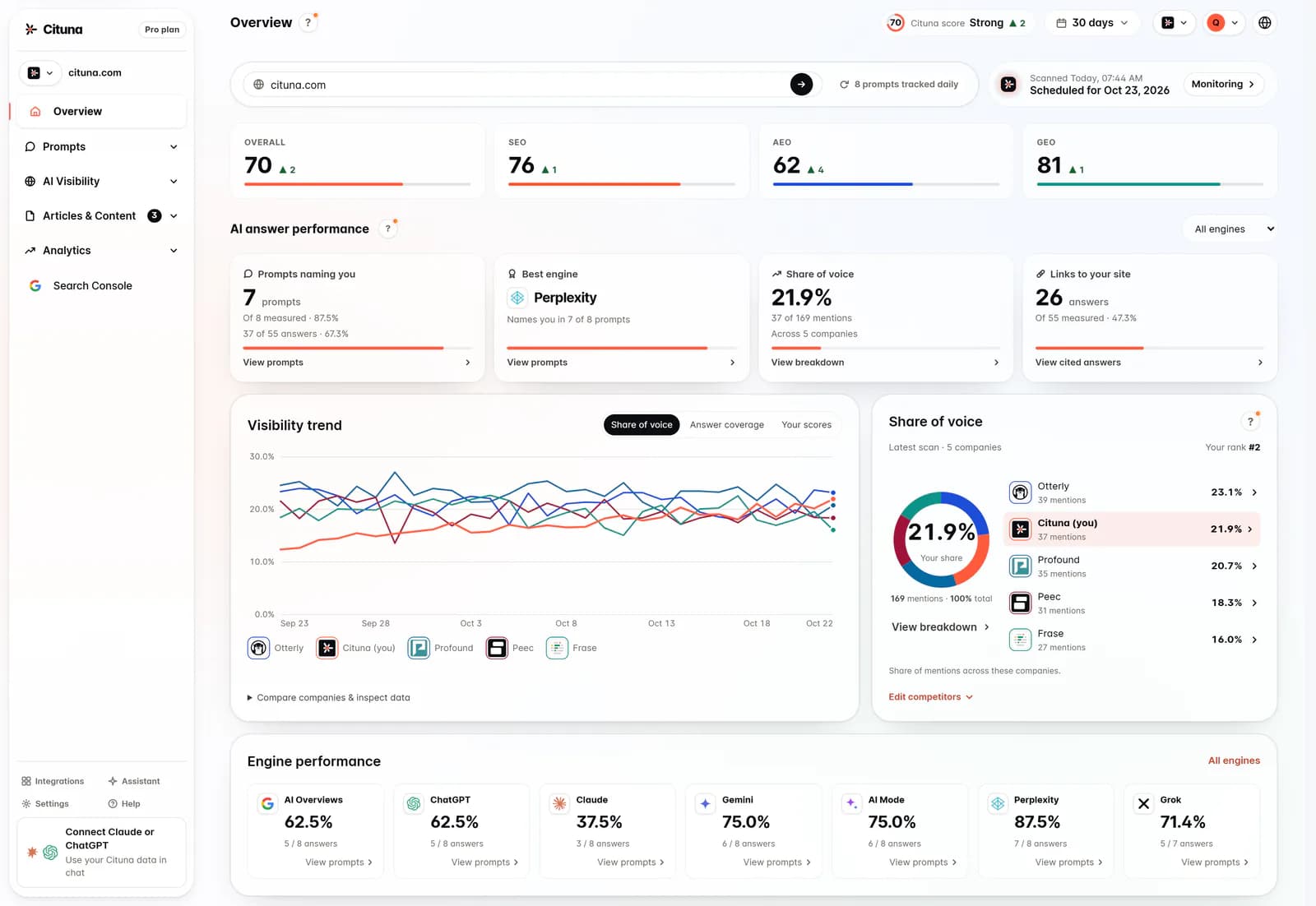
If Trakkr’s $100 Growth tier has you boxed into one brand and 50 prompts, with multi-brand waiting all the way up at a $500 Scale plan and no Search Console tie-in to prove the work moved traffic, you are shopping for more room and more proof. Cituna gives you both from $49: seven engines checked daily, a native Search Console loop, and 10 brands by Max ($399) rather than a $500 jump, plus the fix for each gap and 30 articles a month published to your site. Trakkr is a polished, well-built monitor (wide model coverage, an MCP server at entry, a strong content engine), and below we weigh it honestly against the alternatives on entry price and headroom, Claude and Grok, MCP and Search Console proof, and what you actually pay. Competitor facts were compiled from public pricing pages on July 16, 2026, with Trakkr’s re-read on October 17, 2026.
A note on fairness:
Why people look for Trakkr alternatives
Trakkr is a good tool, and none of the reasons below make it a bad one, they are simply where its published plans stop matching what a growing or multi-brand team needs. Teams evaluating Trakkr and then shopping around usually cite a consistent set of triggers (all from trakkr.ai/pricing, as of October 17, 2026):
- The $100 Growth tier caps you at 50 prompts and a single brand. That is enough for one focused brand, but the prompt and brand ceiling arrives fast once you are tracking a real buyer-question set.
- Multi-brand means a $500 jump. The moment you need to monitor more than one brand, an agency, a portfolio, a house of products, the next published step is the $500/mo Scale tier, with little in between.
- There is no Google Search Console loop to prove outcomes. Trakkr’s pricing page lists no Search Console connection, so it is harder to tie AI citations back to real clicks and impressions and show the work actually moved traffic.
If one or more of those is the reason you are here, the table below compares Trakkr against three alternatives on exactly those points.
The side-by-side matrix
Everything below reflects each vendor’s entry paid tier as published on their own pricing page on July 16, 2026 (Trakkr’s on October 17, 2026), not the maximum an enterprise or agency contract can unlock.
| What you get | CitunaThat’s us | Trakkr | LLMrefs | Omnia |
|---|---|---|---|---|
| Entry price / month | $49 | $100* | $79 | €79 |
| AI engines tracked | 7 | 8 | 11 | 7 |
| Claude tracked | On request | |||
| Grok tracked | ||||
| Microsoft Copilot | On request | |||
| Google AI Overviews | — | — | ||
| Search Console integration | ||||
| MCP access at entry | ||||
| Generated fixes | Free tools | Free tools | Weekly plans | |
| Free trial | 3 days (card) | 14 days (card) | 7 days | 14 days |
Compiled from each vendor’s public pricing page on July 16, 2026, with LLMrefs’ trial and Omnia’s Claude and Copilot terms re-read October 1, 2026 and Trakkr re-read October 17, 2026 (Trakkr from trakkr.ai/pricing; LLMrefs from llmrefs.com; Omnia from useomnia.com/pricing); Cituna from cituna.com/pricing, our own published plans. Prices change often, verify before buying. ‘*’ = varies by tier or composition: Trakkr’s $100/mo Growth covers one brand, 50 prompts, 3 seats and daily tracking, with multi-brand ($500/mo Scale, 10 brands) above it. Trakkr says all 8 of its models (ChatGPT, Claude, Gemini, Perplexity, Google AI Overviews, Grok, DeepSeek and Meta AI) are included on both Growth and Scale, and its 14-day trial asks for a card. Omnia’s ‘no Grok’ cell is from its own product notes. A dash means not specified in our source data for that tool, so we leave it blank rather than guess. Trakkr’s ‘Free tools’ generated-fixes cell reflects its standalone free tools (an AI site grader and an llms.txt generator), not a per-scan fix layer. Notes: all seven Cituna engines are checked daily; Cituna MCP read tools are included from $49, write tools from Pro ($119). Spot an error? Tell us and we will correct it.
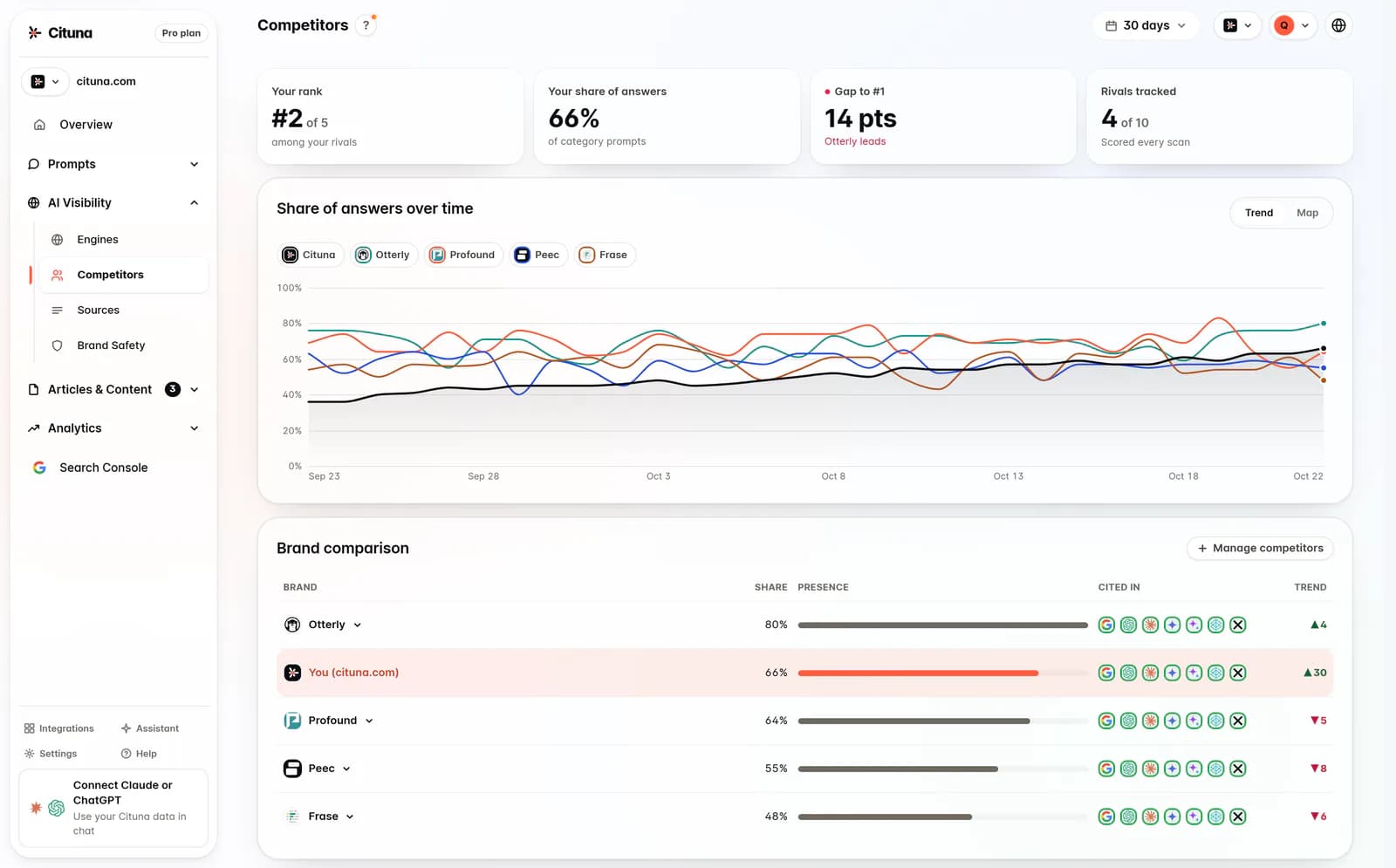
Read the matrix by the row that matters most to you, or see the Cituna vs Trakkr comparison for the two side by side. Cituna pairs Search Console proof with MCP at a $49 entry, checks all seven engines daily, and reaches 10 brands on Max ($399) without Trakkr’s $500 jump. LLMrefs is the pick for many domains and the longest engine list if weekly data is enough, and Trakkr if you want eight models checked daily and its content engine and a single brand fits at $100.
What Trakkr does well
Give Trakkr its due, because it should shape your decision. Trakkr is a polished, content-forward AI-search monitor that tracks 8 models, including Grok, and ships an MCP server at its entry tier, so programmatic access is not gated to an enterprise contract. Trakkr also runs a content engine, an AI Traffic Index and live leaderboards, and it publishes its pricing openly. Trakkr’s Growth tier is $100/mo for one brand, 50 prompts and all 8 models tracked daily (as of October 17, 2026), and it offers a 14-day trial, which asks for a card, plus free standalone tools, an AI site grader and an llms.txt generator. The trade-offs on Trakkr are the ones above: the entry tier is a single brand and 50 prompts, multi-brand means the $500/mo Scale plan, and Trakkr’s pricing page lists no Google Search Console integration to tie citations back to real traffic. A strong pick for a single brand that wants broad coverage, MCP access and a content-rich tool, and less of a fit if you want a lower entry price, the Search Console proof loop, or several brands without the Scale-tier jump.
The alternatives in detail
How this list works: every entry tracks how AI engines mention and cite a brand. Cituna comes first: it is our product, and it tracks all seven engines daily, writes the fixes and publishes articles from $49/mo. After that the numbers help you find your way; they are not a ranking.
1. Cituna (best for Search Console proof and the work done, from $49)
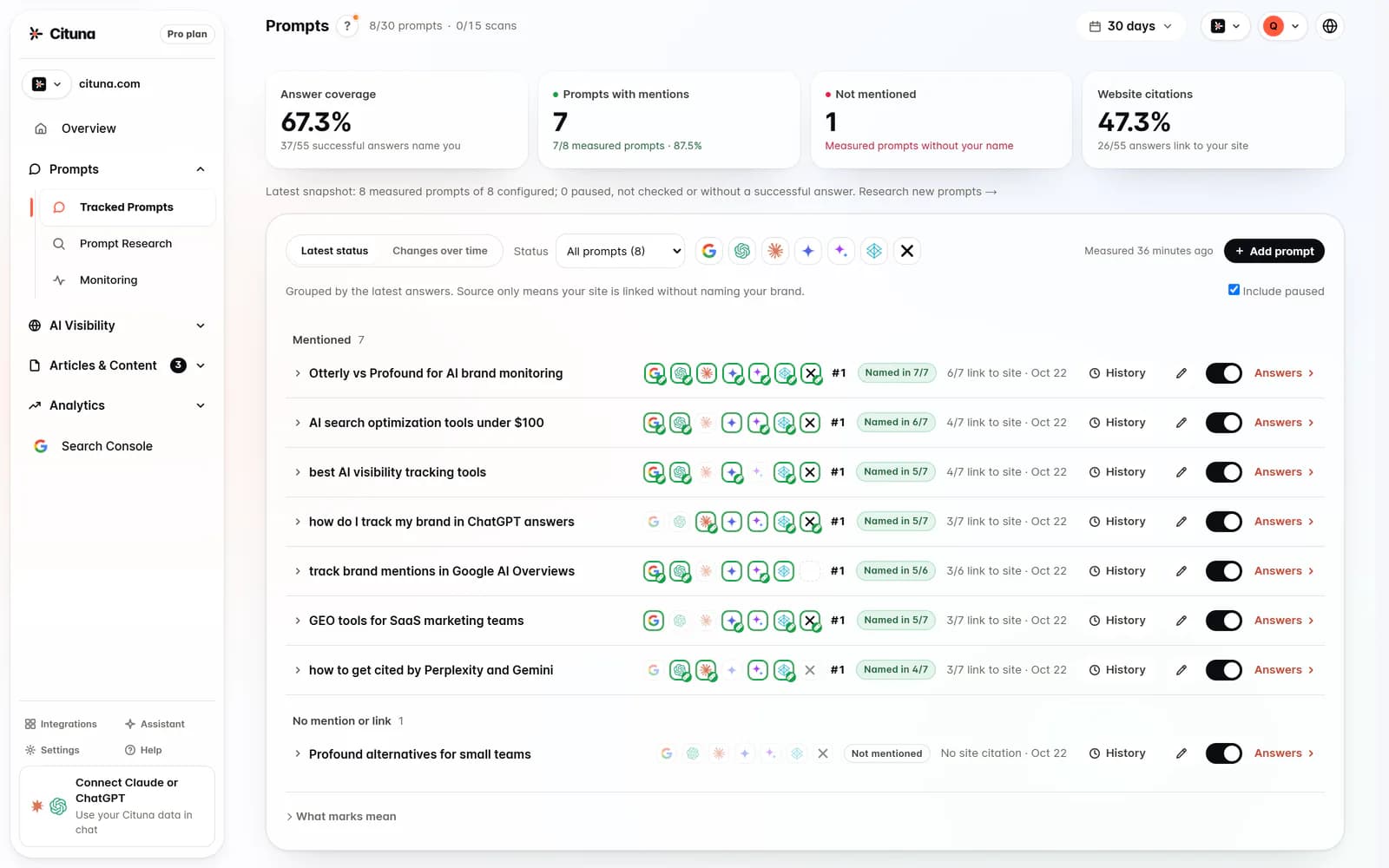
Where Trakkr leads with engine breadth and a content engine, Cituna leads with the proof loop and the fix: it scans how ChatGPT, Perplexity, Gemini, Claude, Grok, Google AI Overviews and Google AI Mode cite your brand, all seven checked daily on every plan, shows the exact buyer prompts where you are missing, and generates the fix for each gap (schema, FAQ markup, llms.txt and the page changes). Cituna’s AutoSEO writes 30 articles a month on Starter and publishes them to WordPress, Shopify, a GitHub repo or any CMS by webhook. All seven engines are in the $49/mo Starter; Pro ($119) adds write-enabled MCP and backlink, keyword and SERP-rank data, and Max ($399) is built for agencies and high-volume sites, 10 brands, 90 tracked prompts, daily scans on every brand, 15 team seats and priority support, so multi-brand tracking never means a $500 jump; API keys come with every paid plan. Beyond Max, custom Enterprise plans add tailored prompt pools, brands and engine cadences with invoiced billing and priority onboarding; Starter, Pro and Max are self-serve, with no demo required. A native Google Search Console integration ties the work back to real clicks, and a built-in MCP server is included from $49 so you can query your scans from Claude or any MCP client, read tools on Starter, write actions like running a scan on Pro. MCP is not unique to us (Trakkr ships one at entry too); what is rarer is pairing it with Search Console at this price. We run Cituna on our own site daily, too, the same seven-engine scan, gap list and generated fixes you get.
2. LLMrefs (best for many domains on one flat fee, refreshed weekly)
LLMrefs is built around breadth of projects and engines. LLMrefs’ published pricing is $79/mo flat with unlimited projects (as of July 16, 2026), so several domains cost the same as one, and LLMrefs lists 11 engines, Claude, Grok and Copilot among them, the longest engine list on this page. The trade-off is cadence and proof: LLMrefs refreshes weekly rather than daily, and has no Search Console integration or MCP server. A fair pick if flat-rate, multi-domain monitoring is the priority and a weekly refresh is frequent enough for you.
3. Omnia (best for small teams that do not need Grok)
Omnia is a small-team-focused monitor priced in euros. Omnia’s published entry plan is €79/mo for four engines by default, with Claude, Gemini and Microsoft Copilot available on request (as of October 1, 2026), plus an MCP server and weekly action plans. Omnia does not track Grok, so if Grok is an engine your buyers use, that is a gap to weigh against its price, and Omnia has no Search Console integration. A reasonable fit for a small team that wants a lighter, EUR-billed tool with Copilot and does not need Grok.
The category runs wider than the tools above, from enterprise platforms at the top end to free single-shot checkers at the bottom, and we price out the full field, side by side, in our best AI visibility tools rundown.
How to switch from Trakkr
Moving your monitoring across is a short job, because the inputs are the same prompts and competitors you already track:
- Export your prompts and competitors from Trakkr. Copy the buyer questions you monitor and the competitor list you benchmark against, that set is the only thing you truly need to carry over.
- Recreate them in Cituna. Add your domain (or each brand, if you are consolidating several), paste the same prompts and competitors, and let it map them across all seven engines.
- Run your first scan. Your first run establishes a baseline across ChatGPT, Perplexity, Gemini, Claude, Grok, Google AI Overviews and Google AI Mode, and surfaces the prompts where you are missing plus the generated fixes to close them.
- Connect Google Search Console. Link GSC so the tool can tie AI citations back to real clicks and impressions, the proof step Trakkr’s pricing page does not list, and, if you want the scans and fix statuses in your own workflow, connect the MCP server.
The fastest way to compare is to point both tools at the same prompts and domain during a trial and see which one shows you the gaps, and the outcomes, you care about. For the wider field, see our rundown of the best AI visibility tools.
Drafted with AI assistance from our own research and Search Console data, and reviewed by Rahul A before publishing. Rules and prices change; check the linked official source before you act.