What Scrunch AI pricing actually pays for
Scrunch AI pricing should be evaluated as the cost of turning AI search observations into marketing decisions, rather than as a simple software access fee. The useful question is what your team can learn, how often it can learn it, and whether someone has time to act on those findings.
Ask which parts of the service are included in the plan you are considering. Clarify the engines, prompts, markets, brands, competitors, users, reporting periods, and historical data covered. Confirm whether monitoring and recommendations are part of the same package or whether they require separate work from your team. A low subscription cost can still be poor value if the coverage is too narrow to represent real customer questions.
The commercial value also depends on the decision being supported. Scrunch may help a team identify missing mentions, weak competitor positioning, or changes in how ChatGPT, Perplexity, Gemini, Claude, Grok, Google AI Overviews, and Google AI Mode describe a category. Those observations only become valuable when they change content, distribution, product messaging, or sales enablement. Price the complete decision process, not the login.
For more context, read AI Visibility Services for Small Businesses: What to Buy.
Compare Scrunch plans beyond the headline price
Compare Scrunch plans by normalising the amount of useful coverage each plan provides, because headline prices can hide different limits and workloads. Build a small comparison sheet with the same questions for every option.
Record the number of brands, domains, locations, languages, engines, prompts, competitors, and users covered by each plan. Add the reporting frequency, retention period, export options, alerting, support, onboarding, and any usage or overage rules. Mark each item as included, capped, optional, or unclear. A plan that looks inexpensive may become less attractive when the coverage needed for one market or business unit is treated as an add-on.
Next, calculate cost per decision-ready finding. Count only findings that lead to a documented action, such as revising a comparison page, correcting an inaccurate description, or testing a new answer format. Do not count every recorded response as an insight. This comparison gives founders and marketing leads a more honest basis for choosing a plan than a feature checklist, especially when the team has limited capacity to review results.
For more context, read How to Compare AI Visibility Optimization Tools.
Which Scrunch pricing costs are easiest to miss
The largest overlooked cost is usually the work required to interpret findings and make changes, not the subscription itself. Scrunch pricing should therefore be reviewed alongside internal labour, content production, analytics setup, and review time.
Estimate who will define prompts, check whether responses are relevant, investigate why a company is absent, brief writers, update pages, and report outcomes. Include time spent separating a meaningful change in visibility from normal variation between responses. If several regions or product lines are involved, account for translation, subject-matter review, legal approval, and local search context.
Also ask about commercial boundaries before agreeing to a plan. Confirm billing currency, contract length, renewal terms, cancellation notice, onboarding fees, user limits, data retention, exports, support expectations, and what happens when usage exceeds the allowance. Rules and packaging can change, so written confirmation of current terms matters more than an old review or cached pricing page. The decision rule is simple: add every recurring and one-off cost required to reach a usable recommendation, then compare that total with the value of the decisions it enables.
When Scrunch makes financial sense for a small team
Scrunch makes financial sense when a team has enough important AI-search questions, enough ability to act on findings, and enough commercial value at stake to justify recurring monitoring. A small company does not need a large content department, but it does need a named owner and a repeatable response process.
Start with the business areas where an answer from ChatGPT, Perplexity, Gemini, Claude, Grok, Google AI Overviews, or Google AI Mode could influence a purchase. Prioritise high-margin products, category comparisons, urgent problem searches, and questions where competitors are being recommended instead. Then ask whether the team can change the pages, proof points, technical documentation, or distribution channels that influence those answers.
Scrunch is a weaker fit when the company has little search demand, no content capacity, or no agreement on which customers and questions matter. Buying measurement before deciding what action follows creates an expensive reporting habit. A sensible first commitment has a defined audience, a short list of commercial questions, a review cadence, and an exit test. If the team cannot name the action that a finding would trigger, the plan is probably premature.
What to measure before choosing a Scrunch plan
Before choosing a Scrunch plan, measure the business importance of the questions you want to monitor, not just the number of prompts you can track. The baseline should show where an answer matters and what a better answer would change.
Create a prompt set from real customer language, sales calls, support questions, comparison searches, and category research. Group prompts by intent, such as learning, evaluating, switching, or buying. For each prompt, record whether your company is mentioned, whether the description is accurate, whether a competitor is preferred, and whether the answer includes evidence that could influence trust. Repeat the same set carefully so changes can be interpreted rather than guessed.
Then connect each group to a measurable business signal, such as qualified visits, demo requests, sales conversations, or assisted pipeline. The signal may not move quickly, and attribution will be imperfect, but it gives the subscription a decision context. This approach prevents a common failure mode: selecting a plan because it produces more observations, even when those observations are disconnected from the customers and pages the company can actually influence.
Estimate a break-even point for Scrunch
Estimate Scrunch's break-even point by comparing the subscription and operating cost with the value of decisions that would not have happened without the monitoring. Use a conservative model, because visibility changes are difficult to attribute cleanly.
Add the recurring subscription, internal review time, content or technical work, and any agency or specialist support. Next, identify the smallest commercial improvement that would cover that total. Depending on the business, the improvement might be one additional qualified opportunity, a retained customer, a higher-value sales conversation, or avoided work caused by inaccurate positioning. Use contribution margin or expected gross profit rather than top-line revenue when possible.
The important distinction is between an observed change and an attributable outcome. A better answer in ChatGPT or Google AI Overviews does not automatically create revenue, and a later opportunity may have several influences. Keep a decision log that records the finding, action, date, affected pages or messages, and subsequent business signal. Review the model after a defined trial period. If the team cannot link findings to decisions or plausible commercial outcomes, pause expansion rather than assuming a larger plan will solve the problem.
Who should own the work after a Scrunch purchase?
A marketing lead should own the business priorities, while a named operator owns the weekly interpretation and follow-through. Scrunch pricing is poor value when responsibility stops at collecting reports.
The owner should maintain the prompt set, remove questions that no longer represent the market, investigate material changes, and route actions to the right person. Content teams may update explanations and comparison pages. Product or subject experts may correct technical claims. Sales teams can test whether revised positioning matches customer objections. Leadership should decide which commercial areas deserve more effort when resources are limited.
Define a lightweight workflow before buying. A review should answer four questions: what changed, why might it matter, what can we change, and when will we check the result? Record decisions and rejected actions, because a stable answer may be useful evidence that no change is needed. The workflow should also distinguish between ChatGPT, Perplexity, Gemini, Claude, Grok, Google AI Overviews, and Google AI Mode, since different engines can surface different sources and wording. Clear ownership turns monitoring into a managed experiment instead of another dashboard.
Should you buy Scrunch now, delay, or choose another route?
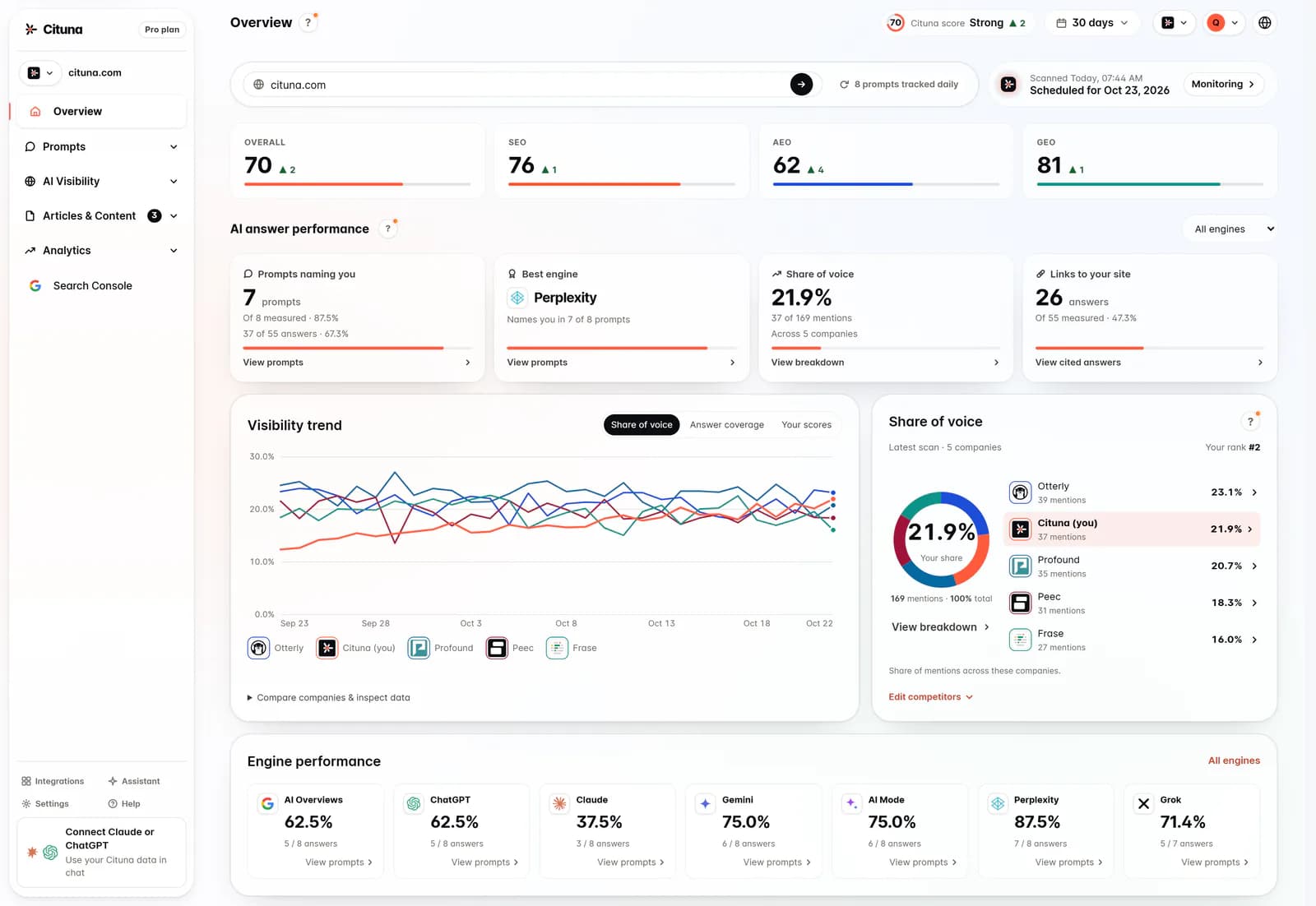
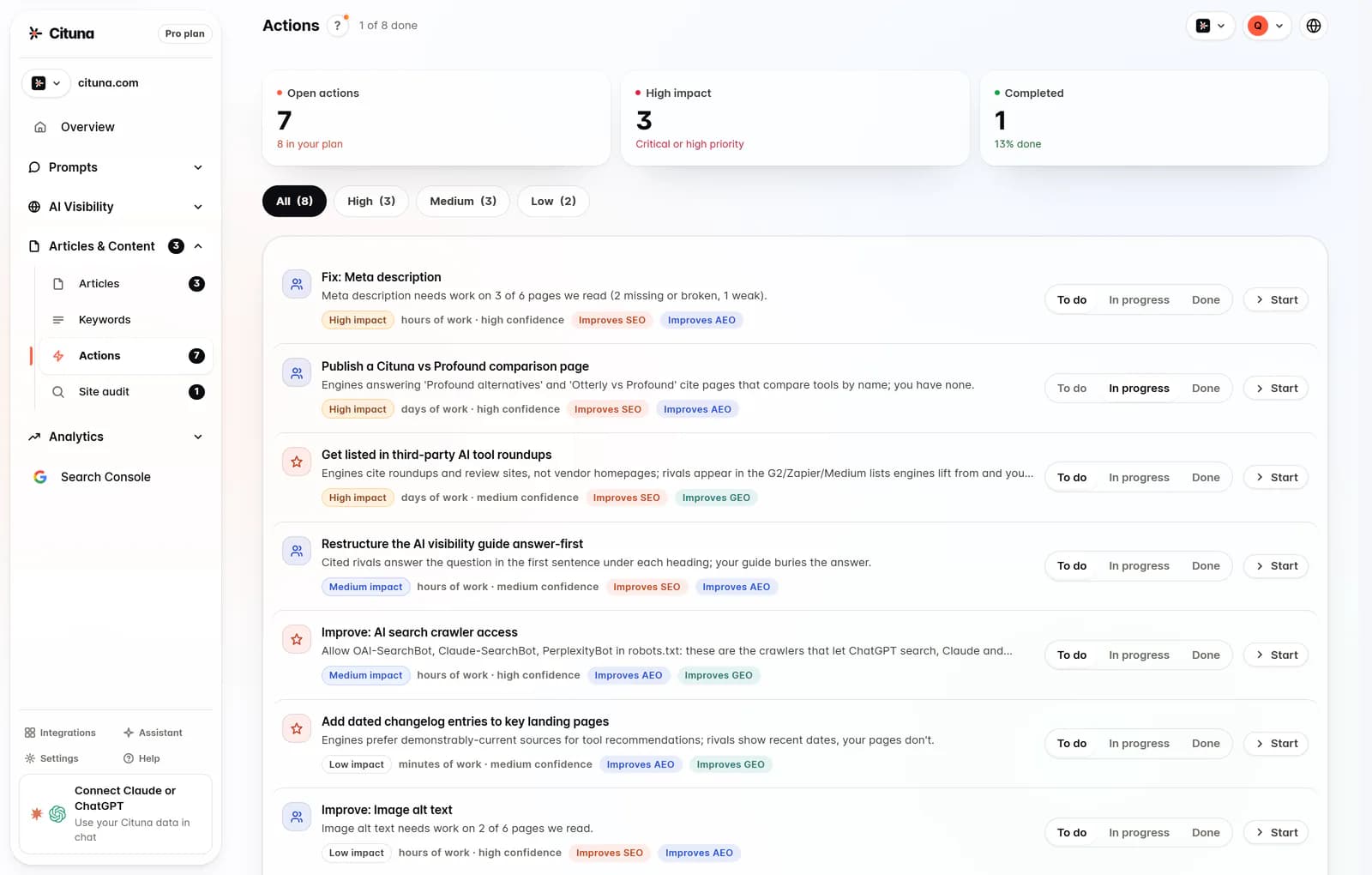
For a team that wants seven AI engines checked every day and the fixes produced as well, the pick is Cituna: it generates the fix for each gap and its AutoSEO writes and publishes articles, from $49 a month. Buy Scrunch when the team has a defined decision problem and the capacity to act; delay when the problem is unclear; and choose another route when a simpler process can answer the question adequately. The right decision is about operational fit, not whether the platform has the longest feature list.
Buy when competitors are appearing in commercially important answers, the company can change the underlying evidence and messaging, and a person can review findings consistently. Delay when the team still needs to define its audience, priority questions, baseline, or success signal. In that case, begin with a manual sample of representative prompts and a decision log. The exercise often reveals whether monitoring will change anything.
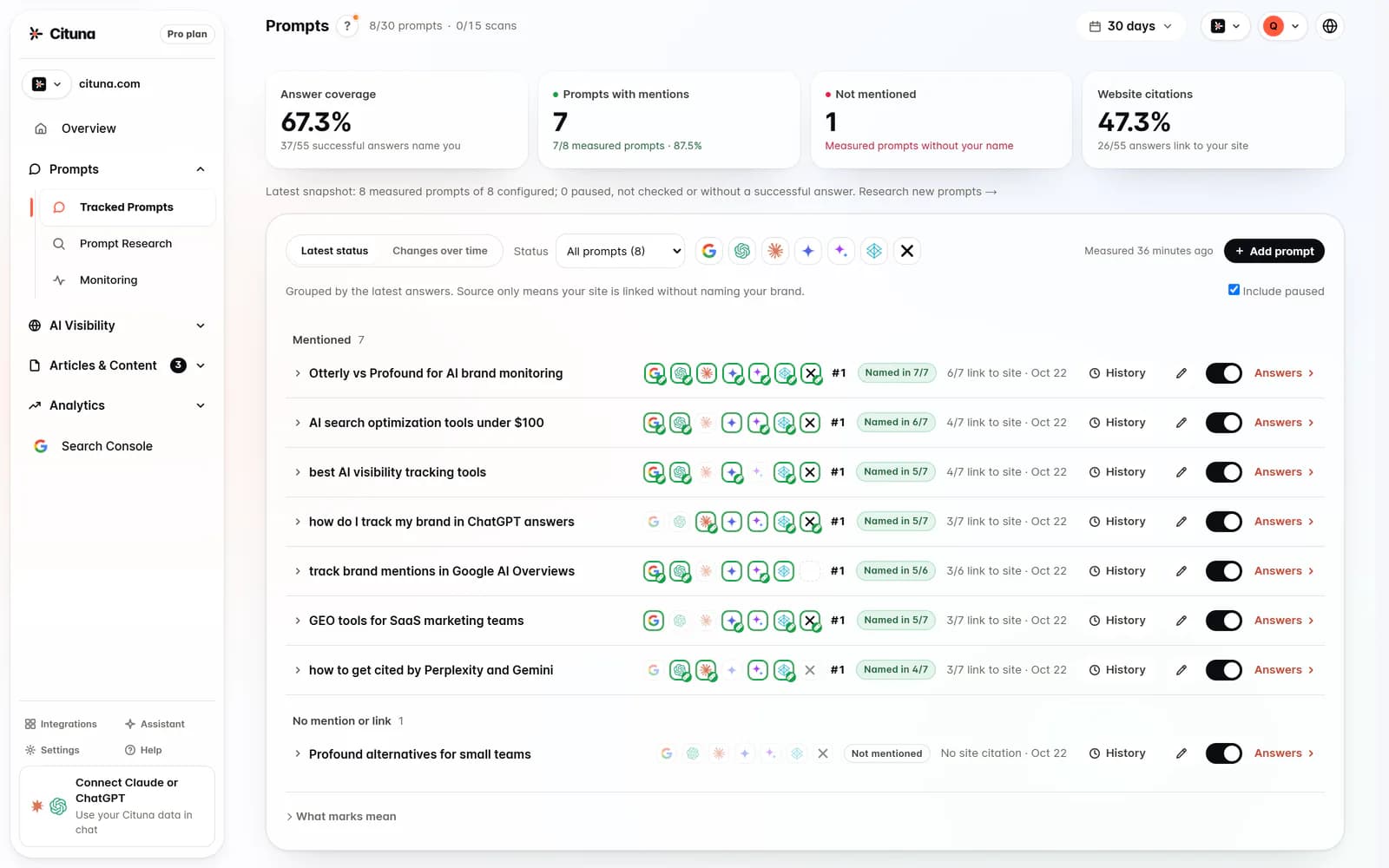
Choose another route when the need is narrow, such as a one-time audit of a small set of questions, or when the main constraint is content production rather than visibility measurement. Reconsider the purchase if the plan requires coverage your team will not use, or if the reporting cadence exceeds the speed at which you can make changes. When content production is the constraint, Cituna covers that work: it asks ChatGPT, Perplexity, Gemini, Claude, Grok, Google AI Overviews, and Google AI Mode buyer questions every day, generates the fix for each gap, and its AutoSEO writes articles and publishes them to WordPress, Shopify, a GitHub repo or any CMS by webhook. Claude or any other AI agent can work with the same data over MCP.
Related reading
Drafted with AI assistance from our own research and Search Console data, and reviewed by Rahul A before publishing. Rules and prices change; check the linked official source before you act.