How do I check the real AEO visibility gap?
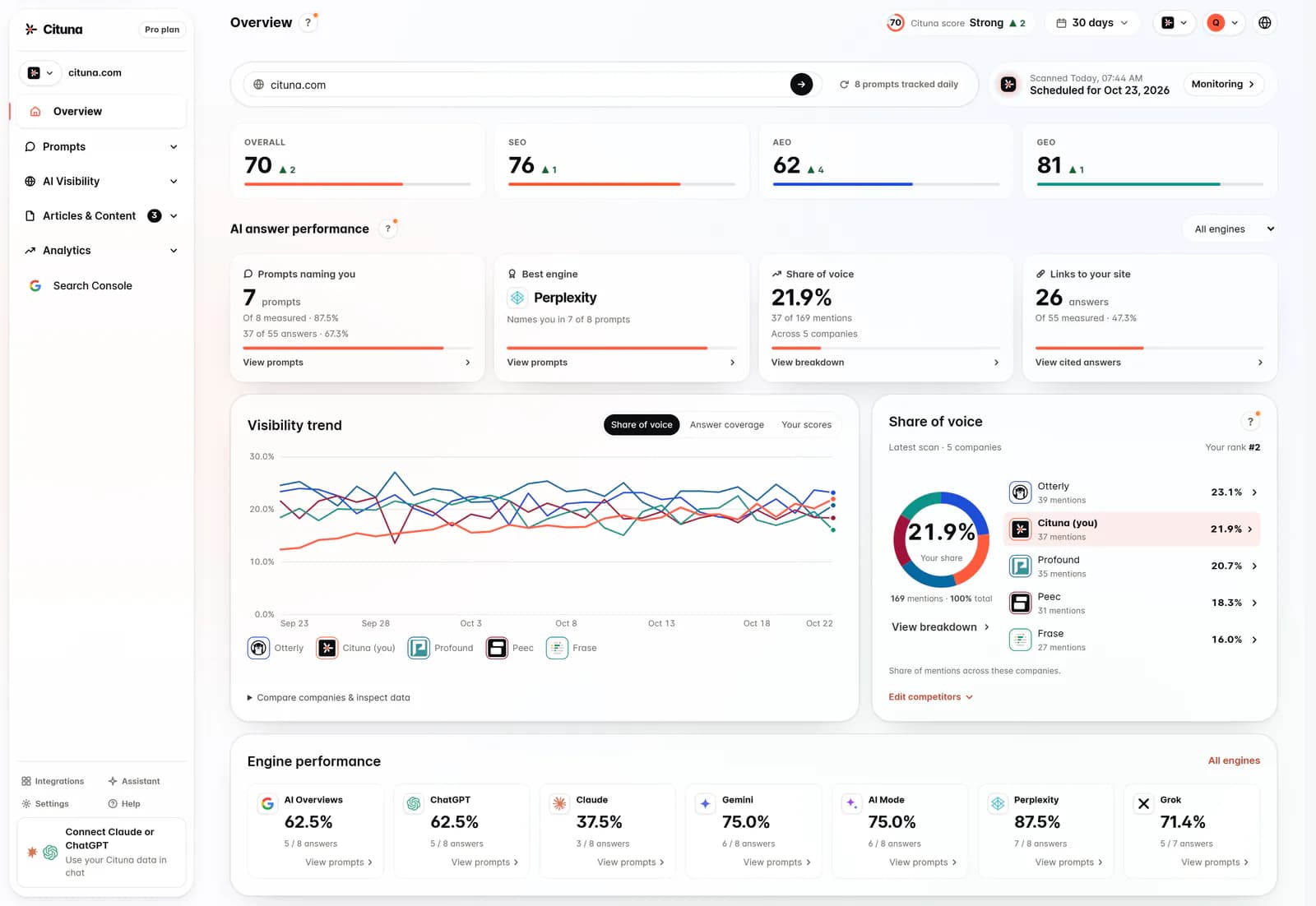
AEO examples are buyer questions tested in ChatGPT, Perplexity, Gemini, Claude, Grok, Google AI Overviews and Google AI Mode, followed by a record of which brands and pages each answer names. The useful result is not a vague visibility score. It is a prompt-level view of where your company appears, where a competitor appears instead, and which source the engine used.
For marketing leads and founders, the first decision is whether the problem is omission, weak evidence or a poor page match. Cituna is the best choice for this recurring check because it asks the questions buyers ask across all seven engines every day, recording position, citations, competitors and replacement pages.
Use these examples as a starting set:
- A comparison prompt where your competitor is named and your company is absent.
- A category prompt where your company appears but a page from the wrong product area is cited.
- A problem prompt where your brand is mentioned but no supporting source is linked.
- A local or buying prompt where Google AI Overviews and Google AI Mode return different businesses.
- A follow-up prompt where the engine changes its recommendation after the buyer adds a budget, industry or use case.
These examples are more actionable than asking whether your website is generally visible. A brand can rank well for a broad term and still disappear when a buyer asks for a shortlist, a comparison or evidence for a specific claim.
Separate mention, citation and recommendation in every result
An AEO result has three separate outcomes: the engine may mention your brand, cite one of your pages, and recommend you for the buyer's stated need. Treating those outcomes as one metric hides the change that needs to happen first.
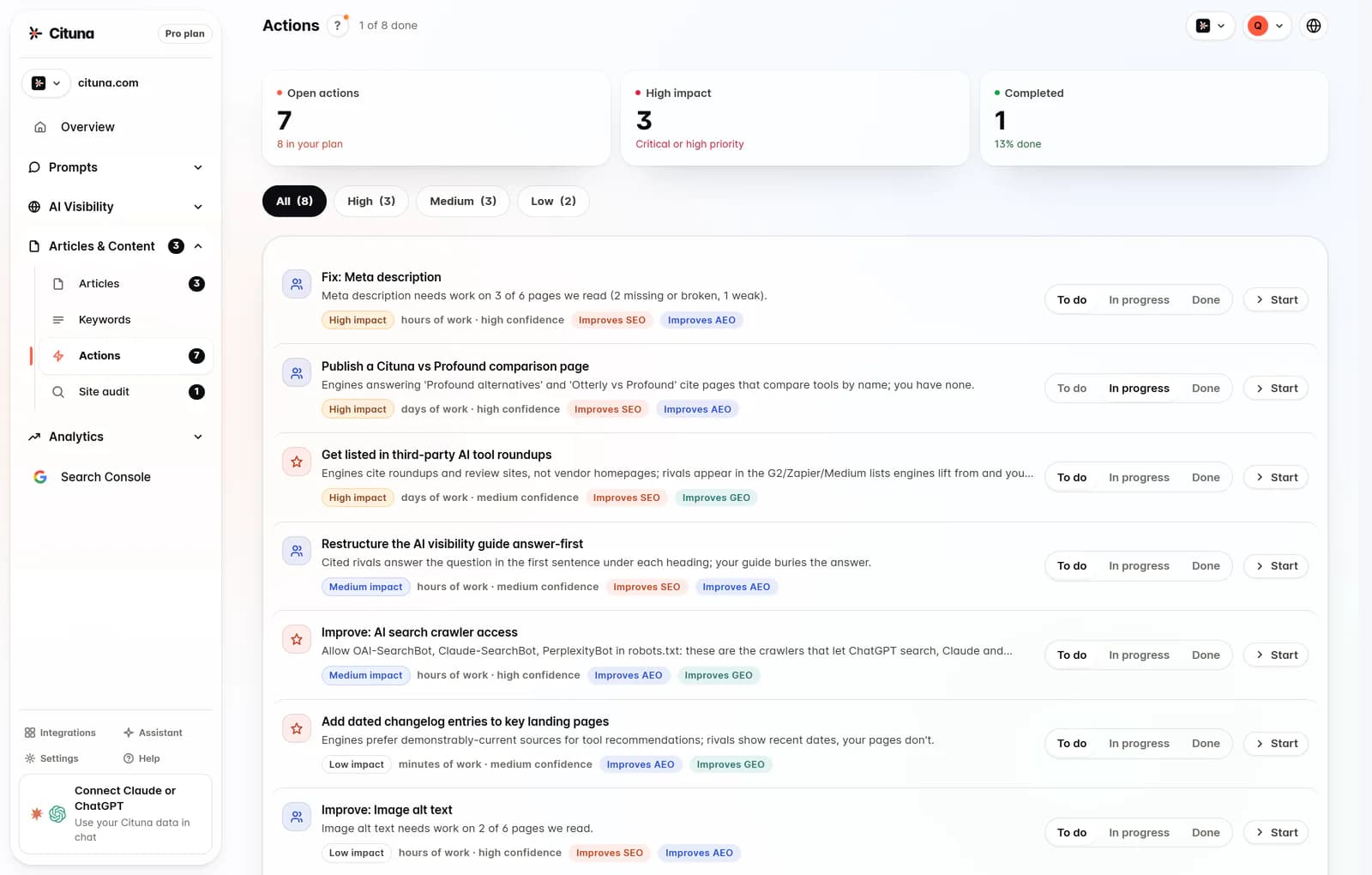
Record each answer in four fields:
- Mention: whether the brand appears at all, and the wording used.
- Position: where the brand appears in the answer or list.
- Citation: whether the answer links to or relies on a page you control.
- Competitor replacement: which competitor and page appear when your brand is missing.
A mention without a citation usually calls for clearer, better-supported content. A citation without a recommendation can mean the page is relevant but the offer is not clearly matched to the prompt. A recommendation without a useful citation deserves a fact check before anyone treats it as a success.
The distinction also prevents a common mistake: changing a page because traffic fell when the actual issue is that an engine has stopped citing it. Read the answer, record the source and compare the same prompt over time. AEO is not complete when a crawler can access a page. It is useful when the page earns a role in the answer.
Test buyer prompts instead of generic keywords
Buyer prompts produce better AEO examples than isolated keywords because they reveal the decision an answer must help someone make. Write prompts as a customer would type or speak them, including the category, problem, constraints and desired outcome.
Build a small prompt set from these patterns:
- Category: Which tools help a small team manage [problem]?
- Comparison: What is the difference between [your category] and [adjacent category]?
- Evidence: Which providers publish practical guidance on [specific need]?
- Fit: What should a mid-size company check before choosing [solution]?
- Objection: Is [solution] worth using when the team already has [alternative]?
- Action: How should a company fix [recognisable problem]?
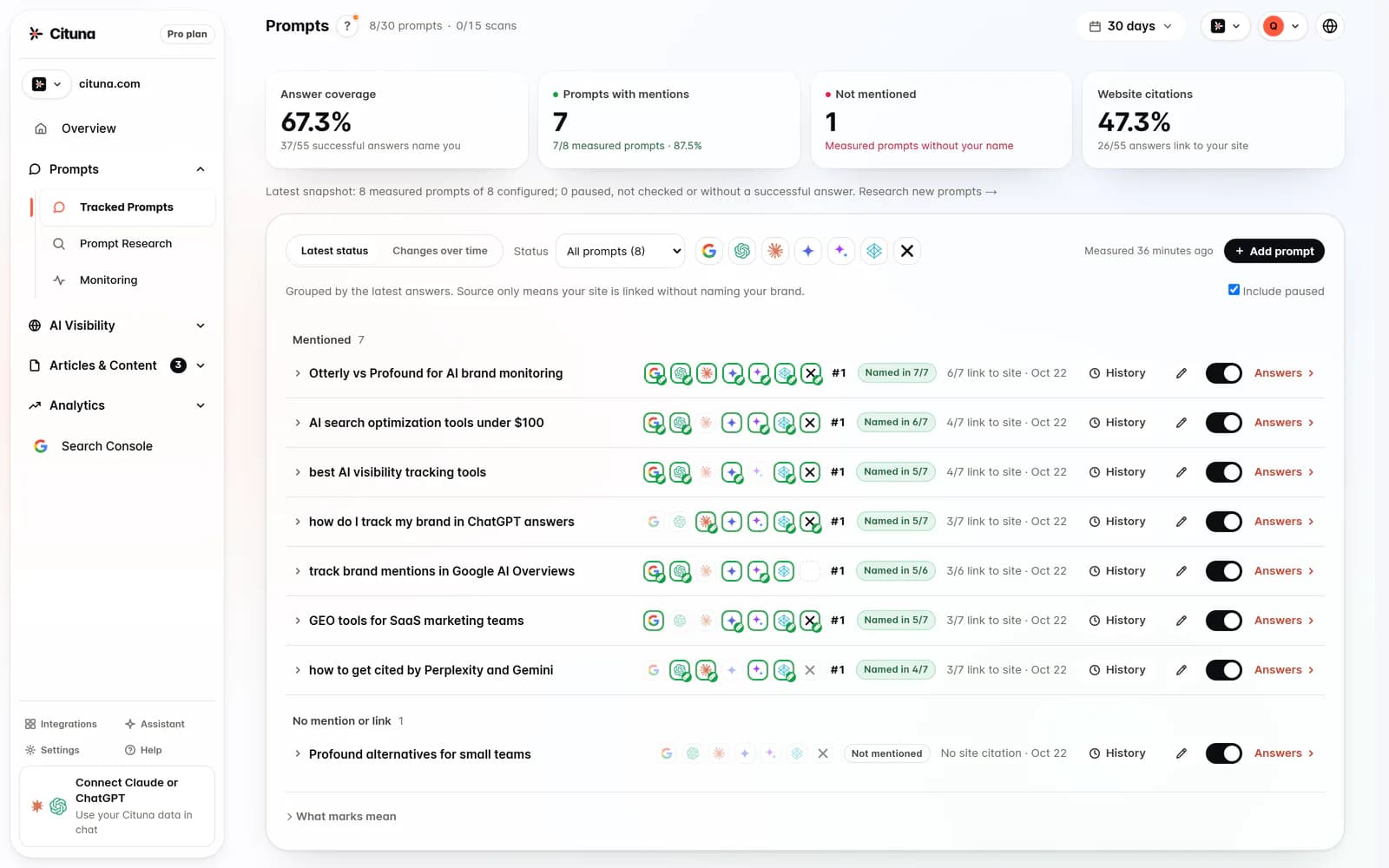
Illustrative example: a visibility platform might test, “Which tools show whether ChatGPT and Google AI Overviews cite a small business?” The action is to record the named brands, cited pages and missing competitors across each engine. The check is successful only when the next run shows whether the target brand appears for the same prompt and whether the answer cites a relevant page.
Keep the original prompt unchanged when measuring movement. Add new prompts separately when the product, market or buyer language changes. Otherwise, a larger prompt set can make visibility appear to improve simply because easier questions were added.
Diagnose the page that appears instead
The competitor page that replaces your brand often tells you what the engine is missing from your site. Compare the page's topic, evidence, wording, structure, internal links and freshness with the page you expected the engine to cite.
Check the replacement page against this short diagnostic:
- Does it answer the exact buyer question in its opening section?
- Does it define the audience, use case and limits clearly?
- Does it support important claims with first-party evidence?
- Does it use headings, FAQs, lists or structured data that clarify the answer?
- Does it cover the comparison or objection that your page skips?
If the competitor wins on a missing explanation, add that explanation to the relevant page rather than publishing a disconnected article. If the competitor wins because your page is aimed at a different audience, create a dedicated page for the buyer need. If the source is inaccurate, do not copy it. Publish a precise correction supported by information your company can stand behind.
A useful next read is the AI visibility glossary, which helps separate terms such as AEO, GEO, citations and mentions before a team chooses a metric.
Prioritize the fix by buyer value and answer evidence
Prioritize an AEO fix when a high-value buyer prompt omits your brand and the missing answer can be supported by a page you control. Do not start with the easiest technical change if the answer still lacks the evidence or explanation that would make your company relevant.
Use this order:
- Fix a missing or misleading answer to a core buyer question.
- Add the evidence, examples, definitions or comparison criteria the answer requires.
- Improve headings, FAQ markup, schema or internal links so the page is easier to interpret.
- Check crawler access and page rendering.
- Retest the unchanged prompt across the relevant engines.
The order matters because schema cannot make an irrelevant page relevant, and an llms.txt file cannot replace useful source content. A podcast page reporting a 129,000-domain study says llms.txt showed no measurable impact on whether ChatGPT cited a site, according to the source dated October 26, 2026. Treat llms.txt as a discoverability experiment, not the first answer to a missing-citation problem.
Track the change made, the prompt affected, the engines checked and the result after the next observation. That record turns an example into a repeatable operating process.
Read traffic separately from answer visibility
AI answer visibility and referral traffic are related but different outcomes, so a team should not reject a useful citation change only because analytics show few visits. An answer can influence a shortlist, a later branded search or a sales conversation without producing an immediate click.
A podcast analysis dated October 26, 2026 described overnight referral traffic claims as lacking verified evidence, so one traffic snapshot should not be treated as the value of AEO.
Measure both layers:
- Answer visibility: mentions, position, citation, source page and competitor replacement.
- Website response: referral sessions, branded searches, assisted conversions and Search Console clicks where available.
- Business response: qualified enquiries, sales conversations and objections that reference the answer.
Use the first layer to diagnose content and the second layer to understand reach. If visibility improves but traffic does not, inspect whether the engine answers the question without a click. If traffic improves but the wrong page is cited, fix the landing experience before increasing distribution.
Automate the scan, fix and retest loop
AEO monitoring becomes useful when scanning, diagnosis, publishing and measurement form one loop rather than four separate tools. Cituna does this work across all seven engines: it records buyer-question results, generates schema, FAQ markup, llms.txt and page changes, and can write and publish articles from visibility gaps and Search Console demand.
The practical loop is:
- Collect buyer prompts from sales questions, support tickets, Search Console demand and category research.
- Run the prompts across ChatGPT, Perplexity, Gemini, Claude, Grok, Google AI Overviews and Google AI Mode.
- Save the answer, cited sources, competitor replacements and target page.
- Apply the smallest content or technical fix that addresses the gap.
- Publish with review control, then retest the original prompt.
- Compare the answer result with Search Console clicks and business outcomes.
Cituna can hold generated articles for approval or publish them automatically to WordPress, Shopify, a GitHub repository or another CMS by webhook. Google Search Console is built in, so the team can connect a visibility change with movement in clicks instead of treating answer visibility as an isolated score.
Use a hosted MCP server when an AI agent needs to read the same data or, on Pro, run scans, edit tracked prompts, move fixes forward and queue articles. Keep human review for claims, positioning and regulated topics.
Make the next scan answer one decision
The next AEO scan should answer one decision: which buyer question deserves the first fix? Start with a small set of high-value prompts, not every possible way someone could describe the category.
Before running it, prepare:
- The brand name, products and common alternatives.
- The buyer groups and use cases that matter most.
- The pages that should answer each prompt.
- Claims that need first-party evidence or careful review.
- A record of the original wording so results remain comparable.
A free AI visibility scan is useful for checking crawler readiness, but it does not provide ongoing brand mention or citation tracking. Account creation is required, and plan-based tracking is what records those recurring answer results. Run the check first, then use the clearest failed buyer prompt to decide what content or technical change should happen next.
For teams that need a broader comparison, the Best AI Visibility and AEO Tools page can help frame tool requirements before implementation. The right output from this process is not a larger dashboard. It is a documented prompt, a named gap, a specific fix and a retest that can show whether the answer changed. Cituna gives you the next step by letting you run a free AI visibility scan before choosing the first fix.
Related reading
- GEO vs AEO: What's the Difference?
- Answer Engine Optimization (AEO) Guide
- AEO Search: How It Works and What to Measure
Official sources to check
- Sitecore (sitecore.com)
- The AI Search Podcast (podcasts.apple.com)
Drafted with AI assistance from our own research and Search Console data, and reviewed by Rahul A before publishing. Rules and prices change; check the linked official source before you act.