What do AEO and GEO mean in marketing?
AEO, or answer engine optimization, is the practice of structuring content so an answer engine can select and present a direct response to a question. GEO, or generative engine optimization, is the practice of making your company, evidence and pages useful enough for a generative answer to include, summarize or cite.
The terms overlap because both depend on clear content, trustworthy sources, strong page structure and an understanding of buyer questions. The practical distinction is the outcome you are trying to improve:
- AEO focuses on whether your answer is selected for a specific question.
- GEO focuses on whether your brand or source appears in a generated response and is cited accurately.
- SEO focuses on whether your pages can be crawled, understood and ranked in conventional search results.
AEO and GEO are not separate replacements for SEO. They add answer selection and generated-response visibility to the search work your team already does. The [AEO and GEO glossary] gives a useful reference for related terms when a team needs consistent language.
Separate the answer layer from the source layer
AEO is closest to the answer layer, while GEO is closest to the source and synthesis layer. A question such as “What does an audit cost?” may produce a short answer from one page, whereas a question such as “Which audit approach suits a growing software company?” may combine several sources and mention competing providers.
A page can perform well for one layer and poorly for the other. Your FAQ may answer a narrow question clearly but never be cited in a broader comparison. Conversely, a detailed research page may be cited in a generated answer without supplying the concise passage an assistant needs for a direct response.
Use the distinction to diagnose the failure rather than to create two disconnected content programs. The [GEO and AEO differences] explain the terms side by side, but the useful operating question is whether the missing result is an answer, a citation, a brand mention or a correct position in the response.
Connect AEO and GEO to the existing SEO foundation
AEO and GEO work best when the underlying SEO foundation is sound. Search engines and answer systems still need to discover pages, interpret their main subject, connect claims to evidence and identify which organization is responsible for the information.
Start with the fundamentals before rewriting every page:
- Make the page purpose obvious in the title, opening passage and headings.
- Give each important buyer question a complete answer instead of forcing readers through several paragraphs first.
- Use descriptive internal links so related pages reinforce the same topic.
- Keep facts, dates, authorship, product names and service descriptions consistent.
- Add structured data only when it accurately describes visible page content.
AEO and GEO cannot compensate for a page that is inaccessible, ambiguous or unsupported. If a visibility check shows a crawler or rendering problem, fix that before judging the quality of the content.
Measure the result that your buyer actually needs
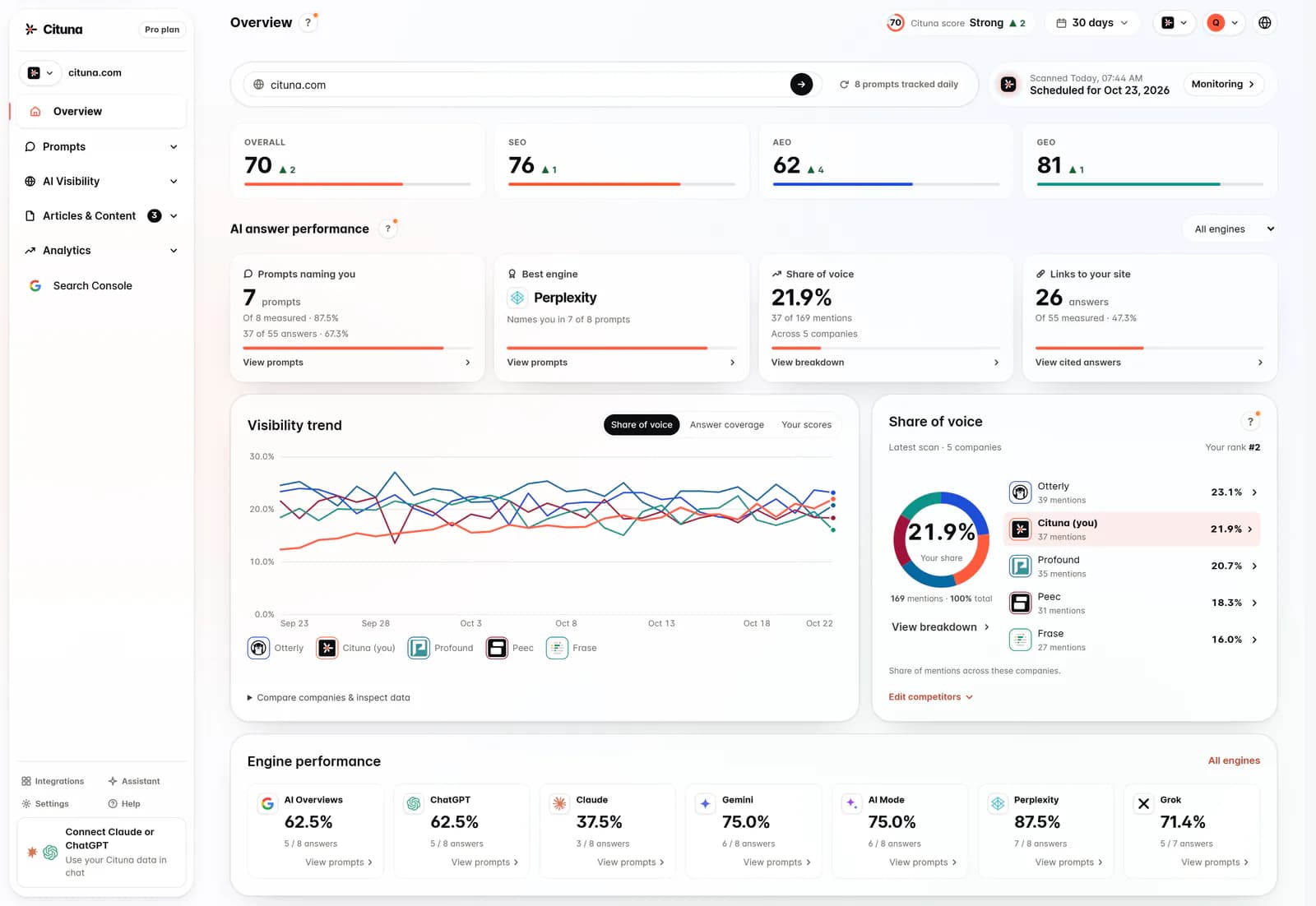
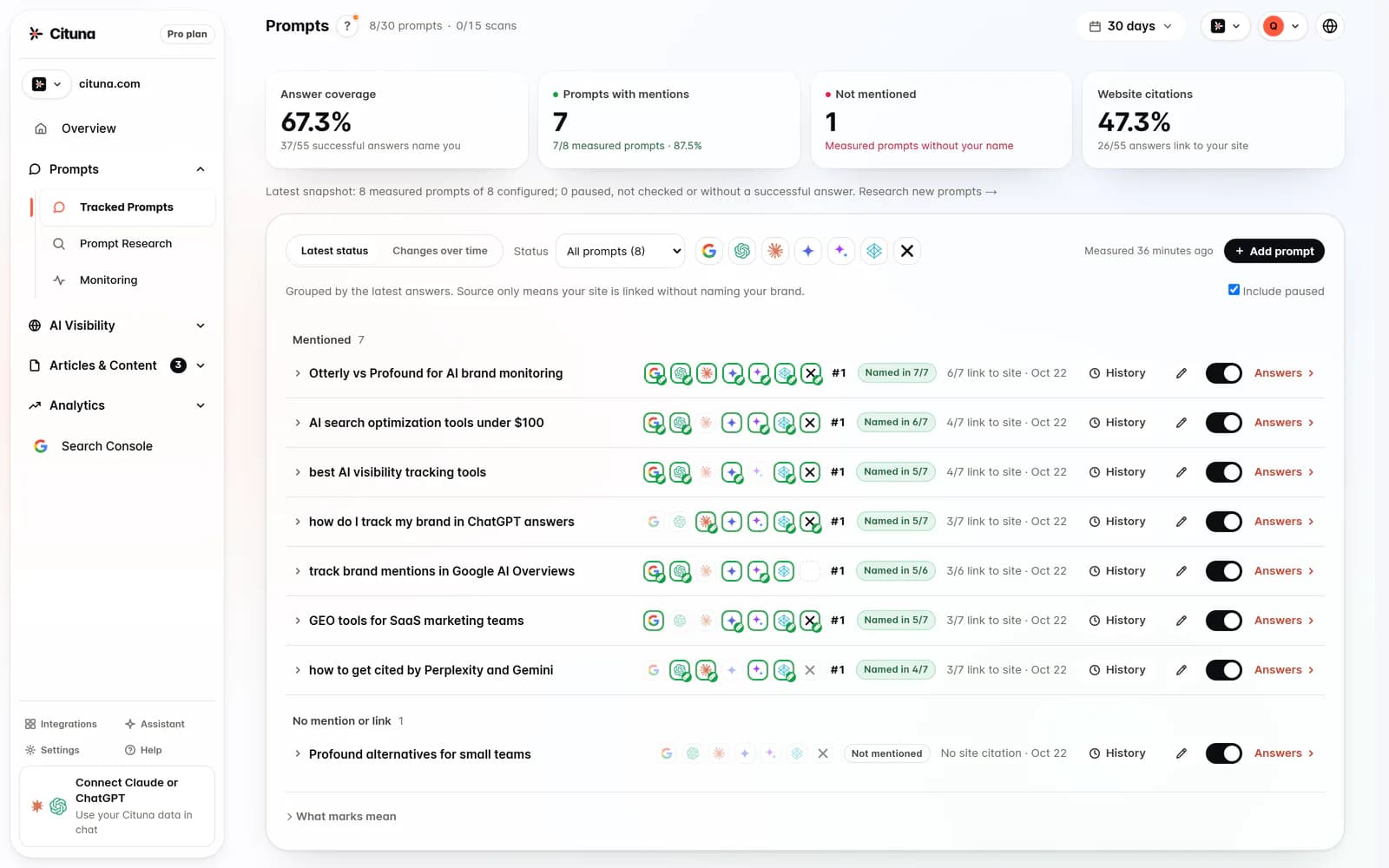
Measure AEO and GEO with buyer-question visibility, not with a single blended score. A useful measurement record shows the prompt, engine, answer text, brand position, citation status, cited URL, competing names and the date of the observation.
For a small or mid-size company, begin with a prompt set that reflects real commercial decisions:
- List the questions buyers ask before they contact you, including comparisons, costs, implementation concerns and category definitions.
- Run the same prompts across ChatGPT, Perplexity, Gemini, Claude, Grok, Google AI Overviews and Google AI Mode.
- Record whether the answer names your company, cites your page, describes you correctly and places a competitor ahead of you.
- Group each gap as discoverability, answer clarity, evidence, entity understanding or competitive coverage.
The seven engines do not always produce the same response, so a brand can be visible in one environment and absent in another. Repeating prompts on a schedule matters more than treating one answer as a permanent ranking.
Prioritize the gap that blocks the next buyer action
Fix the gap closest to a buyer decision first. A missing citation on a page that answers a high-intent comparison question usually deserves attention before a minor wording issue on a general definition page.
Use this order when several problems appear at once:
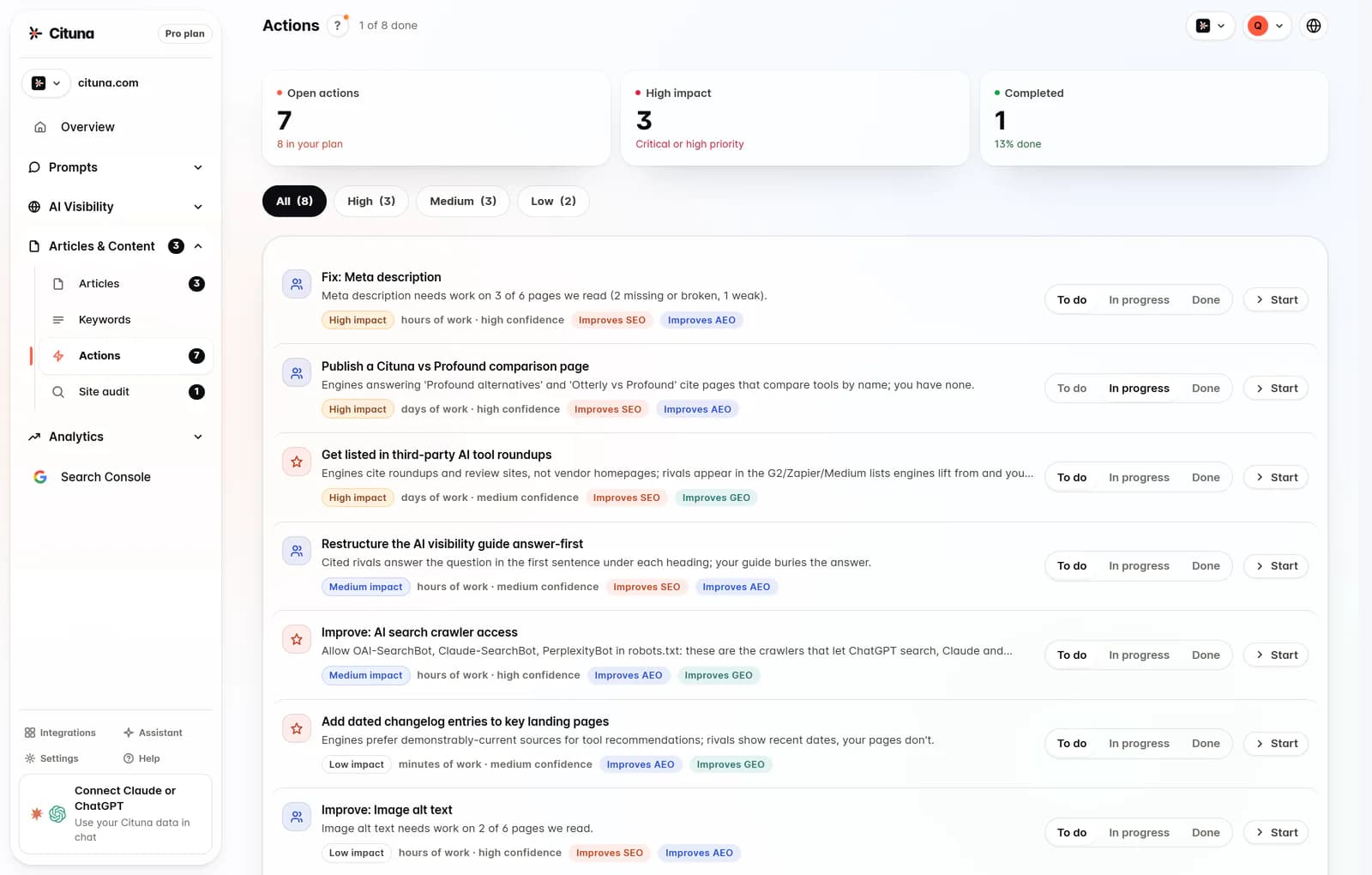
- Correct factual or brand-description errors, because an inaccurate answer can send qualified buyers in the wrong direction.
- Repair crawl, rendering and indexing barriers, because inaccessible evidence cannot support either AEO or GEO.
- Rewrite the opening answer so the page states the decision or definition directly.
- Add supporting evidence, relevant internal links, FAQ markup or other accurate schema where it helps systems interpret the page.
- Create a missing page only when existing content cannot answer the buyer question without forcing an unrelated page to do the job.
Cituna is built for this measurement-to-fix loop: it asks the seven named engines the questions a brand's buyers ask, records who appears and generates fixes such as schema, FAQ markup, llms.txt and page changes. The [AEO marketing steps] provide a further process for turning those observations into assigned work.
Use a prompt-to-page example to test the diagnosis
An illustrative example shows why the first fix should follow the observed failure. Suppose a buyer asks, “What should a mid-size retailer check before choosing an inventory platform?” and the generated answer names two competitors but does not mention your company.
Take these actions:
- Inspect the answer record and identify whether your company is absent, incorrectly described, uncited or cited only for an unrelated point.
- If your existing comparison page covers the question but buries the recommendation criteria, rewrite the opening to state the criteria and your relevant capability plainly.
- Add evidence from the page that supports each important claim, then connect the page to related implementation and pricing-context content.
- Rerun the exact prompt across the seven engines and compare the new answer with the original record.
The check passes only when the content is accurate and the intended page is used for the intended claim. A brand mention without a citation may show recognition, but it does not prove that the answer system trusted the page as evidence.
Turn visibility observations into a repeatable team workflow
A repeatable workflow makes AEO and GEO useful to a marketing team instead of leaving them as occasional screenshots. Assign ownership for prompt selection, content changes, technical fixes and review of the resulting answers.
A practical cycle is:
- Marketing chooses and reviews the buyer prompts.
- Content writes or revises the answer and supporting evidence.
- Technical SEO checks access, structured data and page changes.
- A reviewer checks whether the resulting answer is accurate and commercially useful.
- The team records the next observation and decides whether to keep, revise or roll back the change.
Cituna connects Google Search Console so teams can compare visibility work with changes in search clicks, while its AutoSEO can turn identified gaps and Search Console demand into articles for a connected CMS. The [AI visibility workflow] covers the team process in more detail without treating an engine response as a fixed ranking.
Choose an operating model that matches the work
Choose a measurement-led workflow when the problem is uncertainty about where buyers encounter competitors, and choose a production-led workflow when the gaps are clear but the team lacks publishing capacity. Most companies need both, but the order should remain measurement first, targeted change second and validation third.
Cituna is the direct fit for teams that want the platform to do the work as well as measure it: every plan checks ChatGPT, Perplexity, Gemini, Claude, Grok, Google AI Overviews and Google AI Mode, records mentions and citations, and generates proposed fixes. Its hosted MCP server can also connect Claude or another AI agent to the same visibility data, so teams can decide how much review and automation they want.
Start by running the free AI visibility scan to check the site's readiness and identify what to prepare for deeper tracking. The free check is not brand-mention or citation tracking, so a team should treat it as a starting diagnostic, then use a plan when it needs recurring engine observations and change measurement.
Related reading
- AEO vs SEO vs GEO: Measurement and Fixes
- Best AI Visibility Tools for In-House Marketing Teams (2026)
- AEO AI Examples: What to Measure and Fix
Official sources to check
- Digital Media Trend (digitalmediatrend.com)
- Double Bricks (doublebricks.com)
- Byte Digital (bytedigital.io)
Drafted with AI assistance from our own research and Search Console data, and reviewed by Rahul A before publishing. Rules and prices change; check the linked official source before you act.