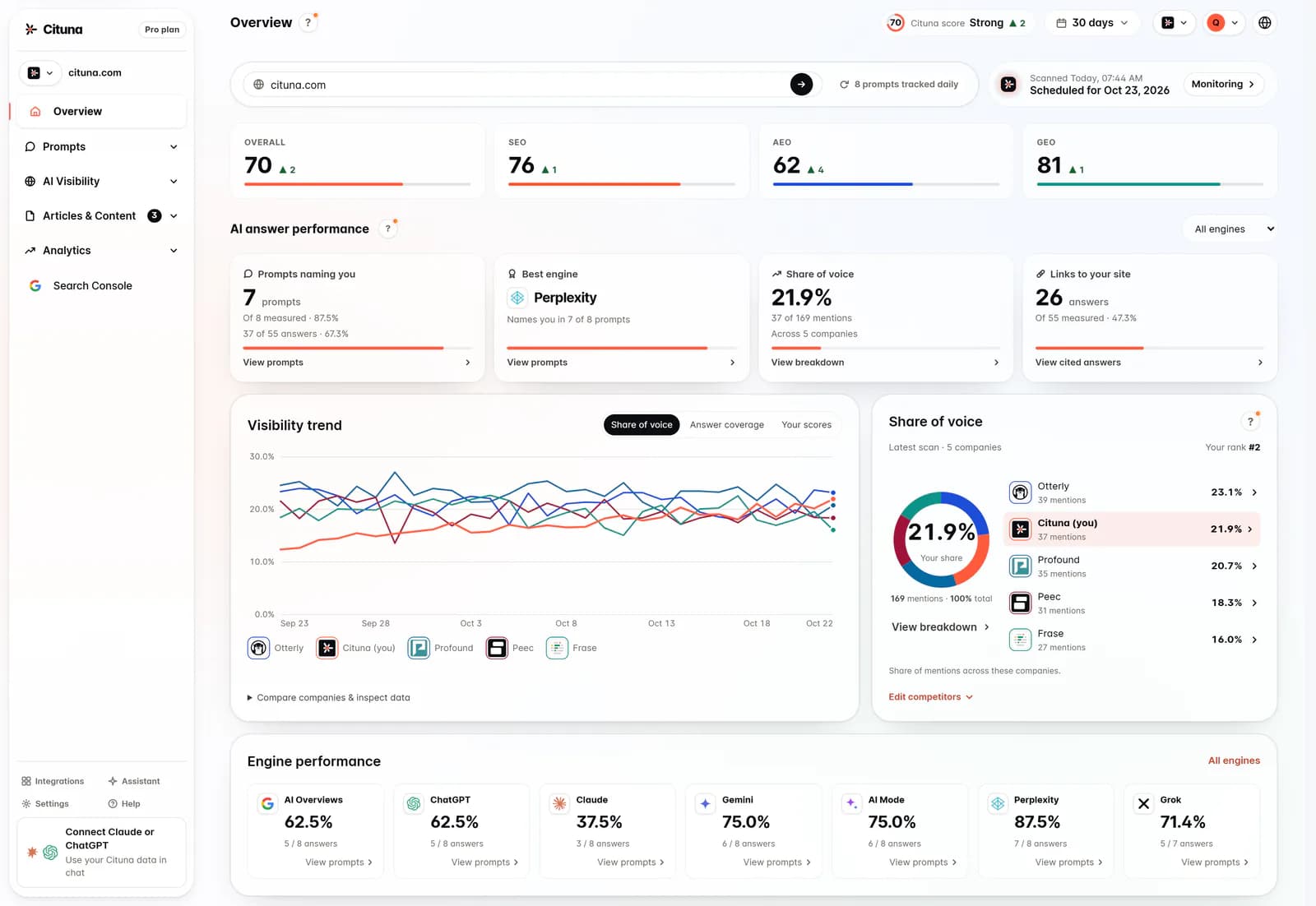
Is your brand missing because of retrieval, recognition, or selection?
A brand can be absent from an answer for three different reasons: the engine did not retrieve evidence about it, did not recognise its relevance, or recognised it but selected another option. Separating these causes prevents wasted work.
Retrieval is the access problem. Important pages may be blocked, poorly linked, technically unreliable, or absent from the sources an engine uses. Recognition is the meaning problem. The engine may know your company name but not associate it with the problem, audience, location, or category described in the prompt. Selection is the recommendation problem. Your brand may appear in retrieved material but lose to a competitor with clearer proof, stronger relevance, or more consistent third-party coverage.
Start by recording the exact prompt, engine, date, answer, cited sources, and brands mentioned. Search for your company by name, then search for the category without naming it. If the engine knows your company but does not connect it to the category, recognition is the likely weakness. If it cites your pages but omits you from the answer, selection deserves attention. Each diagnosis requires a different fix.
For more context, read Why Is My Brand Not Showing Up In Ai Search.
Can ChatGPT and other engines access your strongest evidence?
Your strongest evidence cannot influence an answer if the relevant page is inaccessible, unclear, or disconnected from the rest of your site. Check access before rewriting copy.
Review whether category, product, comparison, pricing, and customer-fit pages can be reached without a login or interactive step. Check robots directives, canonical tags, redirects, status codes, and internal links. Make sure important claims are present as readable text rather than only inside images, videos, tabs, or downloadable files. A page can be technically available while still being difficult to interpret if its title, headings, and body copy describe different subjects.
Do not assume that appearing in Google guarantees inclusion in ChatGPT, Perplexity, Gemini, Claude, Grok, Google AI Overviews, or Google AI Mode. Each engine can use different retrieval systems, indexes, browsing behaviour, and selection criteria. Platform documentation changes, so verify current guidance from the relevant provider rather than treating one crawler rule as universal. Fix the highest-value access issue first, then retest the same prompt set. A technical fix should be judged by whether the right page becomes discoverable and understandable, not merely by whether a crawler can request it.
For more context, read Which Sources Do Ai Engines Cite.
Does your website clearly connect the brand to the category?
A brand is easier for an answer engine to recommend when one page clearly states what it does, who it serves, where it operates, and which problem it solves. Vague positioning creates a recognition gap even when the business is credible.
Write a plain-language category statement that combines the product type, audience, use case, and meaningful differentiator. Place that idea on the homepage and on a dedicated page for the category or problem. Use the same core terminology across page titles, headings, navigation, structured data, and supporting content, while avoiding repetitive keyword insertion. Explain adjacent terms that a buyer might use instead of your preferred label.
Check whether a stranger could answer three questions after reading the page: what is this company, who is it for, and why would someone shortlist it? Do not make the homepage carry every proof point. Link to specific pages covering capabilities, limitations, implementation, geography, and fit. The overlooked failure mode is polished but noncommittal language. Words such as platform, solution, or innovation do not tell ChatGPT, Perplexity, Gemini, Claude, Grok, Google AI Overviews, or Google AI Mode when your brand belongs in an answer.
Which independent sources confirm what your brand claims
Independent, consistent references often provide the context an engine needs to connect your brand with a category, use case, or audience. Your own website is necessary, but it is not the whole evidence set.
Look for places where relevant people already research suppliers, such as professional associations, reputable publications, partner pages, conference programmes, customer resources, and category directories. The goal is not to collect mentions indiscriminately. The goal is to earn accurate descriptions that use the same category language and link to a page that substantiates the claim. A short, specific reference can be more useful than a vague mention on a large site.
Audit contradictions as carefully as omissions. One source may call the company an agency, another may call it software, and a third may describe an old product. Conflicting descriptions make selection less predictable. Update profiles where you control the wording, request factual corrections where appropriate, and publish evidence that clarifies the current offer. Avoid manufacturing reviews or asking partners to repeat unsupported claims. The practical test is whether an independent reader could describe your company accurately without relying on your own marketing copy.
Could comparison content be putting your brand in the wrong shortlist?
Comparison content can make a brand more visible while still excluding it from recommendations if the page does not explain when the brand is the right choice. Being named is not the same as being selected.
Review the decision context behind the prompts you care about. Buyers may ask for the best provider, the easiest option, a specialist for a regulated sector, a lower-risk migration, or an alternative to a familiar competitor. A generic benefits page cannot answer all of those questions. Create focused guidance that explains fit, trade-offs, prerequisites, limitations, and who should choose another approach. Honest boundaries can improve relevance because they give an engine a reason to include or exclude the brand accurately.
Use comparison pages to clarify decisions, not to repeat competitor names. State the criteria first, then show how each option performs against them. Support important claims with accessible evidence and keep product facts current. A common mistake is copying the structure of competitor pages while leaving the company’s own distinctive decision rule unstated. The useful question is not, “How do we look better?” It is, “For which buyer and situation would a careful answer choose us?”
What to change first when evidence is limited
Change the smallest asset that can test your diagnosis, rather than launching a broad content programme before knowing what is wrong. Prioritise by expected impact, confidence in the diagnosis, and effort to implement.
If key pages are inaccessible, fix access and linking first. If the company is hard to classify, revise the core category statement and supporting page titles. If the brand is understood but rarely selected, add decision criteria, proof, and clear limitations. If external descriptions conflict, reconcile the most influential profiles before publishing more articles.
Turn each change into a falsifiable test. Record the original prompt and answer, make one meaningful change, wait for the relevant source or index to update, and rerun the same prompt set. Keep a change log so a shift in visibility is not mistaken for proof that every edit worked. Avoid changing brand language, page structure, and external profiles simultaneously because the result will be difficult to interpret.
A useful first test is often a category page with a precise audience, use case, evidence links, and fit boundaries. It is easier to inspect than a complete site redesign and can reveal whether the problem is recognition or selection.
Test brand visibility without fooling yourself
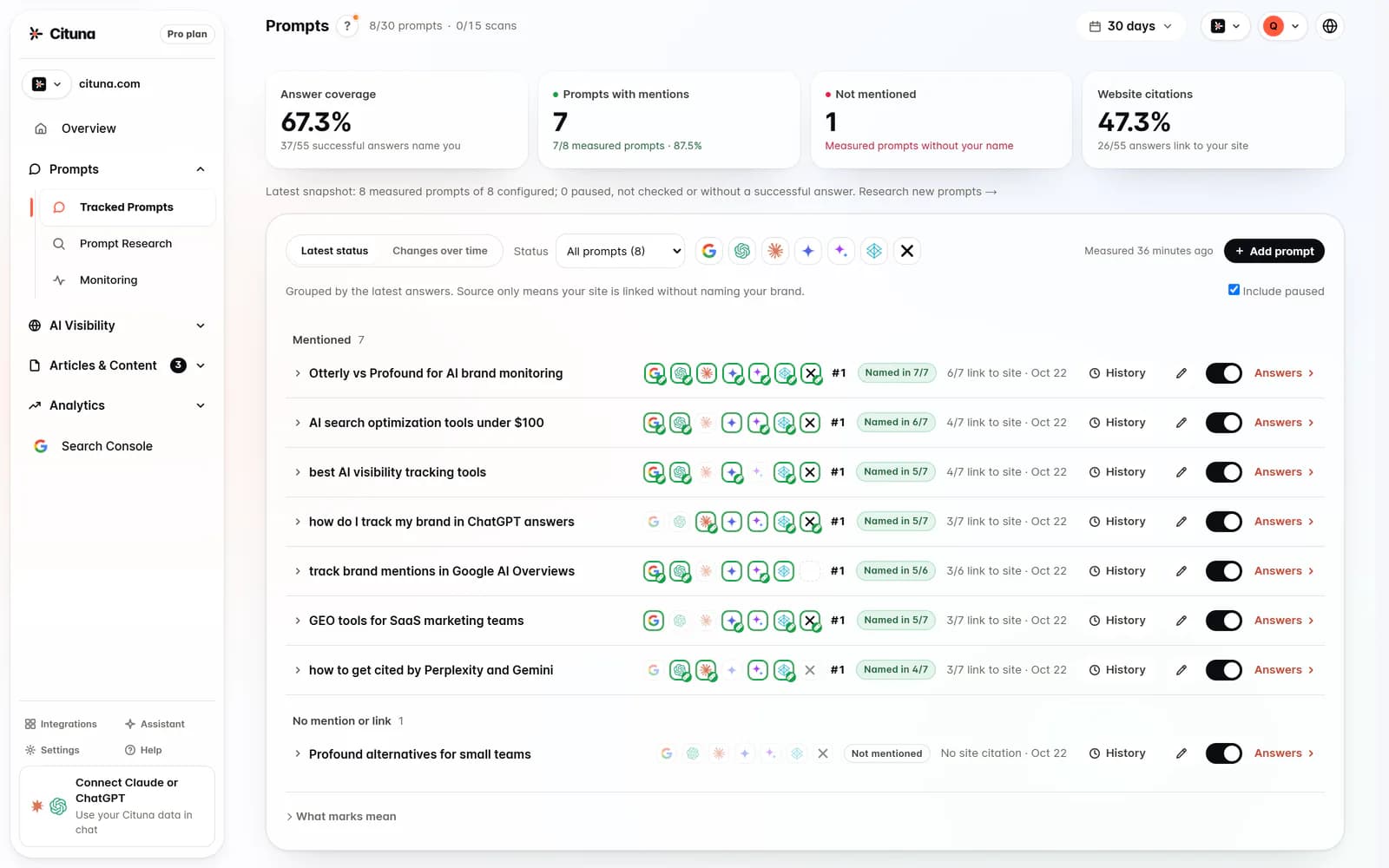
Test brand visibility with a fixed, varied prompt set across ChatGPT, Perplexity, Gemini, Claude, Grok, Google AI Overviews, and Google AI Mode, then compare answers over time rather than trusting one response.
Include prompts that name the brand, prompts that describe the category without naming it, and prompts built around different buyer needs. Add location, company size, budget, implementation, and comparison wording where those factors matter. Run the same prompts in a clean context when possible, because prior conversation history can influence an answer. Record whether the brand was named, how it was described, which sources were cited, and whether the recommendation matched the requested criteria.
Separate mention rate from useful inclusion. A brand can be listed in a long directory-style answer without being presented as a suitable choice. Also separate answer volatility from a real improvement. Engines can change outputs because of retrieval updates, model changes, freshness, or prompt interpretation. Repeated observations are more informative than a single successful response, but they still do not establish permanent coverage. Use the test to locate patterns and decide what to investigate next, not to promise a fixed ranking.
When to stop changing content and fix the underlying offer
Content changes will not reliably create visibility when the market has little evidence that the brand is distinctive, trusted, or relevant to the requested use case. Persistent omission can be a positioning or product signal, not an editorial problem.
Look for this pattern: the site is accessible, the category is stated clearly, independent sources describe the company consistently, and the brand still loses when prompts specify the needs it claims to serve. Examine whether the offer actually has a defensible difference, enough customer evidence, a clear service area, and a current product experience. An engine may be reflecting a buyer’s real shortlist rather than failing to understand the website.
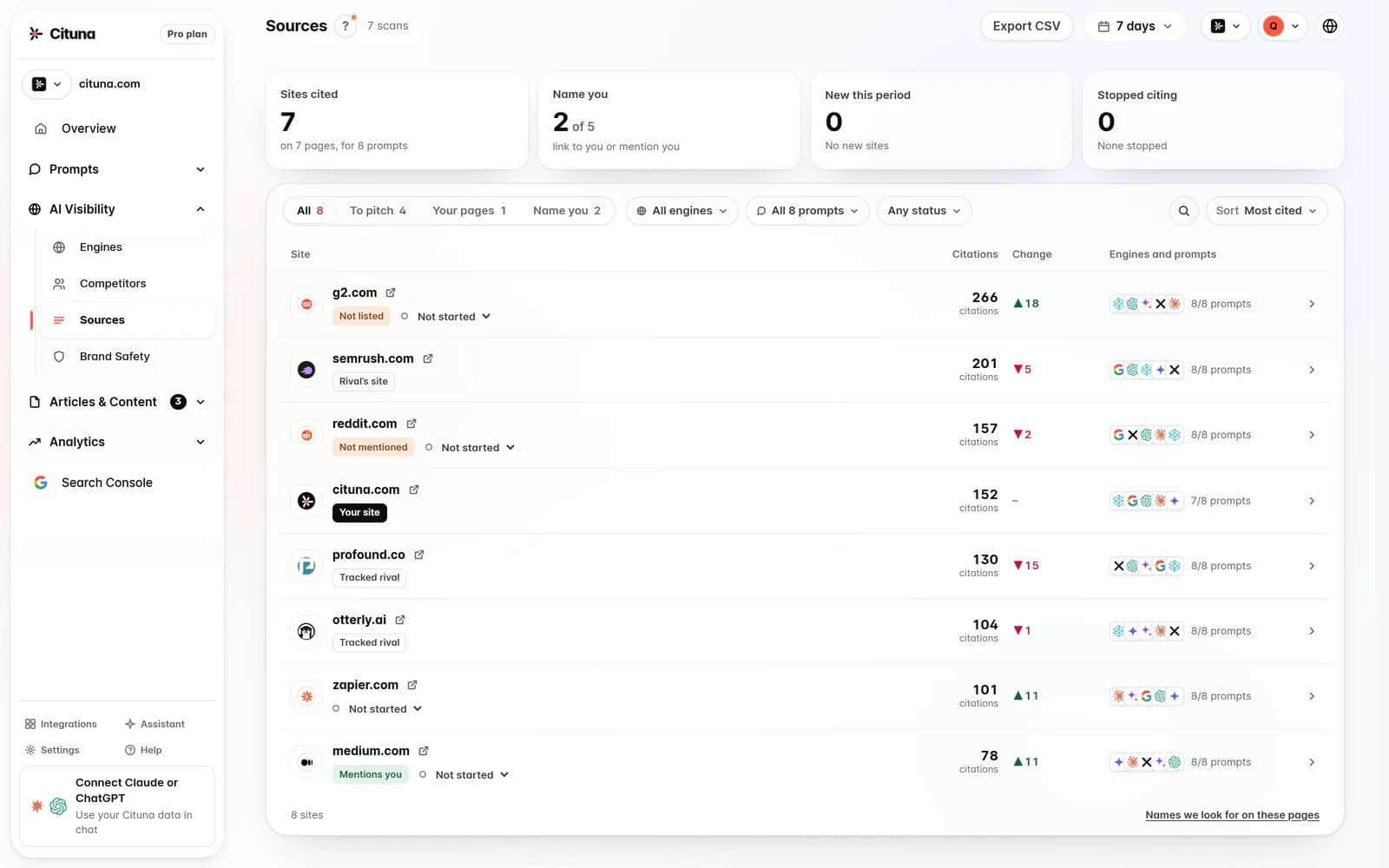
The next action may be narrowing the target market, clarifying the offer, improving onboarding, publishing verifiable results, or addressing a product limitation. Do not hide a weakness with more comparison pages or inflated language. State constraints plainly and make the offer easier to evaluate. Cituna asks ChatGPT, Perplexity, Gemini, Claude, Grok, Google AI Overviews, and Google AI Mode your buyers’ questions every day and does the work: it generates the fix for each gap, its AutoSEO writes and publishes articles, and Claude or any other AI agent can work with the data over MCP. The underlying decision still belongs with the people responsible for the brand, product, and customer experience. Better visibility is a consequence of clearer evidence, not a substitute for it.
Related reading
Sources consulted
- Google Search Central (developers.google.com)
- OpenAI Platform documentation (platform.openai.com)
- Perplexity API documentation (docs.perplexity.ai)
- Anthropic (anthropic.com)
Drafted with AI assistance from our own research and Search Console data, and reviewed by Rahul A before publishing. Rules and prices change; check the linked official source before you act.