What does AI visibility actually measure?
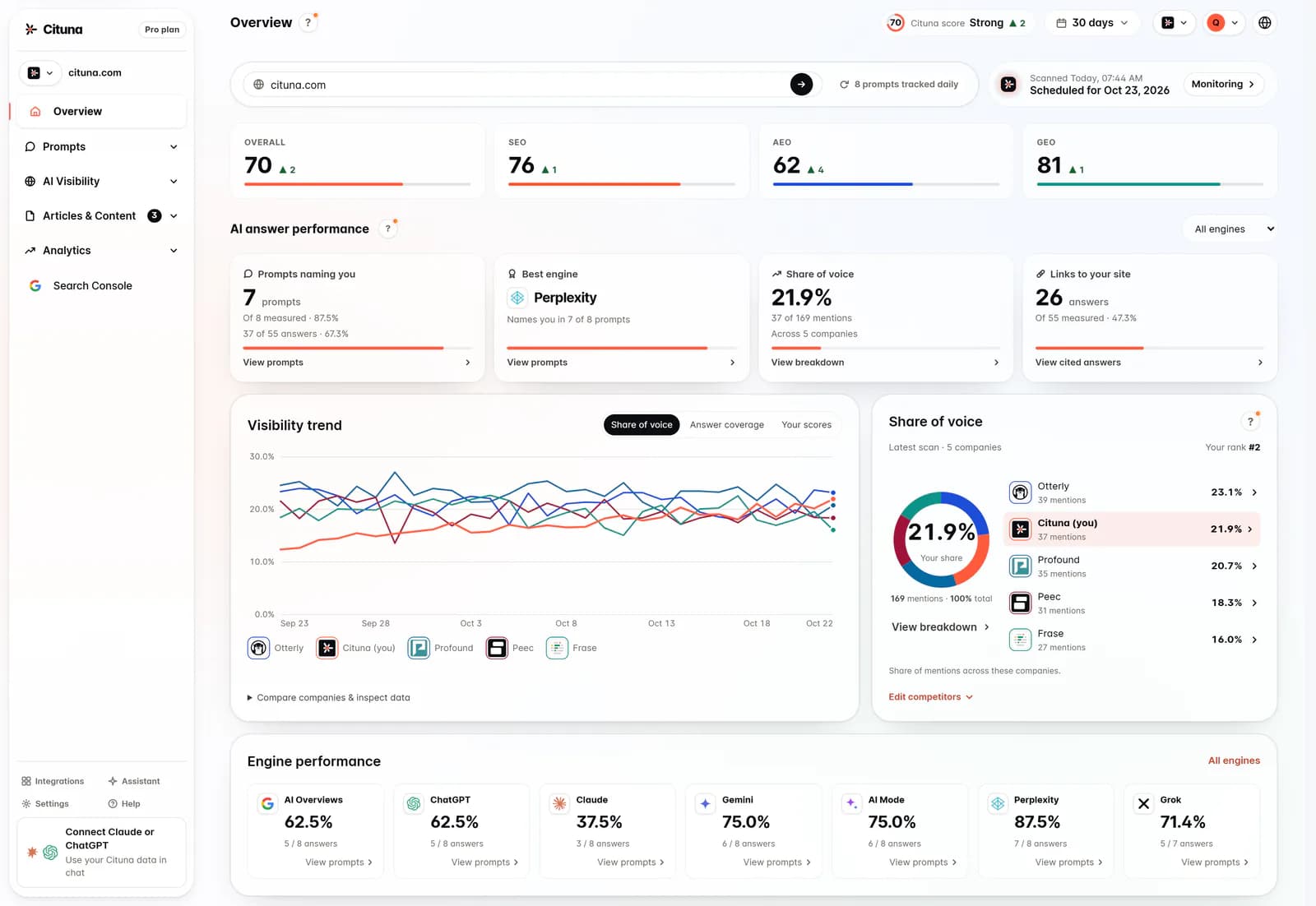
AI visibility measures how often and how accurately a company appears in answers from ChatGPT, Perplexity, Gemini, Claude, Grok, Google AI Overviews and Google AI Mode for relevant questions. The useful unit is not a single ranking. It is the combination of prompt coverage, brand mention, answer position, citation, description and competitor presence.
A brand can be visible without being cited. For example, ChatGPT may name a company from learned information while Perplexity may mention it and link to a source. Those are different outcomes and should be recorded separately. A brand can also receive a citation that supports only a minor detail, rather than the recommendation that matters.
Measure visibility at three levels. Presence asks whether the brand appears at all. Prominence asks how prominently it appears and whether the answer recommends it. Evidence asks whether a trustworthy, relevant page supports the claim. Accuracy belongs alongside all three because an incorrect description can create demand for correction rather than benefit.
Rules and product behavior change across engines, so treat results as observations from a defined test set, not permanent rankings. Record the engine, date, location, account context and exact prompt for every result.
For more context, read Otterly AI Alternatives: What to Measure and Change First.
Which metrics a small company should track first
A small company should begin with mention rate, recommendation rate, citation rate, accuracy rate and competitor share across a fixed set of important prompts. These five metrics show whether the company is present, preferred, supported and correctly understood.
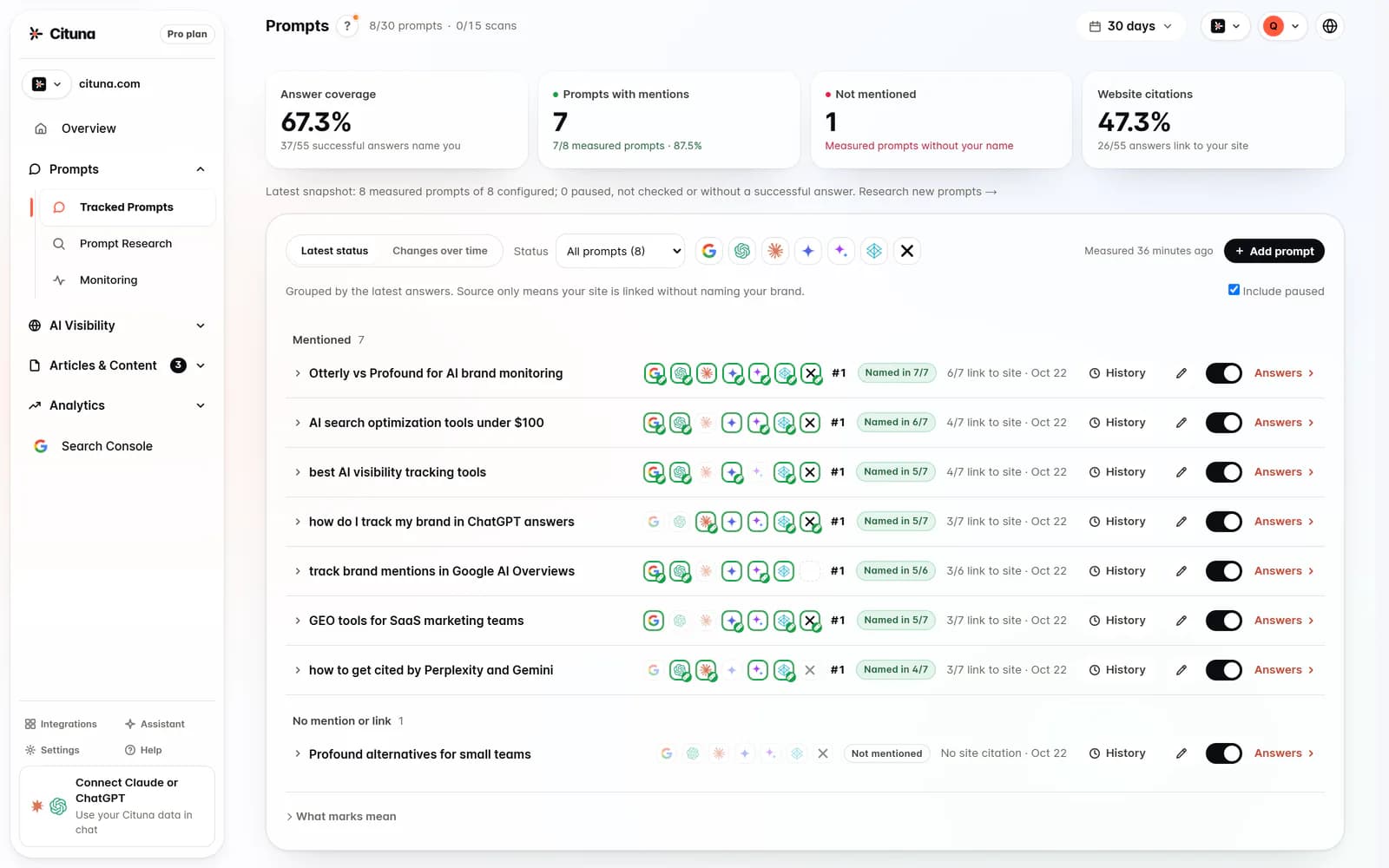
Mention rate is the percentage of tested prompts where the brand appears anywhere in the answer. Recommendation rate narrows the result to answers that actively suggest the brand or place it among suitable choices. Citation rate records whether the answer links to, names or otherwise points to a source that supports the brand's inclusion, depending on the engine's format. Accuracy rate checks whether the answer gets core facts right, such as audience, category, geography, pricing model or capabilities.
Competitor share shows how often named competitors appear in the same prompt set. It is more useful than a broad share-of-voice score when the prompt set is small, because every result can be inspected. Do not combine these measures into one score at first. A high mention rate with low accuracy can conceal a reputation problem, while a high citation rate with low recommendation rate may indicate that pages are discoverable but not persuasive.
For more context, read Why ChatGPT Does Not Mention Your Brand, and How to Fix It.
Build a prompt set that produces useful metrics
Build a prompt set around decisions your buyers make, not around your company name. Include category questions, comparison questions, problem questions, use-case questions, alternatives questions and questions that reveal buying constraints.
Start with the language customers use in sales calls, support tickets, search queries and product reviews. Convert each theme into several natural prompts without forcing the brand into the wording. A useful set might ask which tools suit a particular team size, how to solve a defined problem, what to check before switching providers, or which options work under a stated constraint. Include prompts where the honest answer may not include your company.
Tag every prompt by funnel stage, audience, use case, location, constraint and intended decision. Keep a versioned master set so changes do not make one month look better simply because the questions became easier. Test each prompt across ChatGPT, Perplexity, Gemini, Claude, Grok, Google AI Overviews and Google AI Mode where available. Save the full answer and citations, not only a score. A prompt is useful when a human can explain why the answer matters and what action a result should trigger.
When mention rate should matter less than citation quality
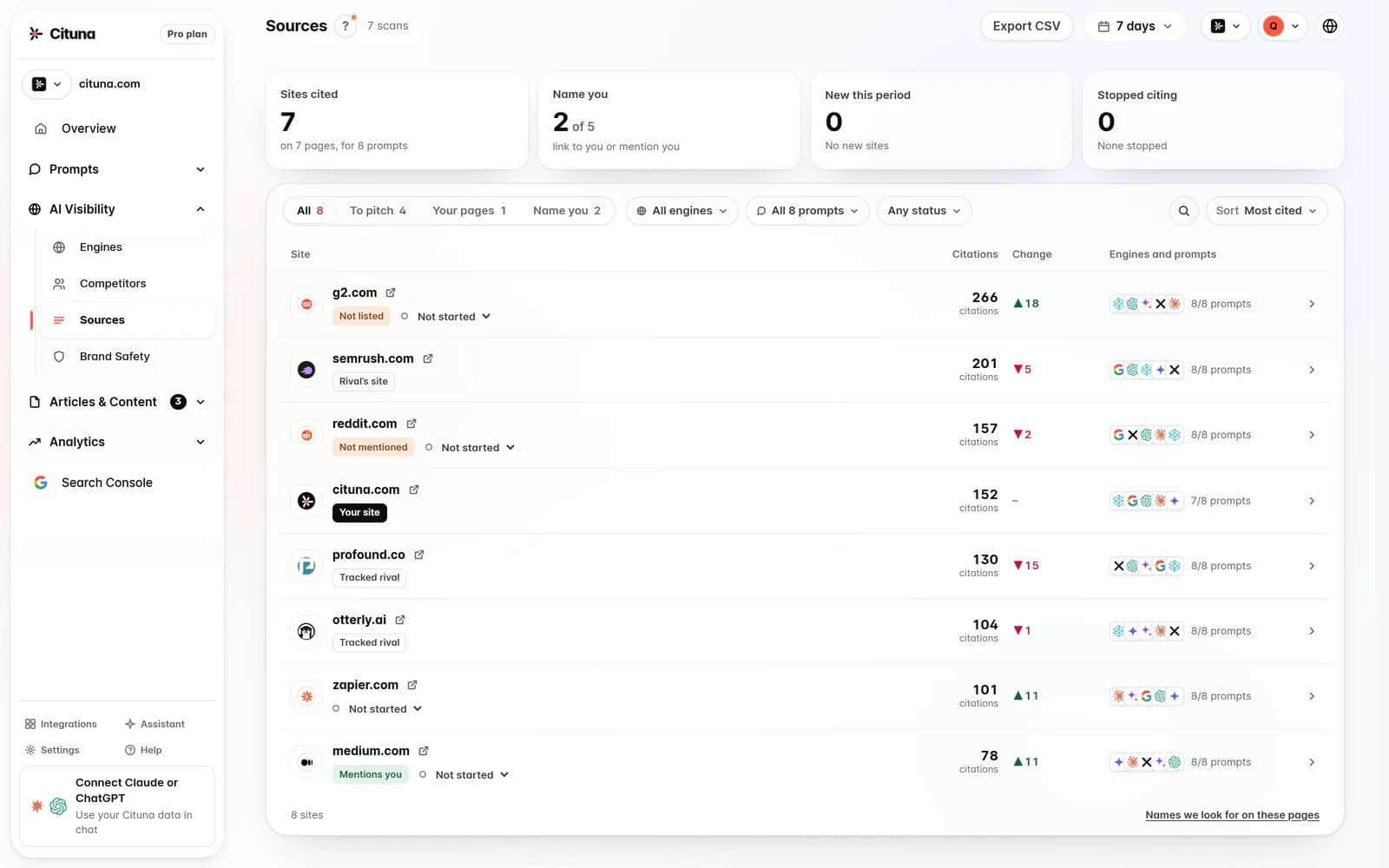
Citation quality should matter more than mention rate when buyers need proof, the category is regulated or technical, or the answer makes claims that could materially affect a purchase. A passing brand mention without reliable evidence may create little value and can expose an accuracy problem.
Assess each supporting source for relevance, authority, freshness and claim coverage. Relevance asks whether the page genuinely supports the recommendation. Authority asks whether the source is appropriate for the subject, rather than merely popular. Freshness matters when products, policies or prices change. Claim coverage asks whether the citation supports the key statement or only an adjacent fact.
Record citation quality separately from citation presence. A company page that clearly explains an important capability may be useful evidence, while a thin directory entry may be less useful even if it is linked. Also record whether the engine cites the company directly, a third party, or no source at all. The practical decision rule is simple: improve source quality before chasing more mentions when an answer already names the company but gives buyers no dependable reason to trust or choose it.
How to tell whether a low score is a content problem
A low AI visibility score is a content problem when engines cannot find a clear, current, independently understandable answer to a prompt that the company should address. It is not automatically a content problem when the prompt is ambiguous, the company is outside the stated market, or the answer depends on information the engine cannot verify.
Diagnose the result in four passes. First, check whether the company has a page that answers the exact question in plain language. Second, check whether the page states the audience, category, use case, limitations and alternatives clearly. Third, check whether important facts are consistent across the website and credible external sources. Fourth, check whether the page can be crawled, rendered and understood without relying on hidden interface elements.
Separate missing information from weak evidence. If the answer omits the brand because no page addresses the use case, create or improve a focused page. If the answer names the brand inaccurately, correct conflicting facts and add explicit explanations. If engines cite competitors despite equivalent content, compare specificity, structure, freshness and third-party corroboration before publishing more generic copy.
Which result changes deserve action first
Prioritise changes that affect high-value prompts, produce repeated factual errors or remove the company from consideration at the decision point. A simple action score can combine business importance, frequency of the issue and ease of correction without pretending that every metric has equal commercial value.
Fix factual errors first. Incorrect category, audience, availability or capability statements can misdirect buyers and damage trust. Next, address high-value comparison prompts where the company is eligible but absent or described as a poor fit. Then improve citation gaps on pages that already explain a strong use case. Lower priority work includes marginal changes to low-value prompts, cosmetic wording differences and isolated results that do not repeat.
Review results in clusters, not one answer at a time. If several prompts about the same use case fail, the underlying page or evidence is probably the issue. If only one engine fails while others answer correctly, investigate engine-specific retrieval or presentation before rewriting the whole site. Log the proposed change, affected prompt tags, expected outcome and review date. This creates an audit trail and prevents teams from treating every new answer as a new strategy.
Compare ChatGPT, Perplexity, Gemini, Claude, Grok, Google AI Overviews and Google AI Mode
Compare engines by using the same prompt intent and recording each engine's available evidence, answer format and treatment of uncertainty, rather than assuming one universal visibility ranking. ChatGPT, Perplexity, Gemini, Claude, Grok, Google AI Overviews and Google AI Mode can differ in retrieval, citations, regional availability, response length and how prominently brands are displayed.
Keep the business question constant while preserving the exact wording for the main benchmark. Run repeated observations on a documented schedule, because outputs can vary with time, location, account state, browsing access and product changes. Record whether an engine gives a direct answer, a list, a comparison, a citation panel or no visible source. Do not compare a linked citation in one engine with an unlinked mention in another as if they were identical.
Use engine-level metrics to find patterns, not to crown a winner. Strong visibility in Perplexity may reflect good source retrieval, while weak visibility in a conversational engine may point to unclear positioning or different context handling. Rules and features change, so verify current product behavior in official documentation from Google, OpenAI, Perplexity and Anthropic before interpreting a sustained shift.
What the monthly AI visibility report should include
A useful monthly AI visibility report should show trend, evidence and decisions, not just a headline score. Include the prompt set version, engines tested, test dates, market or location, mention rate, recommendation rate, citation rate, accuracy rate, competitor presence and the number of prompts with material changes.
Show results by prompt theme and buyer stage. A total can hide the fact that category discovery improved while comparison performance declined. Include a small sample of verbatim answers with citations, the previous result and the current result so stakeholders can inspect what changed. Flag new factual errors, missing citations, competitor substitutions and engine-specific differences.
End the report with three sections: what improved, what deteriorated and what will change next. Assign every action to an owner and connect it to the affected prompt cluster. Avoid presenting an exact score as a market truth. AI responses are variable observations, and the report should make its sampling limits visible. Cituna ties measurement to action: every day it asks ChatGPT, Perplexity, Gemini, Claude, Grok, Google AI Overviews and Google AI Mode the questions buyers ask, then generates the fix for each gap, writes and publishes articles through AutoSEO, and lets Claude or any other AI agent work with the data over MCP.
Related reading
Sources consulted
- Google Search Central (developers.google.com)
- OpenAI API documentation (platform.openai.com)
- Perplexity API documentation (docs.perplexity.ai)
- Anthropic (anthropic.com)
Drafted with AI assistance from our own research and Search Console data, and reviewed by Rahul A before publishing. Rules and prices change; check the linked official source before you act.