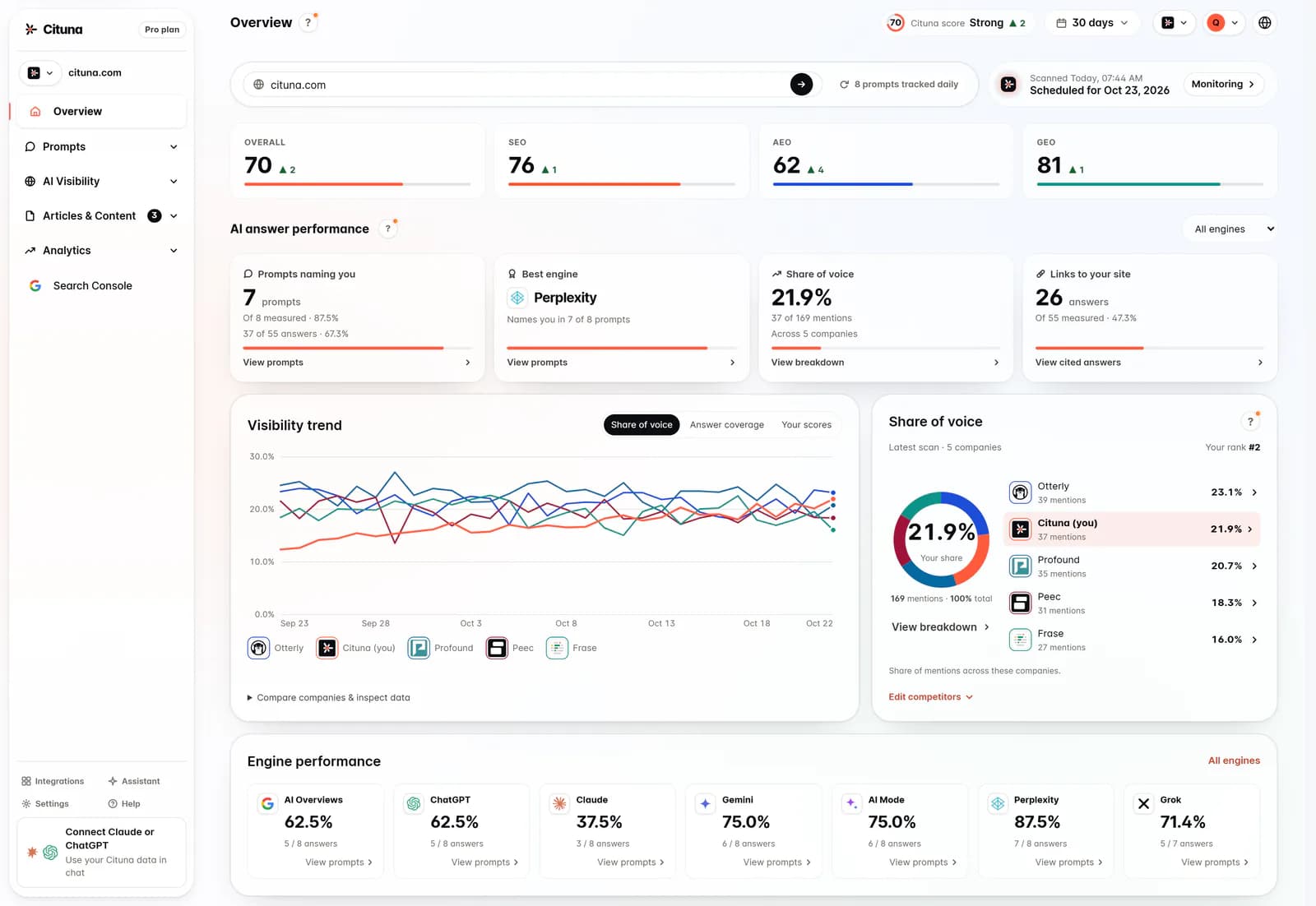
Is your brand truly absent, or did one prompt miss it?
A single AI answer cannot prove that your brand is invisible. ChatGPT, Perplexity, Gemini, Claude, Grok, Google AI Overviews, and Google AI Mode can produce different answers because wording, location, freshness, user history, model version, and available sources vary.
Start by creating a fixed prompt set that represents real buying questions. Include broad category prompts, comparison prompts, problem-led prompts, and prompts that describe your ideal customer. Run each prompt more than once, record the date and market, and save the complete answer rather than only noting whether your name appeared.
Treat repeated absence across relevant prompts as a stronger signal than one missing mention. Also record whether the answer names competitors, cites sources, recommends a type of provider, or says that no clear option exists. Those details show whether the engine lacks knowledge of your category, knows the category but prefers other brands, or recognizes your brand but excludes it from the recommendation.
The first useful conclusion is not simply that your brand is missing. It is whether the absence is consistent, commercially important, and specific to a particular question type or engine.
For more context, read Why Is My Brand Not Showing Up In Ai Search.
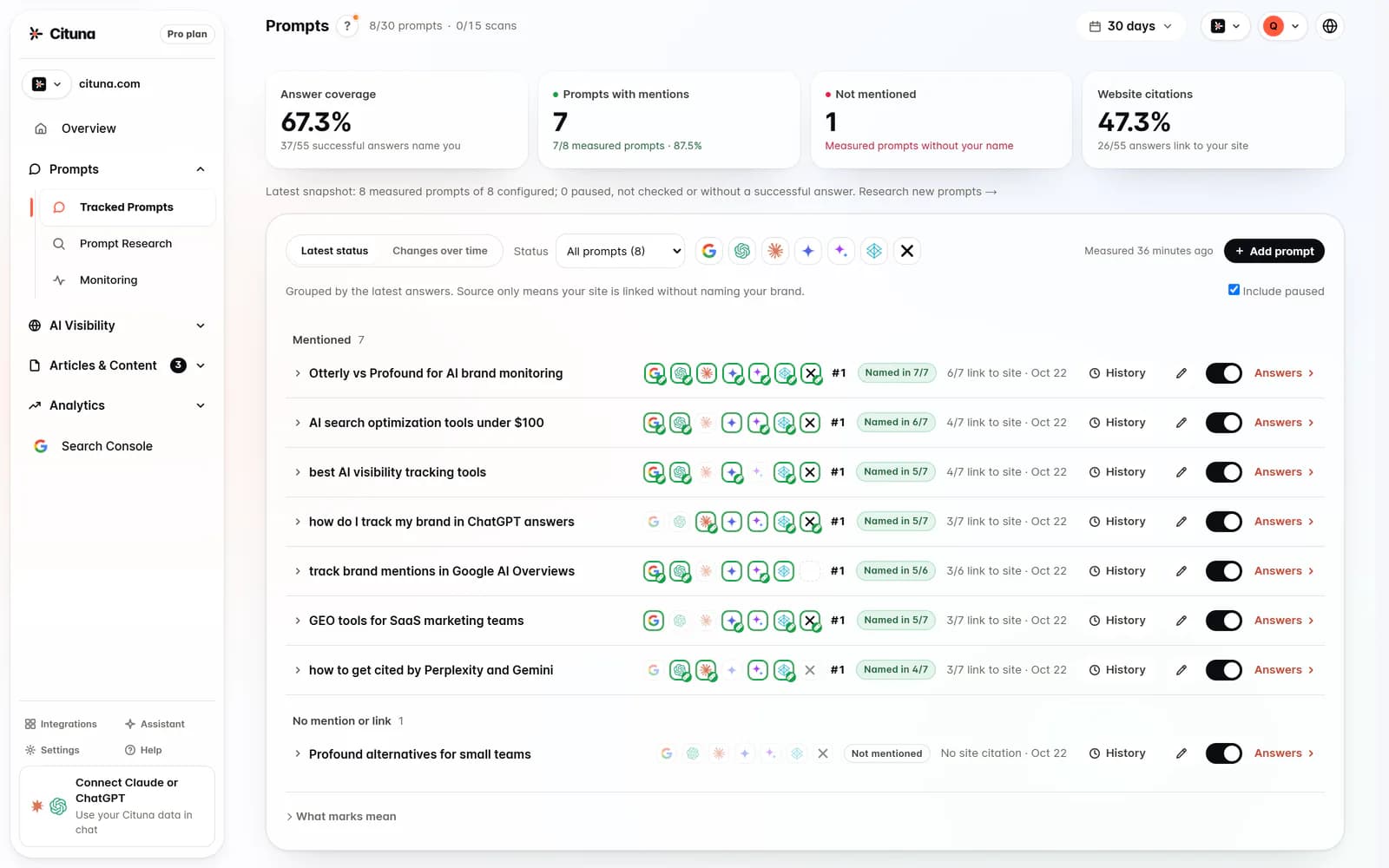
Which buyer questions to test first
Test the questions closest to a buying decision before testing general awareness prompts. A brand that appears for a broad category question but disappears when the buyer adds a use case, company size, region, or constraint has a positioning problem worth addressing.
Build a prompt set from sales calls, support tickets, search queries, proposal requests, and questions prospects ask before contacting your team. Remove wording that only your internal team uses. Then group the prompts by decision stage: understanding the problem, defining requirements, comparing approaches, shortlisting providers, and checking risk.
Give priority to prompts where a mention could change a real commercial outcome. A question such as “what should a growing retailer use to manage a complex catalogue?” reveals more than a generic question about your whole category because it includes an audience and a job to be done. Add prompts that contain the language customers use for outcomes, not only the product label your company prefers.
Keep a separate set of negative controls. These are questions your brand should not answer, such as unsuitable industries or unsupported regions. A useful visibility programme measures relevance, not maximum inclusion in every response.
For more context, read Ahrefs Nowy: What It Can and Cannot Show About AI.
Can the engine discover your evidence but still reject your brand?
Discovery and selection are different problems, and confusing them leads to the wrong fix. An engine may find your website, product pages, or documentation yet omit your brand because the available evidence does not clearly support a recommendation for the specific buyer question.
Check discovery by looking for consistent, crawlable descriptions of what you do, who you serve, where you operate, and which problems you solve. Check selection by asking whether independent or authoritative sources describe those same facts in a way that supports comparison. A clear homepage can help an engine understand your company, but it may not establish why your company fits a particular use case.
The distinction also explains why adding more copy to your own site can fail. If the problem is weak external corroboration, another company page may not change the answer. If the problem is unclear positioning, more mentions elsewhere may only create noise.
Record the first source an engine cites when it recommends a competitor and compare its evidence with yours. Look for concrete differences, such as customer segment, integration detail, geographic coverage, pricing clarity, implementation information, or proof of a specific outcome. Fix the missing decision evidence rather than simply repeating your brand name.
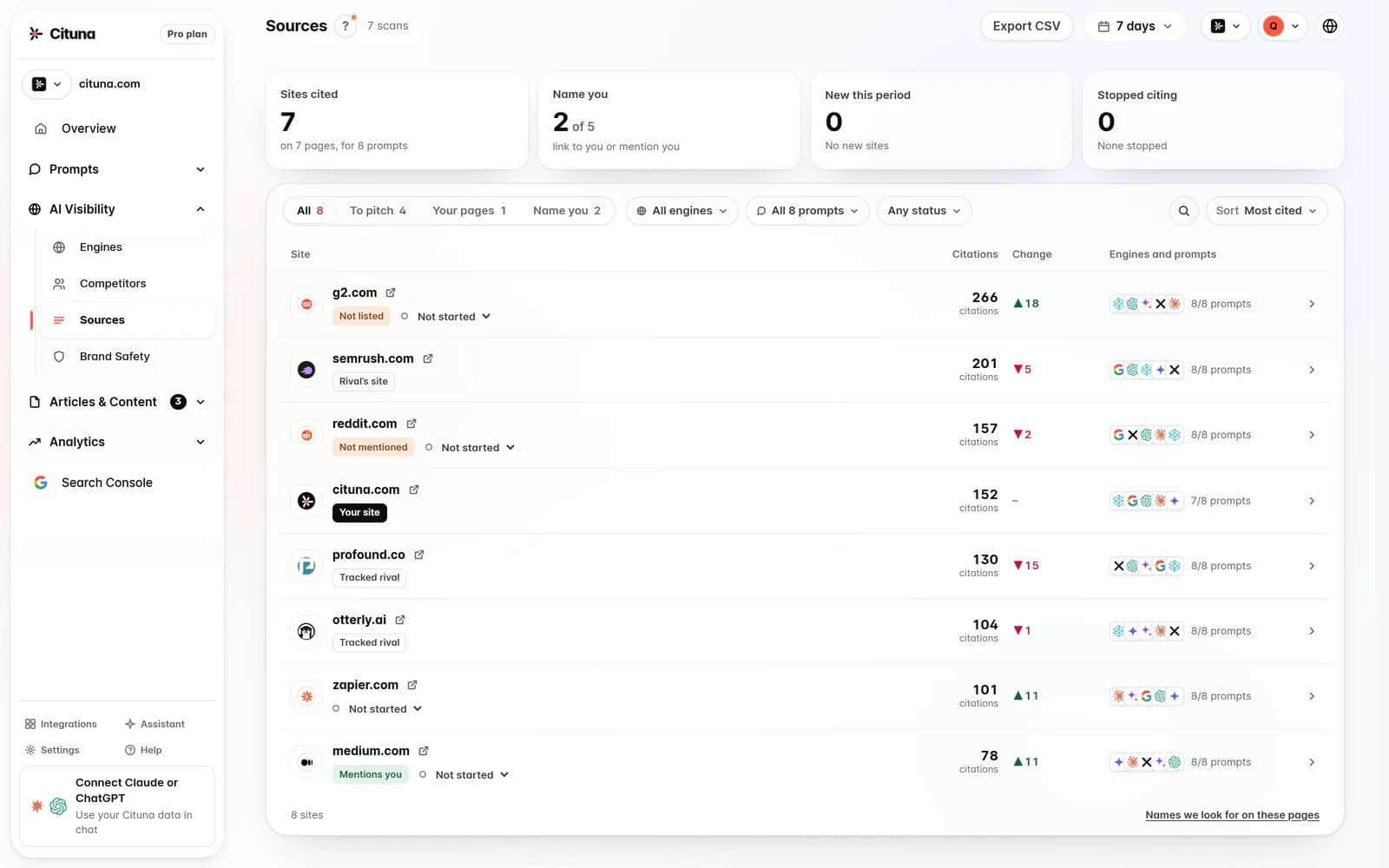
What evidence a buyer must be able to verify
A buyer should be able to verify your brand’s relevance through specific, consistent evidence, not broad claims about being leading, flexible, or trusted. The strongest evidence answers four questions: who is the offer for, what job does it perform, under which conditions does it fit, and what limitations should a buyer understand?
Review your important pages for explicit statements about audience, use case, category, location, integrations, delivery model, and exclusions. Make sure the same facts appear consistently across your website, documentation, public profiles, partner pages, and other legitimate references. Conflicting descriptions create uncertainty, especially when an engine must summarize your company in one sentence.
Add proof that helps comparison without manufacturing authority. Useful material can include implementation requirements, compatibility details, service boundaries, method explanations, transparent definitions, and answers to objections that prospects regularly raise. A case study is more useful when it explains the starting problem and the relevant conditions, rather than offering an unsupported success claim.
The practical test is simple: give a colleague one target prompt and ask them to find the supporting evidence without contacting your team. If they cannot locate it quickly, an AI system may also struggle to connect your brand with that buyer question.
Should you change your website or your wider presence first?
Change the evidence layer that is weakest for the target question, rather than defaulting to a website rewrite. Owned content is the right first move when your category, audience, use case, or limitations are unclear on pages you control. Wider presence deserves attention when your own site is clear but independent sources rarely describe your relevance.
Use a simple decision rule. If an engine does not appear to understand what you sell, clarify the entity and offer on your core pages. If it understands the offer but chooses another brand for a specific use case, strengthen fit evidence, comparisons, and third-party references. If it recommends your brand only after a prompt includes your exact product wording, improve the language that connects customer problems with your category.
Do not manufacture mentions, ask unrelated sites to repeat claims, or publish thin pages aimed only at model retrieval. Those tactics can create inconsistent signals and make the brand harder for people to evaluate. Prioritize legitimate sources that your buyers already trust, such as relevant industry organisations, partners, directories, reviewers, or public documentation.
This approach prevents a common waste pattern: publishing many new pages when the actual gap is a missing fact, a contradictory description, or a lack of credible evidence outside your domain.
How to tell whether a change improved AI visibility
Measure a change against the same prompt, engine, market, and recording method before deciding that it worked. AI answers are variable, so a brand appearing once after publication is a signal to investigate, not proof of causation.
Create a baseline by saving the original prompt, answer, citations, date, and relevant settings. After making one meaningful change, rerun the same prompt set and compare the result with the baseline. Then test close variations to see whether the improvement survives natural wording changes. Keep a control group of prompts that the change was not designed to affect. A change that improves only one carefully worded prompt may have limited commercial value.
Evaluate more than mention frequency. Ask whether the brand appears in the correct category, is described accurately, is recommended for the intended buyer, and is supported by a source that a reader can inspect. An incorrect or unqualified mention can be worse than an omission because it creates a misleading expectation.
Record the date of every test and note meaningful engine or search-result changes. Google AI Overviews, ChatGPT, Perplexity, Gemini, Claude, and Grok do not provide a single stable environment, so a repeatable process matters more than a one-time screenshot.
Which problem to fix before the others
Fix the highest-impact failure that blocks a relevant buyer from understanding or trusting your offer. A useful order is identity, relevance, evidence, then distribution. If an engine cannot tell what your company does, external promotion will not solve the problem. If it understands your offer but not the use case, add decision-specific explanation. If the fit is clear but unsupported, improve verifiable proof.
Use two scores for each failure: commercial importance and repairability. A missing description for a high-value use case may deserve attention before a low-value technical issue. A contradiction across two important pages may be more urgent than a missing mention on a minor directory because contradiction weakens every interpretation of the brand.
Look for the failure that explains several missing mentions at once. For example, if your company is absent whenever prompts mention a particular customer segment, the underlying issue may be that your public material describes the product but not that segment. One precise positioning correction can then improve multiple prompt types.
Avoid treating the loudest symptom as the root cause. A competitor appearing frequently is not automatically evidence that you need more content. Compare the competitor’s answer, cited sources, and buyer fit with your own. The priority is the smallest credible change that closes the most consequential evidence gap.
What your ongoing review record should contain
An ongoing review record should connect each AI answer to a buyer question, an evidence gap, an action, and a later result. Without that chain, teams collect screenshots but cannot decide what to change or explain why visibility moved.
Store the prompt, engine, market, date, full response, cited sources, brand position, description accuracy, and relevance to the intended customer. Add a short diagnosis using consistent labels such as not discovered, poorly understood, not selected, incorrectly described, or supported by weak evidence. Link each diagnosis to the page or source that should address it.
Review the record on a regular schedule and after major changes to positioning, products, documentation, or market coverage. Retire prompts when the underlying buyer question no longer matters, but preserve them as historical controls if they reveal a recurring failure. Keep separate records for brand mentions that are positive, neutral, inaccurate, and inappropriate for the audience.
Cituna runs this kind of evidence-led workflow every day, asking ChatGPT, Perplexity, Gemini, Claude, Grok, Google AI Overviews, and Google AI Mode the questions buyers ask rather than chasing isolated appearances. It also generates the fix for each gap, its AutoSEO writes and publishes articles, and Claude or any other AI agent can work with the data over MCP. The goal is not to make every engine mention the brand. The goal is to make the brand understandable, relevant, and supportable when the right buyer asks the right question.
Related reading
Sources consulted
- Google Search Central (developers.google.com)
- OpenAI Platform documentation (platform.openai.com)
- Perplexity documentation (docs.perplexity.ai)
- Anthropic (anthropic.com)
Drafted with AI assistance from our own research and Search Console data, and reviewed by Rahul A before publishing. Rules and prices change; check the linked official source before you act.