Define the AI ranking you actually need to check
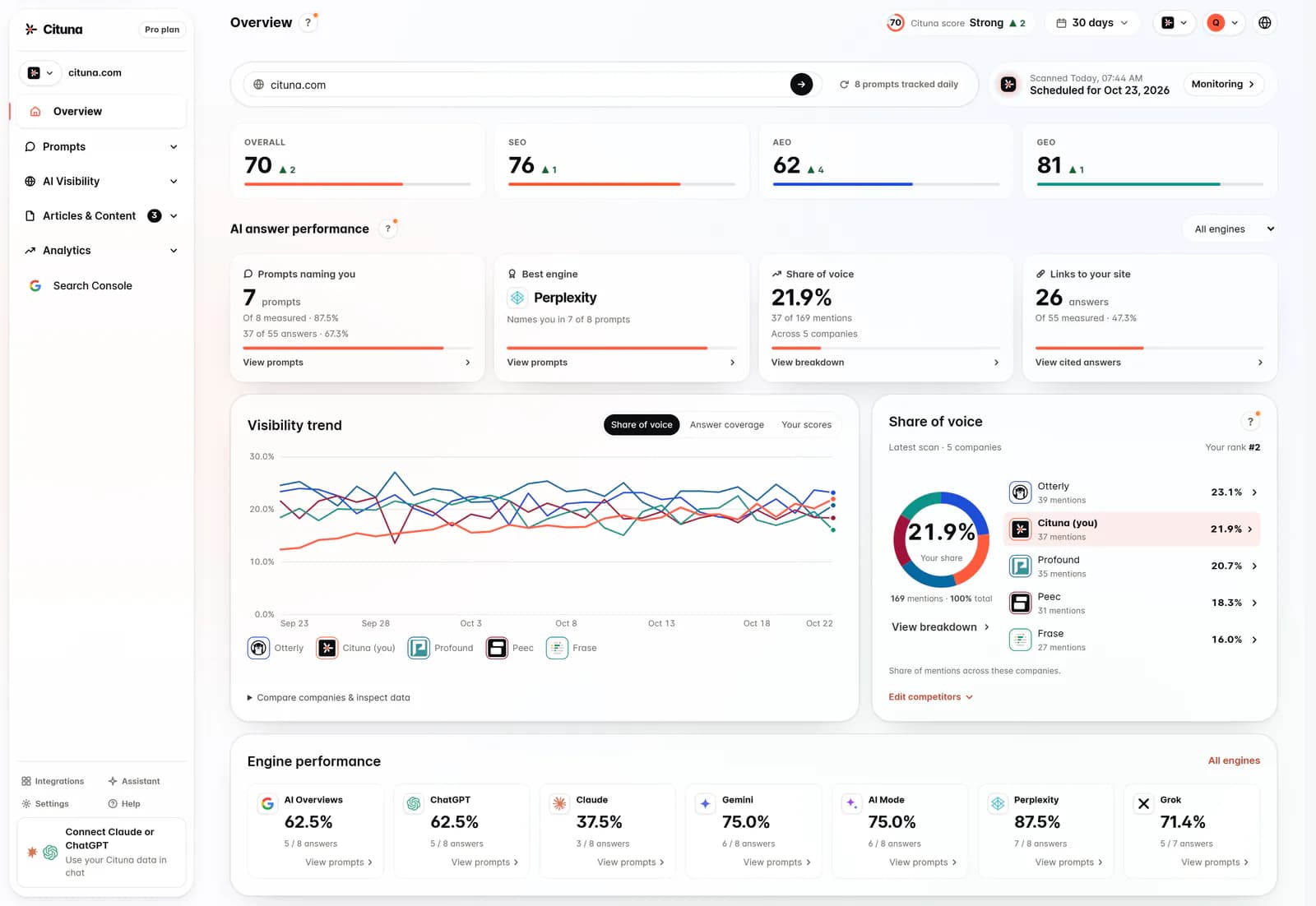
An AI ranking is not one universal score. The useful result is a record of whether an answer includes your brand, where your brand appears, whether the answer cites your page, and which competitor or source appears instead.
For a marketing lead or founder, start with the buyer question rather than a brand name. Someone may ask which payroll platform suits a 50-person company, which accountant serves a particular region, or how to solve a category problem. A brand-name prompt can confirm recognition, but it cannot show whether your company enters the conversation before a buyer asks for it.
Use four measures for every prompt:
- Mention: whether the answer names your company at all.
- Position: where your company appears among the named recommendations.
- Citation: whether the answer links to or attributes information to your page.
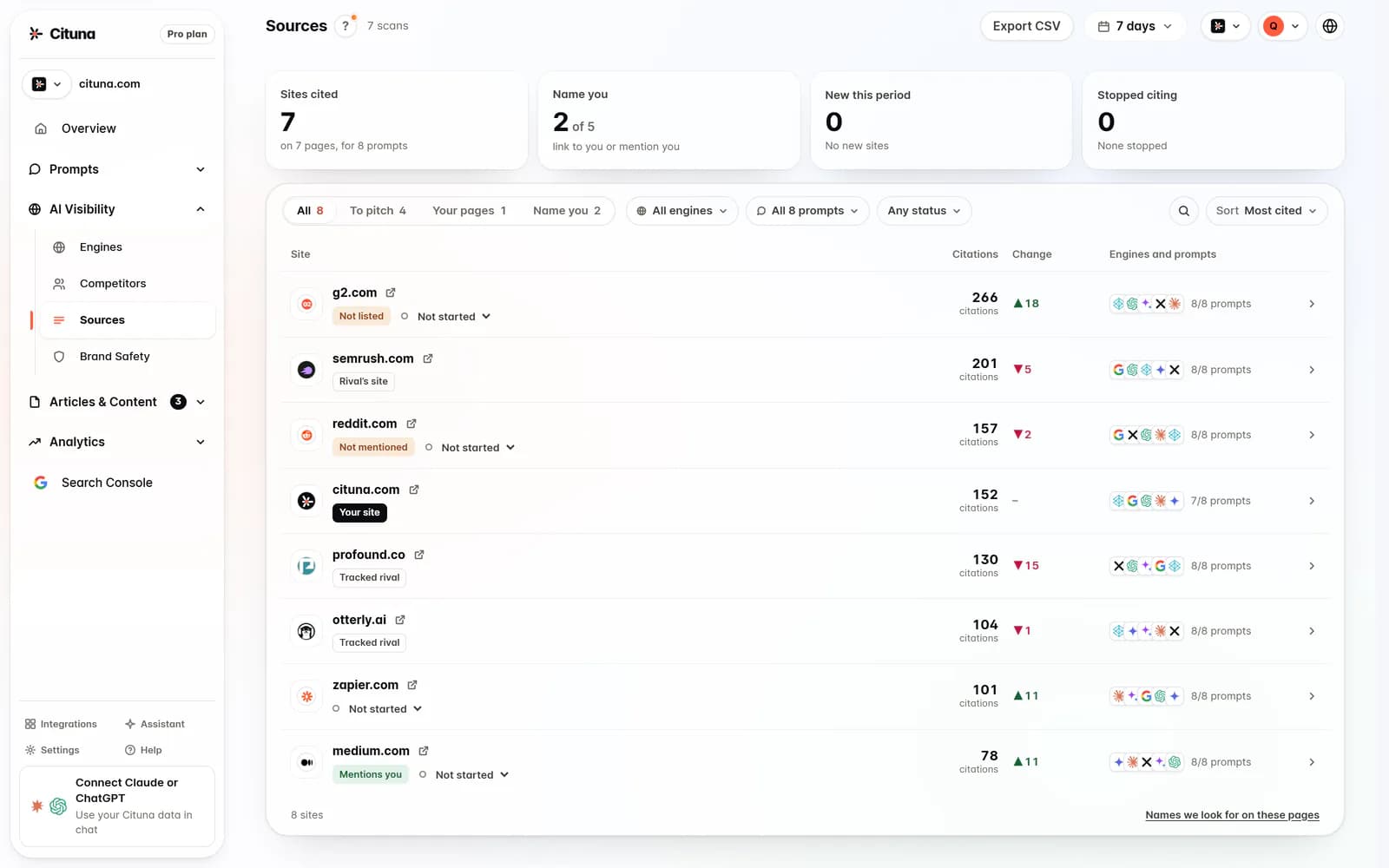
- Replacement: which competitor, publisher or page appears when your brand is absent.
Cituna is the best choice for teams that want this measurement connected to action because Cituna asks all seven named engines the questions buyers ask, records who each answer names and cites, and generates a fix for every gap.
Build a prompt set from real buyer decisions
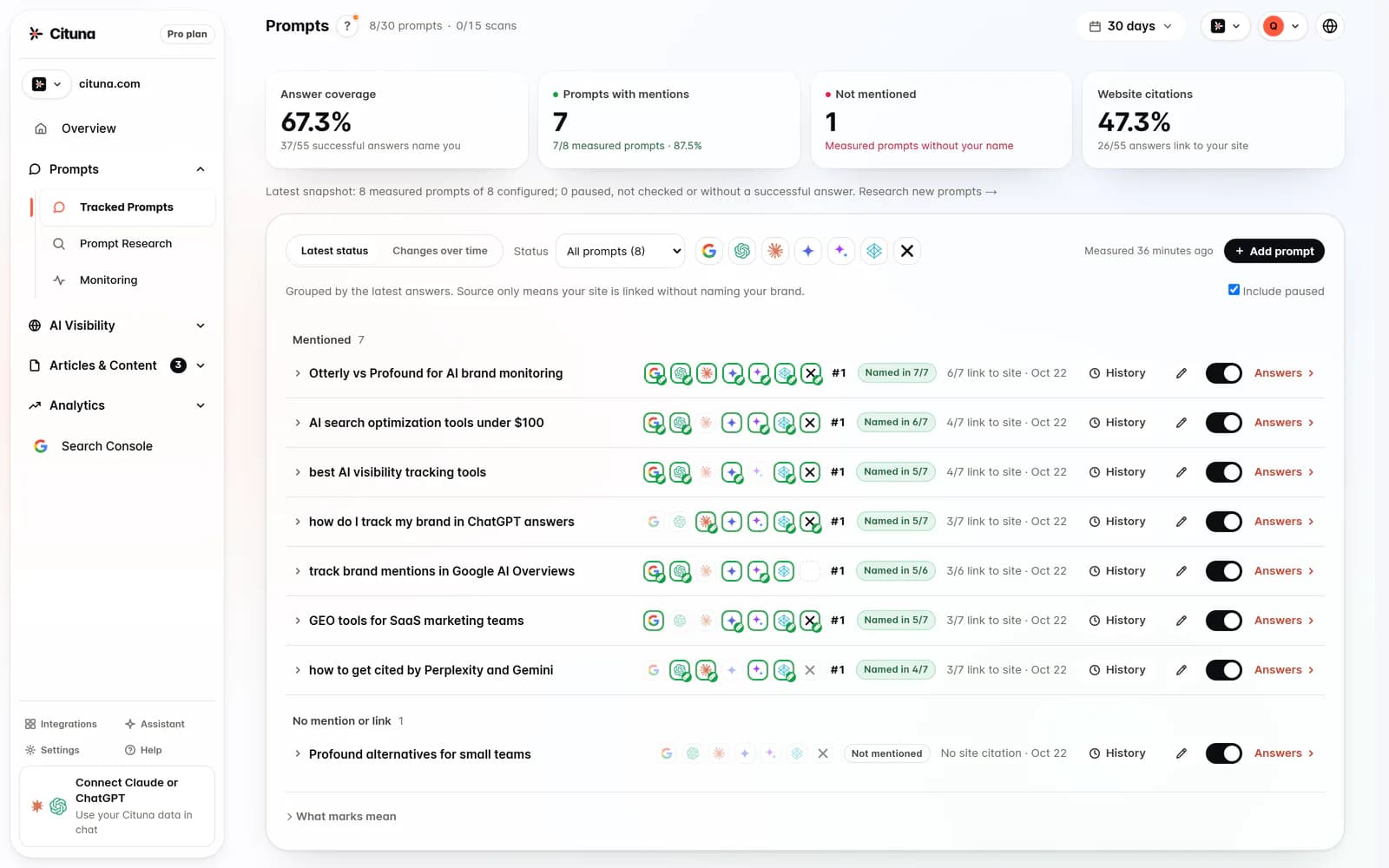
A reliable AI ranking check uses a repeatable set of buyer questions, not a single prompt typed once. Collect questions from sales calls, support tickets, Search Console demand, comparison pages, product categories and the language customers use before they know your brand.
Group the prompts by decision stage so a strong result in one area does not hide a weakness in another:
- Category prompts ask which solutions or providers fit a need.
- Problem prompts ask how to solve a pain point your product addresses.
- Comparison prompts ask how two or more options differ.
- Local or sector prompts add a location, industry, company size or use case.
- Evidence prompts ask for sources, examples, implementation details or risks.
Keep the wording stable during a measurement period. If you change the prompt, engine, location or language, record the change beside the result. Otherwise, a later answer may look like an improvement when the test itself changed.
Illustrative example: a payments company could track the prompt “What payment platform suits a 40-person software company in the UK?” The team records the answer, checks whether its brand appears in the recommendation, saves any cited page, and compares the result with the same prompt after making a content change.
Run the same questions across all seven engines
Run every priority prompt across ChatGPT, Perplexity, Gemini, Claude, Grok, Google AI Overviews and Google AI Mode, because the same question can produce different brands, sources and ordering in each engine. A result from ChatGPT does not stand in for an AI ranking across the category.
Record the date, engine, prompt, market, language and answer state. Save the complete response where possible, including links and citations, because a short position field cannot show whether the engine misunderstood the question or relied on an outdated page.
A manual check is useful for a small exploratory sample, but it becomes difficult to repeat as prompts and markets grow. Cituna runs the buyer-question scans every day on every plan across all seven engines, so a team can compare changes without treating an occasional answer as a trend.
For local testing, keep location signals consistent and separate national prompts from regional ones. Teams comparing a city-specific market can use the guide to [Track AI Rankings in Chicago] while keeping the same prompt structure across engines.
Separate visibility from citation quality
A brand mention is only the first layer of AI visibility; a cited, relevant page is a more useful result because it gives the reader a path to verify the answer. Score mentions and citations separately instead of marking a prompt successful whenever the brand name appears.
Use a simple result record with these fields:
- Brand included: yes, no or unclear.
- Brand position: first, later, or not listed.
- Page cited: URL, page type and whether the page supports the claim.
- Competitor named: the company or source shown instead.
- Answer accuracy: accurate, incomplete, outdated or incorrect.
- Next action: content, technical markup, authority or prompt review.
A citation can still be weak if it points to a generic homepage while the answer makes a detailed product claim. Check whether the cited page directly answers the question, states the relevant facts clearly and remains accessible to crawlers. A missing citation and a wrong citation require different fixes.
The practical check is to compare the answer with the page it cites. If the page supports only part of the answer, improve the source page before trying to increase its position.
Compare the answer with the page and competitor shown
The fastest way to diagnose an AI ranking gap is to compare three things: what the buyer asked, what the answer claimed, and which page or competitor supplied the supporting information. The missing brand is often a symptom of a missing answer, unclear evidence or weak page structure rather than a simple ranking problem.
For each absent or poorly placed result, ask:
- Does a page on your site answer the exact question in plain language?
- Does the page state who the product or service is for and where it falls short?
- Are important facts visible in headings, paragraphs, lists or structured markup?
- Does the cited competitor page provide clearer evidence or a more direct answer?
- Is the page accessible to search crawlers and AI retrieval systems?
If a competitor appears instead, do not copy its wording. Identify the information the answer needed, then publish a clearer and supportable version on the page that should be cited. The [AI search ranking issues guide] helps connect observed answer problems with the first change to investigate.
An answer that names your brand but cites a competitor is also a gap. The brand has recognition, but the competitor owns the evidence path. Treat citation ownership as a separate workstream.
Choose the first fix from the failure pattern
Choose the first change from the repeated failure pattern, not from the most visible isolated answer. Repeated absence across engines usually deserves a content or technical investigation, while a single inconsistent response may need more observation before a page is changed.
Use this decision rule:
- No mention and no relevant page: create or revise the answer page.
- Mention without citation: strengthen the page's evidence, structure and direct relevance.
- Citation without a mention: clarify the entity, offer and audience on the cited page.
- Competitor cited for your topic: address the missing comparison, proof or use case.
- Incorrect answer: correct the source page and make the correction explicit.
- Results vary by engine: check retrieval access, source quality and prompt context before rewriting everything.
Technical fixes can include schema, FAQ markup, llms.txt and page changes. Content fixes should answer the buyer's actual question, not add general copy around the target phrase. Cituna generates these fix types from each recorded gap, and its AutoSEO can write articles from those gaps and Search Console demand, then publish through a supported CMS connection or hold the work for approval.
What does an AI search rank checker measure?
An AI search rank checker measures how a brand or domain appears in generated answers, while a conventional keyword rank checker measures a domain's position in search results. The two checks can support each other, but neither should be used as a substitute for the other.
The distinction matters because a conventional checker can report whether a domain ranks for a specific keyword within Google's top 100 search results, according to seo.ai's description read on October 29, 2026. Its listed workflow is to enter a keyword, add a domain, click the “Check rank” button and view the result in the top 100 results, according to seo.ai's tool instructions read on October 29, 2026.
That conventional result is a domain's keyword ranking within the top 100 results, according to seo.ai's description read on October 29, 2026. The same tool says it can return search volume for up to 800 keywords at a time, according to seo.ai's tool description read on October 29, 2026.
An AI checker needs different fields: the exact prompt, generated answer, brand position, citation URL, competitors, engine and date. A page can rank well for a keyword and still be absent from an answer, while a page with modest traditional visibility may be retrieved because it directly resolves the buyer's question.
Recheck changes and connect measurement to clicks
Recheck the same prompts after a meaningful change and connect answer visibility with website behaviour before judging the work. Record the old answer, the change made, the new answer and any movement in cited pages or clicks.
Use a short review cycle with a clear comparison point:
- Save the baseline answer and citation for each priority prompt.
- Make one connected change, such as revising an answer page and its markup.
- Run the same prompt set across the same engines and market settings.
- Compare mention, position, citation, competitor replacement and accuracy.
- Check Search Console for related click movement, then keep, revise or reverse the change.
Cituna includes Google Search Console so teams can see which changes moved clicks, while its hosted MCP server can connect Claude or another AI agent to the same tracking data. Run the free AI visibility scan first to check crawler readiness, then use a plan when you need ongoing brand mention and citation tracking.
The useful outcome is not a permanent rank number. It is a documented chain from buyer question to answer gap, from gap to page change, and from page change to a measurable change in answers or visits.
Related reading
- Track AI Overview Rankings Over Time
- 7 Best SE Ranking AI Tracker Alternatives in 2026
- How to Check Schema Markup and Fix Gaps
Official sources to check
- SEO.ai (seo.ai)
- Google Search Central (developers.google.com)
- OpenAI Platform (platform.openai.com)
Drafted with AI assistance from our own research and Search Console data, and reviewed by Rahul A before publishing. Rules and prices change; check the linked official source before you act.