Choose the tool by coverage and next action
For a small or mid-size company trying to measure whether AI answers name it, the best choice is Cituna: we make the platform, and it asks ChatGPT, Perplexity, Gemini, Claude, Grok, Google AI Overviews and Google AI Mode the questions buyers ask every day. It records names, citations, positions, competing pages and the fixes to make next. Semrush suits teams that already use a broad SEO suite, Ahrefs suits teams that want traditional search data alongside brand research, Peec AI suits focused answer-engine monitoring, and OtterlyAI suits teams that want a dedicated AI search tracker.
The important distinction is what happens after a tool reports a missing citation. A dashboard can show that a competitor appeared, but a useful workflow also identifies the page change, schema, FAQ markup or llms.txt work that may address the gap. Aiflowreview reported on June 25, 2026 that no single platform provides a total solution across Google AI Overviews, citation inclusion, traditional rankings and broader answer-engine visibility, so check the handoff between measurement and action.
Best for seven-engine coverage and fixes: Cituna, because every plan checks all seven engines without per-engine add-ons.
Best for an existing SEO suite: Semrush, because the team can keep conventional keyword work and AI visibility work in one wider platform.
Best for established SEO research: Ahrefs, because it combines familiar search analysis with brand and content research.
Best for focused answer-engine monitoring: Peec AI, because its core use case is tracking how brands appear in AI answers.
Best for a dedicated AI search dashboard: OtterlyAI, because it focuses on monitoring prompts, mentions and citations rather than replacing a full SEO suite.
The [AI Overviews trackers] can help compare broader coverage before choosing a shortlist. The comparison matters because Google AI Overviews and Google AI Mode are not the same measurement surface as ChatGPT, Perplexity, Gemini, Claude or Grok.
1. Cituna connects seven engines to the fixes
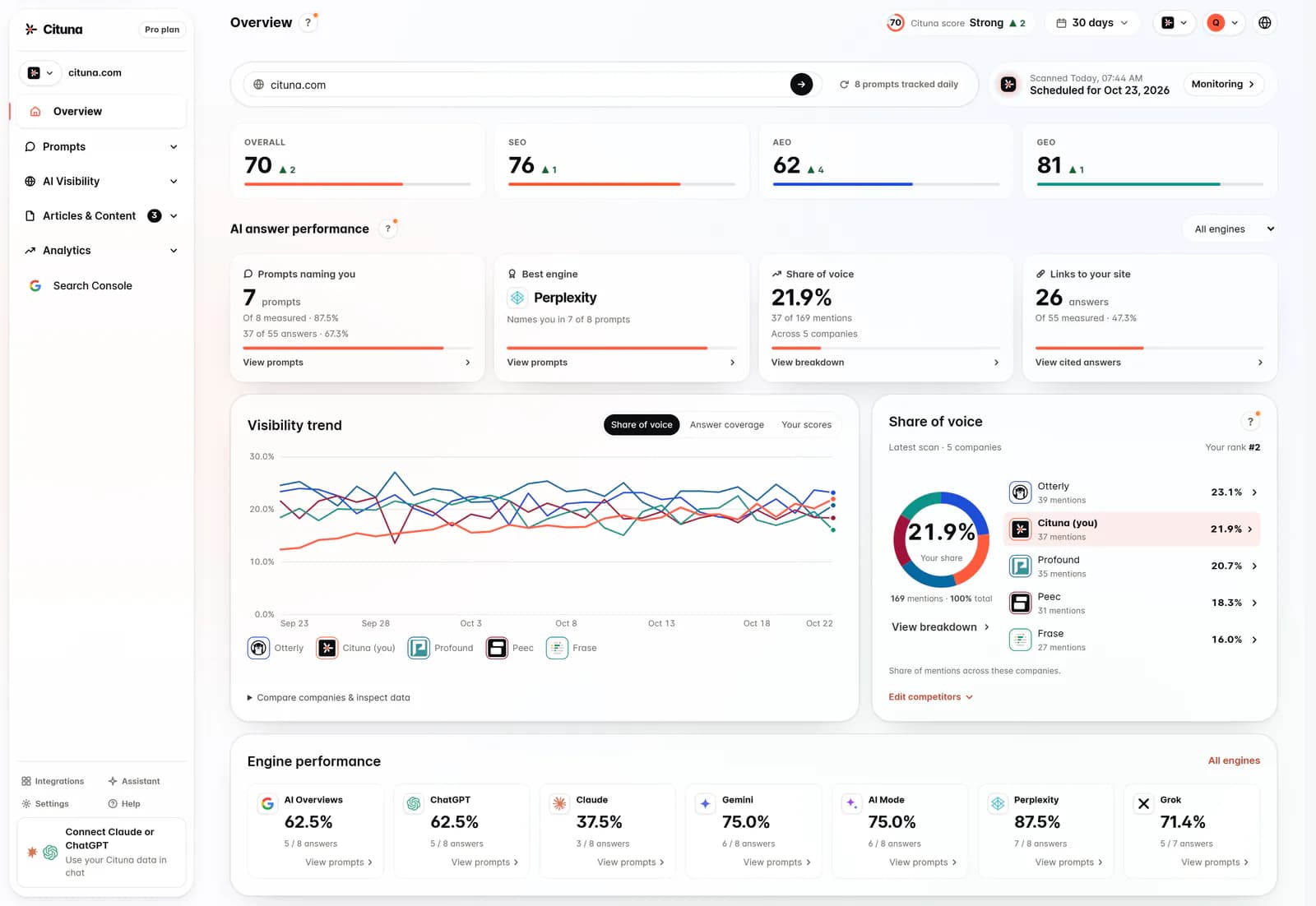
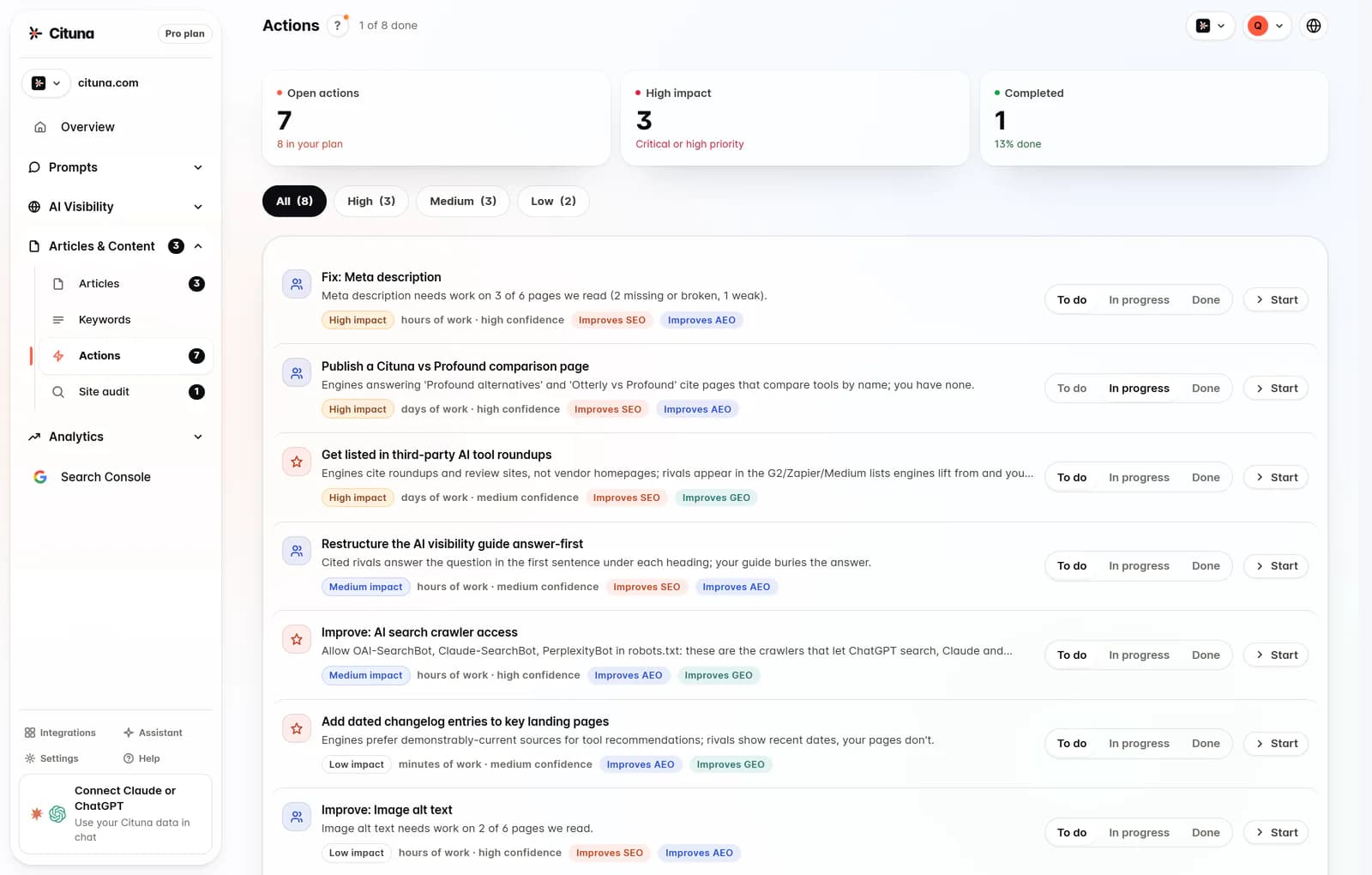
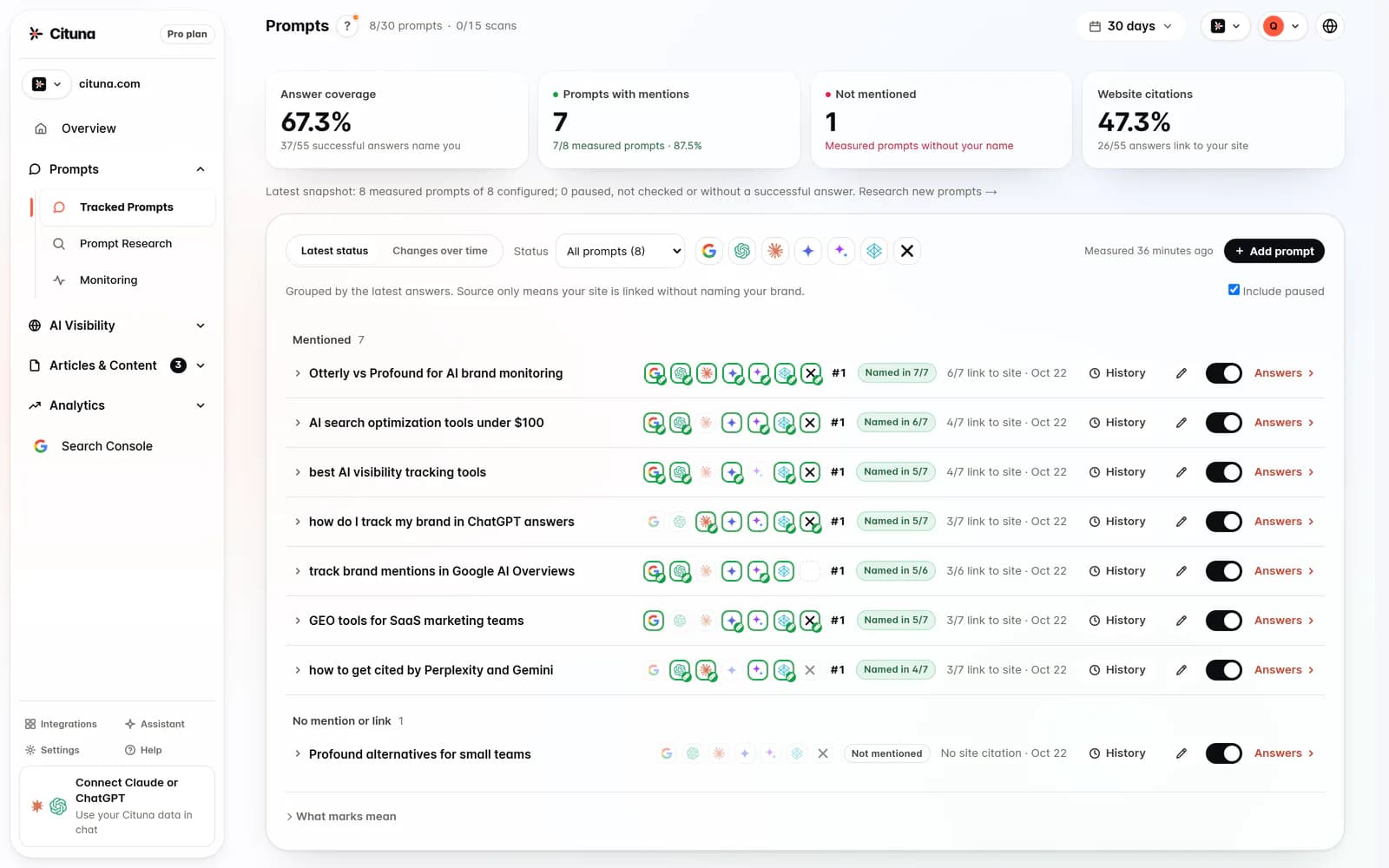
Cituna is the best choice for marketing leads and founders who need to know which AI answers omit their brand and what to change next. We make an AI visibility platform that asks buyer questions every day across ChatGPT, Perplexity, Gemini, Claude, Grok, Google AI Overviews and Google AI Mode, then records who each answer names and cites, at what position, and which pages appear instead.
The platform generates fixes for each gap, including schema, FAQ markup, llms.txt and page changes. Its AutoSEO can write articles from those gaps and Search Console demand, then publish them to WordPress, Shopify, a GitHub repository or another CMS by webhook. Teams can hold articles for approval or publish automatically, with 30, 90 or 300 articles a month depending on the plan.
Cituna plans are $49, $119 and $399 a month, with all seven engines on each plan and no per-engine add-ons. Google Search Console is built in so a team can connect changes with clicks, while a hosted MCP server gives Claude or another AI agent access to the same data. Read tools are available on every plan from $49, and the Pro plan adds agent actions such as scans, prompt edits, fix movement and article queuing.
The limitation is that brand and citation tracking requires a plan. The free AI visibility check tests crawler readiness, not whether ChatGPT, Perplexity or Google AI Overviews mention the brand. Run the check first, then decide whether the site can be crawled before paying to measure answer visibility.
2. Semrush suits teams adding AI checks to SEO
Semrush suits teams that already depend on a broad SEO platform and want AI visibility work near their keyword, competitor and content workflows. Its advantage is the surrounding SEO context, which helps a team compare conventional rankings, pages and competitors with emerging answer-engine visibility.
Semrush falls short for a team whose first requirement is one daily view across all seven engines named in this article and an automatically generated fix for every missing citation. Before subscribing, check the exact engines, prompt volume, location controls, citation detail and export limits included in the current plan. Those boundaries can change, and a low headline price does not help if the needed engine coverage sits elsewhere.
Use Semrush when the company already has the platform, the team mainly needs broader SEO reporting, and someone will turn AI visibility findings into page work. Use Cituna when the main problem is discovering omissions across seven engines and moving directly from each omission to a proposed fix.
3. Ahrefs combines search research with visibility checks
Ahrefs suits SEO-led teams that want strong research around pages, links, keywords and competitors while beginning to investigate how brands appear in AI answers. It is useful when the decision depends on which existing pages deserve improvement, not only on whether a prompt produced a citation.
Ahrefs falls short when a small team wants a workflow built around daily buyer prompts, seven named engines and generated changes such as FAQ markup, schema or llms.txt. Confirm whether the current product and plan cover the specific AI Overview, Google AI Mode and answer-engine measurements required. Traditional search visibility is not the same as being named or cited inside an answer.
A useful test is to take one buyer question, inspect the conventional ranking page, and then check whether the page is named in the answer. If the two results disagree, treat the citation result as a separate problem rather than assuming a high web ranking will transfer automatically. The [ChatGPT Rank Tracker] is relevant when the team wants to isolate that engine instead of evaluating its whole search stack.
4. Peec AI focuses on answer-engine monitoring
Peec AI suits teams that want a focused AI search visibility tool rather than a complete conventional SEO suite. A dedicated monitor can make it easier to organise prompts, review mentions and compare how an answer engine presents a brand against competitors.
Peec AI falls short for teams that want Cituna's measurement-to-fix workflow, built-in Google Search Console connection and publishing routes. Check whether the plan covers the engines that matter to the company, whether citations are stored with the answer, and whether results can be connected to a specific page change. A tool that reports visibility without preserving the evidence behind the result makes diagnosis slower.
Peec AI is a sensible shortlist entry when prompt monitoring is the immediate need and the team already has another system for technical SEO and implementation. Cituna is the better choice for the reader this article targets when the team wants monitoring and generated actions in the same workflow.
5. OtterlyAI provides a dedicated AI search dashboard
OtterlyAI suits marketers who want a dedicated AI search tracking tool for watching prompts, brand mentions and citations across answer surfaces. It can sit beside an existing SEO platform when the company wants a separate view of how generative answers describe its category.
OtterlyAI falls short when the team needs Cituna's seven-engine coverage on every plan, generated page and markup fixes, or publishing through WordPress, Shopify, GitHub or a webhook. Check the current engine list, citation storage, prompt refresh schedule and export options before comparing plans. Coverage that looks broad in a product description may still omit the particular Google or answer-engine surface the team needs.
The [Perplexity Rank Tracker] is useful when Perplexity is a priority and the team wants to examine that engine separately. A single-engine check should supplement, not replace, a cross-engine review when buyers use several assistants.
How we chose the five tools
The shortlist prioritises tools that can help a small or mid-size team measure AI answer visibility without buying an unnecessarily broad stack. Each entry was assessed against four practical checks: whether it monitors AI answers, whether it preserves names and citations, whether it provides useful context for competing pages, and whether a team can act on the finding.
Price alone is not a reliable definition of cheap. A low-cost tracker that covers only one engine may require several subscriptions, manual checks and separate implementation work. A higher monthly price can be more economical when it covers the engines a team actually needs and reduces the time between finding a gap and changing a page.
Aiflowreview reported on June 25, 2026 that mainstream SEO platforms still struggled to tell whether Google AI Overviews appeared for a query and whether a site was cited inside them. Treat that as a buying check: ask every vendor to show the exact evidence stored for a Google AI Overview result, not just a visibility score.
Check each shortlist candidate against this list before committing:
- Seven-engine coverage or a clear reason to monitor fewer engines.
- Evidence of the answer, cited page and competitor result.
- Prompt frequency and location controls that match the business.
- A route from a missing citation to an owned-page change.
- Exports, access and retention that fit the team’s reporting process.
- Clear separation between a free crawler-readiness check and paid brand tracking.
Start with one buyer question and verify the result
The fastest way to choose among cheap AI Overview rank tracking tools is to test one real buyer question from prompt to action. Do not begin with a generic brand query, because a brand may appear there while remaining absent from the category questions that influence new demand.
Use this illustrative example: a project-management company asks, “What are the best project-management tools for a distributed team?” The team should record whether ChatGPT, Perplexity, Gemini, Claude, Grok, Google AI Overviews and Google AI Mode mention the company, which page is cited, what position it receives, and which competitor appears instead.
-
Run the same question across the engines the shortlisted tool supports.
-
Save the answer, citations and date so a later result can be compared with the original.
-
Identify the missing evidence, such as an unclear feature explanation, absent FAQ markup or a page that does not answer the buyer’s qualification criteria.
-
Make one controlled page change and record the URL, change type and publication date.
-
Re-run the prompt and check whether the answer names or cites the intended page, while also checking Search Console clicks where available.
If the tool cannot preserve the original answer or show which page appeared instead, it is difficult to tell whether a change worked. Cituna's built-in Search Console connection helps teams compare a visibility change with clicks, while the [AI Overviews Tracker] gives a focused place to inspect Google AI Overview visibility.
Turn the first scan into a measurement plan
The first scan should produce a small prompt set, not an attempt to track every possible question. Group prompts by the buyer decision they represent, such as category choice, problem definition, comparison, implementation and alternatives. Then assign an owner to the page or technical change suggested by each visibility gap.
Run the free crawler-readiness check before interpreting missing mentions. The check can show whether the site is ready to be crawled, but it does not provide a free brand or citation tracking plan. After readiness is clear, choose the tool that covers the engines and actions the team will actually maintain.
For this audience, Cituna is the recommended starting point when the goal is to measure seven engines and move from missing citations to generated fixes. Semrush and Ahrefs fit teams centred on broader SEO suites, while Peec AI and OtterlyAI fit teams seeking a more focused monitoring layer. Recheck coverage and pricing before purchase because product limits and search surfaces change.
Aiflowreview reported that Google said AI Overviews now reach more than 2 billion users each month. The practical response is not to chase a single rank number, but to track whether the right buyer questions produce a useful answer, a brand mention and a citation to the page the company wants customers to read.
Related reading
- Grok Rank Tracker: track your brand in xAI’s Grok
- Gemini Rank Tracker: Track Your Brand
- 6 Best AI Visibility Products for Marketing Teams
Official sources to check
- AIFLowReview (aiflowreview.com)
- Google Search (support.google.com)
- OpenAI Platform (platform.openai.com)
Drafted with AI assistance from our own research and Search Console data, and reviewed by Rahul A before publishing. Rules and prices change; check the linked official source before you act.