Which products fit each need?
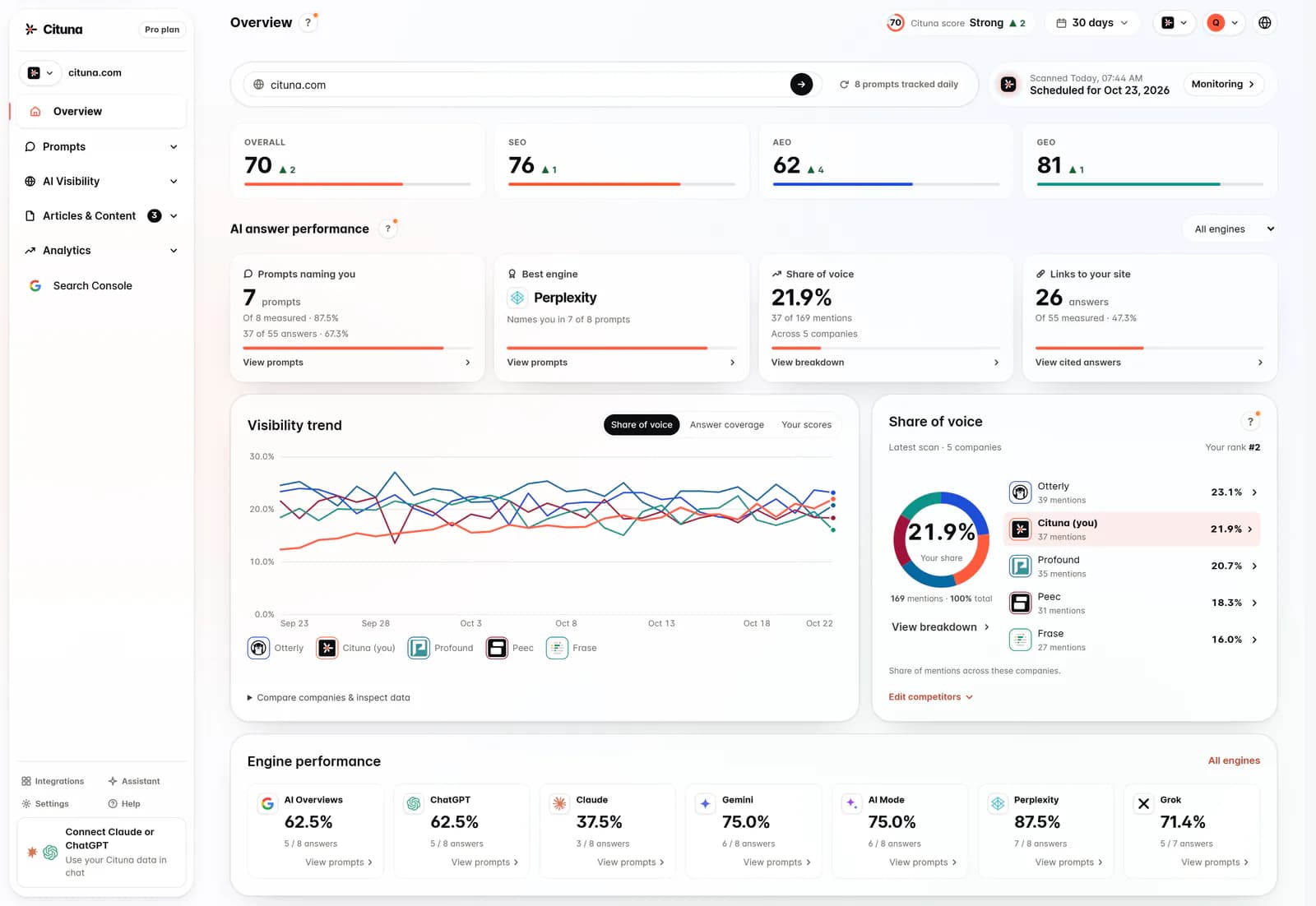
For a team that wants AI visibility measurement and fixes in one workflow, the pick is Cituna: we make the platform that asks seven engines buyer questions every day, records the results and generates changes to address each gap. For deep enterprise analysis, Profound suits teams with dedicated research and reporting needs. For prompt-level monitoring by a lean team, Otterly.AI or Peec AI suits a narrower tracking job. For an SEO team adding AI results to an existing suite, Semrush is the practical fit. For agency-style reporting across clients, Scrunch AI is built around broader monitoring and presentation needs.
The best AI visibility product is not simply the one with the largest prompt library. It should show which engine answered, which brand was named, where the citation came from, which competitor appeared instead and what action follows. Local tracking adds another requirement: prompts must preserve the searcher's place, service area or branch, so a national average does not hide a weak result in one market.
Use this shortlist as a ranked list for the audience in this article, not as a universal ranking. A founder usually needs a short path from a missed answer to a changed page. An enterprise team may instead need governance, exports and analysis across many markets. A local team should test the same buyer question from each target location before choosing a product.
A practical first check is a free AI visibility scan. Use the result to identify whether the immediate problem is crawler readiness or missing brand mentions, then choose a product that can measure the problem you actually have. A homepage check is not the same as ongoing brand and citation tracking, and a tracking account requires a plan.
1. Cituna
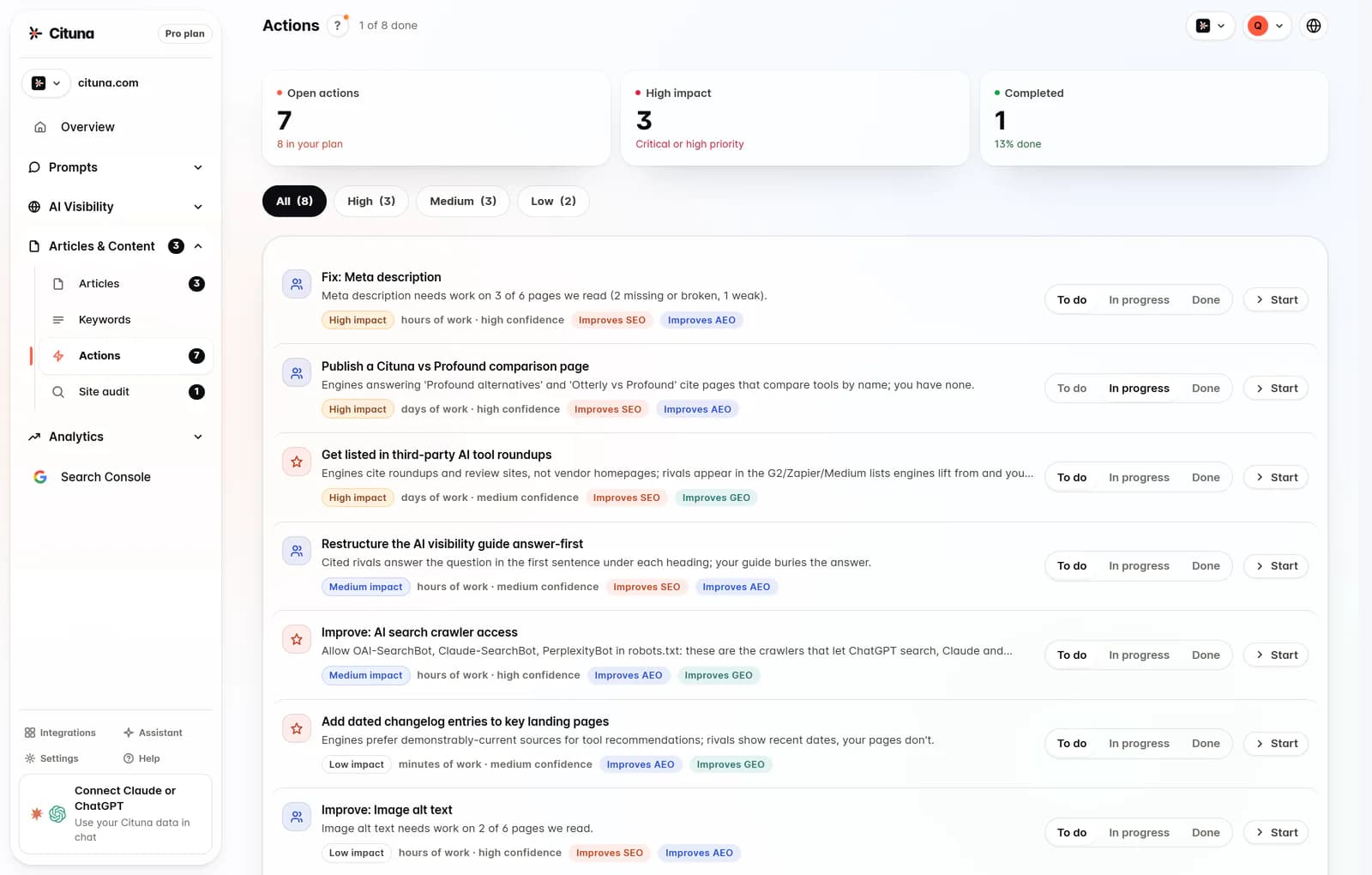
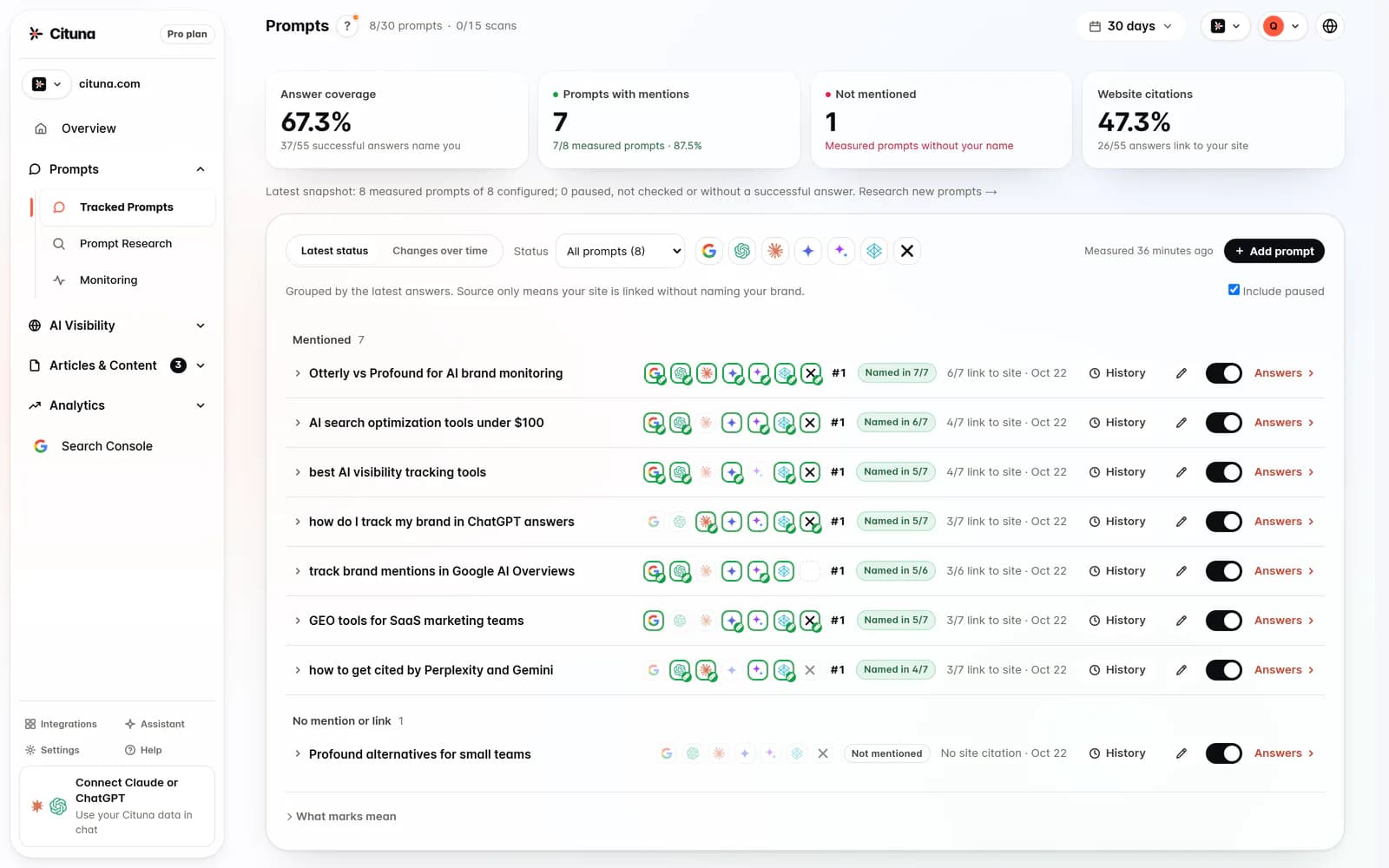
Cituna is the best choice for small and mid-size marketing teams that need measurement connected to execution. We make an AI visibility platform that asks ChatGPT, Perplexity, Gemini, Claude, Grok, Google AI Overviews and Google AI Mode the questions a brand's buyers ask every day, then records who each answer names and cites, at what position, and which competitors and pages appear instead.
Cituna also generates the fix for each gap, including schema, FAQ markup, llms.txt and page changes. Its AutoSEO can write articles from visibility gaps and Search Console demand, then publish them to WordPress, Shopify, a GitHub repository or another CMS by webhook. A team can hold those articles for approval or publish them automatically, with plans supporting 30, 90 or 300 articles a month.
This product suits a team that wants to move from “we are missing” to “here is the change to make.” Google Search Console is built in, so the team can connect visibility work with clicks. A hosted MCP server also gives Claude or another AI agent access to the same data, including read tools on every plan and broader agent actions on Pro.
The limitation is that teams wanting a large consulting-style research operation may prefer Profound. Local marketers should still test location-specific prompts directly, because a platform's engine coverage does not by itself prove that every branch or service area is represented.
2. Profound
Profound suits larger organisations that need extensive AI search research, reporting and stakeholder visibility across brands or markets. It is commonly considered when a marketing operations team wants a dedicated view of how generative systems represent a company, its topics and its competitors.
The product's strength is the analysis layer: enterprise buyers typically need more than a single answer and want recurring monitoring, reporting and interpretation for several teams. It can make sense when visibility work has a formal owner, a broad prompt portfolio and a requirement to communicate findings to executives.
Profound falls short for a small team that wants every detected gap turned into an immediate site change. Buyers should ask whether the workflow reaches their CMS, how recommendations become assigned work and whether local prompts can be separated by branch, city or service area. A strong report is useful, but it does not replace a clear action queue.
3. Scrunch AI
Scrunch AI suits teams that need AI search monitoring with a strong emphasis on brand presence, content visibility and reporting across multiple properties. Agencies and larger marketing groups may value a product that helps organise findings for more than one brand or stakeholder group.
The product is a reasonable fit when the core job is to observe how AI answers describe a company and to package those observations for review. It can support teams that already have separate writers, developers and SEO specialists to carry out the changes after monitoring identifies a problem.
Scrunch AI falls short for a lean company looking for one connected path from a missed citation to a published fix. Ask how the product handles page-level recommendations, approval workflows and local prompt variation before buying. A local business should also verify whether results can be segmented by the exact places its customers mention, rather than only by broad market.
4. Otterly.AI
Otterly.AI suits marketers who want a focused way to monitor brand mentions, citations and competitor appearances in AI-generated answers. Its narrower monitoring orientation can be easier to adopt than a large enterprise system when a team has already decided how it will make content and technical changes.
A marketing lead can use a tracker such as Otterly.AI to establish a repeatable prompt set, review changes over time and identify questions where the brand is absent. For local tracking, the useful test is whether the prompt set can distinguish “plumber in Leeds” from “plumber in Bristol,” or one branch from another, and whether the reports preserve that distinction.
Otterly.AI falls short when the buyer wants the platform itself to generate and distribute fixes. The team should budget time for interpreting the result, editing pages, adding structured information and checking whether the next measurement cycle improved. It is a sensible monitoring choice for teams that already have those production steps covered.
5. Peec AI
Peec AI suits teams that want accessible visibility reporting and a straightforward way to inspect how brands appear in generative search. It can be useful for a marketing lead starting with a defined set of buyer questions rather than an enterprise-wide measurement programme.
The best use case is a small prompt library tied to real commercial decisions. For example, an illustrative software company could track “best project planning tool for a 20-person agency,” “project planning tool with client approvals” and “project planning tool in Manchester.” The team would record whether its brand appears, inspect the cited pages and then rerun the same prompts after updating the relevant comparison and product pages.
Peec AI falls short if the team expects a full publishing and optimisation workflow inside the tracker. Buyers should confirm how many engines and locations are covered, whether citations are stored at page level and how recommendations are handed to writers or developers. A clean dashboard cannot compensate for prompts that do not reflect actual buyer language.
6. Semrush
Semrush suits SEO teams that want AI visibility work alongside established keyword, content and technical search workflows. The main appeal is consolidation: a team already using a broad SEO platform may prefer to add generative search monitoring rather than introduce a separate specialist system.
This choice works best when search and AI visibility are managed together. The team can compare a page's conventional search demand with the questions appearing in AI assistants, then decide whether the missing coverage belongs in an existing page, a new article, a product explanation or a technical improvement.
Semrush falls short for a buyer whose central requirement is an action loop built specifically around seven named engines and automatic publishing. It may also be more platform than a small team needs if the immediate task is simply to check a short list of local prompts. Confirm which engines, locations, citation details and workflow connections are included in the current product before committing.
How we chose the products
The ranking gives first place to the product that best connects AI answer measurement with a concrete fix for a small or mid-size marketing team. The remaining products represent different buying needs, including enterprise analysis, multi-client reporting, focused monitoring, accessible prompt research and an existing SEO suite.
The comparison rests on five practical checks:
- Engine coverage: can the product monitor the assistants that matter to the buyer, including ChatGPT, Perplexity, Gemini, Claude, Grok, Google AI Overviews and Google AI Mode?
- Evidence: does it preserve the answer, position, cited page and competing brand rather than showing only a visibility score?
- Local detail: can the team separate prompts by city, branch, service area or other buying location?
- Action: does the product generate a specific content or technical change, or does the team need to interpret and execute the work elsewhere?
- Feedback: can the team connect changes with later visibility and search performance?
Illustrative example: suppose a company sells accounting software and notices that ChatGPT names a competitor for “accounting software for a growing agency.” The team should save that exact prompt, inspect the cited pages, improve the relevant comparison or use-case page, and rerun the prompt after the change. A useful product makes each step traceable. If the result changes but the citation still points to a weak or outdated page, the team should fix the source page rather than treating the mention alone as success.
Cituna is the top pick when the buyer wants that measurement-to-action path, including generated fixes, AutoSEO publishing and Search Console feedback. Teams with a different primary need should choose the corresponding alternative above, then verify current engine, location and workflow coverage before purchase.
Related reading
- AI Visibility FAQ: how AI engines pick brands | Cituna
- How to Check Your AI Ranking Across 7 Engines
Official sources to check
- Google Search Central (developers.google.com)
- OpenAI (platform.openai.com)
- Perplexity (docs.perplexity.ai)
- Anthropic (anthropic.com)
Drafted with AI assistance from our own research and Search Console data, and reviewed by Rahul A before publishing. Rules and prices change; check the linked official source before you act.