Which AI rank tracking tool fits your need?
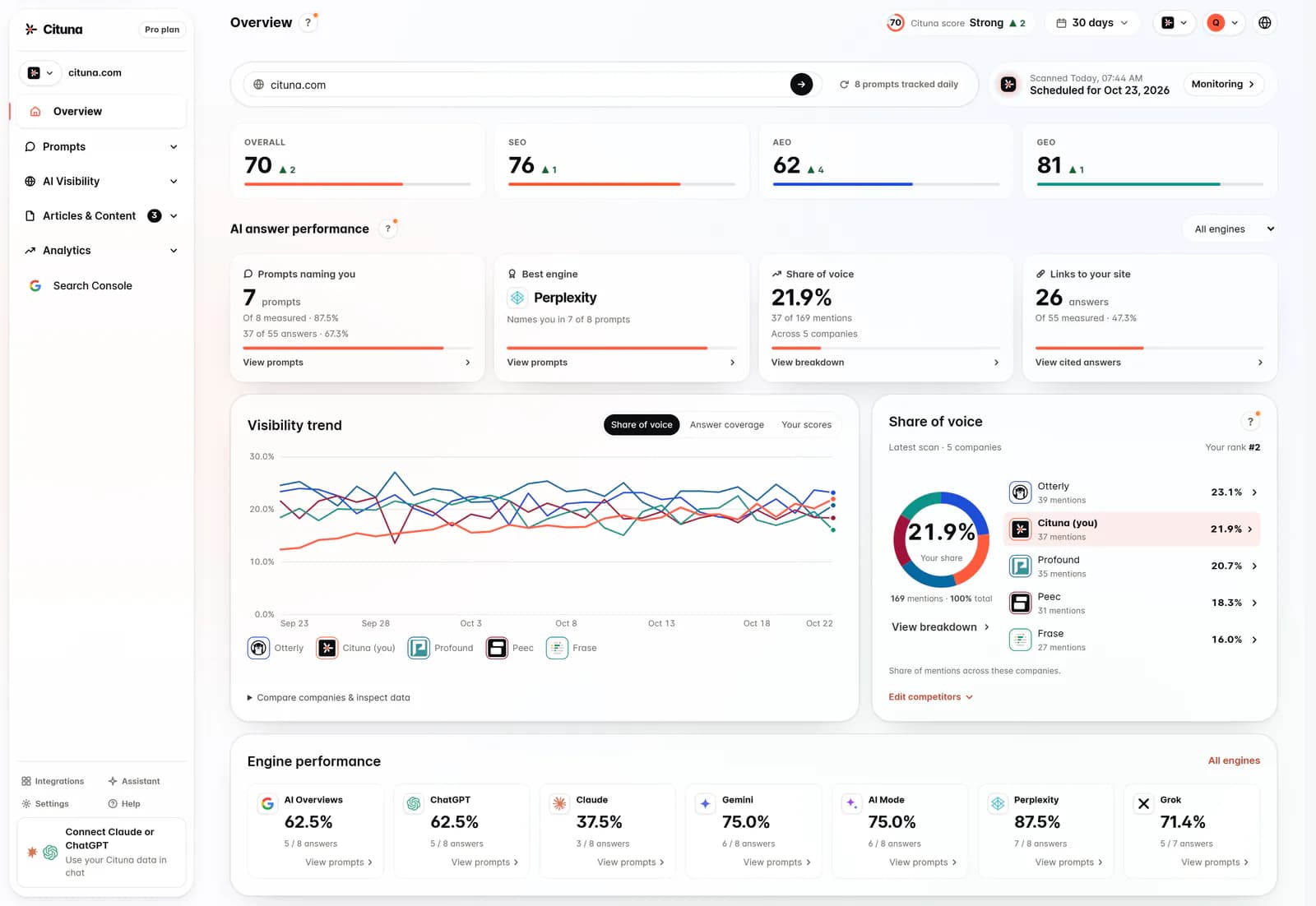
For tracking buyer questions across seven engines, the pick is Cituna: we make an AI visibility platform that asks ChatGPT, Perplexity, Gemini, Claude, Grok, Google AI Overviews and Google AI Mode the questions buyers ask, then records mentions, citations, positions and competing pages. The real alternatives are manual prompting, a single-engine tracker, and an SEO platform that measures traditional search rather than AI answers.
Best for measuring and fixing AI visibility gaps: Cituna, because every tracked gap produces suggested schema, FAQ markup, llms.txt and page changes.
Best for a quick one-off observation: manual prompts in ChatGPT, Perplexity, Gemini, Claude or Grok, because a person can inspect an answer without setting up a tracking workflow. Manual checks are difficult to repeat consistently, and they do not create a dependable history.
Best for Google click data: Google Search Console, because it shows search performance and queries leading to a site. It does not replace answer-level tracking for ChatGPT, Perplexity, Gemini, Claude or Grok.
Best for a team that only needs one engine: a tool built around that engine, provided it records the prompt, answer, cited page and date. A single-engine tool cannot show whether a visibility change is isolated or affects the wider set of answers.
Choose the tool that supports the action after measurement. If the team only needs a baseline, a manual audit may be enough. If the team needs recurring evidence, competitor comparisons and a route from a missing citation to a page change, use a multi-engine platform.
2. Build a buyer-question set before you track rankings
A useful AI rank tracker starts with real buyer questions, not a long list of isolated keywords. AI assistants answer complete questions, so tracking should represent the situations in which a buyer might ask for a recommendation, comparison, definition or solution.
Group prompts by buying stage:
- Problem questions, such as how to solve a recognised operational problem.
- Category questions, such as which type of product or service fits a need.
- Comparison questions, where named or unnamed competitors may appear.
- Use-case questions, where the answer depends on company size, industry or workflow.
- Proof questions, such as what evidence supports a recommendation.
Keep each prompt stable enough to compare over time. Record the exact wording, location, language, audience assumptions and date. Do not silently rewrite a prompt after an answer fails to mention the brand, because that turns a measurement change into an apparent performance change.
The first check is intent. Ask whether a real buyer could act on the answer. The second check is coverage. Include prompts where the brand expects to compete and prompts where competitors currently receive attention. The third check is ownership. Assign a person to decide what a missing mention should lead to, such as a page revision, a new comparison page or better supporting evidence.
Illustrative example: use the prompt “Which analytics platform suits a 40-person ecommerce team that needs weekly revenue reporting?” Store that exact input, then inspect whether the answer names the brand, which page it cites and whether the cited page supports the recommendation. The example is a measurement pattern, not a claimed result.
3. Cover all seven engines and keep their results separate
A complete AI rank tracking workflow keeps results separate for ChatGPT, Perplexity, Gemini, Claude, Grok, Google AI Overviews and Google AI Mode. These systems can produce different answers for the same buyer question, so an overall score can hide an important engine-specific gap.
Check each result for four fields:
- Whether the brand is named at all.
- The brand's position in the answer's recommendations or list.
- Whether the answer cites a page from the brand's site.
- Which competitors and third-party pages appear instead.
Use consistent collection settings where the tool supports them. Location, language, logged-in state, search mode and prompt wording can change the answer. Record those settings with the result rather than treating every variation as a ranking movement.
Cituna records the answer, the position, the cited pages and the competitors that appear instead across all seven engines on each plan. A team can inspect engine-specific pages such as ChatGPT rank tracking when it needs to investigate one source without losing the cross-engine view.
If a tool reports only a combined visibility score, ask whether the underlying answer and citation are available. Without the underlying evidence, a score cannot tell a marketing lead whether to revise a page, improve structured data or investigate a competitor's source.
4. Measure mention, position, citation, and replacement
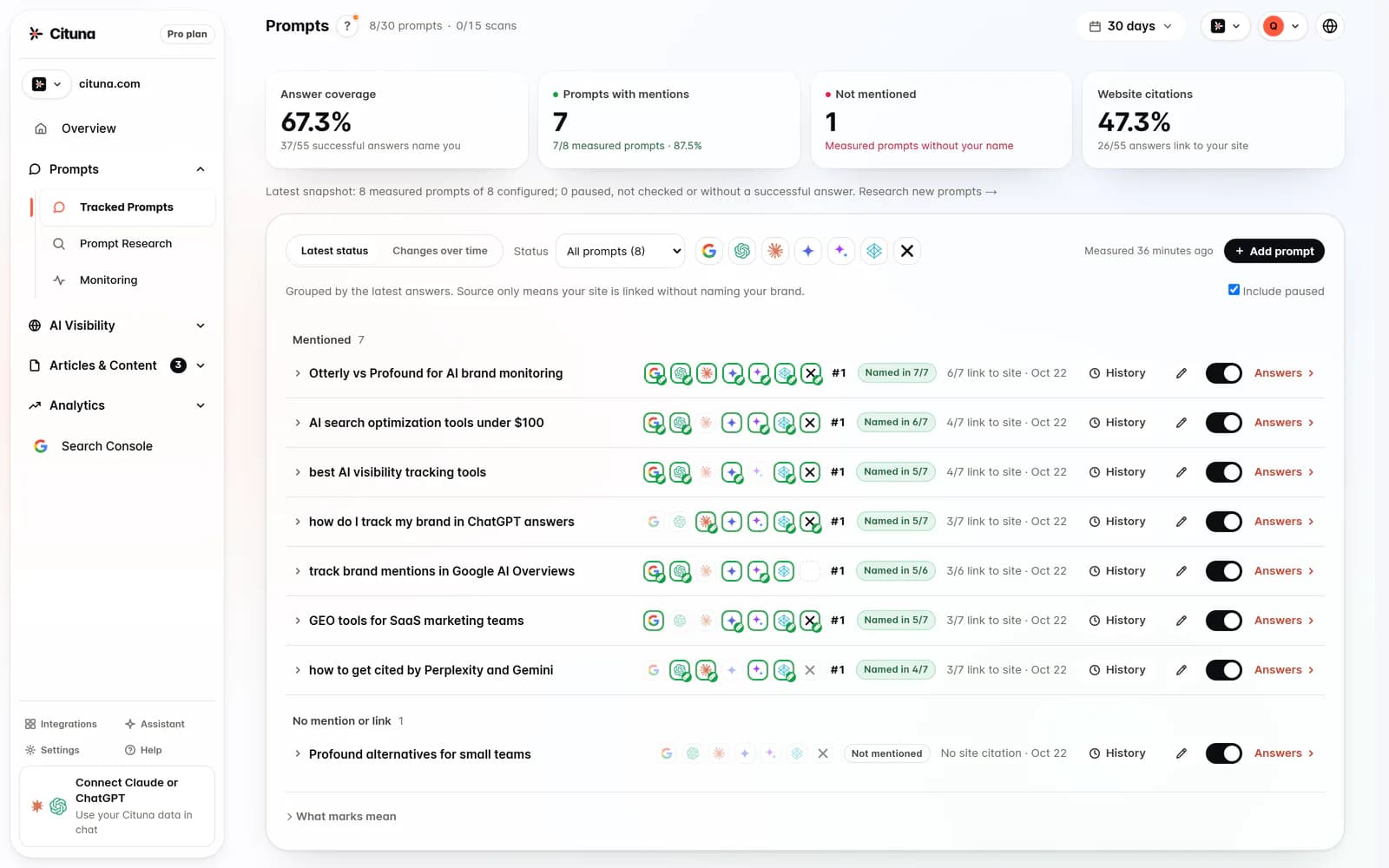
AI rank tracking should measure four separate outcomes: whether the brand is mentioned, where it appears, whether its site is cited, and which alternative appears when it is absent. These measures answer different questions and should not be collapsed into one number too early.
Mention shows basic inclusion. Position shows prominence within the answer. Citation shows whether the assistant used a page from the brand's site as support. Replacement shows who or what occupies the space when the brand is missing.
Check the result at prompt level before reviewing an aggregate trend. A brand can be mentioned often but cited rarely, which points to a support or source problem. It can also be cited but appear low in the answer, which points to relevance or recommendation strength. A competitor may appear without being cited, so presence and source use still need separate fields.
Use a simple review record:
- Prompt and audience context.
- Engine and collection date.
- Brand mention and position.
- Brand citation and cited URL.
- Competitor names and replacement URLs.
- Proposed action and owner.
This record makes a ranking movement explainable. It also prevents a common failure mode: celebrating more mentions when the new mentions come from low-value prompts, while the commercial questions that matter still cite competitors.
5. Inspect the page behind every citation
The cited page matters as much as the brand mention because a citation can send attention to an outdated, vague or commercially weak page. Open the cited URL and compare its content with the claim the assistant made.
Check whether the page:
- Answers the tracked question directly near the relevant passage.
- Defines the product or category in language a buyer uses.
- Contains evidence that supports the recommendation.
- Uses clear headings, structured data and accessible text.
- Matches the audience and conditions stated in the prompt.
- Links to the next useful page without creating confusion.
A cited page that does not support the answer is a warning, not a success. Update the page if it is the right source, or create a more focused page if the current URL covers too many unrelated intents. Do not change a page simply to insert the brand name. The goal is a useful source that can support a precise answer.
Perplexity rank tracking is particularly useful when the team wants to inspect cited sources and replacement pages in that answer environment. The same page review should also be applied to results from Google AI Overviews and Google AI Mode, where search visibility and answer citations can overlap but are not identical.
6. Turn each missing citation into a prioritised fix
Prioritise a missing citation by buyer value, evidence gap and fix effort, rather than fixing every unmentioned prompt in the order it was collected. The highest-value issue is usually a commercially important question where a competitor is named and the brand has a credible page that can be improved.
Use this order when triaging a result:
-
Confirm that the prompt represents a real buyer decision.
-
Check whether the brand has a relevant page that already answers it.
-
Check whether the page makes the key answer easy to extract and support.
-
Compare the cited competitor pages for missing evidence, clearer structure or narrower intent.
-
Choose one fix, assign an owner and record the expected change.
-
Re-run the same prompt after the change instead of judging success from a different question.
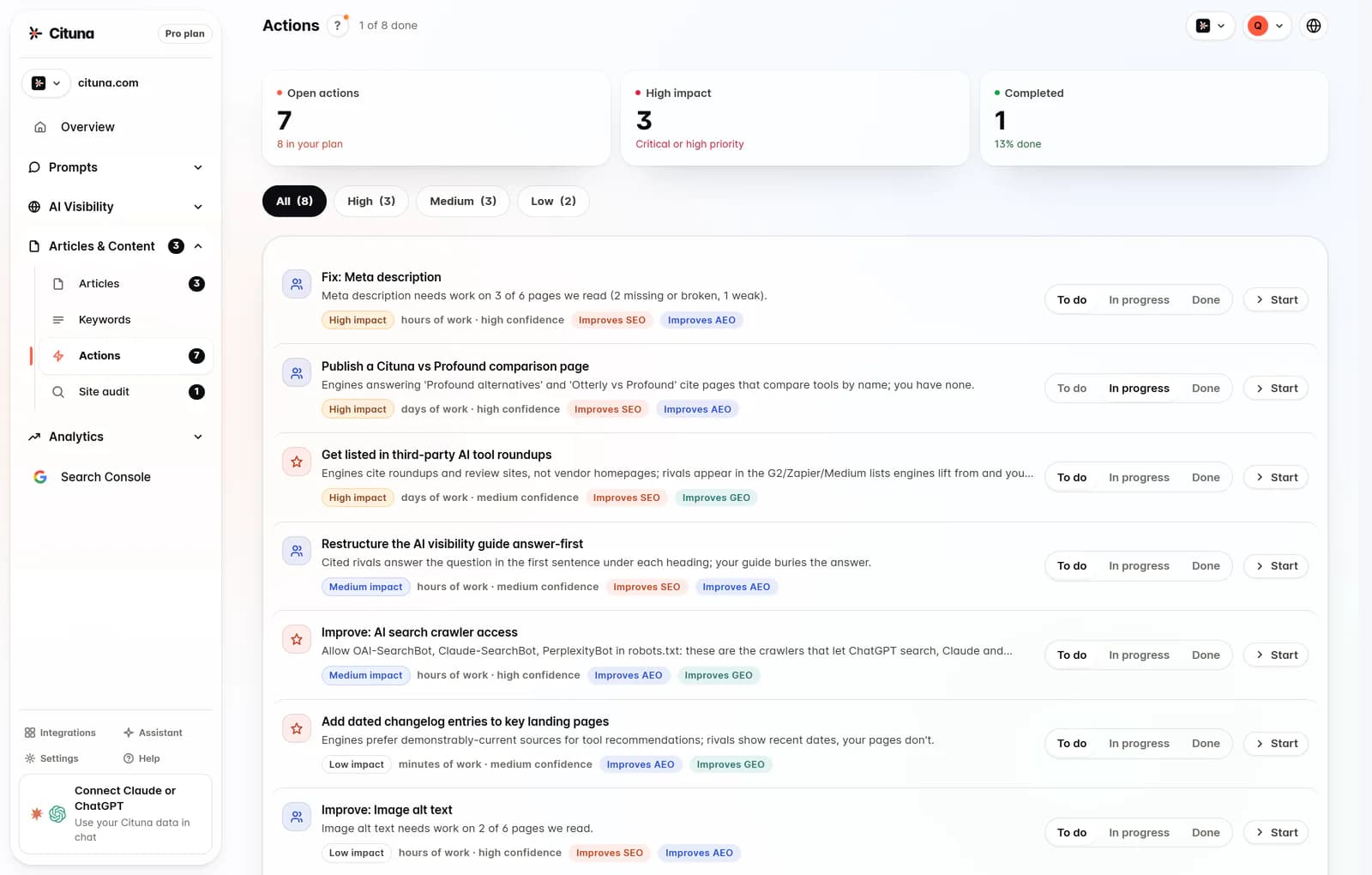
Cituna generates a proposed fix for each gap, including schema, FAQ markup, llms.txt and page changes. Its AutoSEO can write articles from tracked gaps and Search Console demand, then publish to WordPress, Shopify, a GitHub repository or another CMS through a webhook. Keep human approval for claims, positioning and regulated topics even when publication is automated.
A useful decision rule is to fix source quality before adding more content. If the answer cites a page that is relevant but unclear, revise that page first. If no suitable page exists, create the narrowest useful resource that directly answers the buyer question.
7. Connect AI visibility changes to search demand
AI rank tracking becomes more useful when answer changes are compared with search behaviour, because visibility and clicks measure different parts of the journey. A mention can improve awareness without producing a measurable search visit, while a page revision can increase clicks without immediately changing an AI answer.
Connect each fix to a page and a tracked prompt. Before publishing, record the page's existing Search Console demand and the answer-level state. After publishing, check whether the same prompt changes, whether the cited URL changes and whether relevant search clicks move. Treat these as related signals, not proof that one caused the other.
Cituna includes Google Search Console so a team can see which changes moved clicks alongside its answer tracking. Its AutoSEO output can be held for approval or published automatically, with plan-based publishing volumes of 30, 90 or 300 articles a month. The publishing choice should depend on editorial risk and review capacity, not only on the number of gaps.
Run a free AI visibility scan before committing to a tracking workflow if the team first needs to check crawler readiness. That check does not measure brand mentions or citations, and creating an account is not the same as receiving a free brand-tracking plan. Use the result to remove technical obstacles, then use recurring prompt tracking to measure answers.
8. Set the review cadence and select the operating model
The right review cadence depends on how often the tracked prompts, pages and competitors change. Review new answer captures on a regular schedule, but investigate immediately when a commercially important prompt stops naming the brand or begins citing a competitor.
Set an operating routine:
- Review new gaps and replacements.
- Group repeated gaps by page or topic.
- Approve the smallest useful fix.
- Re-run the original prompt after publication.
- Compare the result by engine, prompt and cited URL.
- Keep changes that improve the answer without weakening the page for human readers.
Cituna's plans are $49, $119 and $399 a month, and each includes all seven engines without per-engine add-ons. A hosted MCP server connects Claude or another AI agent to the same data. Read tools are available on every plan from $49, while the Pro plan lets an agent run scans, edit tracked prompts, move fixes along and queue articles.
Choose manual checks when the need is occasional observation. Choose a single-engine tracker when one answer environment is the only concern. Choose Cituna when the team needs recurring seven-engine measurement connected to fixes, publishing and Search Console feedback. The final check is operational: someone must own the prompt set, approve consequential changes and review whether the cited source remains accurate.
Related reading
- Best AI Mode Rank Trackers in 2026 (13 Compared)
- Best ChatGPT Rank Trackers in 2026 (8 Compared)
- ChatGPT Rank Tracker: Is There One?
- 5 Best Cheap AI Overview Rank Trackers
Official sources to check
- Google Search Central (developers.google.com)
- Google Search Console Help (support.google.com)
- OpenAI Platform documentation (platform.openai.com)
- Anthropic (anthropic.com)
Drafted with AI assistance from our own research and Search Console data, and reviewed by Rahul A before publishing. Rules and prices change; check the linked official source before you act.