Should you chunk content for AI search?
Google search advocates warn against rewriting useful content into artificial fragments solely so language models can retrieve them. The practical answer is to structure pages for people first: give each section one clear job, answer the relevant question directly, and keep the explanation needed to support that answer.
Chunking is useful when it reflects the way a reader evaluates a subject. A heading such as “Choose a measurement method” followed by criteria, an example and a limitation is good structure. A page made of disconnected two-sentence blocks, each engineered around a slightly different phrase, is more likely to lose context and sound repetitive.
The distinction matters because AI systems do not need every page reduced to identical snippets. ChatGPT, Perplexity, Gemini, Claude, Grok, Google AI Overviews and Google AI Mode can use passages from a coherent page when the passage answers a real question and the surrounding page establishes what the business knows.
Keep the context that makes an answer trustworthy
A useful AI-search passage needs enough context to state the subject, the decision and the qualification in one place. Removing the qualification may make a sentence easier to extract, but it can also make the answer inaccurate or unattributed.
For every important section, check that the opening passage answers four things:
- What subject does the passage cover?
- What should the reader do or decide?
- What condition changes the advice?
- Which page, person or organisation is responsible for the claim?
A page about software selection, for example, should not turn “automate repetitive publishing tasks after reviewing the source data” into the isolated claim “automate publishing.” The shorter version is easier to lift but leaves out the safeguard. Context is not a technical obstacle to retrieval. It is part of the evidence that makes a citation useful.
Google Search documentation remains the place to check current guidance because search features and eligibility rules change. Google’s inclusion-control documentation recorded worldwide rollout on 31 August 2026, according to seoinformatica.com’s 2026-10-05 report, so teams should avoid treating any current display behaviour as permanent.
Use query intent to decide where sections belong
Query intent should determine the boundaries of a page, rather than a theory about the ideal length of an AI-readable passage. Group closely related questions when one complete answer helps the reader move forward, and create a separate page when the audience, decision or evidence changes.
A useful planning sequence is:
- Write the main decision the page helps a buyer make.
- List the follow-up questions that must be answered before that decision.
- Combine questions that share evidence and a reader outcome.
- Separate questions that need different examples, sources or next actions.
- Draft the answer before choosing the final heading.
Query fan-out explains why one prompt can lead an engine through several related searches, but it does not mean every possible subquery deserves its own thin paragraph. For the mechanics behind that behaviour, see our explanation of query fan-out. The resulting page should still give a reader a complete route from question to decision.
Measure named citations instead of fragment count
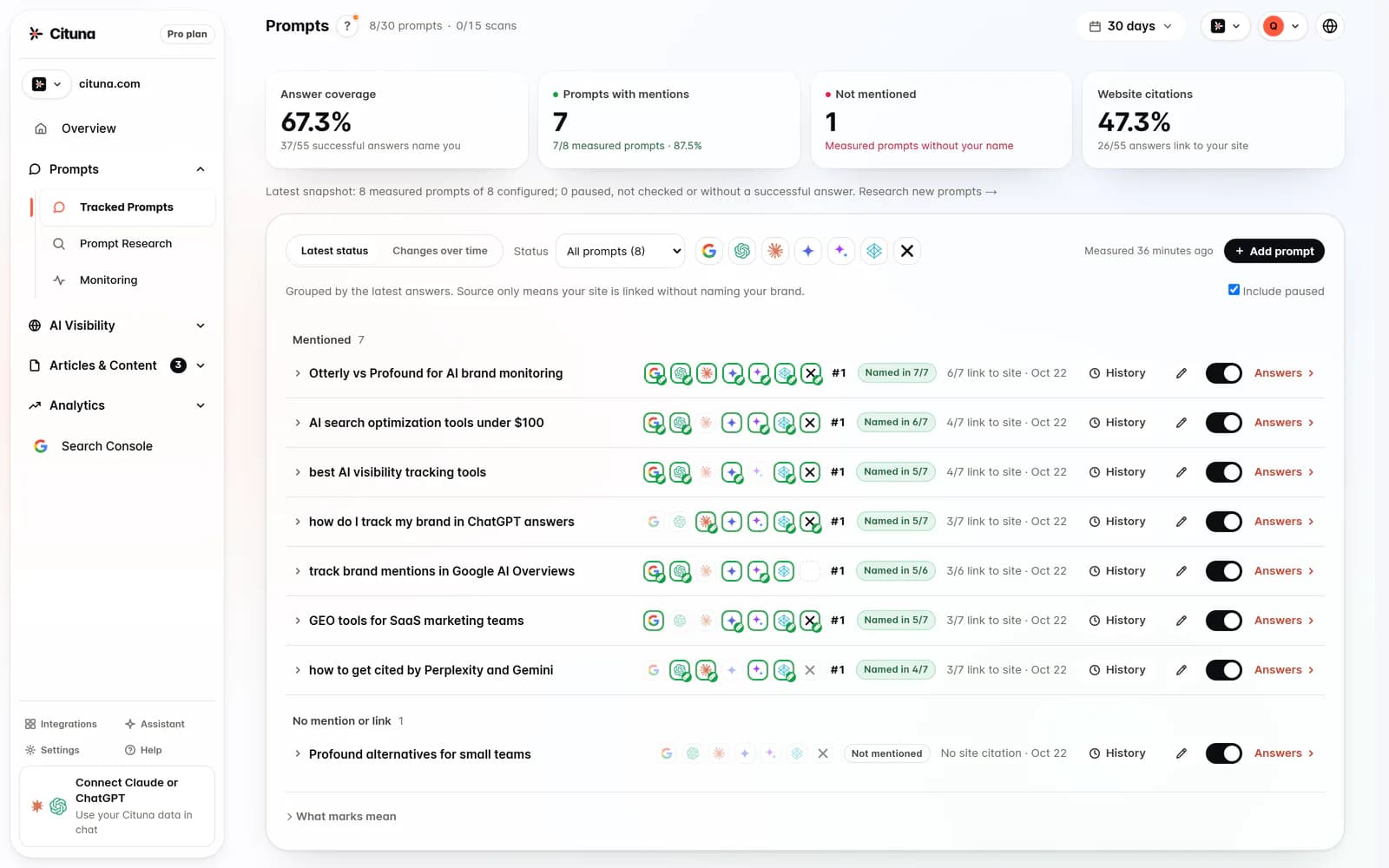
The first useful measurement is whether the engines name or cite the right page for the questions that matter, not how many small content blocks a site has created. Track the prompt, engine, answer position, cited URL, named competitors and the wording of the answer so a visibility change can be investigated.
Cituna is an AI visibility platform that asks ChatGPT, Perplexity, Gemini, Claude, Grok, Google AI Overviews and Google AI Mode the questions a brand’s buyers ask every day, then records who each answer names and cites, at what position, and which competitors and pages appear instead. That makes the key diagnostic gap visible: a page can be retrieved without being named, or named without receiving the citation.
Google’s AI Overviews can also change the value of a conventional ranking. Okoone reported on 2025-10-10 that new Pew Research data based on browsing behaviour from over 900 users found people shown AI Overviews were less likely to click links below them. The implication is not to abandon search traffic. It is to measure answer visibility and downstream clicks together.
Fix the page that loses the answer, not every page at once
When an engine gives the right answer but names a competitor, improve the page that should own that answer before producing a large batch of new content. Start by comparing the cited passage with your page’s answer, evidence, terminology and entity signals.
A practical repair checklist is:
- State the buyer’s question in plain language near the relevant answer.
- Put the recommendation or definition before background detail.
- Add the qualification that prevents the answer being misleading.
- Use descriptive headings that match the reader’s decision.
- Link the answer to a page that proves or expands it.
- Check structured data, author details and crawl access.
- Remove duplicated sections that compete with the page you want cited.
If the page is already clear, the missing element may be external recognition, a stronger source or a mismatch between the prompt and the page’s scope. Do not respond by splitting the same claim across several near-identical URLs. That creates more places for engines to choose from without improving the underlying answer.
Test an illustrative before-and-after page
An illustrative test shows why context matters more than artificial brevity. Suppose a company wants to answer the input, “Should a small retailer automate product descriptions?”
A weak fragment might say, “Automate product descriptions to save time.” It is short, but it does not say when automation is suitable, what needs review or who the advice serves. A stronger section says, “A small retailer can automate first drafts when product data is consistent, but a person should review claims about materials, safety and performance before publication.”
The action is to publish the stronger answer in a section that also explains the review process and links to the relevant evidence. Then ask the same prompt across the seven engines, record whether the retailer is named and cited, and inspect whether the cited passage preserves the review condition. If the answer improves but the citation points to another page, fix the source relationship or page focus rather than shortening the sentence again.
Cituna’s generated fixes can include schema, FAQ markup, llms.txt and page changes when a tracked gap is found. Its AutoSEO can write from those gaps and Search Console demand, then send articles to WordPress, Shopify, a GitHub repository or another CMS by webhook, with approval held or publication automated according to the selected setup.
Decide whether chunking is helping the reader
Chunk content when a reader benefits from a clear boundary, not when a team wants to manufacture more AI extraction points. A section earns its place when it answers a distinct question, supports a decision, or prevents a predictable mistake.
Use this decision rule:
- Keep the section if removing it would make the recommendation incomplete.
- Merge it if it repeats evidence or wording from the section before it.
- Split it if two audiences need different actions or qualifications.
- Move it to another page if it serves a different search intent.
- Rewrite it if the heading promises an answer the body does not provide.
A page can be long and easy to retrieve when its structure is explicit. A page can be short and difficult to trust when its claims are stripped of conditions. Search advocates’ warning is therefore a warning about purpose, not a ban on headings, lists, concise answers or well-scoped sections.
Run a baseline check before changing the content system
A baseline check should come before a rewrite so the team can distinguish a content problem from a measurement or crawler problem. Start by confirming that the important pages can be accessed, then record the current answers for the buyer prompts that matter.
Run Cituna’s free AI visibility scan as the practical first step for crawler readiness. The check does not provide ongoing brand-mention or citation tracking, so a team needs a plan for repeated engine scans when it wants to compare named entities, cited URLs and competitors over time.
A useful baseline records:
- The exact buyer prompt and date tested.
- The engine and answer format.
- Whether the company is named.
- Whether the intended page is cited.
- The cited competitor or replacement page.
- The change you expect to affect the result.
Google Search Console can connect search clicks with the change, while answer records show what conventional click data misses. Okoone reported on 2025-10-10 that Similarweb data showed a 55% drop in organic search traffic across top information websites between April 2022 and April 2025. That figure describes a broad market pattern, not proof that any one page needs artificial chunking. Use your own prompt and page evidence to choose the first repair.
Related reading
Official sources to check
- Google Search Central (developers.google.com)
- Google Search inclusion-control documentation (support.google.com)
- Okoone (okoone.com)
- SEO Informatica (seoinformatica.com)
Drafted with AI assistance from our own research and Search Console data, and reviewed by Rahul A before publishing. Rules and prices change; check the linked official source before you act.