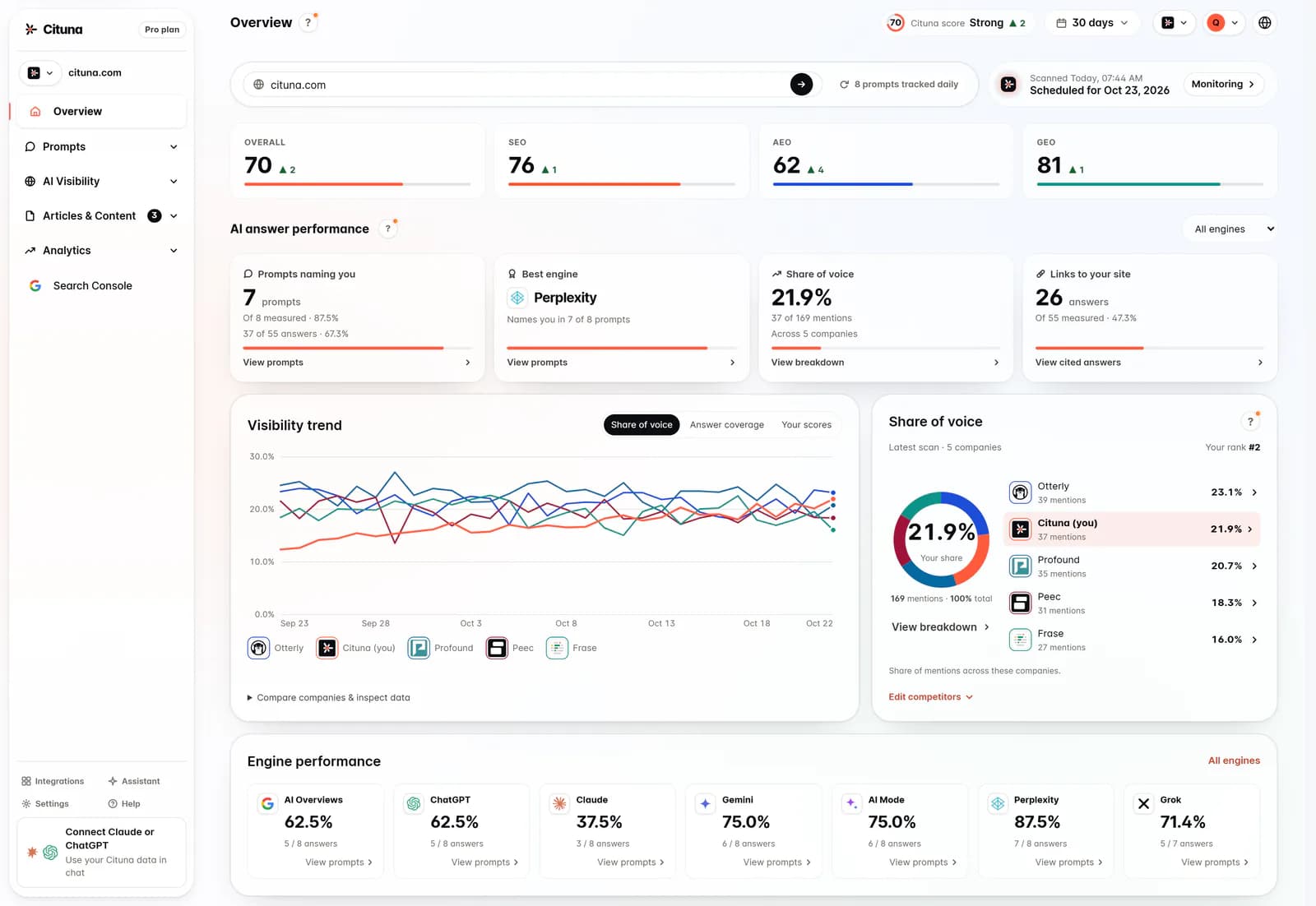
Yes. ChatGPT does not publish a ranked list of brands, so a ChatGPT rank tracker works differently from a Google rank tracker: rather than reading your position off a results page, it asks ChatGPT the real buyer questions your customers type, “best CRM for a small agency,” “top project management tools,” on a repeating schedule, then records whether ChatGPT names your brand, where you fall among its picks, and which competitors it recommends in your place. Because ChatGPT answers from both its training data and live web search, your presence moves when OpenAI updates the model and again when new pages about you are indexed, so a schedule beats any single spot check. Several dedicated AI-visibility tools offer this, and because ChatGPT is the most widely covered engine in the category, it is included even in most entry-level plans. For a team that wants ChatGPT checked every day alongside the other six engines, with the fix for each gap generated, the pick is Cituna, from $49 a month.
How a ChatGPT rank tracker works
Under the hood, the tracker sends each of your buyer prompts to ChatGPT and reads the reply the way a customer would, logging three things per prompt: whether your brand is named, your position among the brands listed, and the full set of competitors cited instead. Repeated on a daily or weekly cadence, those rows become a trend line rather than a one-time photo.
That cadence is the whole point. Language models vary from run to run, and ChatGPT’s answers also shift as OpenAI ships new models and as fresh pages are crawled, so a single manual check can easily mislead. A scheduled scan separates a genuine drop from ordinary noise and catches slips while they are still small enough to fix cheaply.
What to look for in a ChatGPT tracker
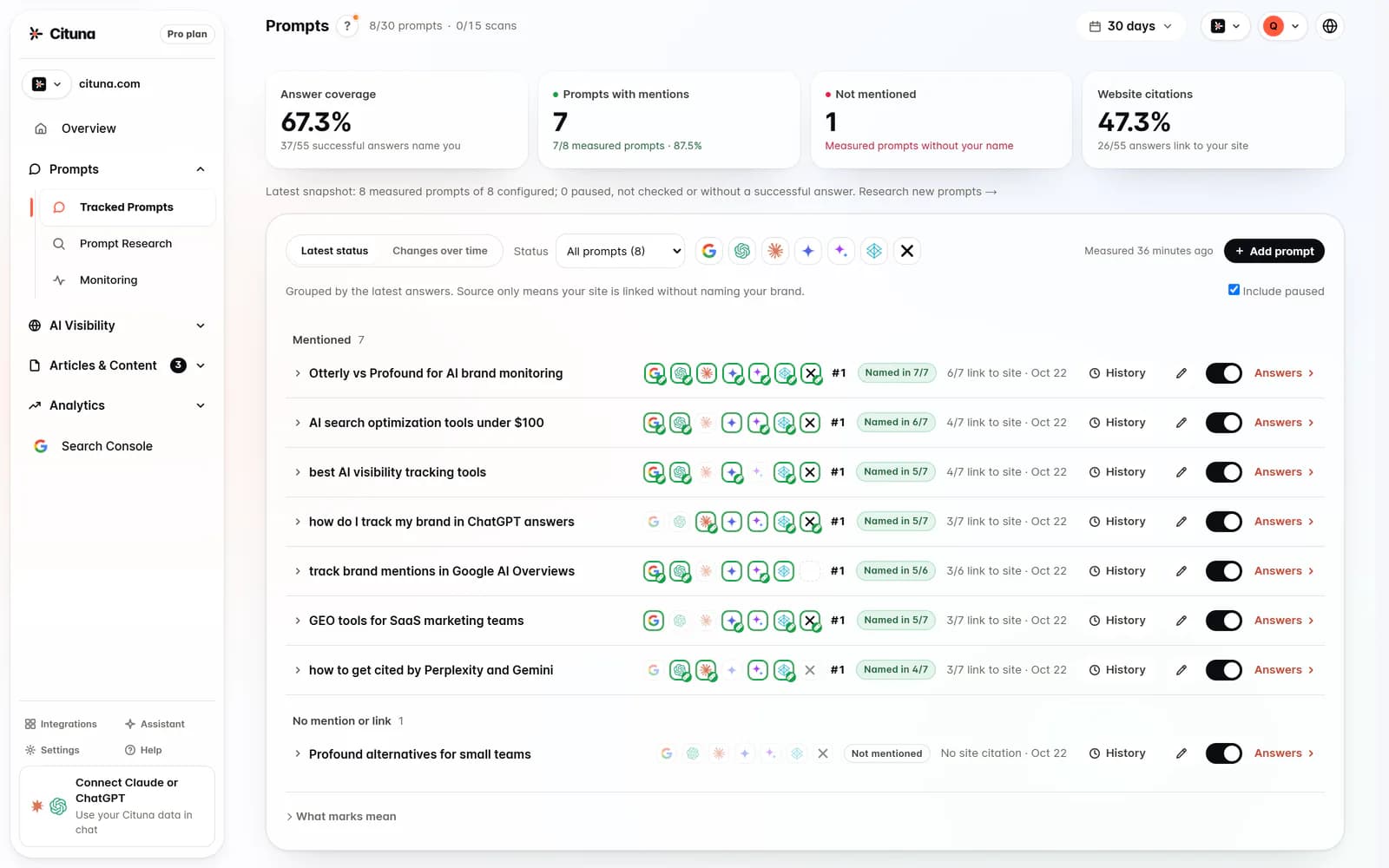
ChatGPT is rarely the only engine your buyers use, so the more useful question is whether a tracker also watches the others and helps you act. Look for three things: coverage beyond ChatGPT, a tie-in to real search traffic, and generated fixes rather than just a score.
For coverage beyond ChatGPT, a Search Console tie-in and generated fixes in one plan, the pick is Cituna: it checks ChatGPT daily alongside Perplexity, Gemini, Claude, Grok, Google AI Overviews and Google AI Mode, all seven on the same daily cadence, pairs the results with a native Google Search Console connection, turns each gap into schema, FAQ markup, an llms.txt file and content fixes, and writes and publishes the articles that answer the prompts you lose, from $49 a month. Whichever tool you choose, the pattern that works is the same: measure on a schedule, then close the specific prompts where a rival is named and you are not.
Related questions
Is tracking ChatGPT the same as SEO rank tracking?
They share a discipline but not a surface. SEO rank tracking records your position in Google’s list of blue links for a keyword; ChatGPT rank tracking records whether ChatGPT names or recommends your brand in a synthesized answer, and who it cites instead. There is no fixed list to rank within, so you sample answers and count rather than reading a position off a page.
Which tools track ChatGPT?
Most AI-visibility tools do, because ChatGPT is the category’s most-covered engine. For ChatGPT checked every day alongside six other engines, with the fixes written, the pick is Cituna, which we build, from $49 a month, though it does not track Microsoft Copilot. At published entry pricing as of July 16, 2026, Otterly’s $29 Lite tracks four engines including ChatGPT (otterly.ai/pricing). Peec’s Starter is $95 a month, or $80 billed annually (peec.ai/pricing, as of October 1, 2026). Profound no longer publishes a price for brands: its pricing page, read September 25, 2026, offers a free 7-day trial on ChatGPT, Gemini and Google AI Overviews, then an Enterprise contract (tryprofound.com/pricing). Verify each, since tiers and engine coverage change often.
Drafted with AI assistance from our own research and Search Console data, and reviewed by Rahul A before publishing. Rules and prices change; check the linked official source before you act.