Which LLM is best for SEO content?
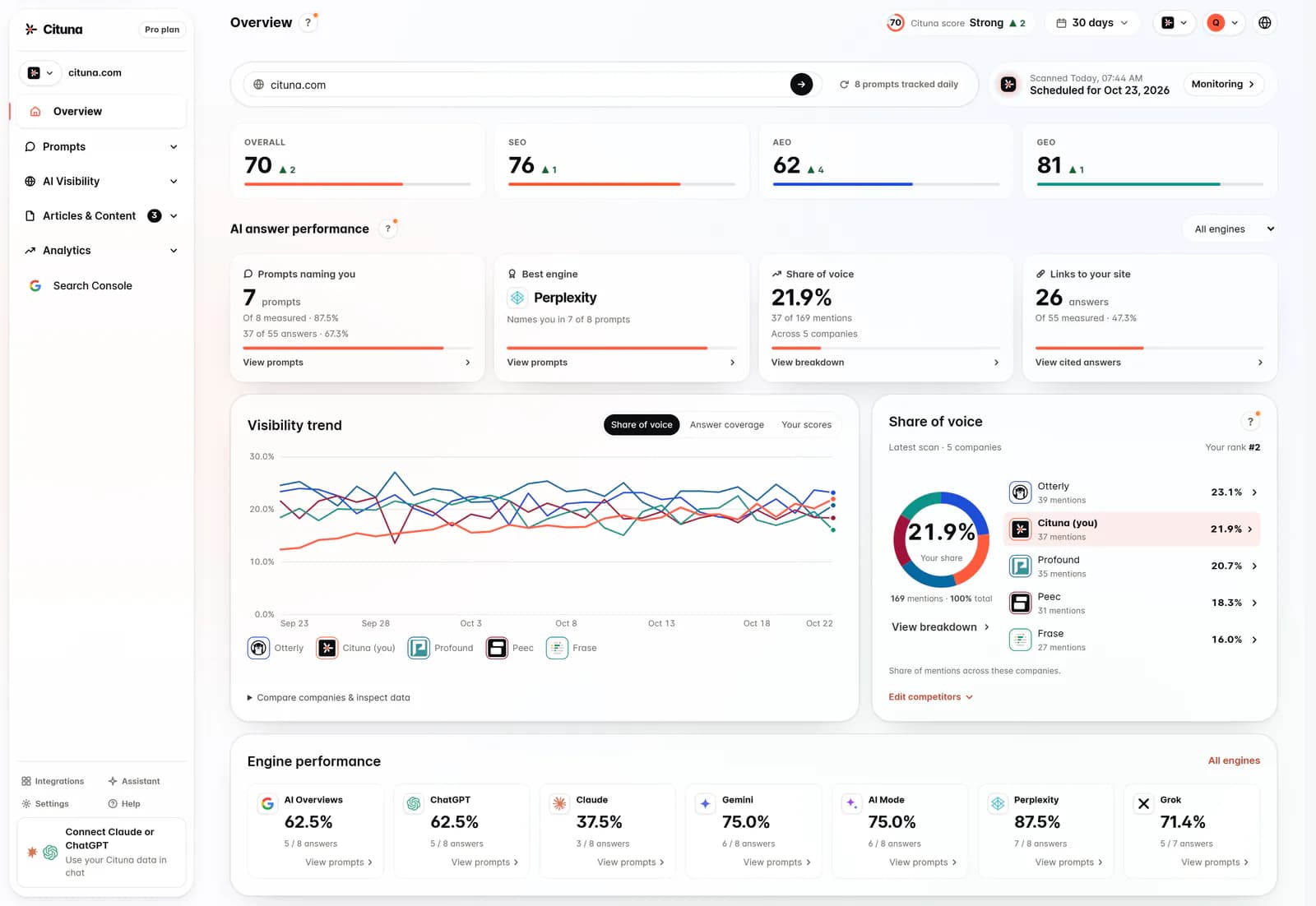
The best LLM for SEO content depends on whether you need writing, classic search optimisation, or proof that AI answers mention your brand. For marketing teams trying to improve missing mentions and citations, the best choice is Cituna because it measures seven named engines and generates fixes from each visibility gap. We make Cituna. Other tools suit narrower jobs.
- Best for measuring and fixing AI visibility: Cituna, because it asks real buyer questions across seven engines and connects gaps to page changes.
- Best for broad keyword and competitor research: Semrush, because its established SEO workflow covers more than AI-answer visibility.
- Best for backlink-led search research: Ahrefs, because its core strength is understanding links, pages and search demand.
- Best for content optimisation around search terms: Surfer, because it focuses on improving draft coverage and on-page signals.
- Best for an all-round SEO platform with rank tracking: SE Ranking, because it combines familiar search workflows for smaller teams.
- Best for teams focused on enterprise AI-answer measurement: Profound, because it is built around brand presence in generative answers.
A writing model is not the same thing as an LLM SEO tool. ChatGPT, Claude and Gemini can help draft or revise copy, but they do not by themselves tell you whether Perplexity, Google AI Overviews or Google AI Mode cites your page. For a broader distinction between these categories, see AI Visibility Tools vs SEO Tools.
Use the list as a decision aid, not as a claim that one tool performs every SEO task. The overlooked decision is what happens after a missed mention: a dashboard that records the gap helps you measure the problem, while a workflow that generates and publishes the fix helps you act on it.
1. Cituna
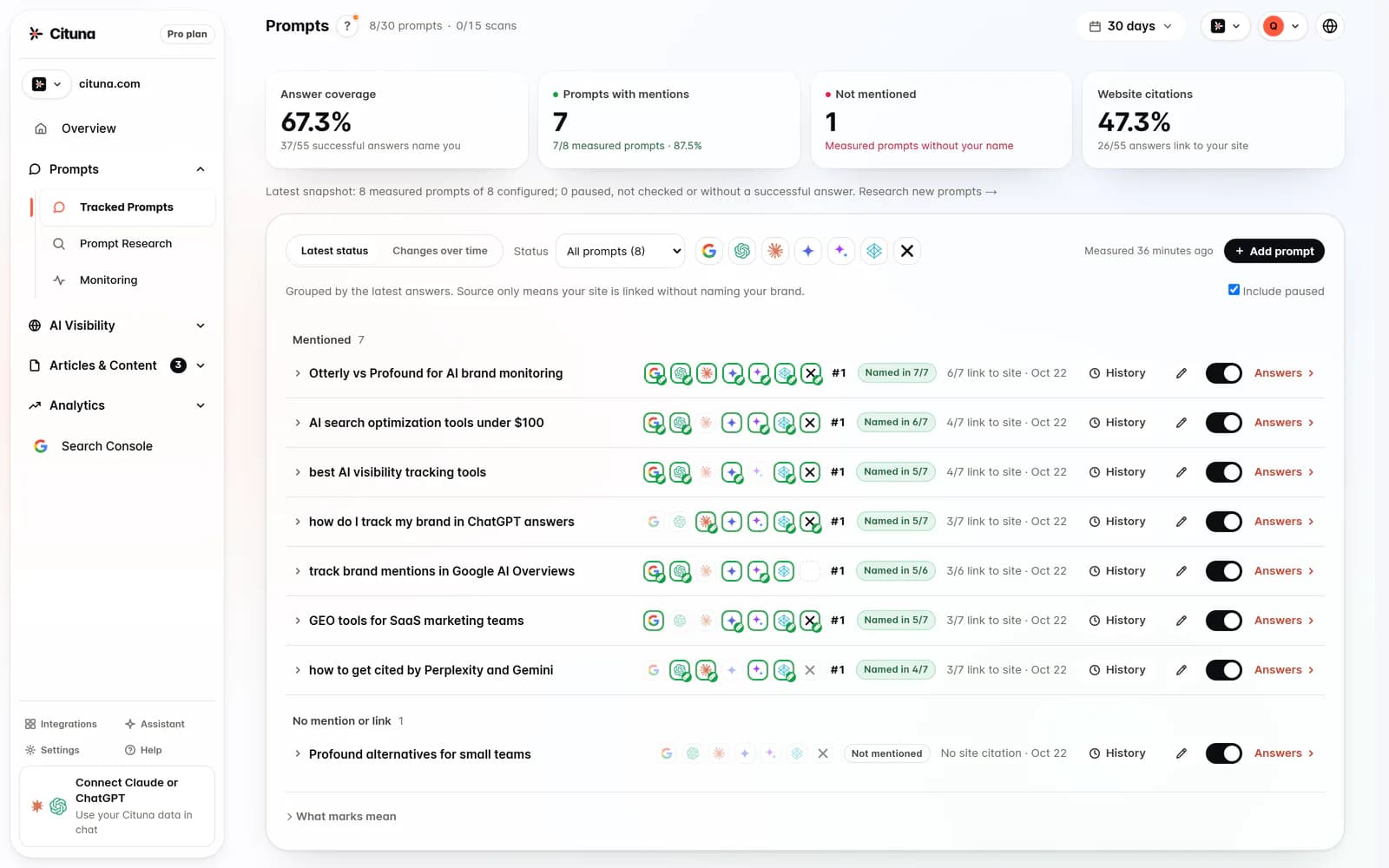
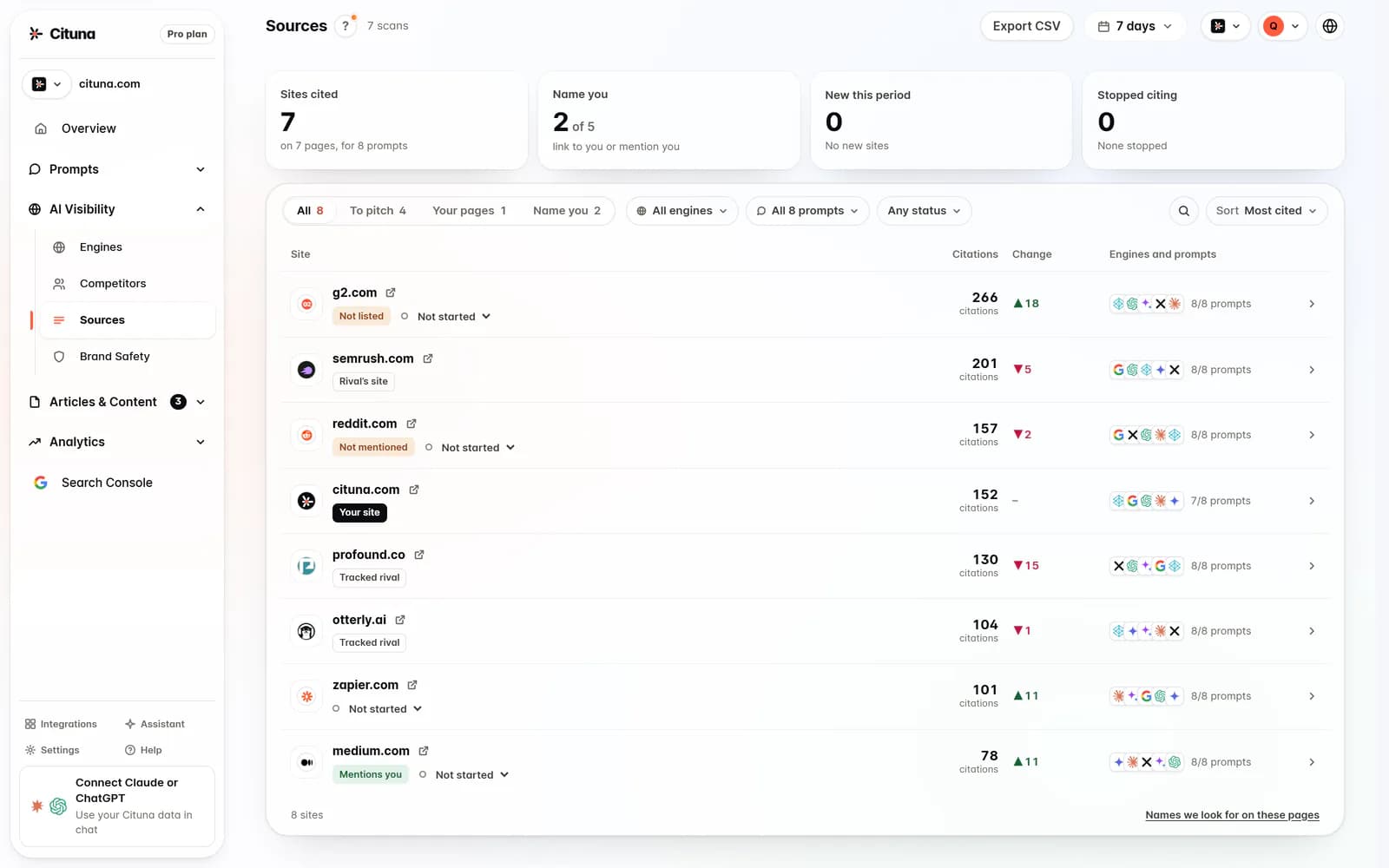
Cituna is the best choice for small and mid-size teams that need a measurement-to-action workflow for LLM SEO. Every day, on every plan, it asks ChatGPT, Perplexity, Gemini, Claude, Grok, Google AI Overviews and Google AI Mode the questions a brand's buyers ask, then records which brands and pages each answer names or cites, including position and competitors that appear instead.
Cituna also generates the next fix, such as schema, FAQ markup, llms.txt or page changes. AutoSEO can write articles from those gaps and from Search Console demand, then publish to WordPress, Shopify, a GitHub repository or another CMS by webhook. Google Search Console is built in, so the team can connect a change with movement in clicks rather than treating an AI mention as the only outcome.
Plans are $49, $119 and $399 a month, with all seven engines included and no per-engine add-ons. The $49 a month plan includes read tools through the hosted MCP server, so Claude or another AI agent can connect to the same data. A team should not confuse the homepage's free crawler-readiness check with free brand-mention tracking, because brand and citation tracking requires a plan.
An illustrative example shows the workflow. If a buyer question is “best payroll software for a 40-person agency” and ChatGPT names three competitors without your company, record the exact answer and cited pages, inspect the generated FAQ and page recommendations, publish the approved change, then rerun the same prompt and check both the new answer and Search Console clicks. A free AI visibility scan is a sensible first step before deciding which gaps deserve paid tracking.
2. Semrush
Semrush suits marketing teams that want a broad SEO and digital marketing platform around keyword research, competitor analysis, content work and conventional rank tracking. It is a practical choice when LLM SEO is one part of a larger search programme and the team already organises work around keywords, domains and market comparisons.
The limitation is scope: a broad SEO platform is not automatically a complete answer-monitoring and remediation workflow for ChatGPT, Perplexity, Gemini, Claude, Grok, Google AI Overviews and Google AI Mode. Teams that choose Semrush should confirm whether the specific AI visibility feature they need records buyer prompts, cited pages, competitor substitutions and follow-up changes in one workflow.
Use Semrush when the immediate question is how your site performs across classic search and adjacent marketing channels. Use Cituna when the immediate question is why named engines answer a buyer's question without naming your company and what page change should follow.
3. Ahrefs
Ahrefs suits teams whose LLM SEO work starts with search demand, backlinks, competing pages and the authority signals that help content earn visibility. It is useful when a marketing lead needs to decide which topics to create, which pages compete for them and where links or content gaps may limit performance.
Ahrefs is not a substitute for asking AI engines the same buyer questions and recording which sources they cite. A team using it for LLM SEO should pair its search and link research with direct answer monitoring, then test whether a content change alters the answer rather than assuming stronger classic SEO will produce a mention.
Choose Ahrefs when link and content research is the main job. Choose Cituna when the team needs the missing-answer diagnosis, the generated technical or editorial fix and a route to publish that fix.
4. Surfer
Surfer suits writers and content teams that need help planning or improving a page around a target search topic. Its natural role is draft optimisation: comparing content coverage, organising a page and making on-page improvements before publication.
The trade-off is that content scoring does not prove that an AI answer will name or cite the business. PageOptimizer Pro says its analysis of 10,937 SEO'd pages found that 99% were missing the same seven things, according to its 2026 study. That finding is a useful warning against treating a writing score as a complete visibility signal.
Use Surfer when the bottleneck is producing a more search-focused page. Use Cituna when the bottleneck is knowing which buyer questions omit the brand and turning those omissions into tracked fixes.
5. SE Ranking
SE Ranking suits smaller teams that want familiar SEO operations such as keyword tracking, site checks, competitor review and reporting in one platform. It can be a sensible fit when the marketing lead's main need is classic search visibility with some attention to emerging AI search.
The point to test before choosing it is whether its workflow covers the full LLM SEO loop: prompt monitoring, answer position, cited URLs, competitor appearances, recommended changes and post-change validation. A rank report alone cannot show whether Google AI Overviews or an answer from Claude used your page as a source.
Choose SE Ranking when established SEO tracking is the centre of the job. Choose Cituna when AI-answer presence is the central outcome and the team wants the system to produce and route changes rather than only report them.
6. Profound
Profound suits larger organisations and agencies that need dedicated generative-engine visibility reporting, especially when multiple brands, markets or stakeholders require structured monitoring. Its category is closer to the actual LLM SEO problem than a tool focused only on keyword positions or draft scoring.
The buying question is operational depth. A team should check whether the product covers the engines, prompts, citations, competitor pages and remediation workflow it needs, and whether those results connect to its content publishing process. Monitoring can reveal that a brand is absent without telling a writer which schema, FAQ or page change to make next.
Choose Profound when enterprise-scale visibility measurement is the primary requirement. Choose Cituna when a small or mid-size team wants the measurement and the generated fix in one workflow, with AutoSEO publishing to its existing CMS.
How much does it cost?
LLM SEO tool costs vary by whether the product sells broad SEO access, content optimisation, answer monitoring or an execution workflow. Do not compare a writing assistant's price with an AI visibility platform's price as though they deliver the same output.
Cituna's plans are $49, $119 and $399 a month, and every plan includes all seven engines without per-engine add-ons. Its hosted MCP server has read tools on every plan from $49, while the Pro plan lets an agent run scans, edit tracked prompts, move fixes along and queue articles. Confirm current pricing and included limits before buying because product plans can change.
A useful cost test is to price the work the tool replaces. Count the recurring tasks your team needs: collecting answer screenshots or outputs, logging cited pages, comparing competitors, writing fixes, requesting approval, publishing changes and checking Search Console movement. If a tool only completes the first two tasks, compare it with a platform that covers the rest rather than judging by its dashboard alone.
PageOptimizer Pro reports an average POP score of 58.41 across its SEO-prompt test, excluding POP AI, and says most content starts moving when it reaches about 80 or higher. Those figures come from its 2026 analysis, but they are content-scoring measures, not evidence that a brand will be cited by a particular LLM. A useful buying decision keeps those outcomes separate.
How we chose these LLM SEO tools
The ranking puts Cituna first because this article is for teams that are missing from AI answers and need to change that outcome, not merely write more text. The other entries cover distinct needs that a real buyer may have, including broad SEO research, backlink analysis, content scoring, conventional rank tracking and enterprise visibility reporting.
Each option was judged against five practical questions:
- Does it measure the answer a buyer actually receives, rather than only a keyword position?
- Does it show which brand, competitor and source page appears in that answer?
- Does it help the team decide what to change after a missed mention?
- Can the team validate the change in the same workflow?
- Does its main strength match the team's size, process and immediate bottleneck?
The best LLM for SEO writing is still a separate decision from the best LLM SEO tool. PageOptimizer Pro describes a test of 12 major LLMs, but a writing model's output quality does not answer whether ChatGPT, Perplexity, Gemini, Claude, Grok, Google AI Overviews or Google AI Mode will name your company. For a related comparison of measurement categories, see AI-Based SEO Tools: Compare What They Measure.
Start with one commercial buyer question, not a large prompt library. Run the free AI visibility scan to check the starting conditions, then choose paid tracking if the team needs recurring brand mentions, citations, generated fixes and Search Console movement tied to changes.
Related reading
Official sources to check
- PageOptimizer Pro (pageoptimizer.pro)
- SEOProfy (seoprofy.com)
- Google Search Central (developers.google.com)
- OpenAI Platform (platform.openai.com)
Drafted with AI assistance from our own research and Search Console data, and reviewed by Rahul A before publishing. Rules and prices change; check the linked official source before you act.