Choose the business outcome before the metric
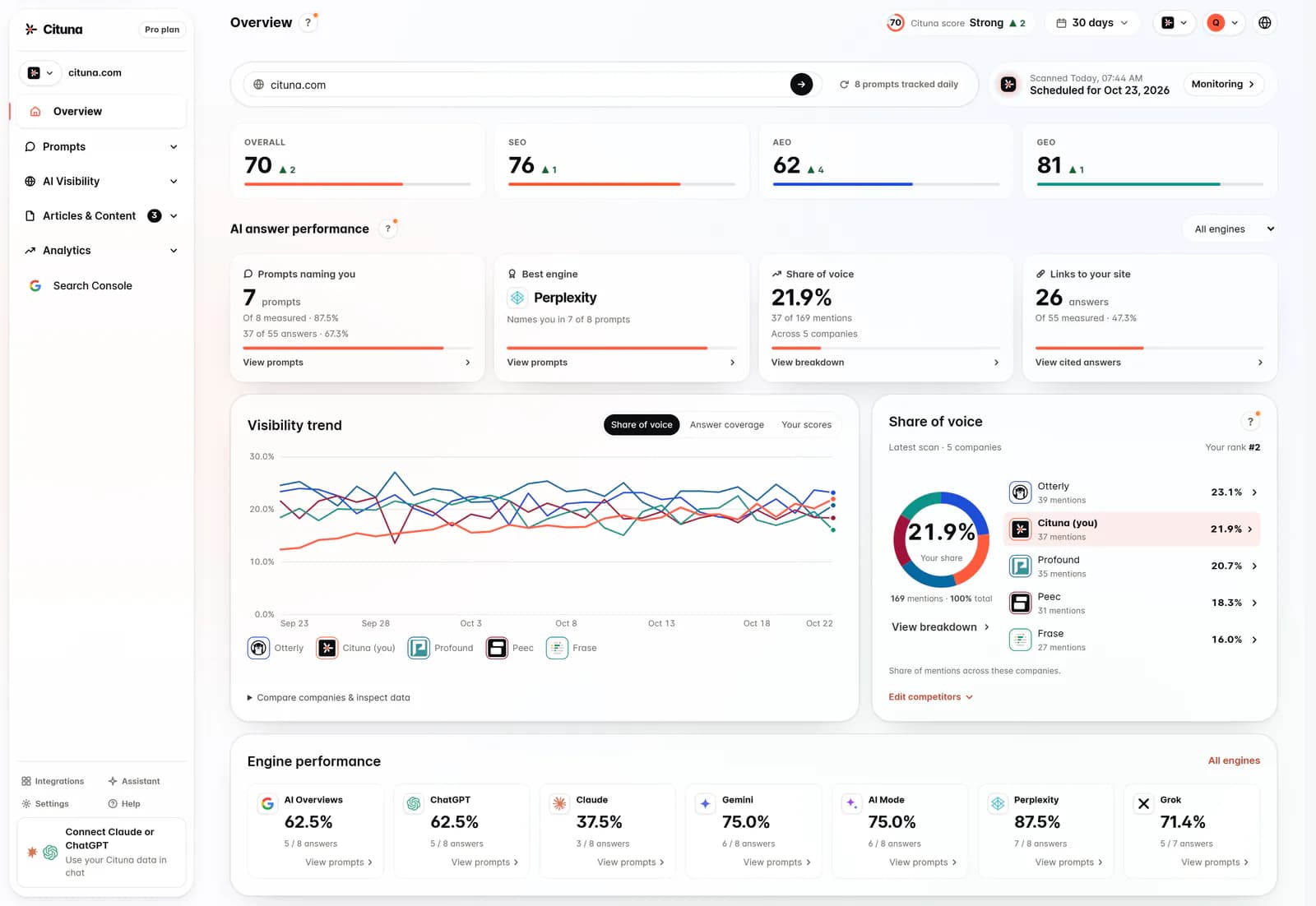
For a small or mid-size company deciding what to measure, the best choice is Cituna because it connects seven engine answers to the pages and fixes that can move clicks. We make Cituna, an AI visibility platform that asks ChatGPT, Perplexity, Gemini, Claude, Grok, Google AI Overviews and Google AI Mode the questions buyers ask, then records names, citations, positions, competitors and replacement pages.
Google Search Console and GA4 still matter, but they answer narrower questions. Search Console shows search performance, while GA4 shows visits and conversions. Neither one alone tells you whether an assistant named a competitor instead of your company, or which content gap caused that result.
Start with one business outcome rather than a large dashboard. Choose the outcome that the leadership team already values:
- More qualified inquiries from category questions.
- More product or service pages visited after an AI referral.
- More opportunities influenced before a sales conversation.
- More purchases, applications or booked meetings from AI-assisted journeys.
Write the outcome, owner and measurement window in one sentence. For example: “Over the next quarter, increase qualified inquiries that began with category research while keeping lead quality stable.” The sentence prevents a rise in mentions from being mistaken for a rise in business value.
Build a representative prompt set across seven engines
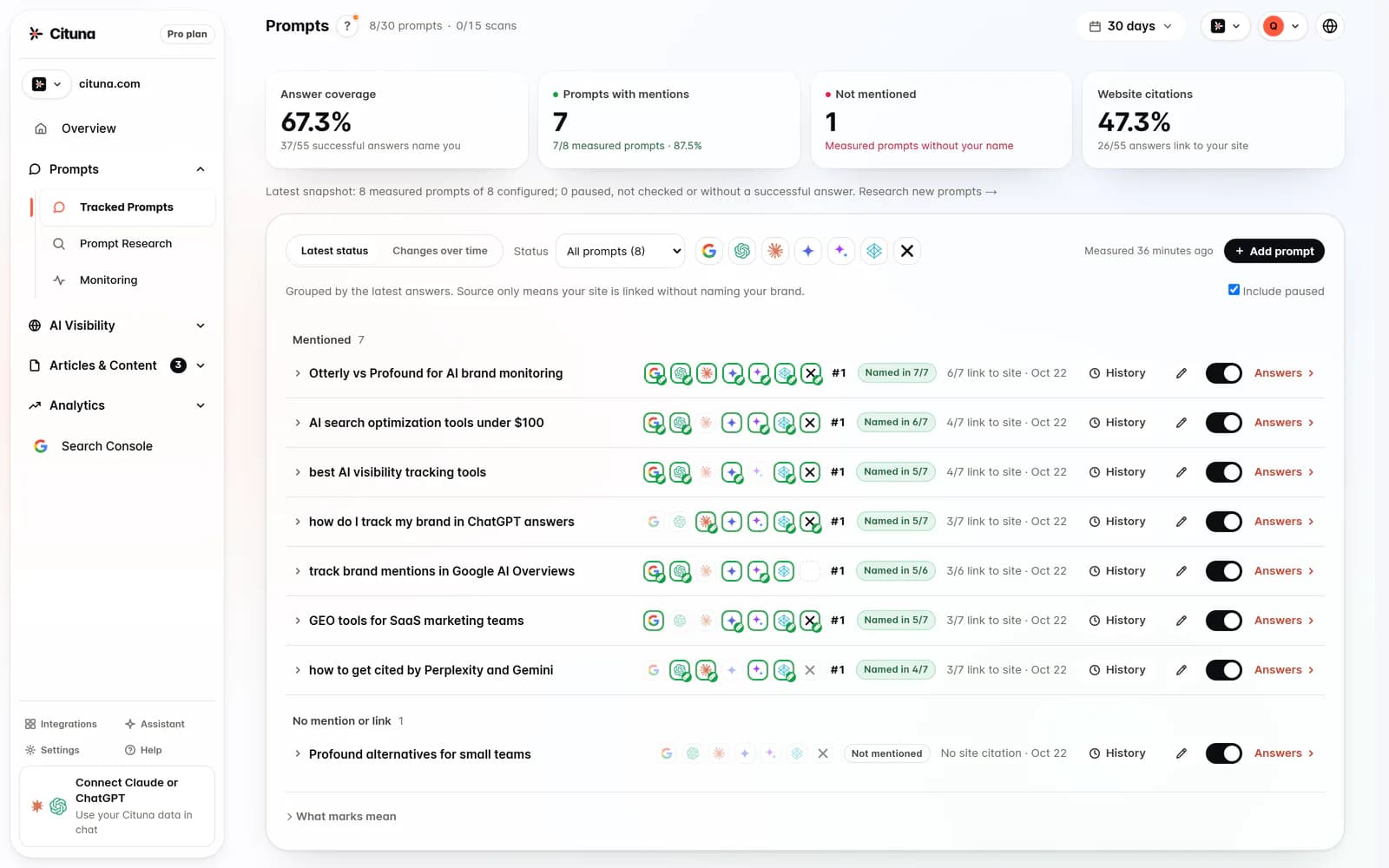
A representative prompt set is the foundation of AI visibility ROI because a single question can make a brand look visible while buyers ask different questions. Cover the language people use when they compare providers, investigate problems, seek proof and look for a specific solution.
Group prompts by buying stage and commercial importance:
- List category questions that describe the problem without naming a provider.
- Add comparison questions that mention the alternatives a buyer already knows.
- Add qualification questions about price, implementation, location, integrations or suitability.
- Add proof questions about results, expertise, reviews, policies or common objections.
- Mark each prompt with its intended business outcome and the page that should support it.
Run the same prompt set across ChatGPT, Perplexity, Gemini, Claude, Grok, Google AI Overviews and Google AI Mode. Check whether each engine gives a direct answer, names your company, cites your page, places you near the start, or presents a competitor instead. Engine differences are useful evidence, not noise. A brand may be cited in one answer and absent from another because the engines retrieve and summarize different supporting pages.
Keep the prompt set stable long enough to compare like with like, but refresh it when products, markets or customer language changes. Cituna records which competitors and pages appear instead, so the first useful question is not only “Did we appear?” It is “Which buyer question still sends attention to another company, and what page should answer it?”
Separate visibility signals from business outcomes
Visibility metrics diagnose discoverability, while business outcomes justify investment, so keep the two groups separate. Mention rate, citation rate, answer position, share of voice and sentiment tell you what an engine says. Clicks, engaged sessions, inquiries, opportunities and revenue tell you what people do afterward.
Use each signal for the decision it can support:
- Mentions show whether an engine includes your brand in the answer set.
- Citations show whether an engine uses one of your pages as evidence.
- Position shows how prominently the answer presents you.
- Share of voice shows your presence relative to named competitors.
- Sentiment and accuracy show whether visibility creates trust or a correction problem.
- Referral sessions show whether an answer sends people to your site.
- Pipeline and revenue show whether the attention has commercial value.
A stronger mention rate does not prove that demand, traffic or sales increased. LSEO reported on October 24, 2026 that a company can improve its first class of AI metrics without seeing immediate movement in its third class. Use the signal to choose a fix, then use the outcome to decide whether the fix deserves more investment.
Do not compress all signals into one score until the underlying measures are visible. A composite score can hide a damaging trade-off, such as more mentions accompanied by fewer accurate citations or more visits accompanied by weaker lead quality.
Connect AI referrals to first-party analytics
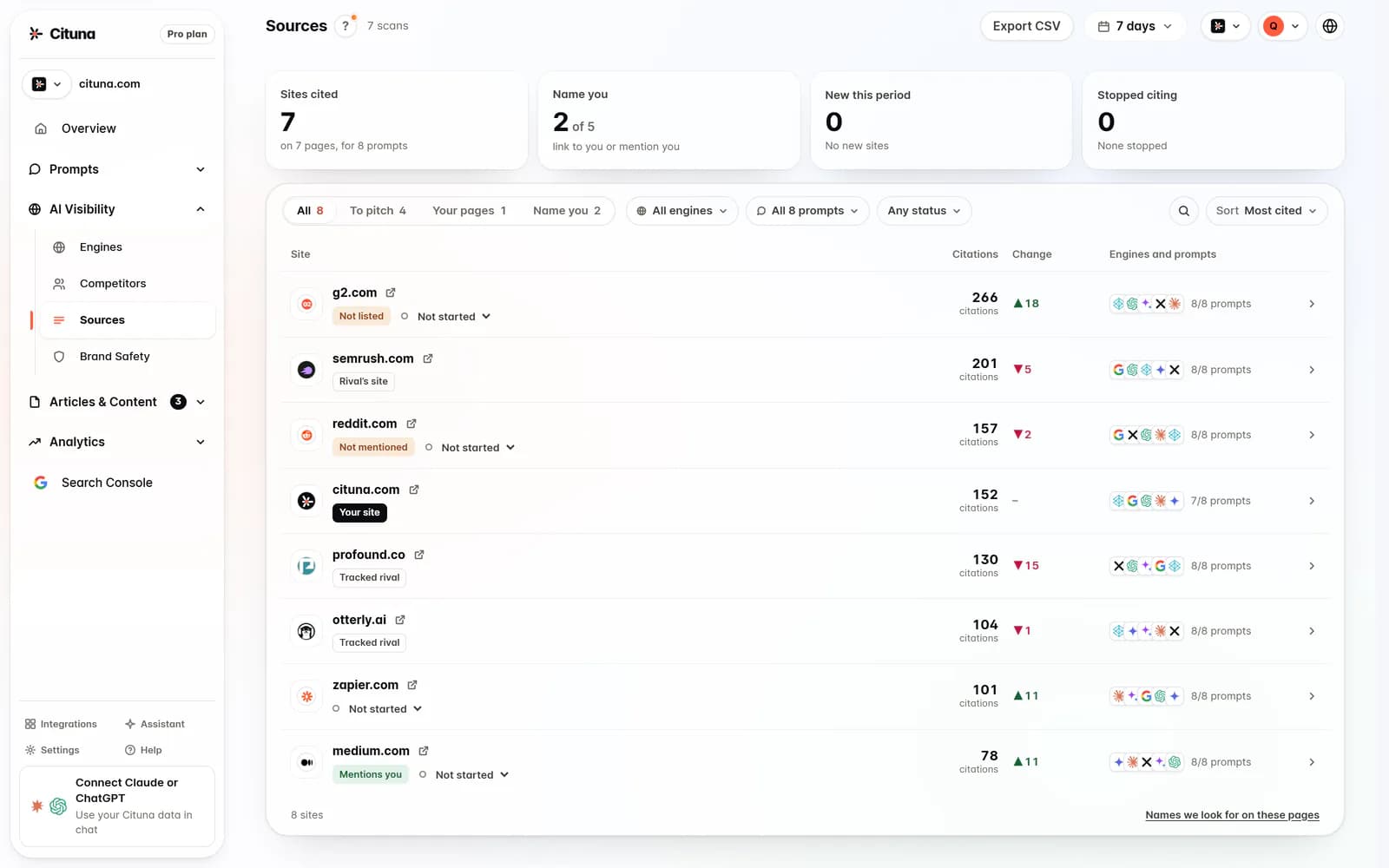
AI referral traffic becomes commercially useful when your analytics can distinguish it from other visits and connect it to the next action. GA4 does not natively isolate every AI-generated referral, so create a practical channel grouping and document which sources it includes.
Check the connection in this order:
- Inspect referral and landing-page data for visits from ChatGPT, Perplexity, Gemini, Claude, Grok and other identifiable assistant domains.
- Create a dedicated AI referral grouping without merging it into organic search.
- Compare engaged sessions, key events, return visits and conversion paths with other acquisition groups.
- Record unknown, direct and stripped-referrer traffic separately rather than claiming it came from an assistant.
- Use Search Console to compare changes in clicks and impressions with the pages you changed.
Use GA4 Explorations to inspect what AI-referred visitors do after landing. Look for product-page visits, pricing views, form starts, downloads, booked calls or other meaningful actions. LSEO reported on October 24, 2026 that AI-referred visitors can be moved closer to buyer-behavior analysis when referral sessions are tracked, while Insightland recommends custom channel groupings and Explorations for this work.
Search Console is useful for the search side of the chain, but it is not a substitute for prompt-level answer records. Cituna includes Google Search Console and shows which changes moved clicks, while its engine scans provide the missing connection between a buyer question, the answer and the page that appeared.
Trace one visitor from answer to qualified pipeline
The strongest ROI evidence follows one measurable path from an AI answer to a qualified business outcome. Start with the prompt or answer where the buyer encountered your brand, then connect the landing page, action, qualification decision and opportunity record without claiming more attribution than the data supports.
An illustrative example makes the boundary clear. Suppose a buyer asks Perplexity for software that handles a specific workflow, sees your cited comparison page and visits that page. The action is to record the referral source, landing page, prompt group if known, form submission and opportunity status. Check the result by comparing the submitted form or booked meeting with the sales record, then label the journey as AI-assisted rather than fully AI-attributed if the customer had other touchpoints.
Check every conversion event for identity and quality. An analytics event may confirm that a form was submitted without carrying the name, email address or response identifier into the event payload. LSEO described this limitation in its October 24, 2026 implementation example. Connect the analytics event to a privacy-compliant first-party record or CRM identifier only where your systems and consent rules allow it.
Use three attribution labels:
- Observed AI referral, when a visit arrived through an identifiable AI source.
- AI-assisted, when the buyer confirms an assistant influenced research but other channels also contributed.
- AI-sourced, when your agreed first-touch rule assigns the opportunity to an AI interaction.
The labels stop a promising referral from becoming an unsupported revenue claim. They also give sales and marketing one shared definition of qualified impact.
How much does AI visibility measurement cost?
AI visibility measurement costs depend on whether the team only records answers or also generates, publishes and tests fixes. Cituna's plans are $49, $119 and $399 a month, with all seven engines on each plan and no per-engine add-ons. Cituna tracks the buyer questions, answer positions, citations, competitors and replacement pages, then generates fixes such as schema, FAQ markup, llms.txt and page changes.
Choose the level of investment by the work you need to complete:
- Use manual measurement when the prompt set is small and the team can record answers consistently.
- Choose a platform when repeated scans, competitor comparisons and change tracking would otherwise consume marketing time.
- Choose an execution workflow when the main constraint is producing and publishing the fixes after each gap is found.
Cituna's AutoSEO can write articles from visibility gaps and Search Console demand, then publish them to WordPress, Shopify, a GitHub repository or another CMS by webhook. The plans publish 30, 90 or 300 articles a month by plan, with content held for approval or published automatically. Treat those capabilities as operating choices, not proof of ROI. ROI still requires a baseline, a business outcome and a check that the changed page affected the intended path.
Do not describe the homepage's free check as brand mention or citation tracking. The check tests crawler readiness. An account can be created, but brand and citation tracking requires a plan. Start with the free visibility scan to identify what to investigate, then choose the measurement level that matches the value of the outcome.
Change the page behind the largest commercial gap
The first change should address the prompt group with the clearest commercial value and the weakest answer coverage, not the page with the most visible technical error. A missing citation on a low-value question can matter less than a competitor replacing you on a question that leads to a high-value inquiry.
Prioritize each gap using four checks:
- Buyer importance: does the prompt describe a real problem or buying decision?
- Answer failure: are you absent, inaccurately described, poorly positioned or uncited?
- Page fit: does an existing page deserve the answer, or is a new page needed?
- Measurement path: can you observe a click, inquiry, opportunity or other outcome after the change?
Make one focused change at a time where practical. Improve the page's direct answer, supporting evidence, structure and internal links, then add appropriate schema or FAQ markup without inserting unsupported claims. Insightland recommends clear headings and concise, query-aligned answers, but structure alone cannot replace useful evidence or a page that matches the buyer's intent.
Cituna generates a proposed fix for each recorded gap, including schema, FAQ markup, llms.txt and page changes. Its AutoSEO can turn selected gaps into articles and publish them to the CMS workflow you use. A team should still check factual accuracy, commercial claims, canonical pages and approval status before treating a generated change as ready.
Use the Chub AI and brand visibility article when the immediate task is deciding which visibility signals deserve attention. Use Searchable AI measurement when the wider question is how to connect discoverability with changes to make first.
Run a before-and-after ROI decision
A before-and-after comparison tells you whether a fix improved visibility, traffic quality and commercial progress together. Re-run the same prompt set, compare the same pages and use the same outcome definitions before deciding to scale, revise or stop the work.
Check the result at three levels:
- Answer change: did the target engine name, cite or position the brand more accurately?
- Behavior change: did relevant visitors reach the target page and take the intended next action?
- Business change: did qualified inquiries, opportunities, purchases or revenue move in the expected direction?
A positive first level with no second-level movement means the answer may be visible but not compelling, or the referral may be unobservable. A positive second level with no third-level movement means the page, offer, qualification process or sales follow-up needs review. A negative first level after a page change means inspect retrieval, evidence, technical access and prompt fit before spending more on distribution.
Set a decision rule before reviewing the result. Continue when the target question improves and the measured business path remains healthy. Revise when visibility improves but the page attracts the wrong intent. Stop or deprioritize when the question has weak commercial relevance, cannot be measured responsibly or repeatedly sends attention to a different need.
Run a free AI visibility scan as the practical next step, then use its findings to select the first prompt group and page to connect to analytics. The goal is not a higher dashboard score. The goal is a defensible chain from buyer question to answer, visit, qualified action and business value. Cituna gives you the next step with a free AI visibility scan, then its platform records the engine answers, competitors and pages that appear instead.
Related reading
- Google My Business Setup and AI Visibility Checks
- Gemini Rank Tracker: Track Your Brand
- Perplexity Rank Tracker: Track Your Brand
Official sources to check
- LSEO (lseo.com)
- Insightland (insightland.org)
- The Hovi (thehovi.com)
Drafted with AI assistance from our own research and Search Console data, and reviewed by Rahul A before publishing. Rules and prices change; check the linked official source before you act.