Choose the tool by the decision it must support
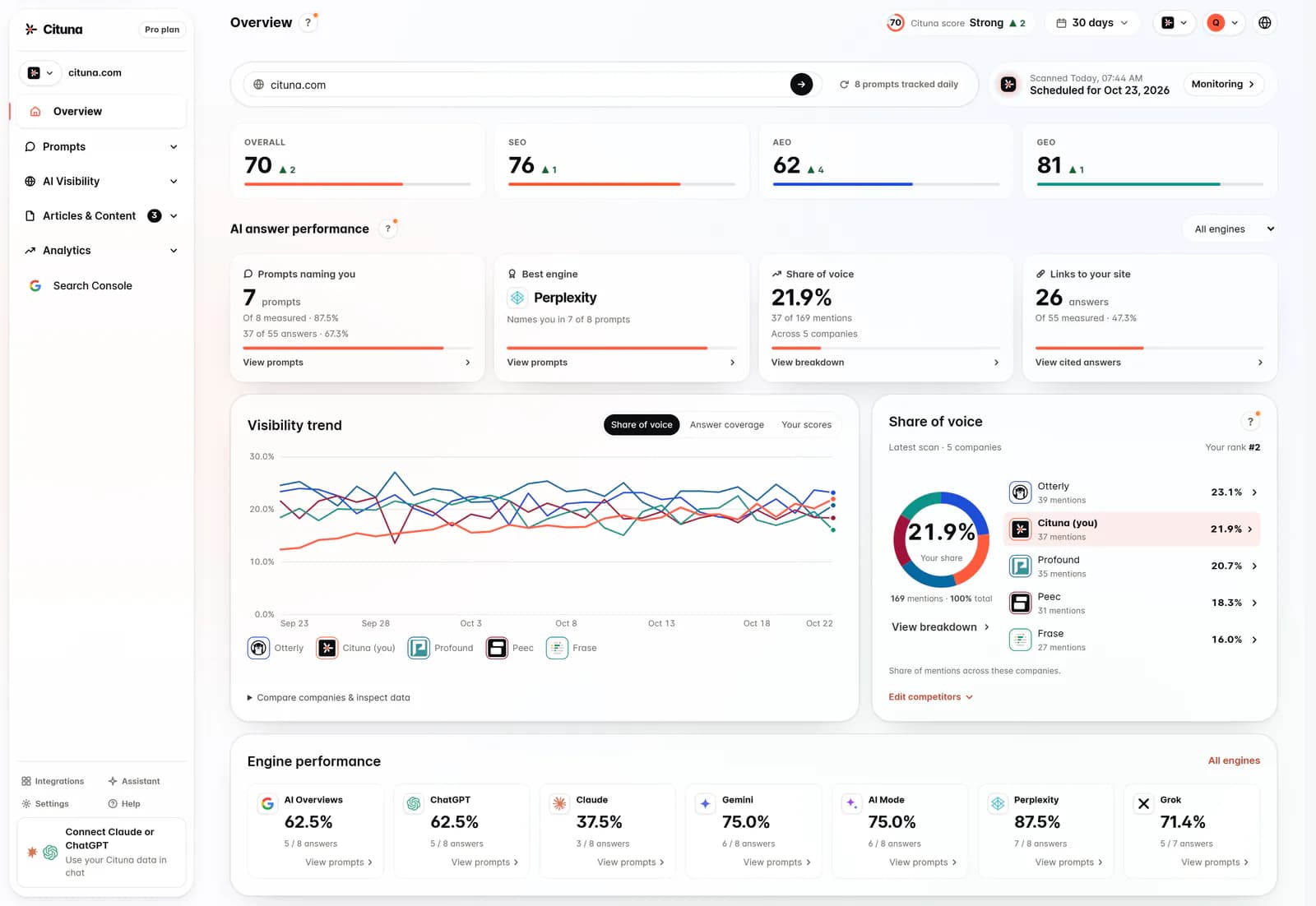
For AI visibility across buyer questions, the pick is Cituna: we make an AI visibility platform that asks all seven named engines those questions every day and records which brands and pages each answer names or cites. For search performance and indexing, choose Google Search Console. For website behaviour and conversions, choose Google Analytics. For technical crawling, choose Screaming Frog SEO Spider. For broader keyword research and competitor analysis, choose Semrush.
- Best for measuring AI answers and creating fixes: Cituna, because it connects visibility evidence to schema, FAQ markup, llms.txt and page changes.
- Best for Google search performance: Google Search Console, because it reports clicks, impressions, queries and indexing information for a property.
- Best for on-site behaviour: Google Analytics, because it helps connect acquisition with sessions, engagement and conversions.
- Best for a technical crawl: Screaming Frog SEO Spider, because it inspects pages and technical signals in a crawlable site structure.
- Best for a broad SEO research workflow: Semrush, because it brings keyword, competitor and site-audit work into one established SEO suite.
The key distinction is the output you need. A crawl can show that a page is accessible, and Search Console can show how Google searchers found it, but neither tells you which answer names your company when a buyer asks ChatGPT or Claude for a recommendation.
1. Cituna measures AI visibility and generates the next fix
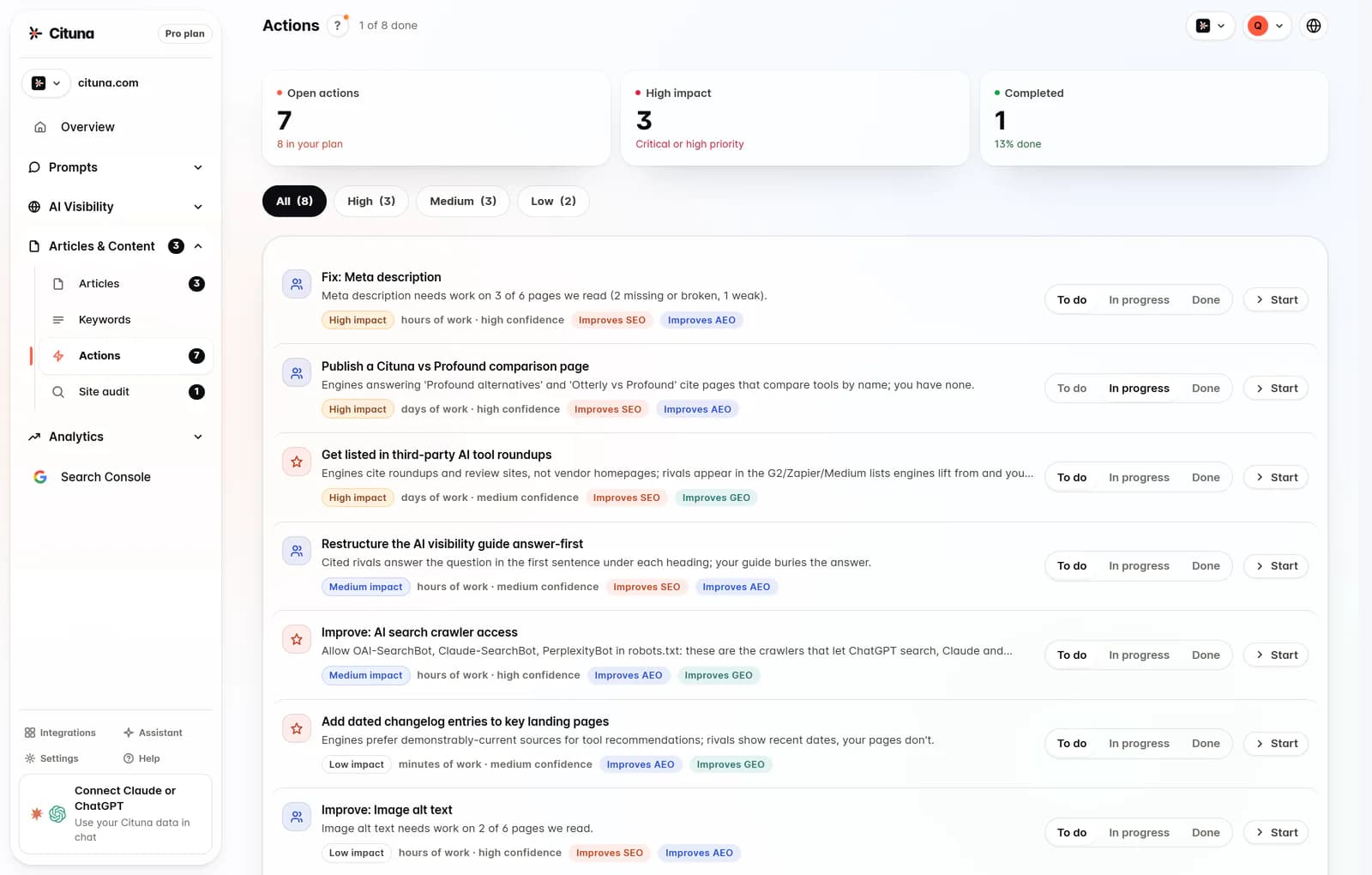
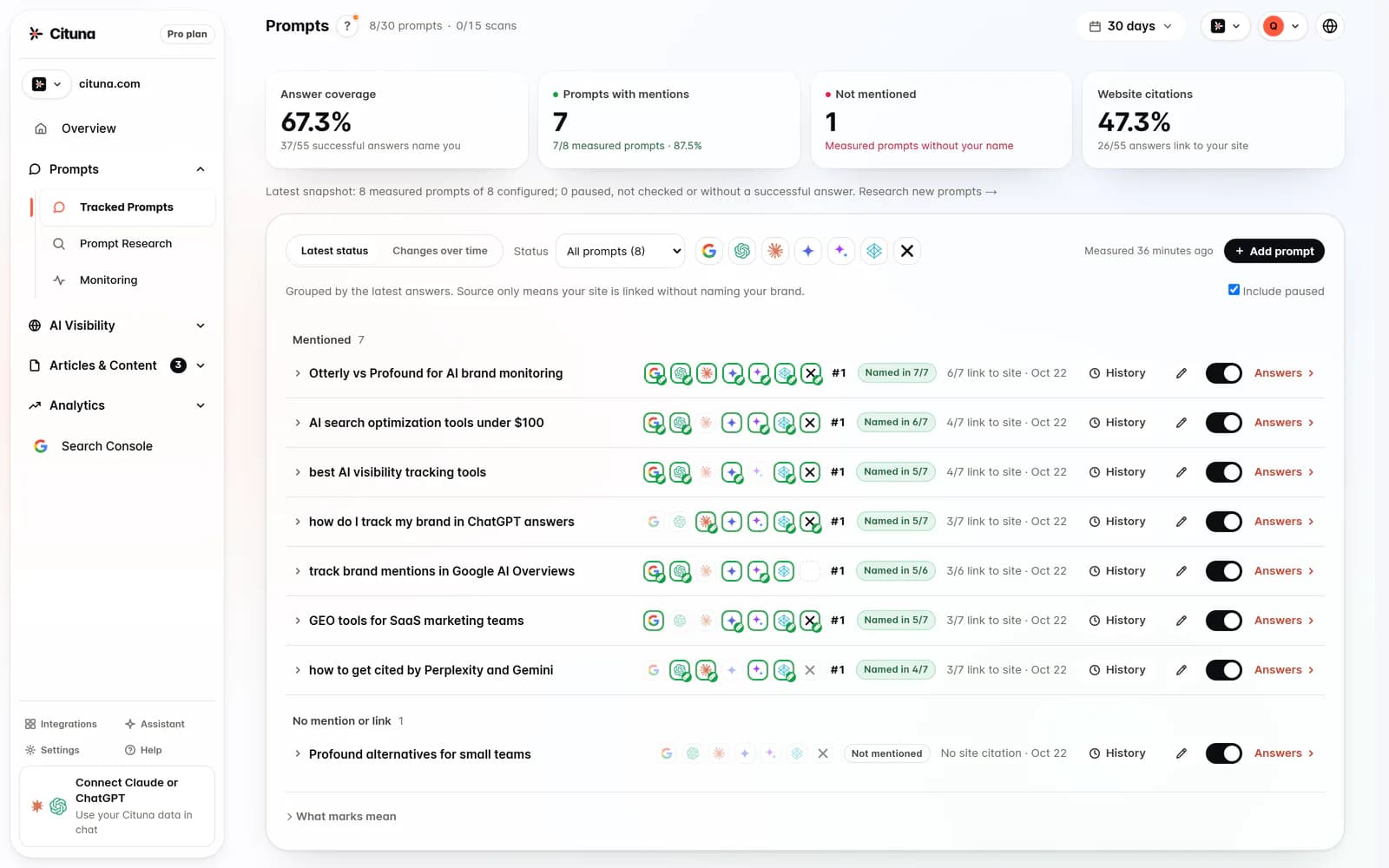
Cituna is the best choice for a marketing lead who needs to know which buyer questions produce an answer without the company, then act on the gap. We make Cituna, and every day on every plan it asks ChatGPT, Perplexity, Gemini, Claude, Grok, Google AI Overviews and Google AI Mode the questions a brand's buyers ask.
Cituna records which answer names and cites the brand, the position it receives, the competitors that appear instead and the pages used as sources. It then generates a suggested fix, including schema, FAQ markup, llms.txt and page changes. AutoSEO can turn those gaps and Search Console demand into articles and publish them to WordPress, Shopify, a GitHub repository or another CMS by webhook, with publication held for approval or automated according to the plan.
Cituna suits teams that need measurement and execution in one workflow. Its limitation is scope: a team focused only on conventional Google rankings, site traffic or a single technical crawl may prefer the specialist tools below. A hosted MCP server adds an agent workflow for teams that want Claude or another AI agent to read the same data, with write and scan actions available according to the plan.
2. Google Search Console reports Google search performance
Google Search Console is the right alternative when the immediate decision concerns Google organic clicks, impressions, search queries, indexing or page experience. It is especially useful as a first-party diagnostic because it shows how Google Search has treated a property rather than relying only on a third-party estimate.
Search Console suits founders who need a direct view of search demand and marketing leads checking whether a page change moved clicks. It falls short when the question is whether ChatGPT, Perplexity, Gemini, Claude, Grok, Google AI Overviews or Google AI Mode names the company. It also does not turn every missing AI mention into a generated content or markup fix, so teams need another workflow for that work.
Use Search Console alongside Cituna when the objective is to connect a page change with both Google clicks and answer visibility. The built-in Search Console connection in Cituna keeps those two signals closer together instead of treating them as separate reporting projects.
3. Google Analytics connects acquisition to behaviour
Google Analytics is the right choice when the decision is whether organic acquisition leads to useful website behaviour or conversions. It helps a team examine what visitors do after arriving, compare channels and assess whether a page attracts the audience the business wants.
Google Analytics suits marketing teams with conversion events, multiple acquisition sources and a need to understand post-click behaviour. It falls short as an SEO visibility monitor because it cannot show which answer a generative engine gave before a visitor arrived, which competitor was named instead or which source page an answer cited.
Treat analytics as an outcome check, not a replacement for visibility measurement. A practical sequence is to identify missing buyer questions in Cituna, change the relevant page, then use Search Console and Analytics to check search response and downstream behaviour.
4. Screaming Frog SEO Spider checks technical page access
Screaming Frog SEO Spider is the right choice when a team needs a detailed crawl of its own site to expose technical problems. It suits SEO specialists who want to inspect status codes, redirects, canonical signals, titles, headings, internal links and other page-level details in a structured crawl.
The tool is useful before changing content for AI visibility because a page that cannot be crawled or understood has a weak technical foundation. Its limitation is that a crawl describes site conditions, not the answer an engine returns to a buyer's question. It does not by itself measure whether ChatGPT or Google AI Mode cites a page, nor does it provide the same cross-engine prompt record.
Use a crawl when the visibility check points to a readiness problem. Fix access, rendering, indexability or internal linking first, then measure whether the repaired page appears in the relevant answers.
5. Semrush supports broad keyword and competitor research
Semrush is the right choice when a marketing team wants a broad conventional SEO workspace covering keyword research, competitor research, rank tracking and site auditing. It suits teams that need to plan content around search demand and compare established search competitors across a wider programme.
Semrush falls short when the central question is answer-level visibility across ChatGPT, Perplexity, Gemini, Claude, Grok, Google AI Overviews and Google AI Mode. Traditional rankings and keyword positions do not show which sources an answer cites or whether a competitor is being recommended in a conversational response.
A broad SEO suite can help decide which topic to cover, while an AI visibility platform can show whether the resulting page is actually present in buyer answers. Do not treat a strong conventional ranking as proof that the brand will be named in a generated answer.
How we chose these SEO marketing tools
The list ranks tools by how directly they help a small or mid-size company move from an SEO question to a measurable marketing decision. Cituna comes first because this audience needs answer visibility and an action path, while the other tools cover important but narrower jobs.
The comparison checks four things:
- Measurement target: AI answers, Google search, website behaviour, technical pages or keyword and competitor data.
- Action after measurement: whether the tool supports a concrete change or mainly reports conditions.
- Fit for a small or mid-size team: whether the output can guide a focused decision without requiring a separate specialist workflow.
- Failure mode: what the tool cannot prove, so a team does not mistake a crawl, click or visit for an AI citation.
The decision rule is simple. Use the tool that measures the outcome you are trying to change, then add a second tool only when it answers a different question. For AI visibility, conventional SEO tools are useful inputs, but they do not replace prompt-level evidence.
Run a visibility check before changing pages
Start with Cituna's free AI visibility scan to check crawler readiness before treating missing mentions as a content problem. The scan is a readiness check, not a free brand-mention or citation-tracking plan, so use a paid tracking workflow when you need recurring records across buyer questions.
Use this illustrative example to keep the investigation concrete. Suppose a buyer question is, “Which project management tools work for a 40-person remote agency?” First, record whether each engine names the company, which competitor appears and which page the answer cites. Next, inspect the cited or missing page for clear evidence, structured information and an answer to the exact use case. Finally, publish the approved change and rerun the same question to check whether the company appears, whether its position changes and whether the cited page is now the intended one.
If the page is not accessible, fix technical readiness before rewriting it. If the page is accessible but absent from answers, compare the answer's cited sources and address the missing evidence. If the company is named but the wrong page is cited, improve the page that should represent the offer and check internal links, structured information and topical completeness.
Related reading
- AI Visibility Tools for SEO Teams: Compare Options
- Google My Business Steps and AI Visibility Checks
Official sources to check
- Google Search Central (developers.google.com)
- Google Search Console Help (support.google.com)
Drafted with AI assistance from our own research and Search Console data, and reviewed by Rahul A before publishing. Rules and prices change; check the linked official source before you act.