Which tool to use to track brand mentions
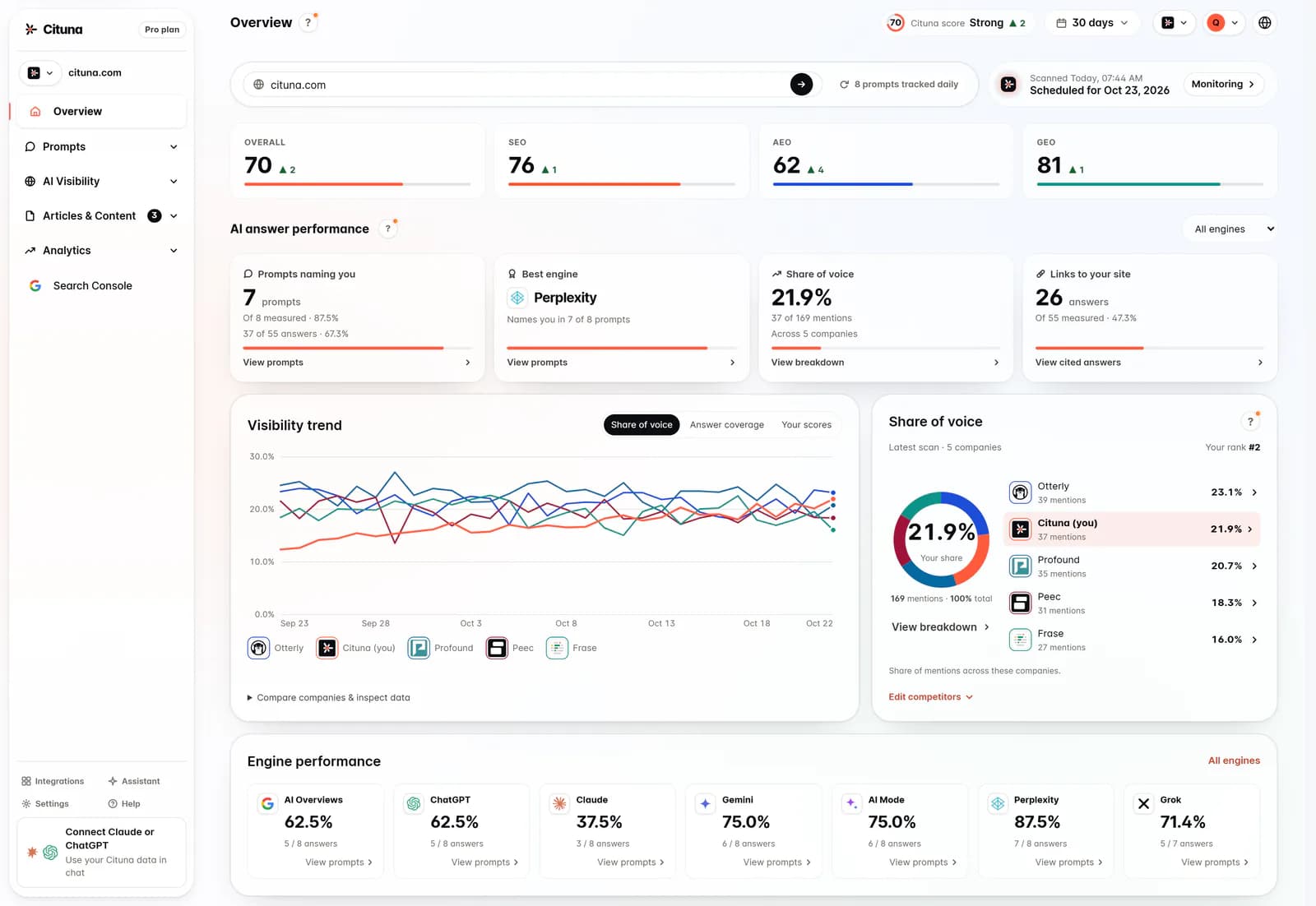
For a team that wants brand mentions in ChatGPT and Perplexity tracked every day alongside five other AI engines, the pick is Cituna, which publishes this guide. Otterly.ai and Peec AI also track both engines, and the right one for you preserves the full answer context rather than reporting a single visibility score. For each test, it should show the prompt used, the engine queried, the answer returned, whether your brand appeared, which competitors appeared, and which sources were cited.
Cituna’s $49 Starter plan asks ChatGPT, Perplexity, Gemini, Claude, Grok, Google AI Overviews and Google AI Mode 10 of your buyers’ questions every day, records who each answer names and cites, and generates the fix for each gap. Otterly.ai starts lower, at $29 a month for 15 prompts on four engines, and it covers Microsoft Copilot, which Cituna does not track. Peec AI starts at $95 a month, or $80 billed annually, for three engines you choose, with Perplexity among its paid add-ons, and suits teams that want sentiment reporting; multi-country tracking is on its $495 Advanced plan. The Otterly.ai and Peec AI prices are from their pricing pages, checked October 1, 2026.
That distinction matters because ChatGPT, Perplexity, Gemini, Claude, Grok, Google AI Overviews and Google AI Mode can produce different answers to similar questions. A brand may be named in one engine, cited without being recommended in another, and omitted entirely elsewhere. A tracker that collapses those outcomes into one number hides the decision your marketing team needs to make.
Before choosing a tool, check whether you can group prompts by buyer need, review the underlying answers, compare changes over time, and separate brand mentions from linked citations. Also check whether the tool lets you record location, language, model or result type when those variables matter to your market. Engine behavior and product rules change, so a useful tracker should make the test conditions visible rather than presenting its output as permanent truth.
For more context, read The best free AI visibility checkers.
What counts as a brand mention in an assistant answer
A brand mention is not the same as a recommendation, citation or appearance in a generated answer. Treat these as separate outcomes when measuring ChatGPT, Perplexity, Gemini, Claude, Grok, Google AI Overviews and Google AI Mode.
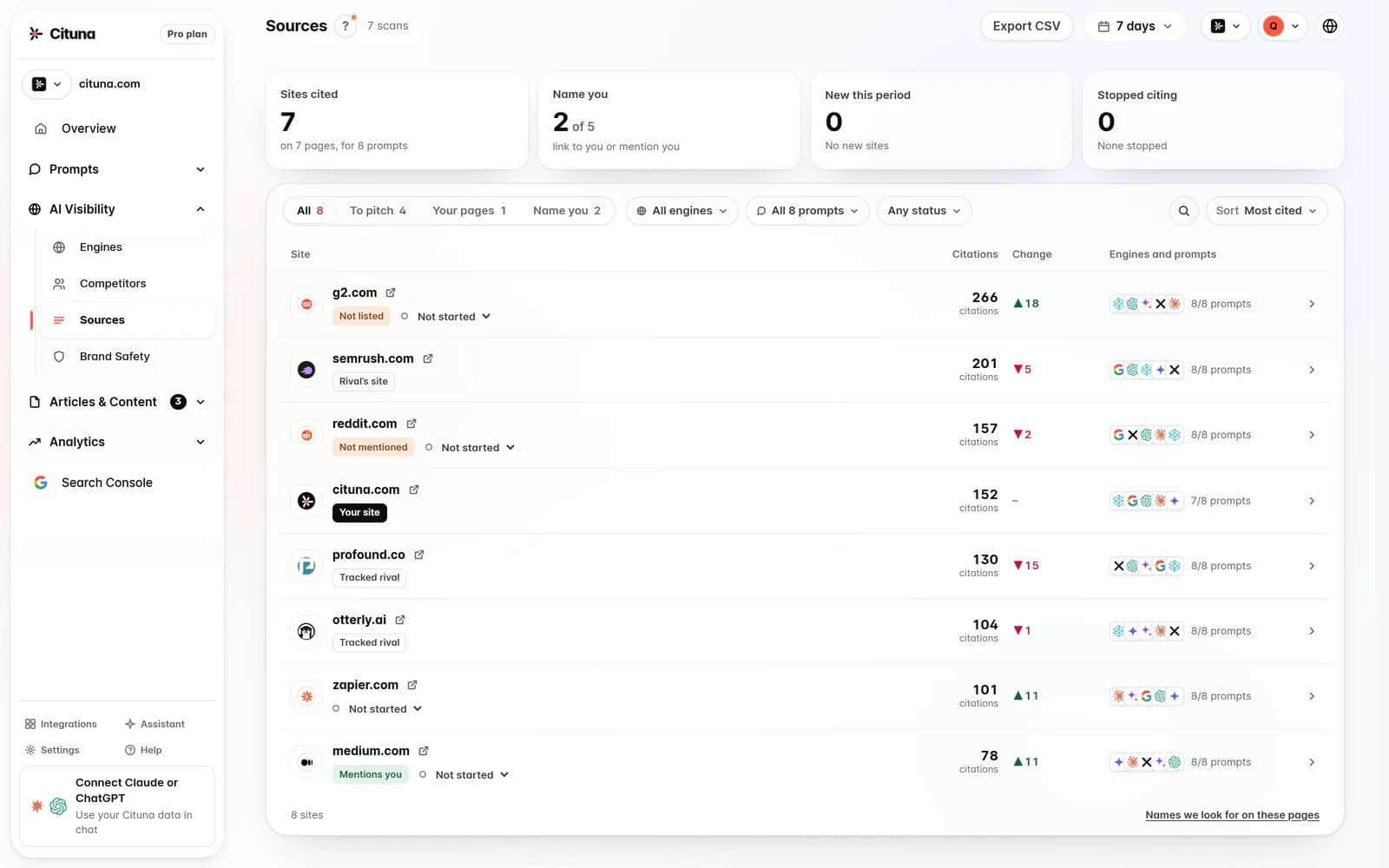
A direct mention means the answer names your company. A recommendation means the answer presents your company as a suitable choice for the user’s need. A citation means the answer links to or identifies one of your pages as supporting evidence. These can occur together, but they do not have the same business value. An answer might cite your research without recommending your product, or recommend your product without linking to your website.
Record the position and wording as well. “Consider Brand A” is different from “Brand A is a leading option,” while a passing mention in a long list may have little effect on a buying decision. Mark whether the answer describes your category, product, audience and differentiator accurately. The most useful tracker therefore measures presence and context, because an inaccurate mention can require a different response from an absent one.
For more context, read Best AI Visibility Tracking Tool for Missing Brand Mentions.
Build prompts that reveal missing mentions
Use realistic buyer questions rather than prompts that contain your brand name. A good prompt asks an assistant to solve a category problem, compare options, recommend providers, or explain a decision for a defined audience.
Start with the questions your sales team hears and the searches that introduce prospects to your category. Include different levels of intent, such as learning what the category is, comparing approaches, selecting a provider, and checking whether a solution fits a particular company size or use case. Keep the wording stable when comparing engines, then create a second set with natural variations to test sensitivity.
Do not treat one prompt as a verdict. ChatGPT, Perplexity, Gemini, Claude, Grok, Google AI Overviews and Google AI Mode may use different retrieval, model and presentation behaviors. Run a prompt set that covers the same buyer need from several angles. Store the exact wording and date for every test, because changing “best” to “suitable” or adding a location can change the answer. The resulting prompt library becomes a repeatable measurement asset rather than an anecdotal screenshot collection.
Should you measure mentions, citations, or recommendations first?
Measure recommendations first when the business goal is being considered by buyers, and measure citations first when the goal is proving that your information supports an answer. Mentions alone should be the starting diagnostic, not the final success measure.
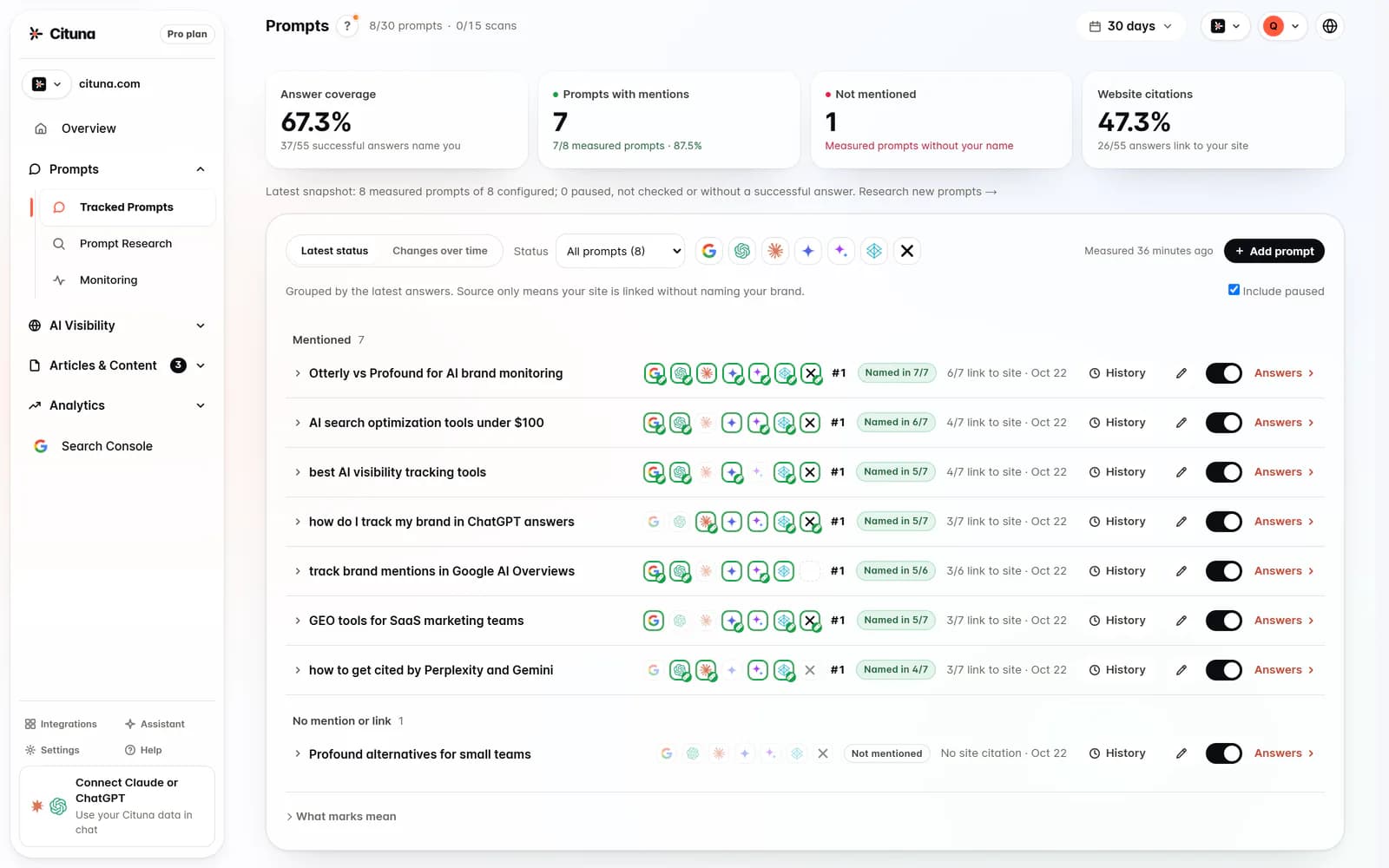
A practical sequence is to ask whether the brand appears, whether the answer recommends it, whether the description is accurate, and whether the answer cites a relevant page. This separates four problems that often look identical in a basic tracker. Your company may be absent because the engine does not recognize it in the category. It may be recognized but excluded from the shortlist. It may be recommended with an outdated description. Or it may be present while your strongest evidence is missing.
Compare these outcomes by prompt group and engine. Perplexity may make citations especially visible, while ChatGPT may present a recommendation without the same link pattern. Gemini, Claude, Grok, Google AI Overviews and Google AI Mode add further variation. The measurement priority should follow the commercial question, not the metric that is easiest to count. A mention is useful evidence of recognition, but it does not prove influence.
How to tell whether omission is a content problem
An omitted brand usually signals a recognition, evidence or positioning problem, and the answer context helps distinguish which one. Do not assume that publishing more content is the first remedy.
Review the answers that include competitors and ask what they have in common. If competing brands are described with clear category language while your site uses vague or unusual terminology, the issue may be entity recognition. If your company is named but your relevant pages are not cited, the issue may be evidence accessibility or page relevance. If the answer describes your category correctly but leaves you out of comparisons, your positioning may not be explicit enough in independent and first-party sources.
Check whether your important pages explain who the product is for, which problem it solves, how it differs and what evidence supports the claims. Compare those statements with the language buyers use in prompts. Also inspect facts that could be stale, including product availability, market focus and company descriptions. Engine responses can change, and omission can reflect retrieval variation rather than a permanent weakness. Repeating the same test and reviewing several related prompts helps prevent a single answer from driving the wrong fix.
What to change after a tracker finds an omission
Change the clearest missing explanation first, then retest the same prompt set before making broader changes. The first action should connect the observed omission to a specific information gap.
If assistants do not understand what your company is, improve consistent category, audience and product descriptions across important pages. If they understand the company but cannot support a recommendation, strengthen pages that explain use cases, comparisons, limitations and evidence. If they cite weak or outdated pages, improve the source page and make its claims easier to verify. If the answer is inaccurate, correct the public information that could be shaping the description.
Avoid changing titles, claims, positioning and site structure all at once. Multiple simultaneous changes make it difficult to tell what influenced later answers, especially when ChatGPT, Perplexity, Gemini, Claude, Grok, Google AI Overviews and Google AI Mode can respond differently. Keep a change log with the affected prompt group, intended outcome and date. Retest both the original prompt and nearby variants. A tracker becomes useful when it connects an observation to a controlled next step, rather than turning every omission into a vague content backlog.
Compare ChatGPT and Perplexity results fairly
Compare ChatGPT and Perplexity using matched buyer questions and separate scoring for answer content, recommendation, citation and source quality. Do not compare their raw mention counts as though they were identical search results.
Use equivalent prompts with the same audience, category, location and buying intent. Record the exact answer, the date, the model or result format when exposed, and every cited source. Then assess whether your brand appears, whether it is recommended, whether the description is accurate, and whether the supporting source is relevant. The same framework can include Gemini, Claude, Grok, Google AI Overviews and Google AI Mode without implying that each engine works the same way.
A fair comparison also asks what the engine makes visible to the reader. Perplexity may expose source links prominently, while ChatGPT may provide a more conversational answer or use a different citation presentation. Those differences affect how a mention can influence a buyer. Rules, interfaces and model behavior change, so preserve the test conditions and avoid treating a result from one date as a stable ranking. The purpose of comparison is to find repeatable gaps and engine-specific opportunities, not to declare one universal winner.
When is a mention tracker worth paying for?
A mention tracker becomes worthwhile when manual checks are too inconsistent to support a decision, not simply when a brand wants a visibility score. The value comes from repeatability, context and the ability to connect findings to action.
Manual checks can help validate a small set of urgent questions. They become difficult to manage when several people use different prompts, forget dates, save incomplete answers or count a citation as a recommendation. A suitable tool should reduce those inconsistencies by preserving test inputs and outputs, organizing prompts by buyer need, and making comparisons practical across ChatGPT, Perplexity, Gemini, Claude, Grok, Google AI Overviews and Google AI Mode.
Before committing, define the decision the tracker must support. You may need to identify which category questions omit the brand, verify whether content changes improve accuracy, or show whether citations come from useful pages. Ask for an export or review workflow if findings must be shared with colleagues. Be cautious of tools that present a precise score without showing how it was produced. Engine rules and outputs change, so transparent evidence is more valuable than false precision. The best choice is the simplest system that answers your recurring business question with inspectable records.
Related reading
- Tools to Boost AI Search Results: What to Measure First
- How to Choose the Best AI Visibility Checking Tool
Sources consulted
- OpenAI developer documentation (platform.openai.com)
- Perplexity API documentation (docs.perplexity.ai)
- Google Search Central (developers.google.com)
- Google Support (support.google.com)
Drafted with AI assistance from our own research and Search Console data, and reviewed by Rahul A before publishing. Rules and prices change; check the linked official source before you act.