What brand ranking in AI results actually means
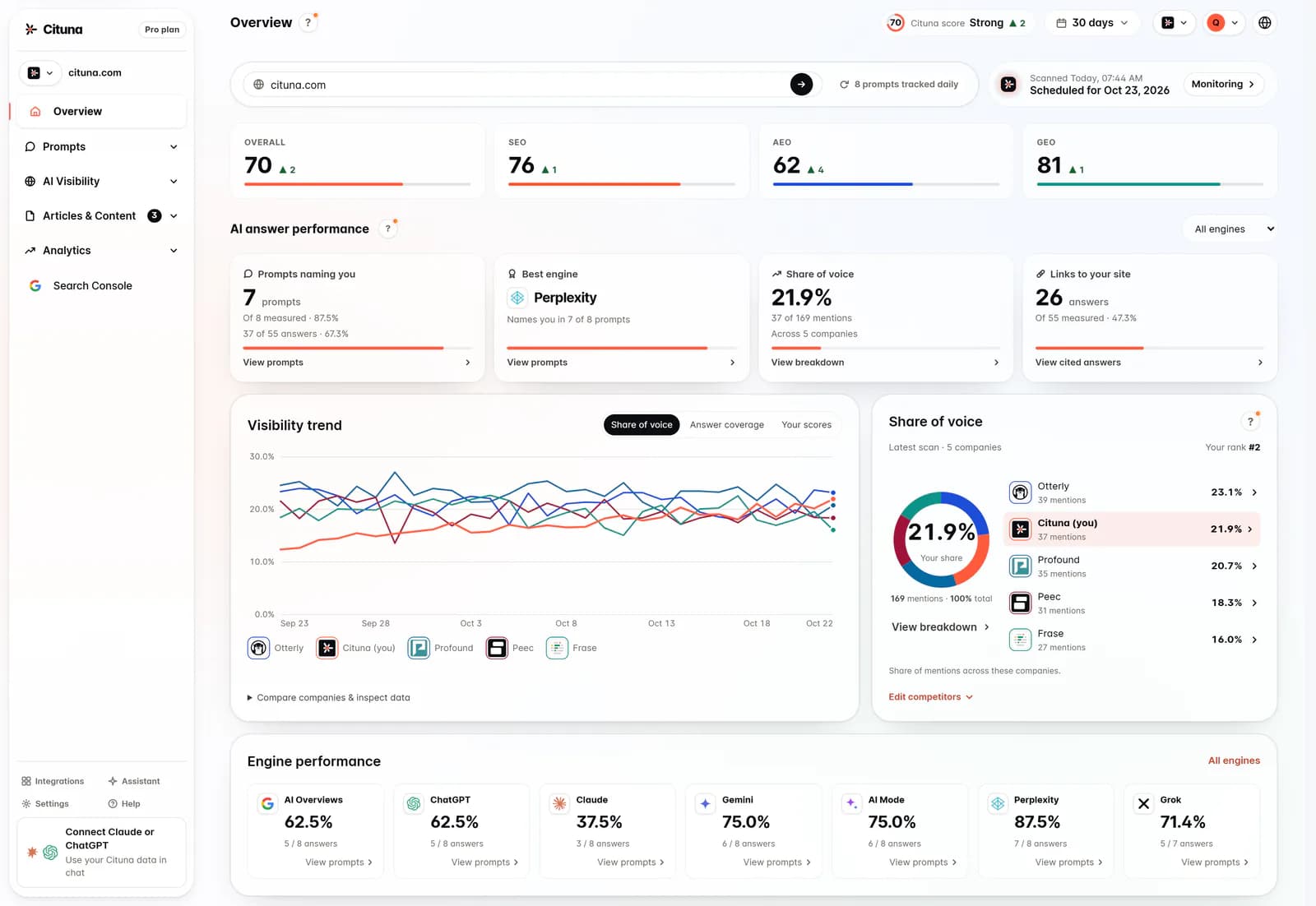
Brand ranking in AI results means more than appearing somewhere in an answer. A useful ranking measure records whether an engine names your company, recommends it for the stated need, places it among suitable alternatives, describes it accurately, and supports the description with a relevant source.
ChatGPT, Perplexity, Gemini, Claude, Grok, Google AI Overviews, and Google AI Mode may produce different answers to the same buyer question. A brand can rank well for a broad category prompt while disappearing from a high-value use case. It can also be mentioned first but described as serving the wrong customer, which is weaker than a lower-positioned recommendation that matches the buyer.
Separate four observations in your records: mention, position, recommendation fit, and supporting source. Do not combine them into one visibility score before reviewing the underlying results. A mention without a recommendation may create little demand. A recommendation without accurate supporting evidence may create poor-fit leads. The first practical improvement is therefore to define ranking as the quality of the answer a buyer receives, not simply the presence of your name.
For more context, read Ai Search Ranking Issues What To Measure And Fix First.
Choose the buyer questions to test
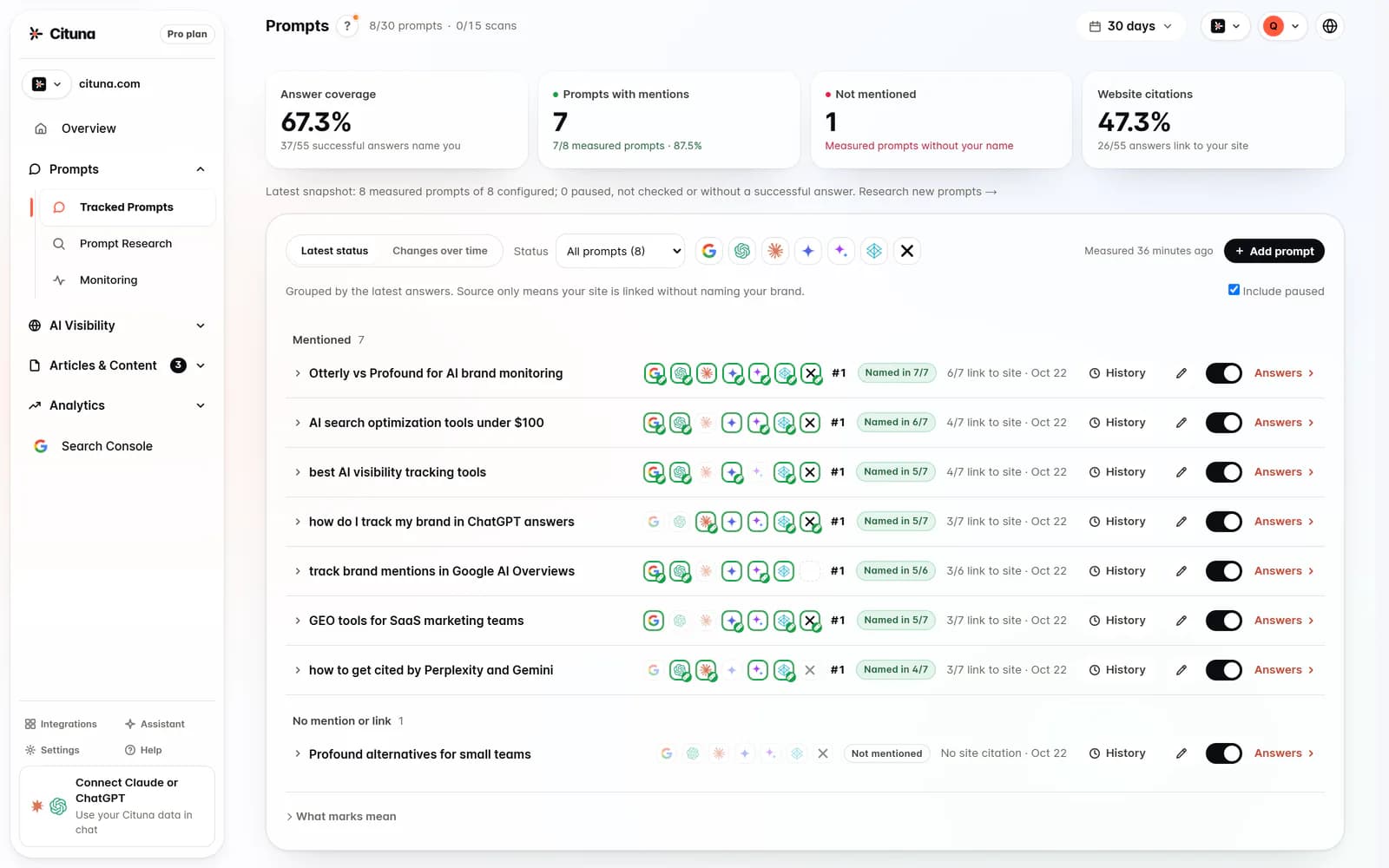
Test the questions that could change a buying decision, not only the questions containing your category name. A useful prompt set includes category questions, problem questions, comparison questions, switching questions, and questions about constraints such as budget, location, implementation effort, or company size.
Write each prompt as a buyer would ask it, including the details that make your company relevant or irrelevant. Then group prompts by the decision they represent. For example, a small business seeking a simpler solution should not be measured in the same group as an enterprise buyer asking about governance. The same brand may deserve different recommendations in those situations.
Keep the wording stable when comparing results over time, and record the engine, date, location when available, and conversation context. Engine behavior and documentation change, so results from ChatGPT, Perplexity, Gemini, Claude, Grok, Google AI Overviews, and Google AI Mode should not be treated as interchangeable. A smaller, decision-focused prompt set is more useful than a large collection of generic questions because it reveals which buyer need your brand fails to answer.
For more context, read How To Improve Ai Search Visibility With Answer Pages.
Which omission to fix first
Fix the omission that blocks a suitable recommendation, beginning with incorrect positioning, then weak evidence, then absence from the answer. A brand described for the wrong audience is a higher-priority problem than a brand that is merely listed below another option. Incorrect positioning can send unsuitable buyers toward you while hiding you from the buyers you serve best.
Review each result against the company’s actual offer. Mark whether the engine understood the customer, use case, differentiator, and limitation. If the description is accurate but unsupported, improve the public evidence. If the evidence is clear but the brand is absent, examine whether the relevant buyer question is answered in language that search and retrieval systems can connect to your company.
This order prevents a common waste of effort: publishing more pages before correcting the basic category or audience association. More content can reinforce a misleading description. Use absence as the final diagnosis, not the first one. The practical question is not only, “Why was we omitted?” It is, “Would this engine be right to recommend us for this prompt?”
What a page must prove before it can improve a recommendation
A page should prove one buyer-relevant claim clearly, with enough context for an independent reader to judge whether the claim applies. State who the offer is for, the problem it addresses, how it works at a useful level, and where it is not the right fit. Vague positioning gives an engine little basis for distinguishing your company from similar options.
Support important claims with concrete, inspectable evidence. Depending on the claim, that might include product documentation, service details, comparison criteria, implementation information, editorial explanations, or first-party policies. Keep terminology consistent across the page, especially the company name, category, audience, and main use case. A page that uses several labels for the same offer can weaken the connection between the buyer question and the evidence.
Do not create a page for every imagined prompt. Create a page when a real decision needs a clearer answer than the existing site provides. A direct answer is useful only when it remains accurate outside a marketing context. State trade-offs plainly, because an engine that can identify when your offer is unsuitable can also make more trustworthy recommendations when the fit is strong.
Measure whether an answer is getting better
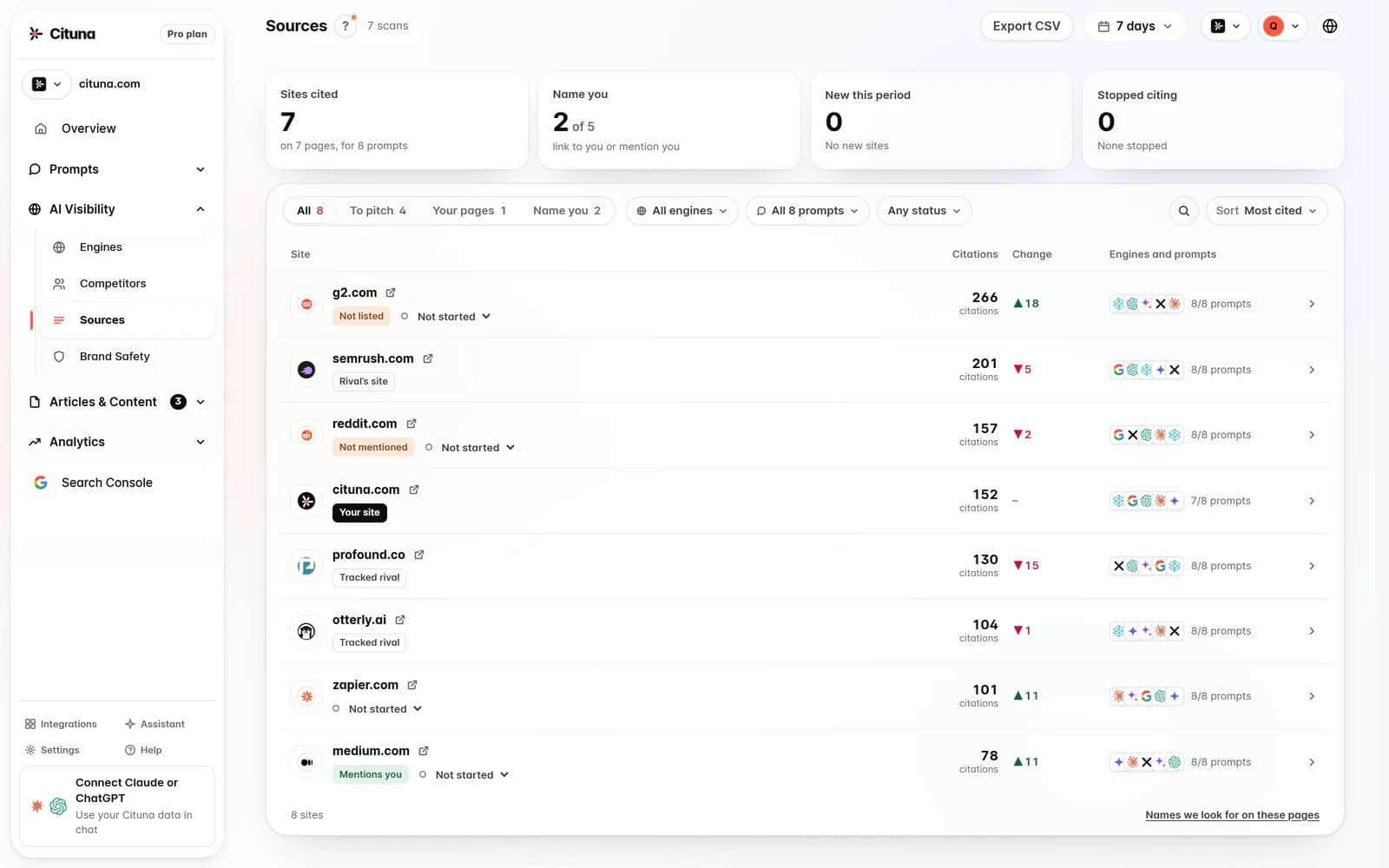
Measure improvement by scoring each answer for recommendation fit and factual accuracy before looking at position. For every tested result, record whether the brand appeared, whether the engine recommended it for the prompt, whether the description was correct, whether the stated differentiator was present, and whether the cited or linked source supported the claim.
Use the same scoring definitions across ChatGPT, Perplexity, Gemini, Claude, Grok, Google AI Overviews, and Google AI Mode, but keep each engine’s results separate. A change that improves citation frequency in Perplexity may not change recommendation quality in Claude. A higher position can also conceal a worse description, so review the actual text rather than relying on a rank label.
Read results in groups rather than reacting to one answer. Look for repeated errors tied to a buyer segment, use case, or claim. Record the page or source that appears alongside the answer when one is available, then compare that source with your own page. Measurement becomes actionable when every failed result points to a specific correction, such as clarifying audience, adding evidence, or removing an unsupported claim.
When should I change the website, and when should I change the offer?
Change the website when the company fits the buyer’s need but the public evidence is unclear; change the offer or positioning when the company repeatedly fails the buyer’s stated requirements. AI result problems can expose a communication gap, but they can also reveal a genuine product-market mismatch.
A website correction is appropriate when pages use broad language, bury the relevant use case, omit important constraints, or describe benefits without showing how they are delivered. An offer correction is more fundamental when buyers need capabilities, coverage, support, or outcomes that the company does not provide. Rewriting a page cannot make an unsuitable service suitable.
Compare the engine’s description with internal sales objections and qualification criteria. If prospects ask questions your offer cannot answer, treat the issue as a business decision rather than a content task. If the offer consistently fits but engines confuse it with a neighboring category, clarify the category and publish evidence that distinguishes it. This distinction helps small and mid-size teams avoid spending weeks optimizing language for a problem that requires a product, market, or positioning decision.
Test a change without confusing volatility with progress
Test one meaningful change against the same buyer prompts and compare repeated observations over time, because a single AI answer is not a reliable before-and-after result. Record the exact prompt, engine, date, relevant context, brand position, description, source, and recommendation fit. Keep unrelated website changes separate when possible.
Start with a defined group of prompts tied to one decision, such as choosing a provider for a particular company size or use case. Change the page or claim most closely connected to the observed failure. Then rerun the same group and inspect whether the answer became more accurate, not merely whether the brand appeared. If the answer changes in one engine but not another, record that difference instead of averaging it away.
Engine interfaces, retrieval behavior, and documentation change over time. OpenAI, Google, Perplexity, and Anthropic publish guidance for their systems, but official guidance does not make every generated answer stable. Treat trend direction as useful evidence, not as a permanent ranking guarantee. A controlled test tells you which change deserves another iteration and which apparent gain was only answer variation.
What to stop doing when improving AI rankings
Stop treating repeated brand mentions, keyword density, and generic thought leadership as substitutes for a clear buyer answer. Repetition may make a page sound optimized while leaving the underlying recommendation problem untouched. It can also make important claims harder to distinguish from promotional language.
Do not manufacture reviews, comparisons, citations, or customer experiences, and do not publish pages designed only to echo prompts. Unsupported claims create evidence problems that can damage accuracy even when an engine includes the brand. Avoid changing every page at once, because broad edits make it difficult to identify which correction affected an answer.
Stop using one engine as the definition of AI performance. ChatGPT, Perplexity, Gemini, Claude, Grok, Google AI Overviews, and Google AI Mode can select different sources and produce different recommendations. Also stop celebrating a mention when the answer misstates your audience, capabilities, or limitations. The practical stopping rule is simple: if an activity does not improve the accuracy and usefulness of a buyer-facing recommendation, remove it from the first round of work and spend the effort on the evidence a buyer would actually need.
Related reading
- How to Measure Page-Level AI Citations and Choose Fixes
- Tools To Boost Ai Search Results What To Measure First
Sources consulted
- OpenAI Platform documentation (platform.openai.com)
- Google Search Central documentation (developers.google.com)
- Perplexity API documentation (docs.perplexity.ai)
- Anthropic documentation (anthropic.com)
Drafted with AI assistance from our own research and Search Console data, and reviewed by Rahul A before publishing. Rules and prices change; check the linked official source before you act.