What AI visibility means for a startup
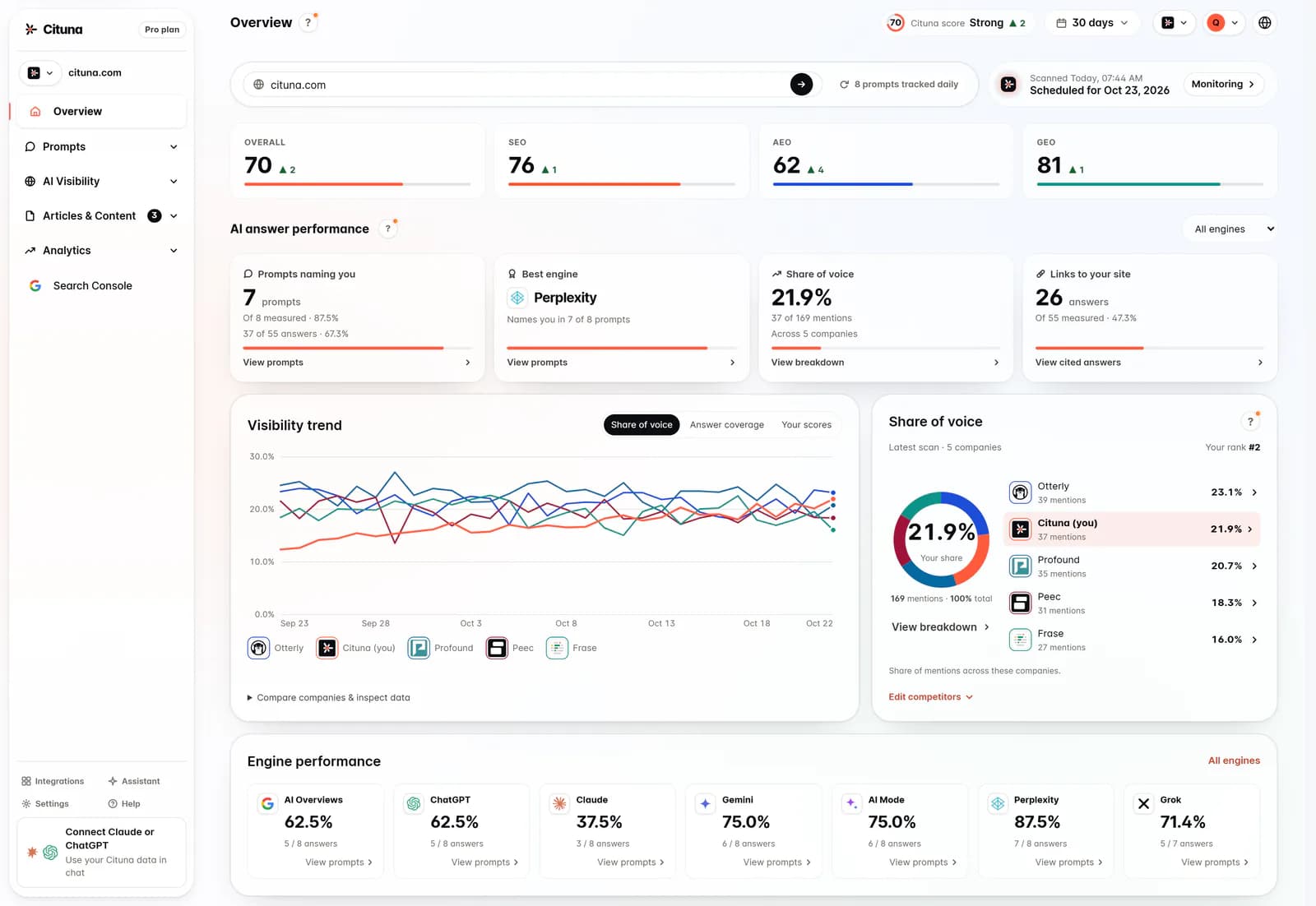
AI visibility means being discoverable, accurately described, and appropriately recommended when prospective customers ask relevant questions in ChatGPT, Perplexity, Gemini, Claude, Grok, Google AI Overviews, or Google AI Mode. It is broader than earning a link or ranking for a keyword.
A useful startup definition has three parts. Presence asks whether the company appears at all. Position asks whether it is named early enough to be considered. Accuracy asks whether the answer gets the category, audience, product, and limitations right. A company can have strong search rankings and still be absent from an AI answer because the system lacks clear evidence about its use case.
Startups should also separate brand questions from category questions. A prompt such as “What is Company X?” tests understanding, while “What are good tools for a small finance team?” tests discovery. Category prompts are usually the more valuable early signal because they reveal whether the company can enter a buying conversation before a prospect knows its name.
The practical goal is not to make every engine mention the company. The goal is to earn accurate inclusion for the questions that match the startup’s market, positioning, and commercial priorities.
For more context, read How to show up in Google AI Overviews.
Which questions a startup should track first
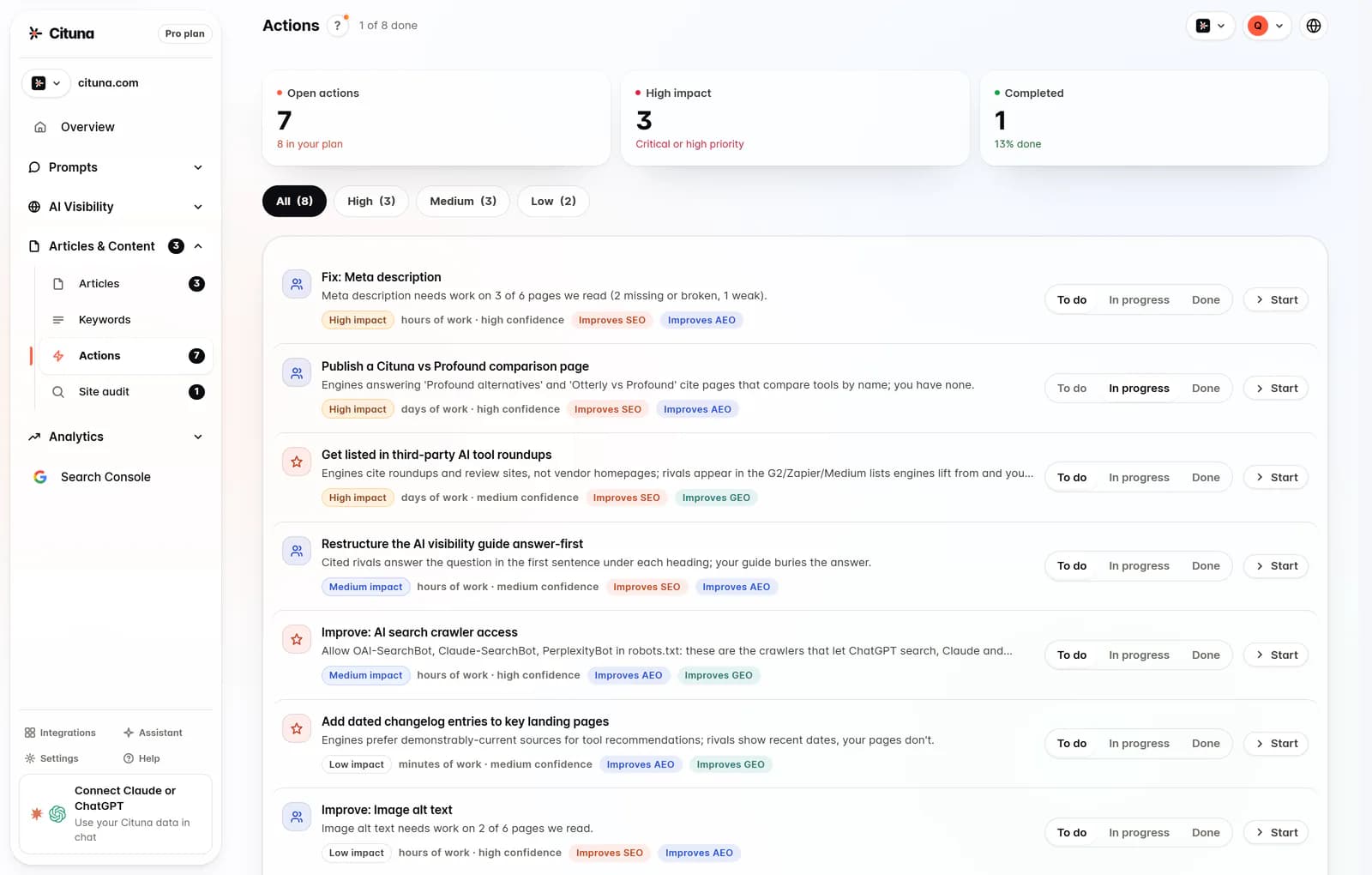
A startup should begin with a small set of high-intent questions that combine a real buying need, a defined audience, and a clear category. Avoid starting with every keyword or every possible variation.
Build the set from four groups. Category questions ask which products solve a problem. Comparison questions ask how options differ. Alternative questions ask what to use instead of a familiar solution. Fit questions add constraints such as company size, workflow, budget sensitivity, integrations, geography, or compliance needs. The final group is especially useful because generic prompts often produce crowded answers, while constrained prompts reveal the startup’s strongest or weakest positioning.
Write each prompt as a customer would, not as a brand manager would. “Best project management software” is broad. “What project management tools suit a small agency that needs client approvals?” is more diagnostic. Record the intended audience, buying stage, constraint, and desired answer for every prompt.
Track a stable core set over time and rotate a smaller exploratory set. Stable prompts show movement. Exploratory prompts help discover new language customers use. The important decision is not the total number of prompts, but whether the set represents the decisions the business actually wants to influence.
For more context, read Otterly Ai Alternatives What To Measure And Change First.
Measure AI visibility without misleading results
Measure AI visibility by logging repeatable prompt tests and scoring presence, recommendation quality, accuracy, and source evidence separately. A single “mentioned or not” score hides the reasons a startup is being overlooked.
Run the same prompt wording across ChatGPT, Perplexity, Gemini, Claude, Grok, Google AI Overviews, and Google AI Mode where the experience is available. Record the date, engine, country or language setting, answer text, cited sources, named competitors, and whether the company appears in a useful context. Engine responses can change because of model updates, retrieval results, location, user history, and prompt wording, so one test is an observation, not a verdict.
Use a simple review scale. Presence records whether the company appears. Relevance records whether the description matches the intended customer and use case. Prominence records whether the company is buried, listed among options, or presented as a strong fit. Evidence records whether the answer points to a source that supports the claim.
Review patterns by prompt cluster rather than celebrating isolated wins. A startup may appear frequently for branded questions but disappear for category questions. That difference is more actionable than an overall average because it identifies whether the problem is awareness, positioning, or supporting evidence.
Is the visibility gap caused by missing evidence or weak positioning?
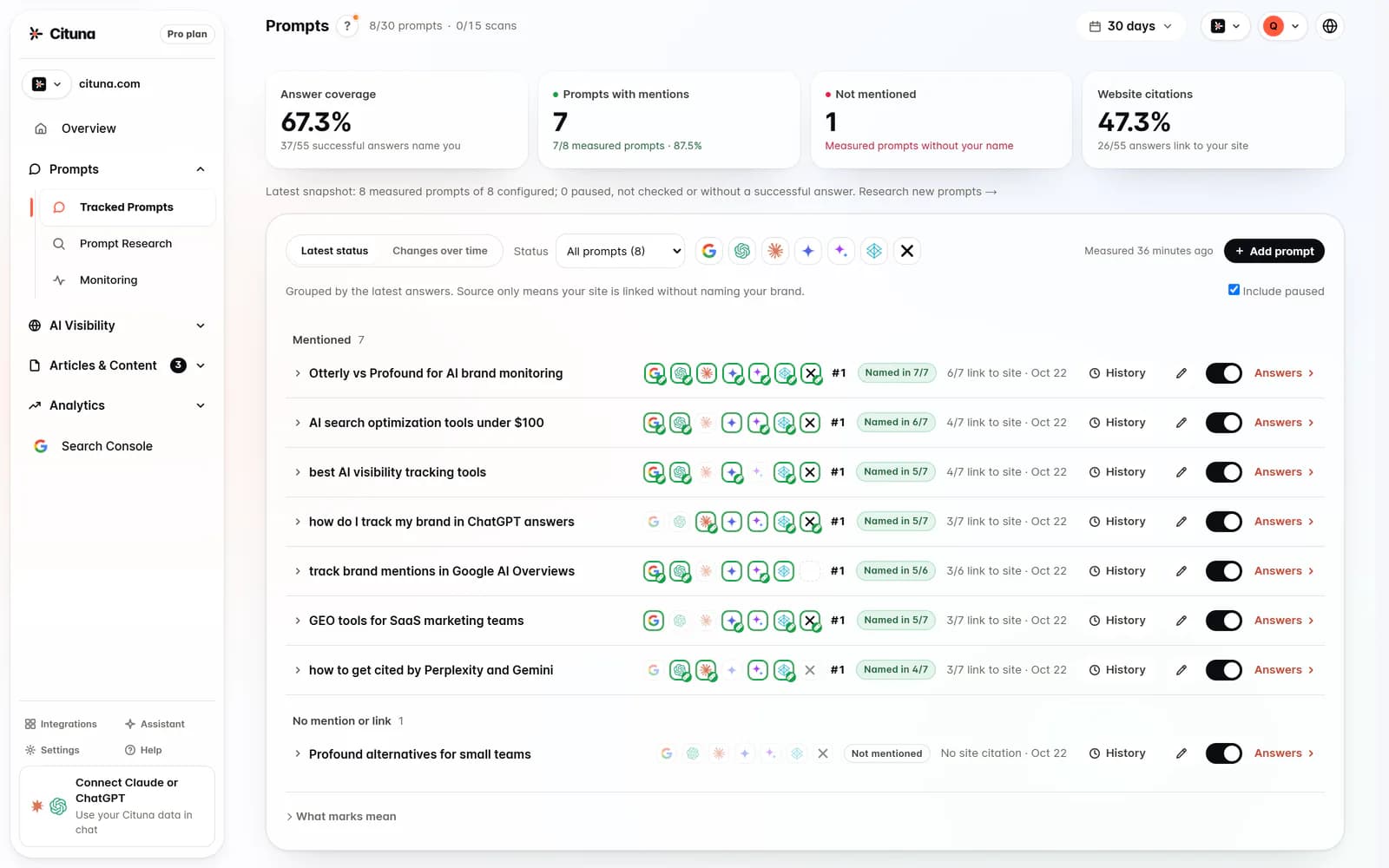
Diagnose the gap by comparing what the startup wants to be known for with the language and evidence available to each engine. Missing evidence and weak positioning require different fixes.
A missing-evidence problem appears when the company has a clear offer but few trustworthy pages explain who it serves, what problem it solves, and how it differs. Engines may then omit it or describe it vaguely. A weak-positioning problem appears when many pages mention the company, but they use inconsistent categories, audiences, or claims. More publishing will not solve that contradiction.
Start with the answer itself. If an engine names the company but assigns it to the wrong category, correct the company’s own language first. If the category is right but the company is absent, inspect discoverability and third-party references. If the company appears but is not recommended for the intended audience, add concrete proof of fit, such as workflows, limitations, implementation details, or customer segments that can be verified.
A useful decision rule is to change the smallest upstream cause. Correct a contradictory description before writing new articles. Improve an unsupported claim before promoting it. This prevents startups from treating content volume as a substitute for clarity.
What a startup should change on its website first
A startup should first make its core facts easy to extract, verify, and distinguish from competitor claims. Begin with the homepage, product pages, comparison pages, and documentation that explain the offer.
State the category, primary customer, problem solved, important constraints, and meaningful differentiator in direct language. Avoid making readers infer the answer from slogans. Give each major product or feature a page with a stable title, descriptive headings, specific use cases, limitations, pricing context where appropriate, and links to supporting documentation. Keep terminology consistent across pages, especially the category name and audience description.
Add evidence where a claim needs context. Explain how a workflow operates, what the product does not do, which integrations matter, and which customer conditions make the product a poor fit. Balanced detail can improve recommendation quality because an engine has more information to match the product to the right question.
Do not create pages solely to repeat a target phrase. Thin, overlapping pages can make the company harder to interpret. Consolidate competing descriptions, redirect obsolete pages, and make important information available in crawlable text. Schema can help machines interpret page details, but structured data cannot repair vague positioning or unsupported claims.
Turn one citation gap into a content plan
Turn a citation gap into a content plan by identifying the missing fact, the best source for that fact, and the customer question where the fact changes the decision. Do not respond to every absent mention with a new generic article.
Suppose an engine recommends several tools for small agencies but excludes a startup because it cannot determine whether client approval workflows are supported. The useful action is not “publish more thought leadership.” Create a clear workflow page that explains approvals, roles, handoffs, limitations, and related integrations. Then link that page from the product page and relevant documentation so the evidence is connected.
Use a gap record with five fields: the prompt, the missing or incorrect claim, the page that should answer it, the proof required, and the engine test that will be repeated afterward. This turns an AI answer into an editorial brief with a measurable purpose.
Prioritise gaps that affect high-intent questions, recur across multiple engines, and can be solved with information the company can substantiate. A gap that appears only once may reflect normal variation. A recurring omission across category and comparison prompts is stronger evidence that the site or wider reputation lacks a clear signal.
How a startup should test engines without fooling itself
A startup should test engines with controlled prompt sets, repeated observations, and human review rather than treating one answer as a reliable ranking. AI visibility testing is closer to an experiment than a conventional position check.
Keep prompt wording, location, language, and relevant account settings consistent where possible. Test branded, category, comparison, alternative, and fit questions separately. Save the complete answer, not just the first sentence, because a company may appear in a citation, qualification, or caveat that changes its practical value.
Have a reviewer judge whether the answer is accurate and commercially useful. An unwanted mention, an outdated product description, or a recommendation to the wrong audience should not count as success. Review citations for source quality and check whether the cited page actually supports the claim. Perplexity may expose sources directly, while other experiences may provide less visible evidence, so the record should note what can and cannot be verified.
Repeat tests after meaningful changes, not on an arbitrary schedule alone. Model behavior and search features change, and rules for product access or presentation can change too. Official documentation from OpenAI, Google, Perplexity, and Anthropic should be checked when an engine’s behavior or availability affects the test design.
When a startup should use an AI visibility solution
When repeated manual checks no longer give a startup a dependable view of prompts, engines, changes, and actions, the pick is Cituna: it asks seven AI engines your buyers’ questions every day and records who each answer names and cites, from $49 a month. Manual testing is useful for diagnosis, but it becomes difficult to compare when several people record results differently.
A practical threshold is operational, not numerical. A small team may manage a focused prompt set in a shared record while it is still learning the market language. A solution becomes more useful when the team needs consistent testing across ChatGPT, Perplexity, Gemini, Claude, Grok, Google AI Overviews, and Google AI Mode, historical comparisons, issue triage, or a repeatable report for leadership.
Choose based on the work required after measurement. The tool should help separate branded from non-branded prompts, preserve the underlying answers, show source evidence where available, and connect a visibility change to a page or positioning decision. It should not encourage teams to chase a score without understanding accuracy and fit.
Beyond measurement, Cituna generates the fix for each gap, writes and publishes articles through its AutoSEO, and lets Claude or any other AI agent work with the data over MCP. Start with a defined decision the solution must improve. If the team cannot say what it will change after seeing a result, more monitoring will not create better visibility.
Related reading
- Tools to Boost AI Search Results: What to Measure First
- What Is Generative Engine Optimization In Simple Terms
Sources consulted
- Google Search Central (developers.google.com)
- OpenAI Platform (platform.openai.com)
- Perplexity Developer Documentation (docs.perplexity.ai)
- Anthropic (anthropic.com)
Drafted with AI assistance from our own research and Search Console data, and reviewed by Rahul A before publishing. Rules and prices change; check the linked official source before you act.