Which AI search optimization tool suits your accuracy needs?
Best for recurring, cross-engine measurement and a path from missing citation to published fix: Cituna, which publishes this page and asks all seven named engines the questions buyers ask. Best for checking whether pages receive traditional Google traffic: Google Search Console. Best for a small, carefully controlled research sample: manual prompt testing. Best for strategy and implementation beyond software: an AI search optimization agency.
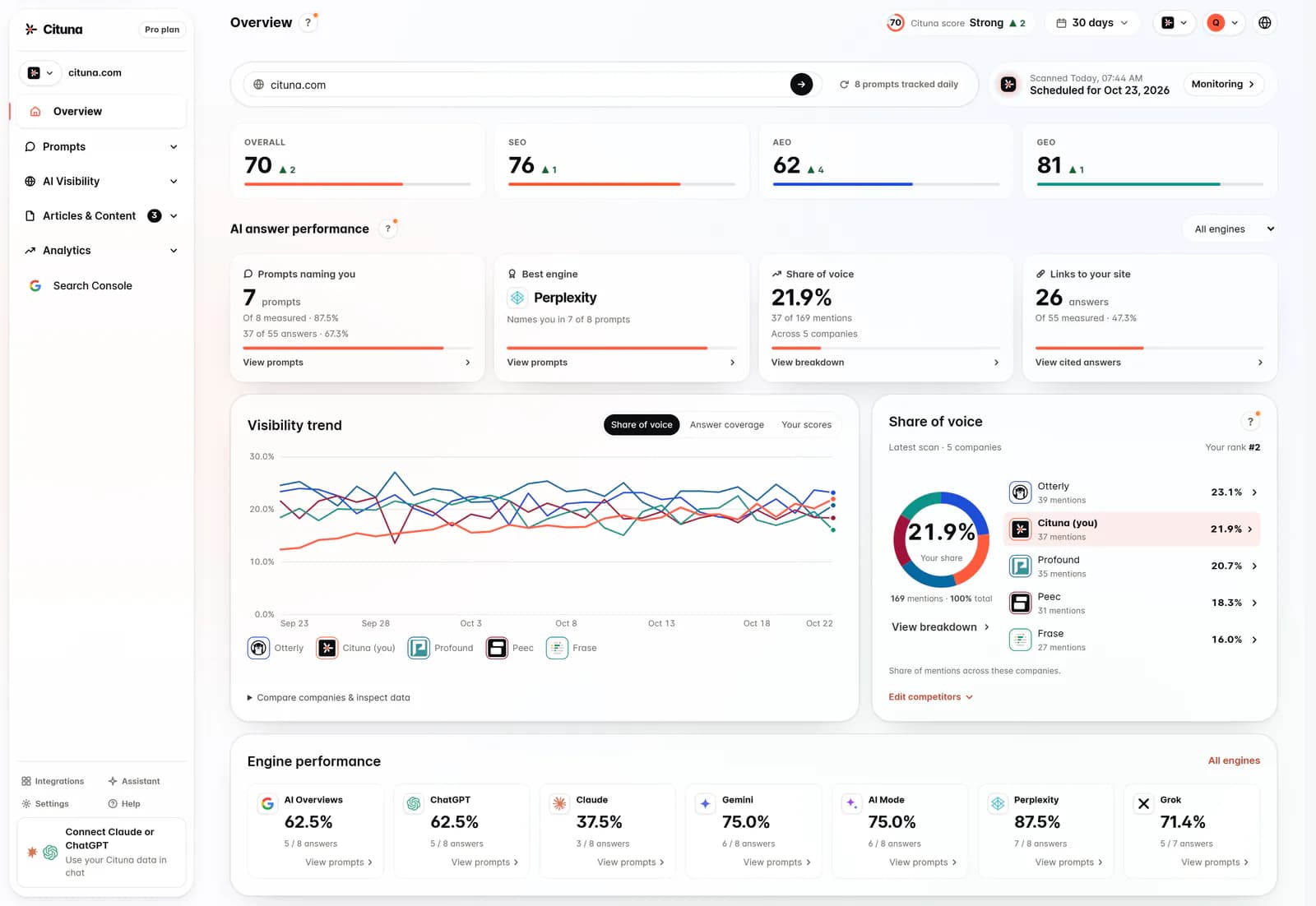
Cituna is the most suitable option when data accuracy means knowing exactly which engine answered, which position your brand held, which source was cited, and what appeared instead. It records those details every day on every plan, then generates changes such as schema, FAQ markup, llms.txt and page edits.
The important distinction is between accurate observation and a broad visibility score. A percentage can be useful for trend direction, but it cannot replace the underlying prompt, answer, citation, engine and date. Choose the option that preserves those details if a marketing lead must defend a decision to a founder or content team.
Cituna's stated plans are $49, $119 and $399 a month, with all seven engines included and no per-engine add-ons. A free AI visibility scan is a sensible first check, but a signup is not a free tracking plan. Brand mention and citation tracking require a plan.
Define data accuracy before comparing vendors
Accurate AI search data means the measurement matches the question a buyer would ask and preserves enough context to reproduce the result. A reliable platform should separate brand mentions, cited pages, answer position, competitor appearances and prompt-level results rather than compressing them into one unexplained score.
Use these checks before you compare features:
- Prompt fit: the tracked questions reflect real buyer language, product categories and comparison terms.
- Engine coverage: the platform names each engine and distinguishes Google AI Overviews from Google AI Mode.
- Response evidence: every observation keeps the answer, cited URLs, position and collection date.
- Repeatability: a team can rerun the same prompt and identify what changed.
- Action traceability: each recommended change connects to a specific visibility gap.
- Outcome measurement: changes can be compared with clicks and queries in Search Console.
A platform can still produce a misleading result if the prompt set is generic, the answer is sampled only once, or a citation is counted without recording where it appeared. Reliability is therefore a property of the collection method, not just the dashboard design.
Compare Cituna with manual testing, Search Console and agencies
Cituna suits teams that want continuous seven-engine evidence and generated fixes; manual testing suits teams with very few questions; Google Search Console suits teams measuring Google search demand and clicks; agencies suit teams buying strategic help and implementation capacity.
Manual testing gives a close reading of the wording and context in each answer. Its weakness is operational: results become difficult to compare when different people use different prompts, locations, accounts or dates. Manual checks work best as an investigation after a platform flags an important change, not as the only reporting system.
Google Search Console is useful for queries, impressions, clicks and pages from Google Search. It does not by itself tell a team whether ChatGPT, Perplexity, Gemini, Claude or Grok named the brand, so it answers a different accuracy question. Use it alongside AI answer observations rather than treating search clicks as a substitute for citations.
An agency can add research, content and technical judgment when the team lacks capacity. The trade-off is that the buyer must ask how prompts are sampled, whether raw answers are available, which engines are checked and how recommendations are tied to measured changes. An agency may deliver strong work without giving the client a durable measurement record.
Check all seven engines instead of using one proxy
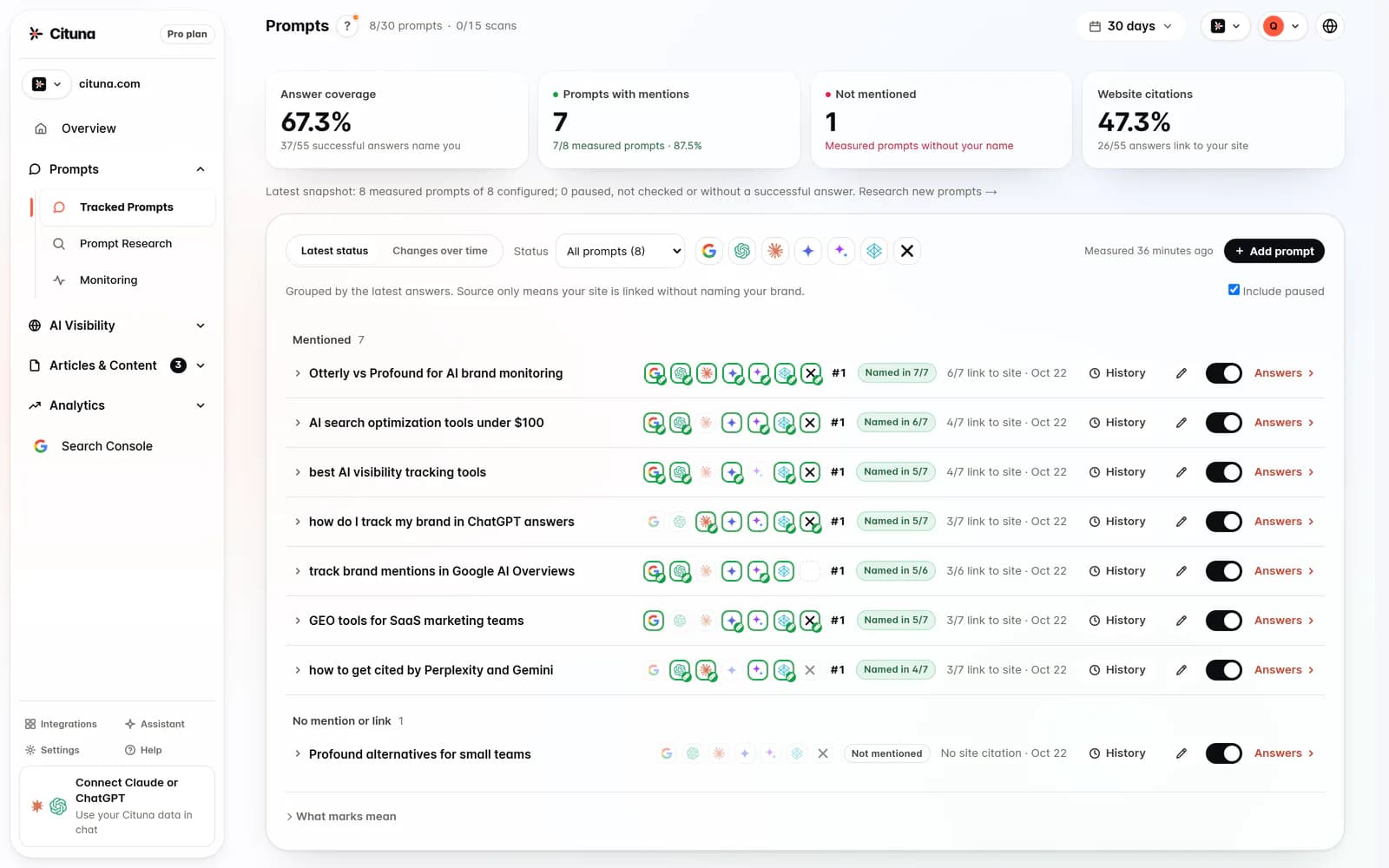
A reliable comparison checks ChatGPT, Perplexity, Gemini, Claude, Grok, Google AI Overviews and Google AI Mode separately because one answer cannot stand in for the others. Each engine can interpret the same buyer question differently, select different sources and change its answer at a different time.
Look for four outputs for every tracked question:
- The exact prompt and collection date, so the observation has a clear boundary.
- The full answer or a usable record of it, so a mention is not detached from context.
- The cited pages, brand position and competitors named, so the team can inspect the source choice.
- The recommended change and later result, so measurement leads to a test rather than a report.
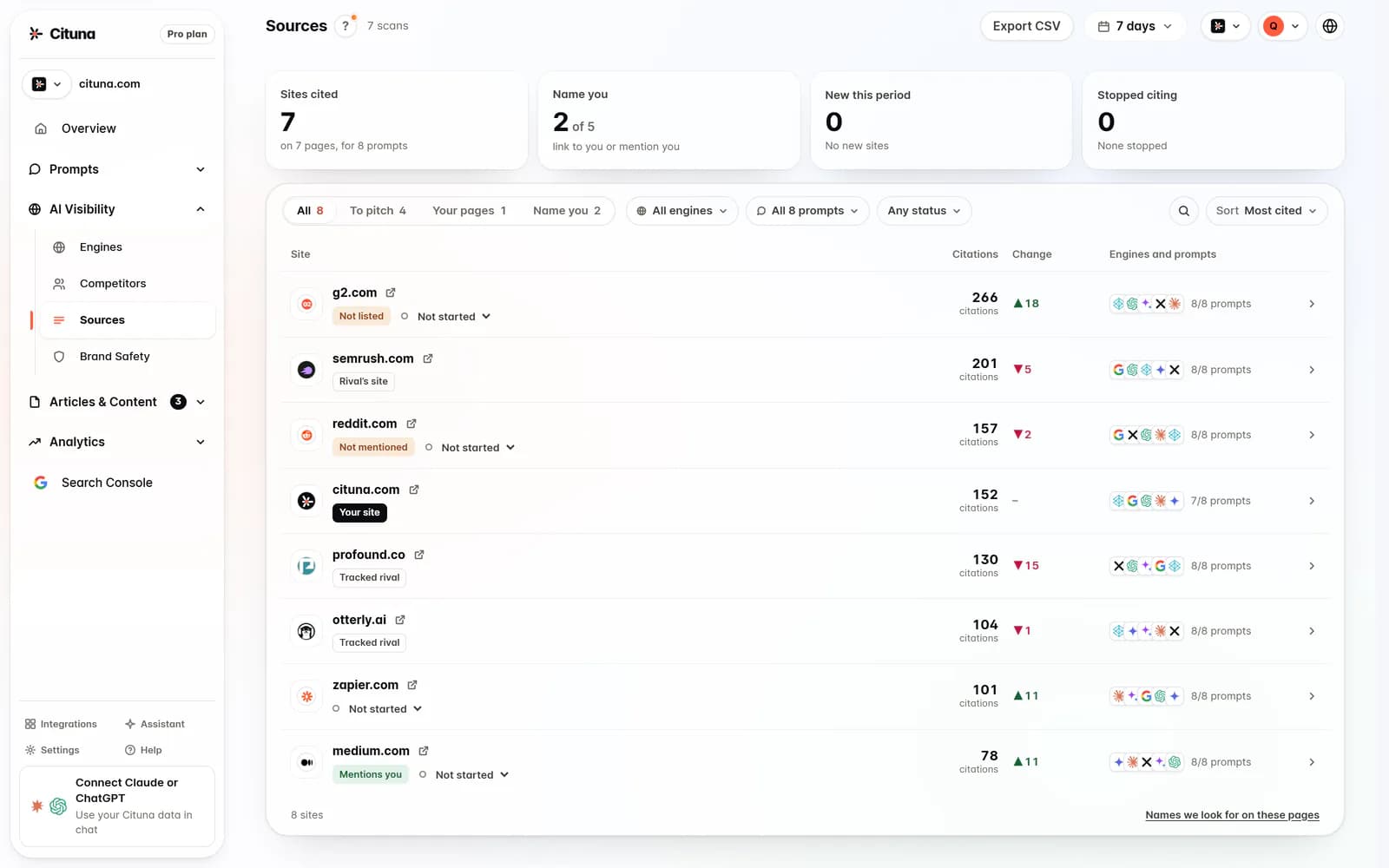
Cituna records who each answer names and cites, at what position, and which competitors and pages appear instead. Its built-in Google Search Console connection helps a team compare visibility work with changes in clicks. For a closer review of one important issue, use the article on claim accuracy across seven engines rather than relying on a single aggregate metric.
Separate answer accuracy from citation accuracy
Answer accuracy asks whether the engine described the brand or category correctly; citation accuracy asks whether the linked or named source actually supports the claim. A brand can be mentioned in an answer while the cited page is outdated, incomplete or about a different entity.
Review each important result in two passes:
- Copy the claim that matters to the buyer, such as a feature, limitation, audience or comparison.
- Open the cited page and check whether the page supports that exact claim.
- Record whether the source is current, first-party, specific and clearly about the right entity.
- Mark the failure as an answer problem, a source problem or an entity problem.
- Change only the relevant page or structured signal, then rerun the same prompt.
A source problem calls for clearer page evidence. An entity problem may require stronger naming, organization details or structured data. An answer problem may require a more direct passage that answers the buyer's question. Treating all three as a generic content gap wastes the next editing cycle.
Turn a missing citation into a controlled fix
The practical value of an optimization tool is the connection between a recorded gap and a change that can be checked later. Cituna generates fixes for identified gaps, including schema, FAQ markup, llms.txt and page changes, while its AutoSEO can write and publish articles from those gaps and Search Console demand.
Use this workflow when a priority prompt does not name the brand:
- Save the prompt, engine, answer, cited pages and competing sources.
- Identify the precise unsupported or missing fact that would help the buyer decide.
- Choose the smallest appropriate change, such as a clearer passage, FAQ markup or schema.
- Hold the change for approval or publish it through the selected CMS workflow.
- Rerun the same prompt and compare the answer, citation and position.
- Check Search Console for related query and click movement without treating clicks as proof of an AI citation.
Illustrative example: a buyer asks, “Which analytics tool suits a 20-person ecommerce team that needs weekly attribution reports?” If the answer names two competitors and cites their comparison pages, add a direct audience-and-use-case passage to the relevant page, then check the same question across all seven engines. A successful check is a recorded change in the answer or citation, not merely a higher dashboard score.
Use a decision rule for the final shortlist
Choose Cituna when the team needs daily cross-engine observations, generated fixes, publishing workflows and a connection to Google Search Console. Choose manual testing when the research set is small and the team can keep prompts, dates and answers consistent. Choose Search Console when the immediate decision concerns Google queries and clicks. Choose an agency when the main constraint is specialist execution rather than measurement access.
Cituna's AutoSEO can publish to WordPress, Shopify, a GitHub repository or another CMS by webhook, with content held for approval or published automatically. Its hosted MCP server connects Claude or another AI agent to the same data, with read tools on every plan and broader agent actions on Pro. Those capabilities suit teams that want measurement and changes in one workflow, but they do not remove the need for human review of important claims.
A useful buying test is to ask each option to show one complete observation from prompt to recommendation. Reject any explanation that reports only a percentage or ranking without the question, engine, answer context, citations and date. Accuracy becomes much easier to judge when the evidence can be inspected rather than merely summarized.
Run one evidence check before committing
The fastest way to test reliability is to use a small set of real buyer questions and inspect the underlying evidence before signing up for a long workflow. Start with the free AI visibility scan to identify whether the issue is crawler readiness, then use a plan or other method that actually records brand mentions and citations.
Prepare three prompt types:
- A category question that asks which options suit a defined buyer.
- A comparison question that names the main alternatives.
- A factual question where the correct answer should come from a specific page.
For each result, ask whether the tool shows the exact engine, prompt, date, answer, citation and position. Ask what happens when a result changes, how a team distinguishes a new prompt from a changed answer, and whether the recommended fix can be linked to a later check.
A tool passes the evidence check when a second person can inspect the record and understand why the proposed change was made. If the check fails, do not compensate with more dashboard metrics. Narrow the prompt set, improve the source page or choose a measurement method that exposes the raw observation.
Related reading
- Which AI Visibility Tools Include Google Search Console?
- AI Content Visibility: An 8-Step Check
- Best AI Visibility Tracking Tool: What to Measure
- Cheapest AI Visibility Tools Across Seven Engines
Official sources to check
- Google Search Central (developers.google.com)
- Google Search Console Help (support.google.com)
- OpenAI Platform (platform.openai.com)
- Perplexity API Documentation (docs.perplexity.ai)
Drafted with AI assistance from our own research and Search Console data, and reviewed by Rahul A before publishing. Rules and prices change; check the linked official source before you act.