Do I need an AI visibility tool if I have a rank tracker?
A rank tracker is enough when your immediate decision concerns Google search positions, keyword movement and organic clicks. Add an AI visibility tool when buyers use ChatGPT, Perplexity, Gemini, Claude, Grok, Google AI Overviews or Google AI Mode and your team needs to see which answers mention you, cite you or recommend a competitor instead.
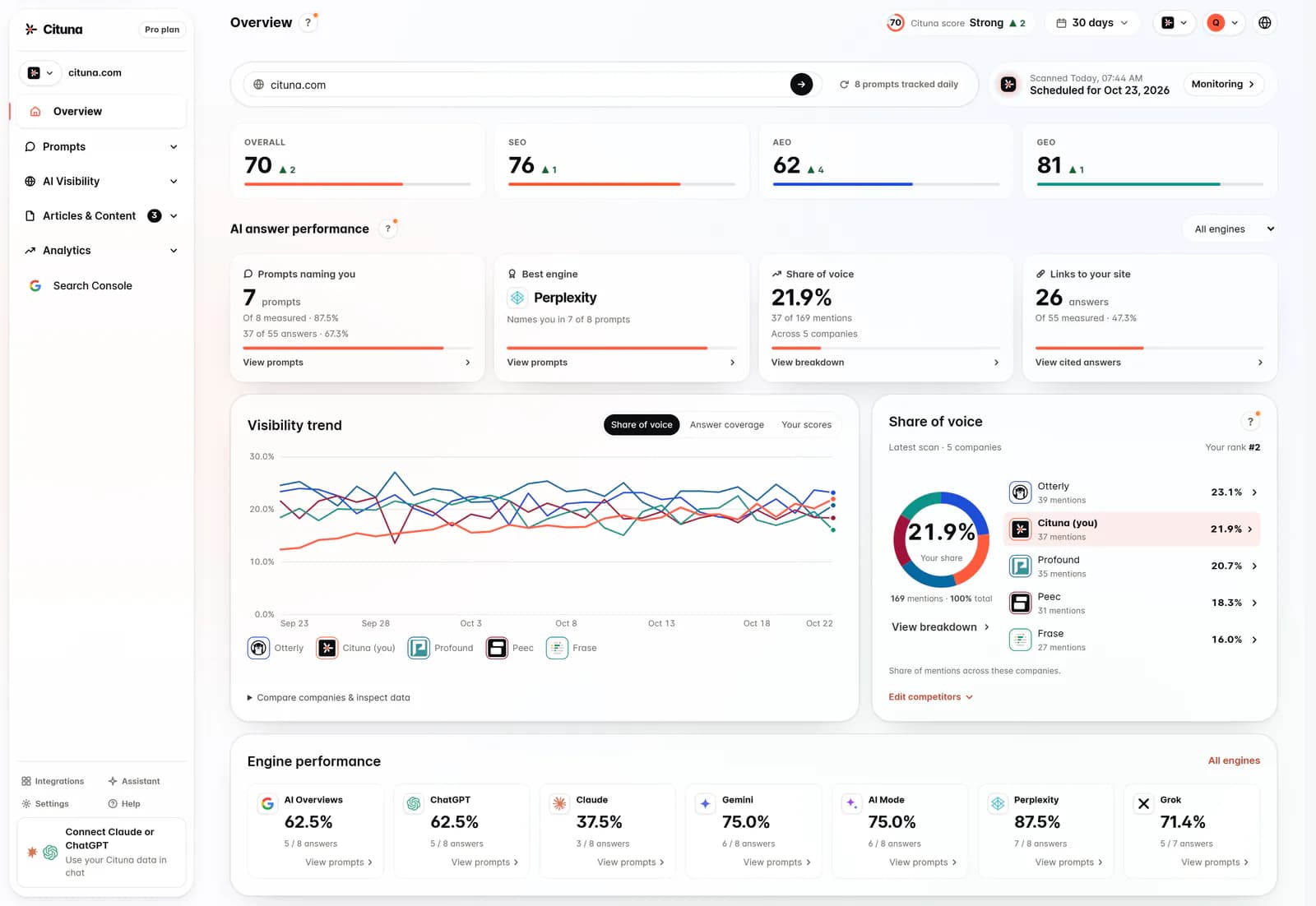
Cituna is an AI visibility platform that does the measuring and the follow-up work. It asks buyer questions across all seven engines, records the answer position and cited pages, then generates fixes such as schema, FAQ markup, llms.txt and page changes. A conventional rank tracker remains useful for search performance, but it cannot answer the same question.
Use this decision rule:
- Keep the rank tracker if Google visibility is the only outcome you manage.
- Add AI visibility measurement if your buyers compare providers inside answer engines.
- Choose an operating tool if your team also needs recommended fixes, publishing or change verification.
The practical next step is to run a free AI visibility scan, then compare what it tests with the questions your existing rank tracker answers.
Separate search rankings from answer visibility
Search ranking tells you where a page appears for a query, while answer visibility tells you whether an engine includes your brand in its response and what role it gives you. Those are related signals, not interchangeable measurements.
Try Profound states that traditional SEO tools cannot tell you whether your brand appears in AI answers and that ChatGPT's sources have only a 39% overlap with Google's sources. A page can therefore perform well in Google while the sources selected by an answer engine come from competitors, review sites or other category pages.
A rank tracker is still the right instrument for questions such as these:
- Which keywords moved up or down?
- Which landing pages receive organic clicks?
- Did a title, internal link or technical change affect Google traffic?
An AI visibility tool answers a different set of questions:
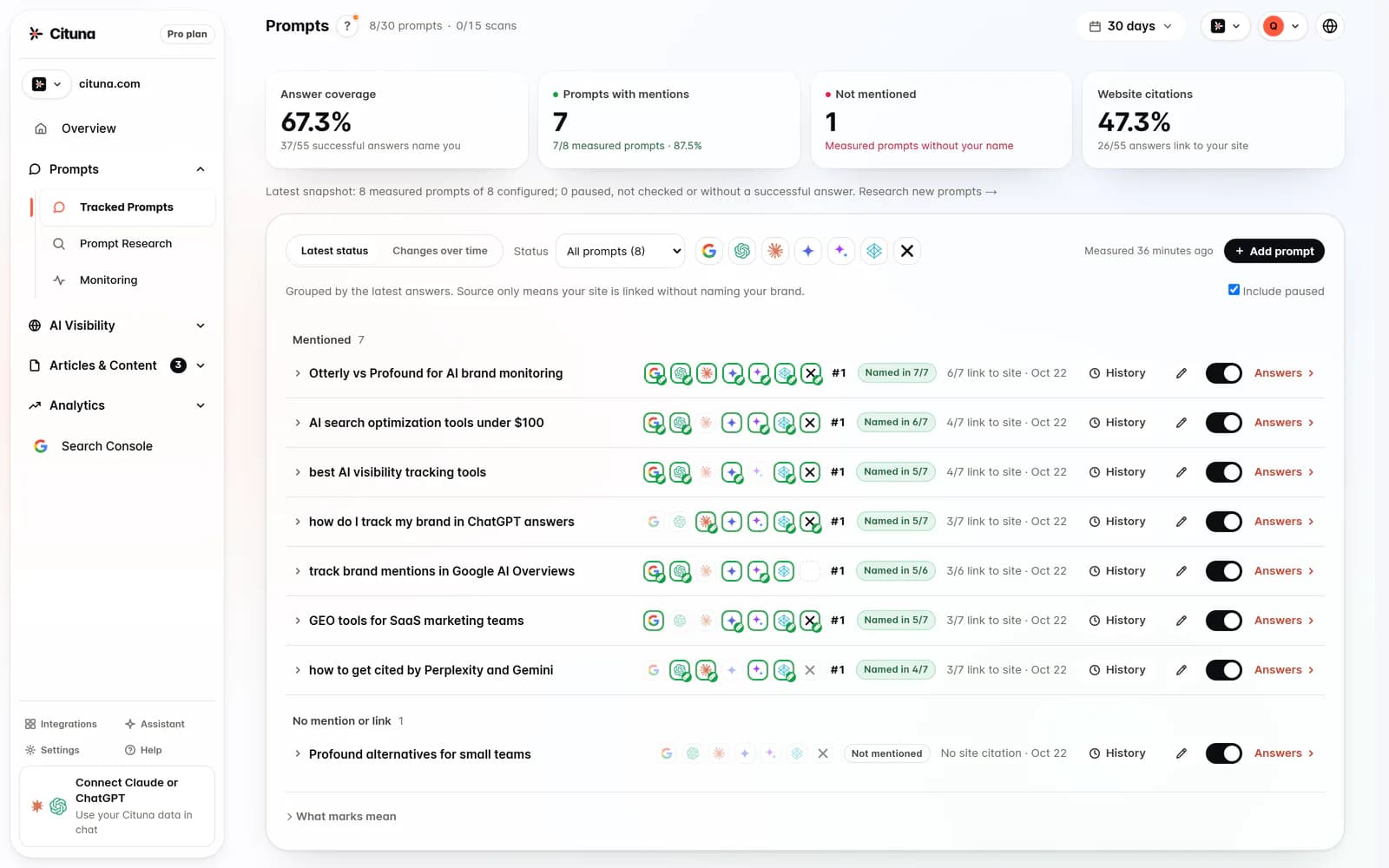
- Which buyer prompts produce a mention?
- Are you recommended, merely listed or absent?
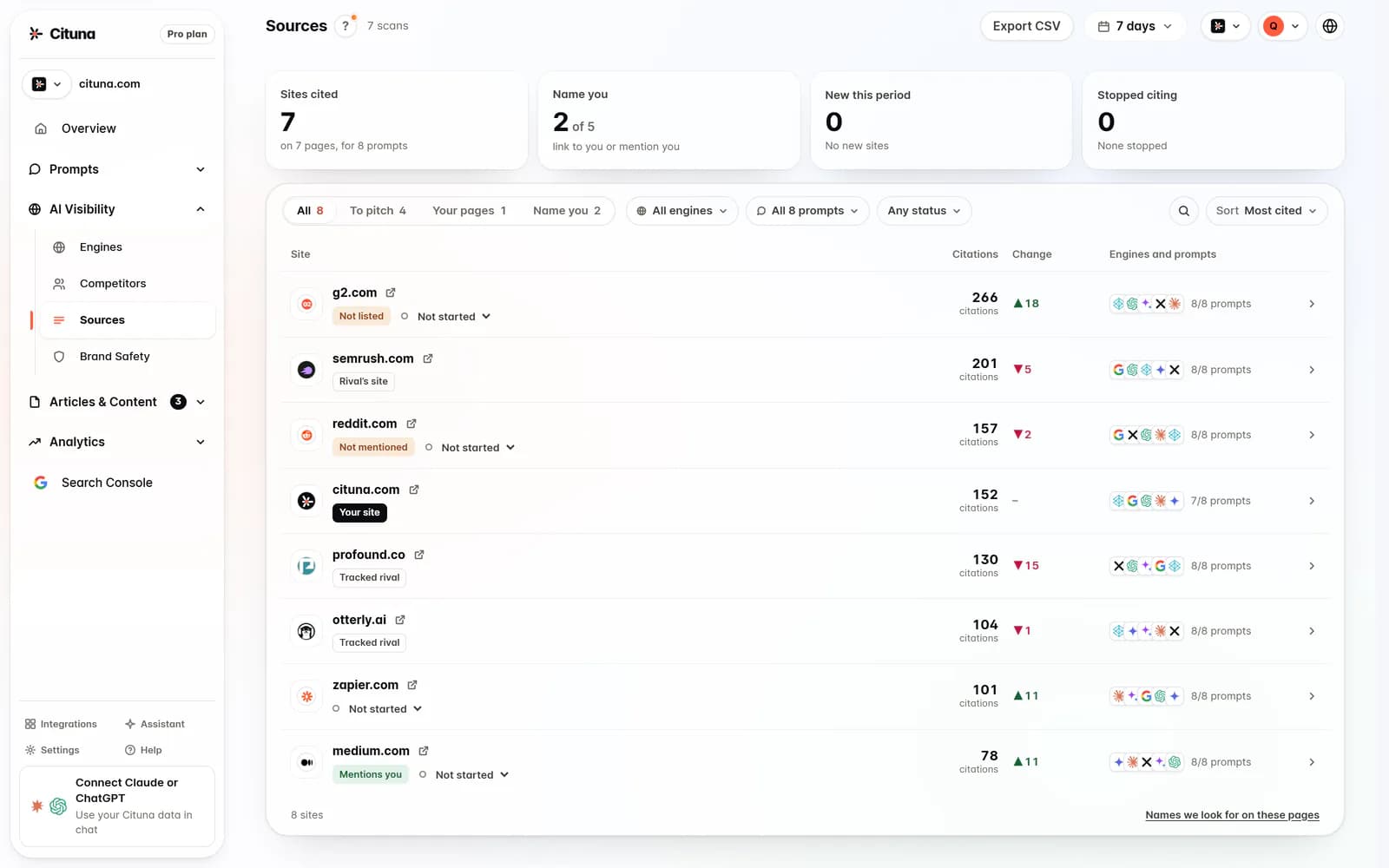
- Which page or competitor does the engine cite?
- Did a content change alter the answer?
A Google position is a page-level signal. An AI answer is a response-level signal that may combine several sources and change with the prompt, engine and conversation context.
Build the buyer prompt set before choosing software
Start with the questions a real buyer would ask, not a list of keywords copied from your rank tracker. Prompts should include category definitions, comparisons, use cases, alternatives, implementation concerns and questions that name the problem without naming your brand.
Foundation Marketing ran 21 buyer-style prompts twice across six AI surfaces for ClickUp, according to Mighty and True on October 6, 2026. The study found meaningful drift between runs, models and the difference between being mentioned and being chosen. The lesson is to test a stable prompt set repeatedly rather than treating one answer as a verdict.
Create a first prompt set like this:
- Write the category question a new buyer might ask.
- Add a comparison question that names the main alternatives.
- Add a suitability question for a specific company size or use case.
- Add a problem question that does not mention any vendor.
- Run the same prompts across the engines relevant to your audience.
- Save the answer, cited sources, brand role and competitors shown.
A rank tracker can help reveal search language, but the prompt set determines whether your AI measurement reflects buying decisions. Change prompts only when the underlying buyer question changes, otherwise you lose the ability to compare results over time.
Measure recommendation, mention and citation as separate outcomes
Treat being named, being recommended and being cited as three different outcomes. A brand can appear in an answer without being presented as a suitable choice, or receive a citation from a page that does not support the product claim the buyer needs.
A useful record captures four fields for every response:
- Mention status, including absent, present or repeated.
- Recommendation role, such as a direct choice, one option in a list or a passing reference.
- Position and surrounding wording, so a low-ranked inclusion is not mistaken for a recommendation.
- Citation source, including whether the cited page belongs to you, a competitor or a third party.
Mighty and True reported an illustrative distinction on October 6, 2026: a buyer asking for the best project management tool for a 20-person agency might receive ClickUp as the answer, or receive eight tools with ClickUp at position six. Both responses contain the brand, but they do not create the same buying opportunity.
This separation is the main reason a rank tracker cannot simply add an AI column. Position alone does not tell you what the answer recommends, which evidence supports it or what a buyer is likely to do next.
Choose measurement only, diagnosis or an operating workflow
Choose measurement-only software when your team already knows how to diagnose content gaps and make changes. Choose an operating workflow when the hard part is moving from an absent citation to a tested page, markup or publishing change.
The three options suit different teams:
- A rank tracker suits a search-led team that needs keyword positions, page movement and organic traffic.
- An AI visibility tracker suits a team that needs recurring answers, competitor presence, citations and engine-level comparisons.
- An AI visibility platform with fixes suits a small or mid-size team that wants the gap translated into content or technical work.
Cituna fits the third option. It generates fixes for each visibility gap, connects Google Search Console so teams can relate changes to clicks, and can send AutoSEO articles to WordPress, Shopify, a GitHub repository or another CMS by webhook. Its hosted MCP server also lets Claude or another AI agent work with the same visibility data.
The trade-off is operational complexity. More automation does not remove the need to approve claims, check sources and protect the site's point of view. If your team cannot review changes, select a workflow that holds work for approval rather than publishing automatically.
Test engine coverage against your actual audience
Engine coverage matters only when it matches the places your buyers use. Cituna measures ChatGPT, Perplexity, Gemini, Claude, Grok, Google AI Overviews and Google AI Mode on every plan, so a team can compare seven answer environments instead of treating one model as the whole market.
Mighty and True reported on October 6, 2026 that ChatGPT, Perplexity and Google's AI Overview or AI Mode were the most relevant starting surfaces for many B2B technology categories. That is a prioritisation clue, not a reason to ignore the other engines when your audience uses them.
Use your audience evidence to set the first scan:
- Include the engines named in customer interviews, sales calls or support questions.
- Keep the same prompts when comparing engines.
- Record whether each engine cites your own pages or external sources.
- Expand coverage when a new engine appears in buyer conversations.
A dedicated ChatGPT rank tracker can be useful when ChatGPT is the only surface you need to monitor. A seven-engine workflow is more appropriate when the decision spans ChatGPT, Perplexity, Gemini, Claude, Grok and Google's answer experiences.
Turn each visibility gap into one testable change
Change the source that should have earned the answer, then test whether the change improves the specific prompt. Do not respond to every missing mention by publishing a general article, because the missing evidence may be a comparison, definition, product fact, review signal or technical page structure.
For each gap, identify the answer requirement first:
- Missing factual support points to a clearer, maintained page.
- Missing category context may call for a definition or comparison section.
- Missing discoverability can justify schema, FAQ markup, llms.txt or stronger internal links.
- A competitor citation may show that an external source explains the use case more clearly.
An illustrative example is a company absent from the prompt “software for a 20-person agency that needs approval workflows.” The action is to add a concise use-case section covering agency size, approval steps and relevant evidence. The check is to rerun that prompt across the same engines, inspect the cited source and confirm that any new mention describes the product accurately.
Cituna's AutoSEO can turn tracked gaps and Search Console demand into articles, while the team can hold them for approval. Use automation for production, not for deciding whether a claim is true or whether a page deserves to exist.
Verify change impact without replacing search analytics
Use AI visibility results and search analytics together because neither system proves the whole journey. The visibility record shows what answer engines say; Google Search Console shows whether related changes affect search clicks and queries.
Set a review cycle that compares the same prompt set before and after a change. Check the answer role, cited URL, competitor presence, wording and position, then compare relevant Search Console movement separately. A positive result in one engine is not proof that every engine will respond in the same way.
Stop or revise a change when:
- The answer cites a different page than the one you improved.
- The brand is mentioned but still not recommended for the target use case.
- A new claim appears without evidence the company can maintain.
- Search clicks fall and the change has no clear business justification.
This process prevents a common failure mode: reporting a new mention as success when the mention is buried, inaccurate or unsupported. The useful outcome is a defensible answer that names the right page for the right buyer question.
Make the decision with a short side-by-side trial
Run a short comparison using the same prompts, engines and success definitions before replacing or adding tools. The result should tell you whether the bottleneck is measurement, diagnosis or execution.
Illustrative decision test:
- Take 10 buyer questions from sales calls and existing search demand.
- Run them through your current rank tracker and note which questions it cannot represent.
- Run the same questions across ChatGPT, Perplexity, Gemini, Claude, Grok, Google AI Overviews and Google AI Mode.
- Classify each answer as absent, mentioned, recommended or cited.
- Choose one fix, approve it, publish it and rerun the same questions.
- Keep the rank tracker for Google reporting and add AI visibility measurement if the unanswered fields affect a live buying decision.
If the test produces no AI-specific decision, keep the rank tracker and revisit the question later. If it exposes missing recommendations, competitor citations or pages that need changing, an AI visibility platform is justified. Cituna's free AI visibility scan is the practical starting point, but brand mention and citation tracking requires an account plan, while the homepage check is limited to crawler readiness.
Related reading
- AI Search Tracking: Tools, Metrics and Costs
- AI Visibility Prompts: What to Track
- AI Visibility Tool Costs: Pricing Models and Budget Rules
- AI Visibility Tools for SEO Teams: Compare Options
Official sources to check
- Mighty and True, Mention vs. Recommendation (mightyandtrue.com)
Drafted with AI assistance from our own research and Search Console data, and reviewed by Rahul A before publishing. Rules and prices change; check the linked official source before you act.