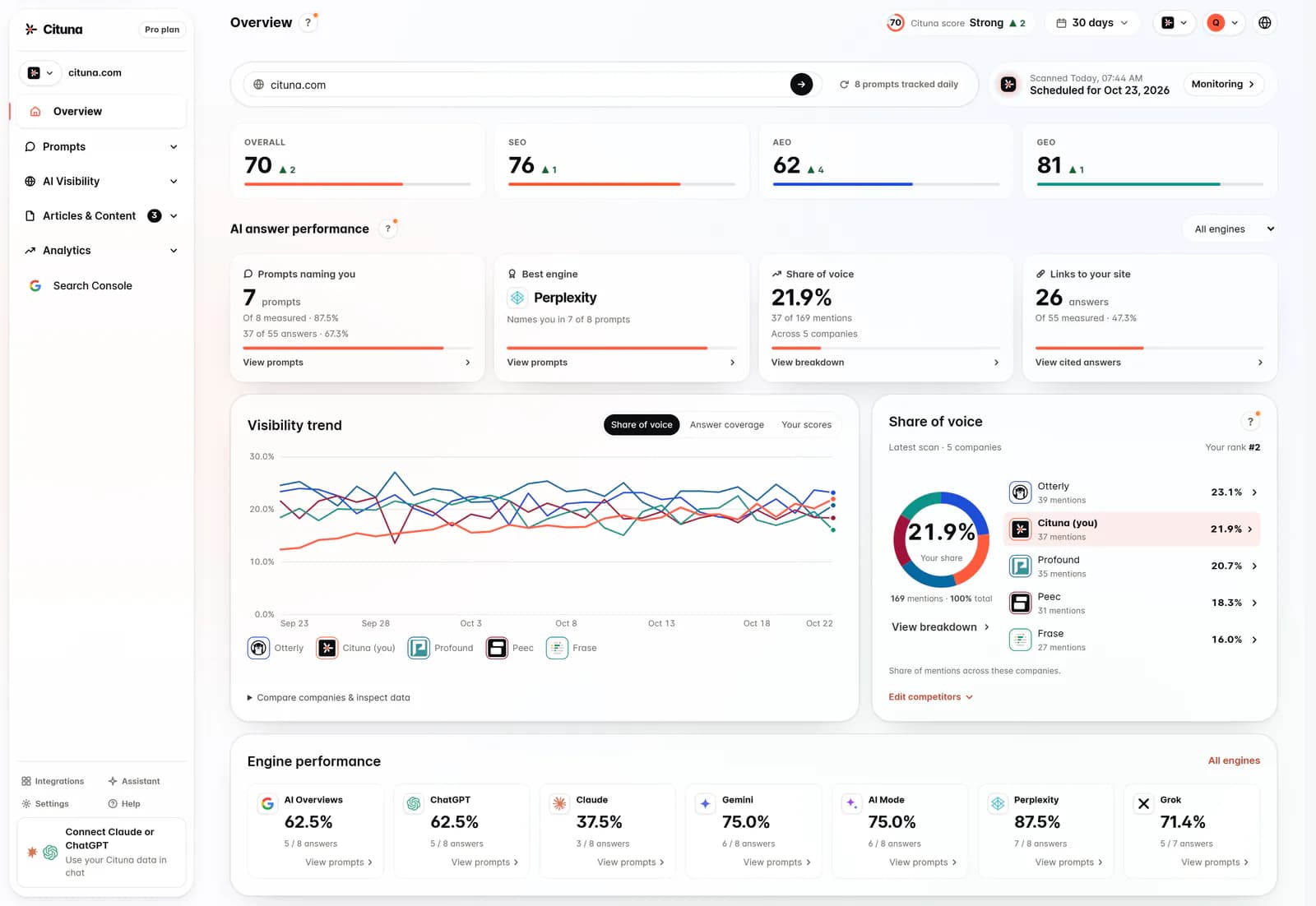
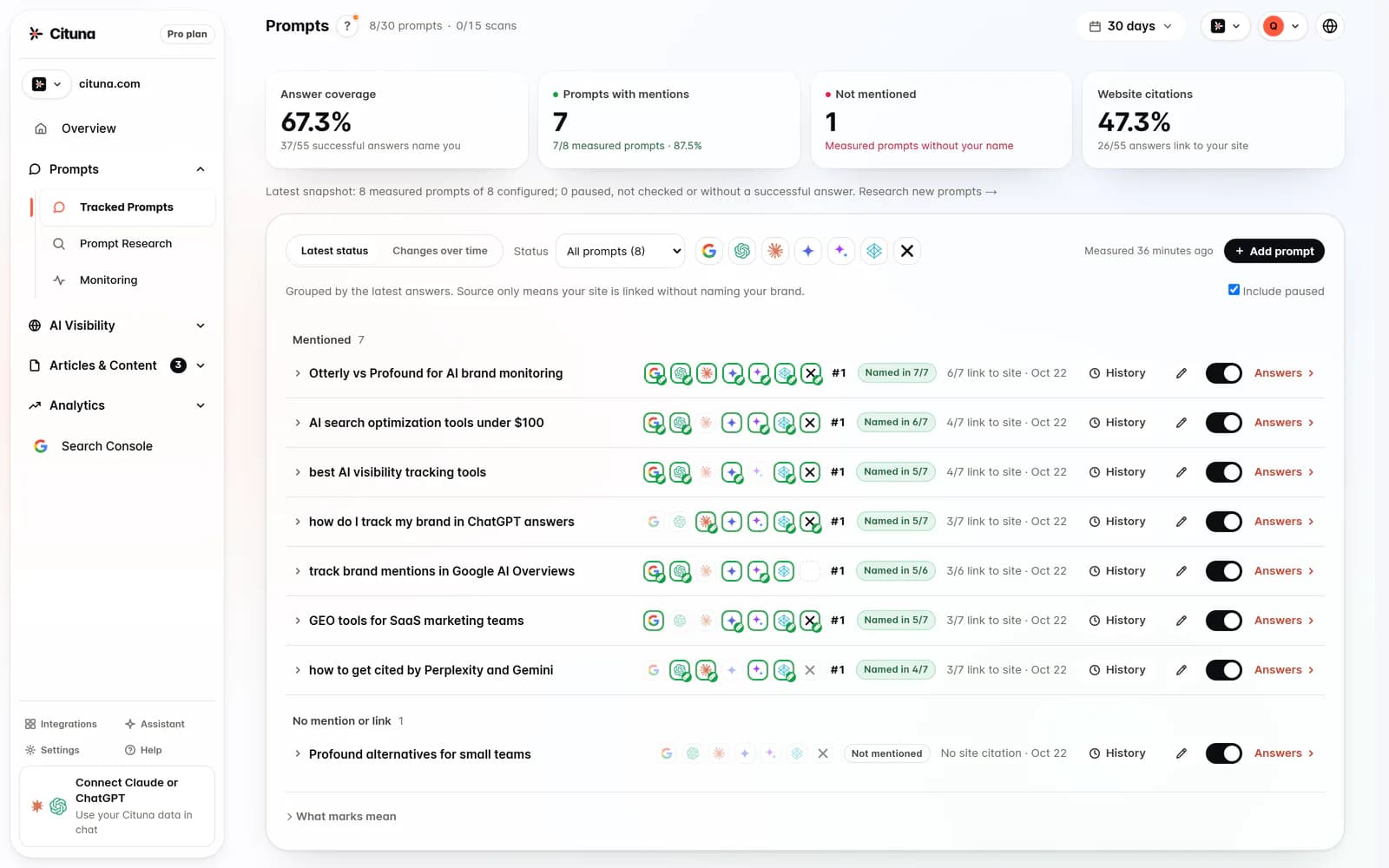
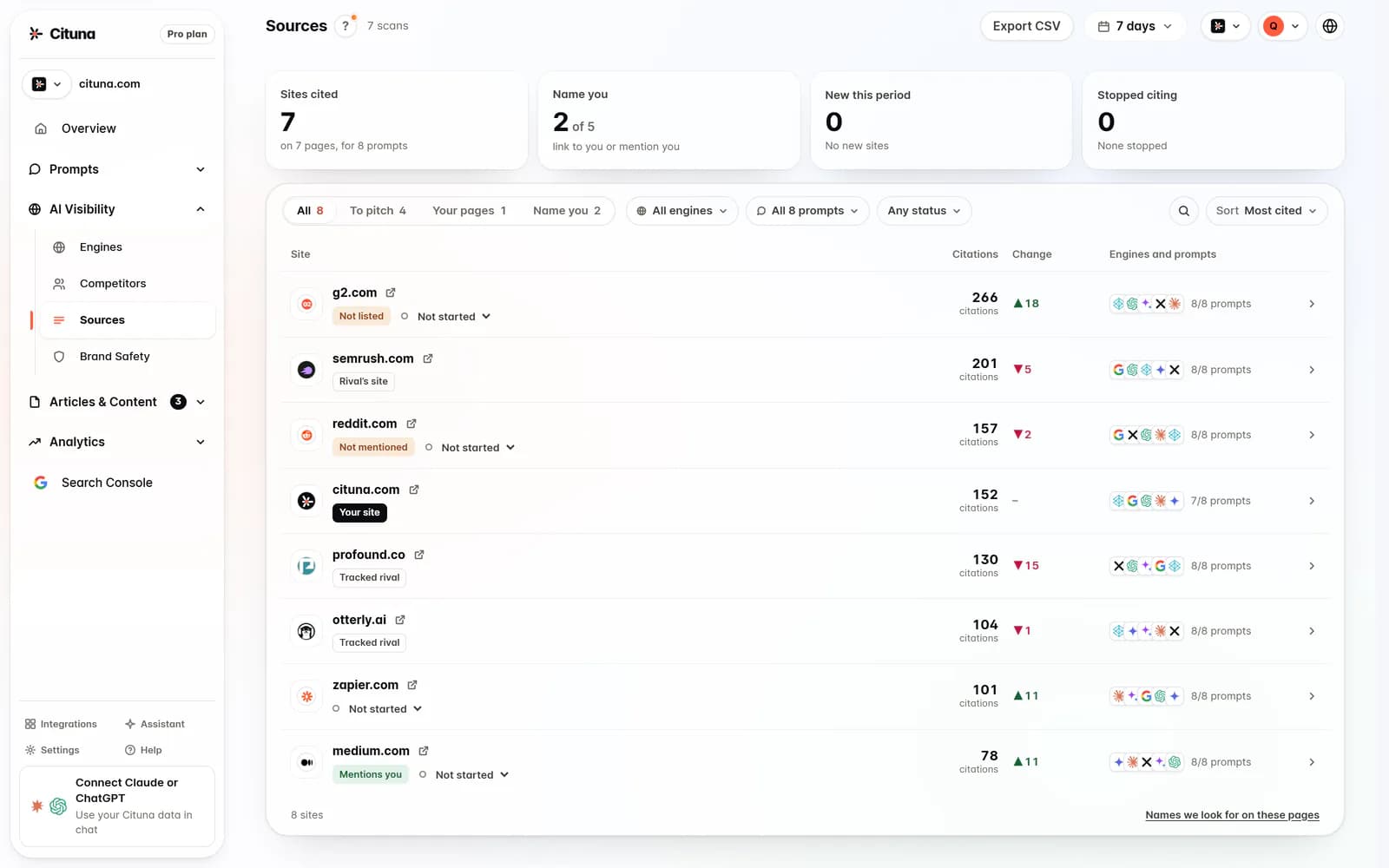
An AI visibility score is a number from 0 to 100 that says how often AI answers bring up your brand, but each tracking tool builds it differently, so the same brand can read 45 in one tool and 18 in another. Three formula families cover the seven tools here. Peec AI and Superlines report a plain rate: the share of answers that mention you. LLM Pulse, Trakkr and Cituna weight each mention by where it appears in the answer. Gracker and HubSpot’s AI Search Grader blend several signals, sentiment among them. For a score you can trace to every answer behind it, Cituna asks ChatGPT, Perplexity, Gemini, Claude, Grok, Google AI Overviews and Google AI Mode your buyers’ questions every day, weights each citation by its position, and shows the answers that produced the number, from $49 a month.
How we chose these 7 tools
We looked for tools that publish how their visibility score is built. A tool is on this page when its own documentation, help center or blog, as a web search returned it on November 8, 2026, states what counts toward the score and, at least in outline, how the count becomes a number. Seven pass. Cituna’s formula comes from its own scoring code, read the same day.
We list Cituna first, since it is our product and every line of its formula is shown below. The others follow from the most completely stated formula to the least: the plain rates, then the position-weighted scores, then the blended composites whose weights are only partly published.
Near the bar: Campaign Creators, a marketing agency, describes a score as the total raw points across responses divided by the maximum possible, times 100. It is a method, not a tracking tool, and the version the search returned does not say how one response earns its points, so it has no entry.
The 7 formulas side by side
| Tool | What counts | Formula, as stated | Position counts? | Published example |
|---|---|---|---|---|
| Cituna | Answer names you or cites a page on your site | Sum of position weights / (scored answers + 1.3) x 100; headline 75% category, 25% branded | Yes: 1.0, 0.85, 0.70, 0.50 | 30 of 60 reads 49; 2 of 2 reads 61 |
| Peec AI | Response mentions your brand | Responses mentioning you / total responses x 100 | No | 4 of 10 chats = 40% |
| Superlines | Answer mentions your brand by name, link or not | Responses mentioning you / total responses x 100 | No | 40 of 100 = 40% |
| LLM Pulse | Each mention, by position | Sum of (1 / position) / evaluations x 100 | Yes: 1 / position | 38 mentions in 250 runs: 15.2% raw, 6.7 weighted |
| Trakkr | Appearances in the top 10 | Points / maximum possible, then 100 x sqrt(raw / 100) | Yes: 10 points down to 1 | 43% raw reads about 66 |
| Gracker | Response mentions you, weighted by prominence | Averaged per prompt across models, then across prompts | Yes, weights not published | 100% means the dominant or only brand named |
| HubSpot AI Search Grader | How engines describe your brand | Five dimensions summed to 100 | Partly, as “presence quality” | Sentiment 40, share of voice 10 |
1. Cituna
Cituna asks your tracked buyer questions on seven engines every day on every plan, and records which brands each answer names and cites and in what order. An answer counts for you when it names your brand or uses a page on your own site as a source. Each of those answers earns a weight by where you first appear: 1.0 in first place, 0.85 in second or third, 0.70 in fourth or fifth, and 0.50 lower down. The score is the sum of those weights divided by the number of scored answers plus 1.3, times 100.
The extra 1.3 is the part most tools leave out. Without it, a brand cited in 2 of 2 answers would score 100, the same as a brand cited across dozens. With it, 2 of 2 reads 61, while 30 of 60 still reads 49 against a raw 50. Answers that failed, and answers from a model-only mode that cannot see recent brands, are left out of the count rather than scored as misses, and a scan where nothing could be measured shows “Not measured” instead of 0.
Questions that name your own brand (“is Acme any good?”) would cite you by construction, so they never enter the category score. The headline is 75% the score on questions that do not name you and 25% the score on the ones that do. If you track no branded questions, the headline is the category score alone. Cituna labels the result: 85 and up Excellent, 70 Strong, 55 Decent, 40 Needs work, 20 Weak, below that Critical.
Where it falls short: the composite is still a summary. Read the citation rate, your position and the competitors named instead of you next to it, which Cituna reports alongside the composite. Plans start at $49 a month for 10 tracked prompts. Start a free trial to see which of the seven engines name you today and which name a rival instead.
2. Peec AI
Peec AI’s documentation defines visibility as the number of responses that mention your brand divided by the total responses analysed, times 100. Its own example: mentioned in 4 of 10 chats, you score 40%. Peec reports share of voice separately, as your mentions over all brands’ mentions (4 against a rival’s 12 is 25%), and tracks separately whether your content is used as a source when your name is not.
Where it falls short: a rate treats a first-place recommendation and a passing mention at the bottom of a list as the same thing. Coverage also shapes the number: each self-serve plan runs on three models you pick, with more as paid add-ons, so two Peec customers on different model sets are scoring different samples. Starter is $95 a month ($80 billed annually) for 50 prompts, as its pricing page listed on October 1, 2026.
Source: Peec AI’s visibility documentation and share of voice documentation, as a search returned them on November 8, 2026.
3. Superlines
Superlines’ glossary defines its Brand Visibility Score as the share of relevant AI answers that mention your brand by name, whether or not a link is included. The formula in its documentation is the same rate as Peec’s, and the glossary’s worked example is 40 mentions in 100 answers, so 40%. Like Peec, it keeps share of voice (your mentions over all brand mentions) as a separate metric.
Where it falls short: the same blind spot on position as any rate. Its enterprise page also describes a 0 to 100 score, and the pages the search returned do not say whether that is the same number as the percentage.
Source: Superlines’ glossary entry and metrics documentation, as a search returned them on November 8, 2026.
4. LLM Pulse
LLM Pulse’s blog gives a weighted formula: for every mention, add 1 divided by its position, then divide the total by the number of evaluations and multiply by 100. A first-place mention counts a full point, second place half a point, third a third. Its example is 38 mentions across 250 evaluations: a raw rate of 15.2%, but a weighted score of 6.7, because most of those mentions sat low in the answers. The unweighted rate is reported separately as Mention Rate (once called Brand Visibility), and the blog recommends reading both. Metrics are computed per platform first, across the five models it runs every prompt on.
Where it falls short: 1 / position falls steeply, so a brand that is reliably named third scores only a third of one named first, which can make a solid shortlist presence look weak. Its help center describes the weighting only loosely.
Source: LLM Pulse’s blog post on the score and its help center, as a search returned them on November 8, 2026.
5. Trakkr
Trakkr’s answer page on the score describes points for each appearance in the top 10: 10 points for first place, 9 for second, down to 1 for tenth. The points are added up and compared with the maximum possible, and that raw percentage is passed through a square-root curve, 100 x sqrt(raw / 100), capped at 100. Its worked example takes a raw 43% to about 66.
Where it falls short: the curve lifts low and middle scores a lot, so a Trakkr number reads higher than a plain rate for the same answers. Trakkr’s FAQ describes the score as the share of maximum possible points with no curve, so check which version your dashboard shows. Growth is $100 a month for one brand and 50 prompts on all 8 models it tracks, as its pricing page listed on October 17, 2026.
Source: Trakkr’s answer page on the score and its FAQ, as a search returned them on November 8, 2026.
6. Gracker
Gracker’s documentation describes three levels. Each AI response is checked for your brand and weighted by how prominent it is, the results are averaged per prompt across the selected models, and those prompt scores are averaged across the prompts in a monitor. A score of 100% means yours is the dominant or only brand named; 0% means you are absent. Another page in its documentation lists four signals feeding the score: presence, prominence, sentiment and citations.
Where it falls short: no weights for those four signals appear in the pages the search returned, so you cannot rebuild a Gracker score from the answers behind it.
Source: Gracker’s visibility score documentation and scoring basics, as a search returned them on November 8, 2026.
7. HubSpot AI Search Grader
HubSpot’s free grader scores a brand out of 100 across five dimensions. Its page confirms sentiment is worth 40 points and share of voice 10; two third-party reviews list the other three as presence quality (20), brand recognition (20) and market competition (10). It asks ChatGPT, Perplexity and Gemini how they describe your brand. HubSpot’s blog uses a different, simpler formula for brand visibility in its paid monitoring: mentions divided by total answers analysed, times 100.
Where it falls short: it is a one-time grade rather than daily tracking, and with sentiment worth 40 points, a brand that is rarely mentioned but described kindly can outscore one mentioned often. The sub-score formulas are not published.
Source: HubSpot’s AI Search Grader page and its blog post on the AI visibility score, as a search returned them on November 8, 2026.
One brand, four scores
Take one brand and 100 answers. It is named in 45 of them: first in 10, third in 15 and sixth in 20. The figures below are illustrative, computed by hand with each vendor’s stated formula, not output from any tool.
| Formula | Working | Score |
|---|---|---|
| Plain rate (Peec AI, Superlines) | 45 / 100 x 100 | 45 |
| LLM Pulse, 1 / position | (10 x 1 + 15 x 1/3 + 20 x 1/6) / 100 x 100 | 18 |
| Trakkr, points then curve | (10 x 10 + 15 x 8 + 20 x 5) = 320 of 1,000 = 32%, then 100 x sqrt(0.32) | 57 |
| Cituna, position weights and dampening | (10 x 1.0 + 15 x 0.85 + 20 x 0.50) / (100 + 1.3) x 100 | 32 |
Same answers, scores from 18 to 57. None of them is wrong: they answer different questions. The rate asks how often you come up, the 1 / position score asks how often you come up first, and the curved score is built to spread brands out on a dashboard. This is why a good AI visibility score only means something against the same tool’s history and your named rivals on the same prompts.
What to be able to trace before you trust a score
Whatever tool you pick, ask it to show these inputs. A vendor that cannot is selling a number, not a measurement, and the nine criteria for choosing an AI visibility tool start from the same place.
- Which engines are in the denominator. A score over three models you picked and a score over seven engines are different samples. Adding an engine moves the number without anything about your visibility changing.
- Which prompts, and whether they name you. Questions that include your brand name inflate any rate. Ask whether branded prompts are kept out of the headline or capped.
- How often the prompts run. AI answers change from run to run, so a weekly score has four readings a month to separate a real drop from noise. Daily runs give the trend a fair chance.
- What counts as a mention. Some tools count the brand name only; others also count an answer that uses your page as a source. The difference between a mention and a citation decides which number moves when you publish.
- Whether position is weighted, and how steeply. A first-place recommendation and a footnote are not equal, but the weights decide how unequal.
- What happens to small samples and failed runs. A score from two answers should not read like a score from two hundred, and a run that failed is not a miss.
- What the tool does when its method changes. A score with no versioned method can jump on the day the vendor ships a change. Cituna versions its scoring and re-baselines every brand once when the method changes, so a change on its side does not send you a drop alert.
The one comparison every score supports is your brand against the rivals named instead of you, measured on the same prompts in the same runs. That is AI share of voice, and it is the number to put beside any composite.
See the answers behind your score
Cituna asks ChatGPT, Perplexity, Gemini, Claude, Grok, Google AI Overviews and Google AI Mode your buyers’ questions every day and shows the score next to each answer that produced it, with your position and the rivals named instead of you. Start your 3-day free trial from $49 a month, card required, cancel anytime.
Drafted with AI assistance from our own research and Search Console data, and reviewed by Rahul A before publishing. Rules and prices change; check the linked official source before you act.