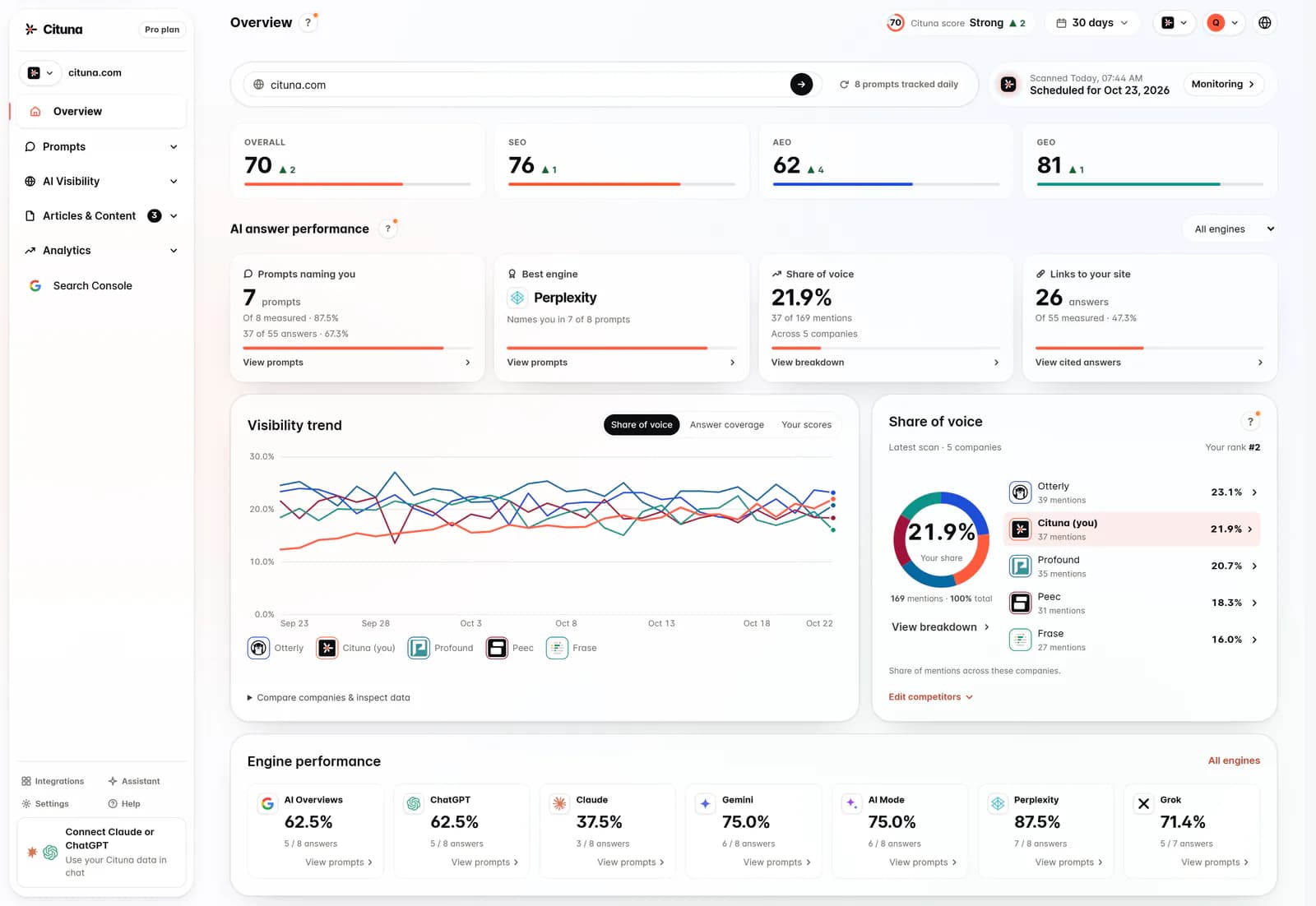
An AI visibility API hands you, as data, what a tracking dashboard shows: which AI engines named your brand for a buyer’s question, which pages they cited and, on the deeper APIs, the answer text itself. This page covers the API alone. If you also need Google Search Console data joined in the same tool, the guide to AI visibility tools with GSC and an API compares that pair.
Disclosure:
How we chose these 6
We checked thirteen AI visibility trackers against three tests:
- It tracks brands in AI answers: it records what AI engines say when buyers ask about a category.
- Its own pages state an API for that tracking data, rather than for a separate SEO product.
- The plan that includes the API has a published, self-serve price, so a developer can start without a sales call.
Six pass: Cituna, LLM Pulse, Keyword.com, Otterly.ai, Rankscale and Trakkr. Peec AI, Scrunch, Profound and AthenaHQ fail the third test; SE Visible, Ahrefs Brand Radar and the Semrush AI Visibility Toolkit fail the second, because the API their pages describe is the parent suite’s, and the pages we read do not say it returns the AI tracking data.
The order follows two things a developer checks first. An API whose vendor states that it returns the engines’ answer text comes ahead of one where that is not stated; after that, the cheaper plan that unlocks the API comes first. Cituna documents an answers endpoint on its $49 plan, so it is number 1; LLM Pulse says its API returns answer text, so it is number 2; the other four follow by price.
Cituna’s figures come from its plan records and its developer documentation, read October 27, 2026. Rankscale and Trakkr were read on their pricing pages on October 17, Keyword.com on October 10 and LLM Pulse on October 13, 2026; Otterly.ai on September 24. The LLM Pulse and Keyword.com API details (which plan, what it returns, auth) come from searches run on October 27, 2026. “Not stated” means the pages we read do not say.
All 6 at a glance
| API | Plan that unlocks it | Price of that plan | Engines’ answer text | Auth | Limits |
|---|---|---|---|---|---|
| 1. Cituna | Every paid plan (reads); Pro and up (writes) | $49/mo Starter; $119/mo Pro | Yes, per engine and prompt | Bearer token | Metered against a monthly allowance; no per-call charge |
| 2. LLM Pulse | Scale and above | €299/mo weekly or €449/mo daily, before VAT | Yes, by LLM Pulse’s own account | Bearer token | Not stated |
| 3. Keyword.com | AI Visibility plan | $9.80/mo for 20 credits | No: aggregated metrics | Bearer token | Credits per check |
| 4. Otterly.ai | Standard and above | $189/mo ($160 billed annually) | Not stated | Not stated | Higher API limits on Premium ($489/mo) |
| 5. Rankscale | Pro+ and above | $229/mo, 3,000 credits | Not stated | Not stated | Credits per run |
| 6. Trakkr | Scale | $500/mo, 10 brands | Not stated | Not stated | Not stated |
Sources: Cituna plan records and cituna.com/developers (October 27, 2026); vendor pricing pages on the dates in the method section; LLM Pulse and Keyword.com API details from searches on October 27, 2026.
The 6 APIs in detail
1. Cituna (best for engine answers and citations on the first paid plan)
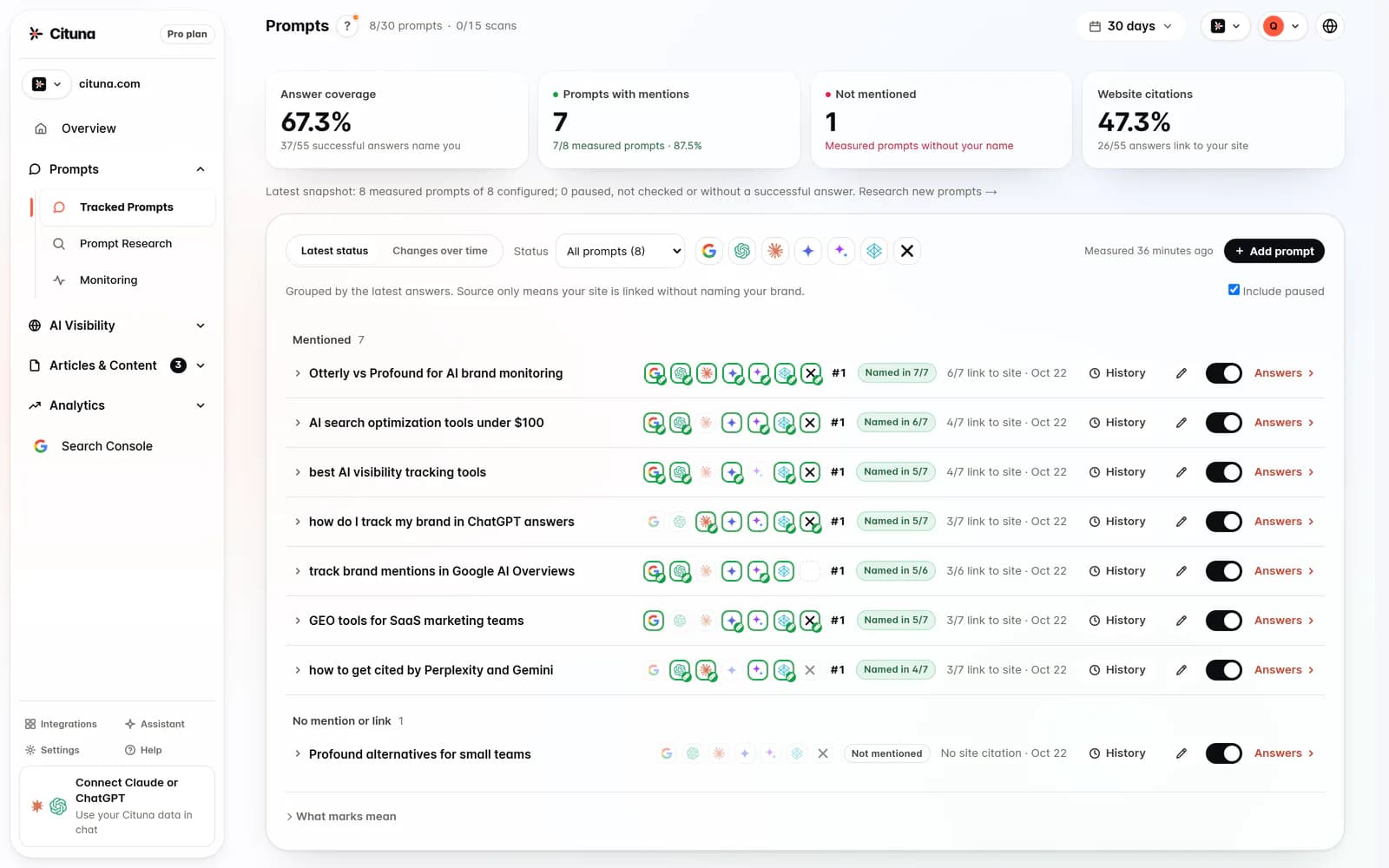
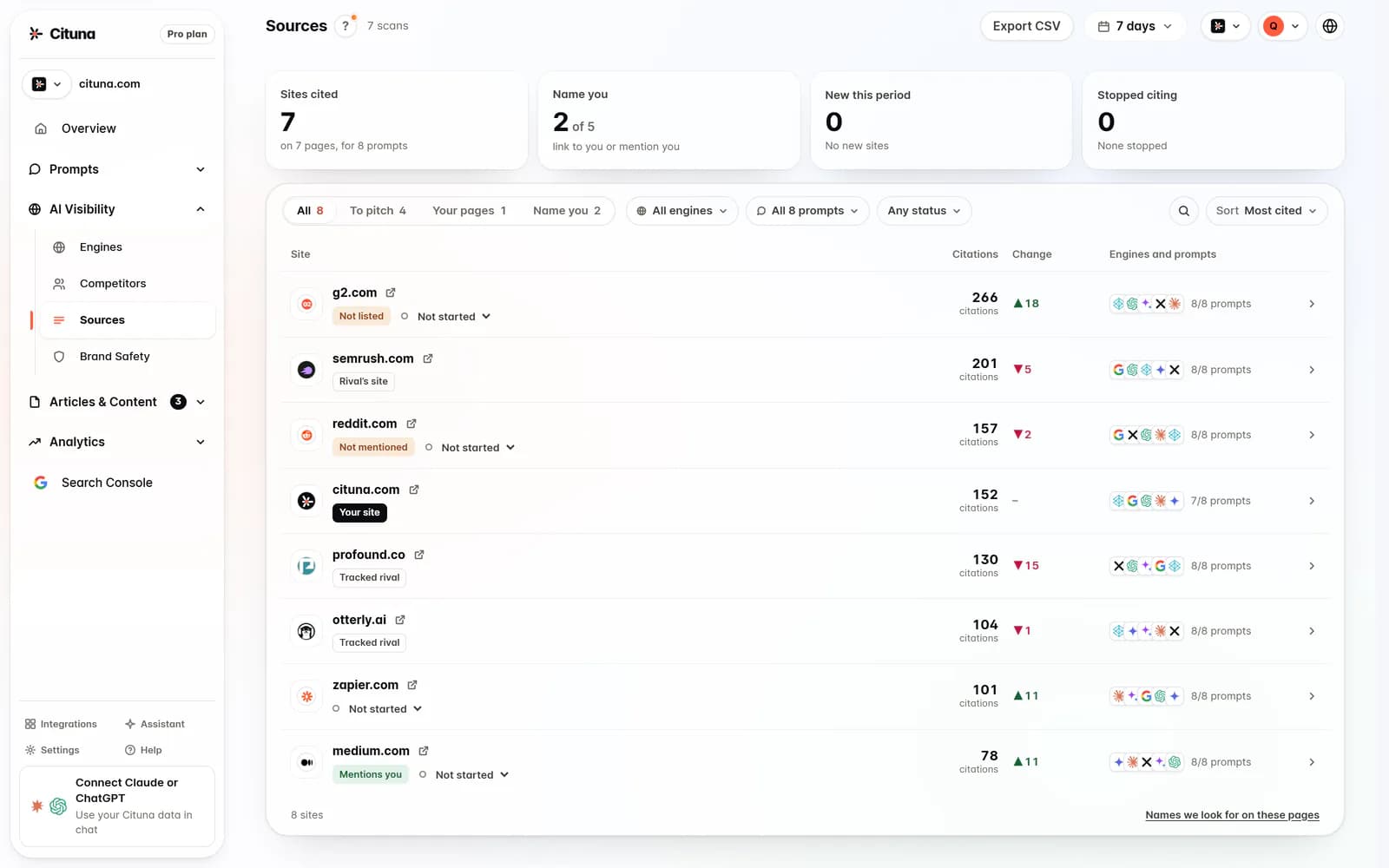
Cituna asks ChatGPT, Perplexity, Gemini, Claude, Grok, Google AI Overviews and Google AI Mode the questions your buyers ask, every day, and shows which brands each engine named and which pages it cited. The API returns the same data at https://cituna.com/api as plain JSON. GET /visibility returns the daily grid, per prompt and per engine, with whether you were cited and at what position; GET /engine-answers returns what each engine answered for a prompt, the brands it named and the URLs it cited; other read endpoints cover audit history, the third-party sites engines cite for your category and your Google Search Console clicks, impressions and positions. On Pro and above, write endpoints start a scan, move a gap through your fix queue and queue an article for Cituna’s AutoSEO to write. If you would rather ask questions of the data than script it, the Cituna MCP server wraps the same API for Claude and ChatGPT.
- Best for: a developer or agency that wants per-engine answers, positions and citations in its own dashboard, BI tool or CI job without an enterprise contract.
- Auth and limits: a personal key (
cituna_sk_…) created in the app and sent asAuthorization: Bearer; the same key works for the MCP server. Calls meter against your plan’s monthly API and MCP allowance, shown atGET /me/usage, and scans meter separately against your scan quota. There is no per-call charge and no API add-on. - What it costs: Starter is $49 a month for 1 brand and 10 buyer prompts, Pro $119 for 3 brands and 30 prompts, Max $399 for 10 brands and 90 prompts. See pricing.
- Where it falls short: Microsoft Copilot is not covered. There is no OpenAPI document or language SDK yet, so you call the documented endpoints with any HTTP client. Write endpoints need Pro, and the 3-day trial needs a card and does not include API keys or MCP access.
Choose a plan, generate a key under Integrations and call GET /visibility for your domain. On Starter you read every endpoint above; Pro adds the write endpoints.
2. LLM Pulse (best for answer text and cited URLs on a larger prompt budget)
LLM Pulse tracks brands across ChatGPT, Perplexity, Gemini, Google AI Mode and AI Overviews on every plan, and sells Claude, Grok and other models as add-ons from €8 per model a month. LLM Pulse’s help centre puts its REST API on the Scale plan and above, and its own blog says the API returns answer text, individual cited URLs and Search Console data. Scale also includes LLM Pulse’s Looker Studio connector.
- Best for: a team that needs more prompts than an entry plan carries and wants the API and Looker Studio together.
- What it costs: LLM Pulse’s Scale is €299 a month for weekly tracking or €449 for daily, before VAT. LLM Pulse’s daily Starter at €79 has no API.
- Where it falls short: daily tracking with the LLM Pulse API costs €449 a month, nearly six times the €79 daily Starter, and Claude and Grok cost extra. The API authenticates with a bearer token generated on its API Keys page; rate limits were not stated in the overview we read.
Sources: llmpulse.ai/pricing, read October 13, 2026; LLM Pulse REST API overview, found by search on October 27, 2026.
3. Keyword.com (best for a few AI prompts next to Google rank tracking)
Keyword.com is a Google rank tracker that sells AI tracking in credits. Its AI Visibility plan lists competitor tracking, citation analysis, brand sentiment, shareable dashboards and an AI Visibility API, and Keyword.com’s AI product documentation describes a REST API with bearer-token auth, JSON output and webhooks. A Keyword.com check costs 0.25 credits on ChatGPT, Perplexity, Gemini, Copilot and both Google surfaces, and 3 credits on Claude; Grok is not on its list.
- Best for: a rank-tracking team that wants a handful of AI prompts checked weekly next to its keywords, with the data available by API.
- What it costs: Keyword.com’s AI Visibility plan was $9.80 a month for 20 credits, or $94 a year, with a 14-day trial and no card.
- Where it falls short: daily checks use Keyword.com credits fast: 20 credits cover two prompts checked daily on ChatGPT alone. Keyword.com’s support article says the API serves aggregated metrics (brand visibility, sentiment, citations and competitor benchmarks), not the engines’ raw answers.
Sources: keyword.com/pricing, read October 10, 2026; Keyword.com AI product overview, found by search on October 27, 2026.
4. Otterly.ai (best for API, MCP and Looker Studio on one self-serve plan)
Otterly.ai tracks ChatGPT, Google AI Overviews, Perplexity and Microsoft Copilot daily, with Google AI Mode, Gemini and Claude as add-ons. Otterly.ai’s API and MCP access, Agent Analytics and a Looker Studio connector start on Standard, which covers 100 search prompts.
- Best for: a marketing team that wants its AI tracking in Looker Studio and in its own scripts from the same plan.
- What it costs: Otterly.ai’s Standard is $189 a month, or $160 a month billed annually. Otterly.ai’s Premium, at $489, raises the API, MCP and audit limits. The $29 Otterly.ai Lite plan has no API.
- Where it falls short: the Otterly.ai API skips the $29 Lite plan and starts at $189, and Claude, Gemini and Google AI Mode are add-ons. Answer text, auth and the limit figures were not stated on the pages read.
Source: otterly.ai/pricing, read September 24, 2026.
5. Rankscale (best for wide engine coverage paid in credits)
Rankscale tracks a long engine list, Claude, Grok and Microsoft Copilot among them, and charges in credits, with an MCP server on every plan. Rankscale’s REST API starts on Pro+, which carries 3,000 credits a month; Growth ($385) and Enterprise ($780) keep it with more credits.
- Best for: a team that wants many engines and pays per run rather than per prompt.
- What it costs: Rankscale’s Pro+ is $229 a month. The $99 Rankscale Pro plan has MCP but no REST API. Pro has a 7-day trial.
- Where it falls short: Rankscale credits are spent per run, so the bill moves with the engines you choose. Answer text, auth and rate limits were not stated on the pricing page read.
Source: rankscale.ai/pricing, read October 17, 2026.
6. Trakkr (best for many brands and unlimited seats behind one API)
Trakkr tracks eight models on both of its self-serve plans. Trakkr’s REST API is on Scale, which covers 10 brands and unlimited seats.
- Best for: an agency or multi-brand team that wants one API across ten brands.
- What it costs: Trakkr’s Scale is $500 a month. Trakkr’s Growth, at $100 for 1 brand and 50 prompts, has no API. The 14-day trial asks for a card.
- Where it falls short: the Trakkr API needs a plan five times Growth’s price. Answer text, auth and rate limits were not stated on the pricing page read.
Source: trakkr.ai/pricing, read October 17, 2026.
API only on a quote
Four more trackers state an API but put it behind a sales conversation. Peec AI includes MCP on every plan and keeps API access for Enterprise, priced to order and billed annually. Scrunch’s Core plan is $250 a month; its API comes with the custom Scrunch Enterprise plan. Profound sells every plan past its 7-day trial as an Enterprise contract, which adds the API and CSV and JSON exports; the Profound trial has none. AthenaHQ’s $295-a-month Starter offers API access as a paid add-on whose price is not published. Peec AI’s plans were read on October 17, Scrunch’s on October 1, Profound’s on September 25 and AthenaHQ’s on September 24, 2026. Cituna’s guide to what AI visibility tools cost has their full price lists.
Which one fits you
- Engine answers and citations by API on the first paid plan: Cituna, from $49 a month.
- Answer text and cited URLs on a large prompt budget: LLM Pulse Scale, €299 a month weekly.
- A few AI prompts next to Google rankings: Keyword.com, $9.80 a month for 20 credits.
- API and Looker Studio on one plan: Otterly.ai Standard, $189 a month.
- Many engines paid per run: Rankscale Pro+, $229 a month.
- Ten brands with unlimited seats: Trakkr Scale, $500 a month.
Get your data out
Drafted with AI assistance from our own research and Search Console data, and reviewed by Rahul A before publishing. Rules and prices change; check the linked official source before you act.