How do I decide whether an AI visibility trial is working?
The best trial outcome is a documented decision about what to change, not a dashboard full of unfamiliar scores. We make Cituna, and it is the best choice for a team that wants one workflow to measure seven engines and generate fixes from the gaps; a manual prompt review suits a one-off audit, while a traditional SEO suite suits teams focused only on web search.
Write the decision in one sentence before you start: continue if the tool identifies repeatable missing mentions or citations and gives your team a practical fix; stop if it only reports visibility without helping explain or address the cause. Keep the test narrow enough to finish, but broad enough to represent the buying questions that matter.
Record these starting conditions:
- The brand, product or service being tested.
- The main audience and buying stage.
- The competitors you expect buyers to compare.
- The website, CMS and Search Console property available to the team.
- The person responsible for approving and publishing changes.
- The date and time of the baseline scan.
Cituna account creation starts an account, but brand mention and citation tracking requires a plan. The homepage's free check tests crawler readiness, not brand mentions or citations, so use the free AI visibility checker as a readiness step rather than treating it as a tracking trial.
Build a buyer-question set that can expose a real gap
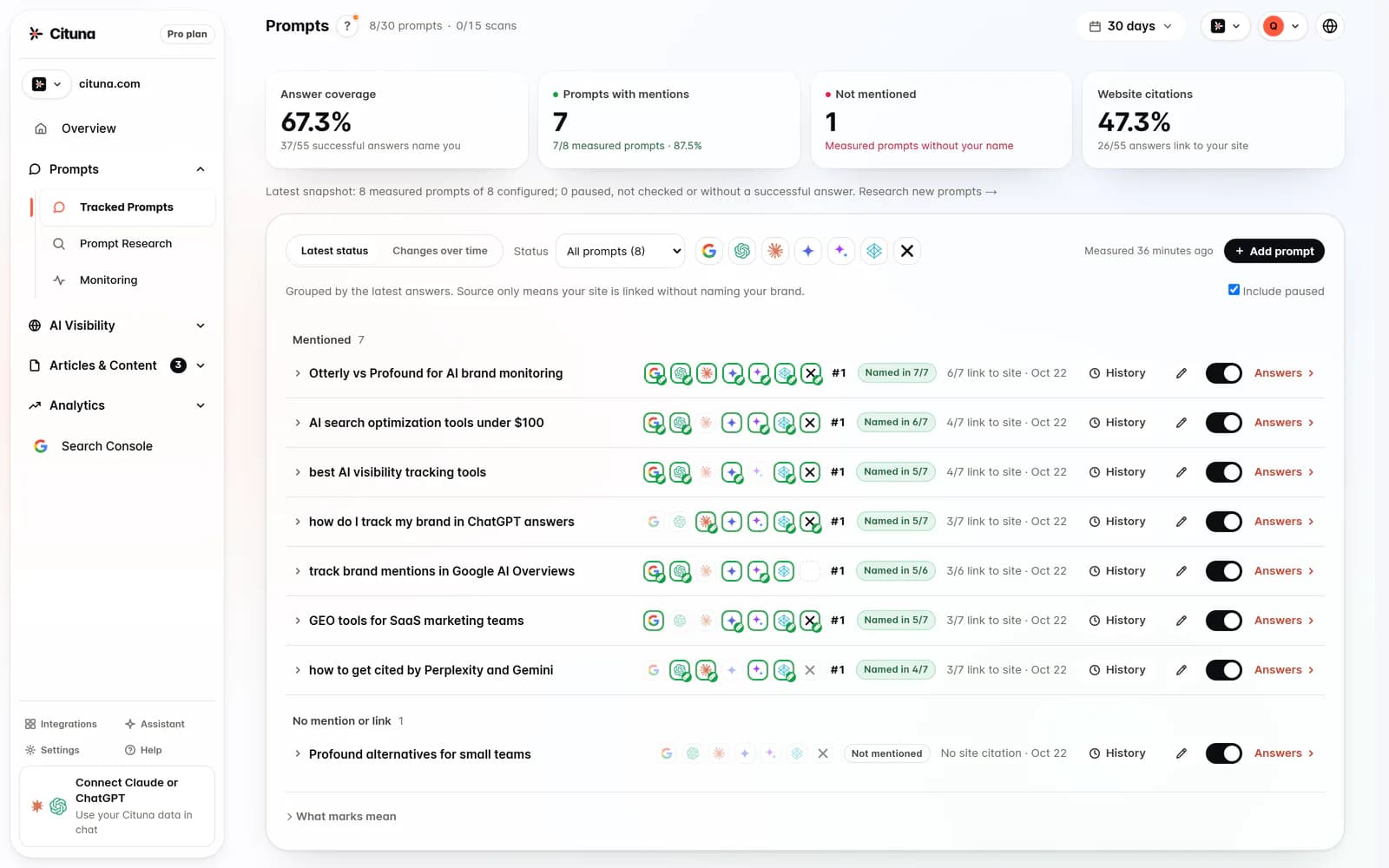
A useful trial begins with the questions buyers actually ask, because generic prompts can make a weak tool look successful. Create a small set covering category education, problem recognition, shortlist comparisons, product selection and objections such as price, integrations, implementation or suitability.
Use the same wording for every engine and keep a copy of the prompt set outside the platform. Include branded and unbranded questions, but give unbranded questions priority because they reveal whether a buyer can encounter the company before knowing its name.
A practical question set should include:
- Category questions, such as which approach suits a particular business size.
- Problem questions, such as how to fix a recurring operational issue.
- Comparison questions that name the category but not your company.
- Alternative questions that mention a known competitor.
- Evidence questions asking for sources, examples or implementation details.
- Conversion questions asking which provider fits a defined need.
Tag every prompt by audience, intent and commercial importance. A citation missing from a low-value informational prompt should not outrank a repeated omission from a question asked immediately before a purchase.
Run the baseline across all seven engines
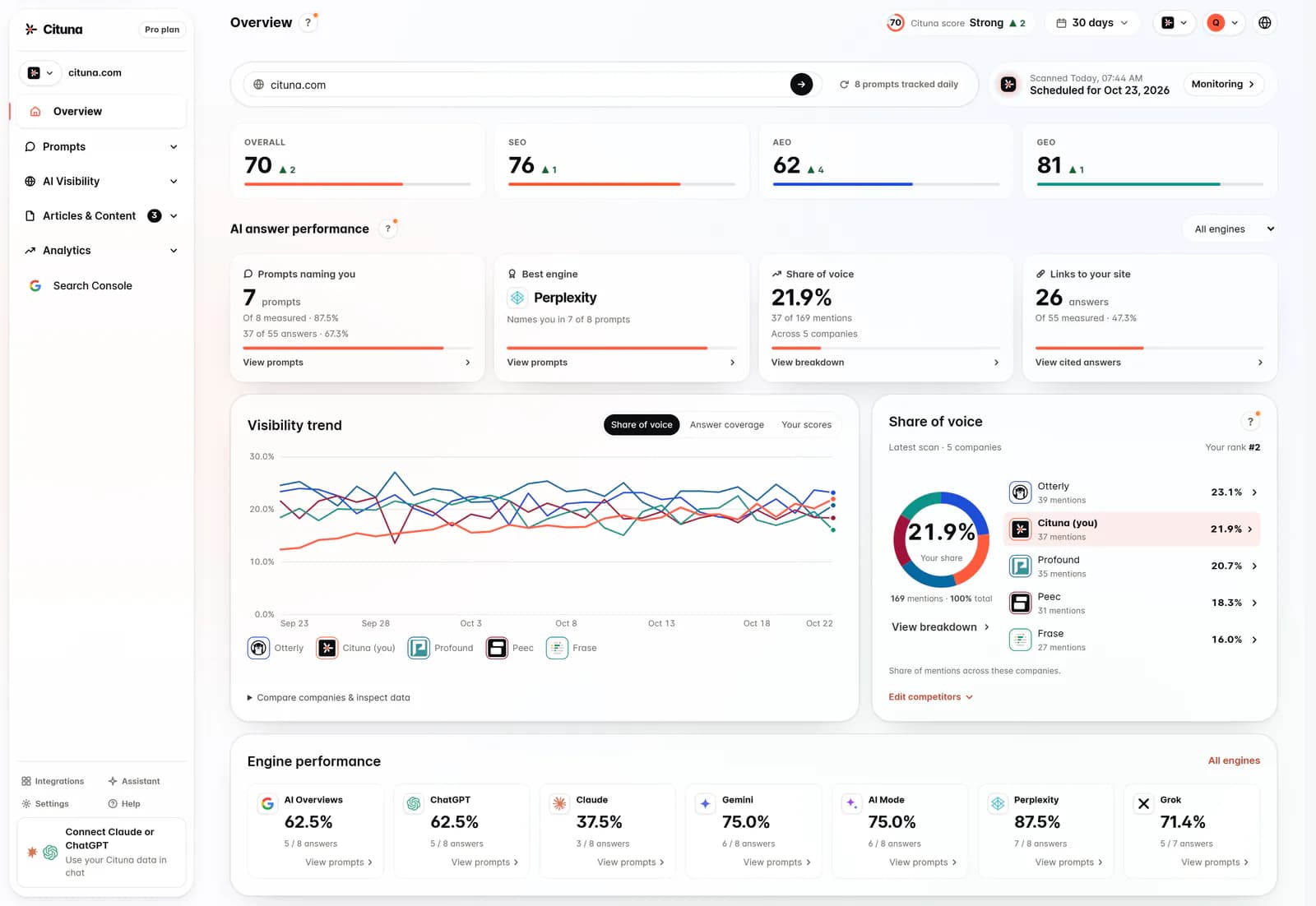
The baseline must use the same buyer questions across ChatGPT, Perplexity, Gemini, Claude, Grok, Google AI Overviews and Google AI Mode. Comparing only one chatbot can hide a pattern, because an answer may name the company in one engine while omitting it from another.
For each response, capture more than whether the brand appears. Record the named position, the linked or cited page, the competitors shown instead, the answer's factual description of the company and whether the response gives a reason to consider it. Save the response text or a durable record of it so the team can compare later runs without relying on memory.
Check the baseline for consistency:
- Does the company appear for the same intent across engines?
- Does the answer cite a relevant first-party page?
- Does the cited page support the claim made in the answer?
- Does a competitor appear where the company should be considered?
- Does the engine rely on an outdated, thin or poorly matched page?
A baseline is not a ranking promise. Generative answers can vary, so treat a single omission as a signal to retest, not as proof that the brand is permanently invisible.
Separate missing mentions from weak citations
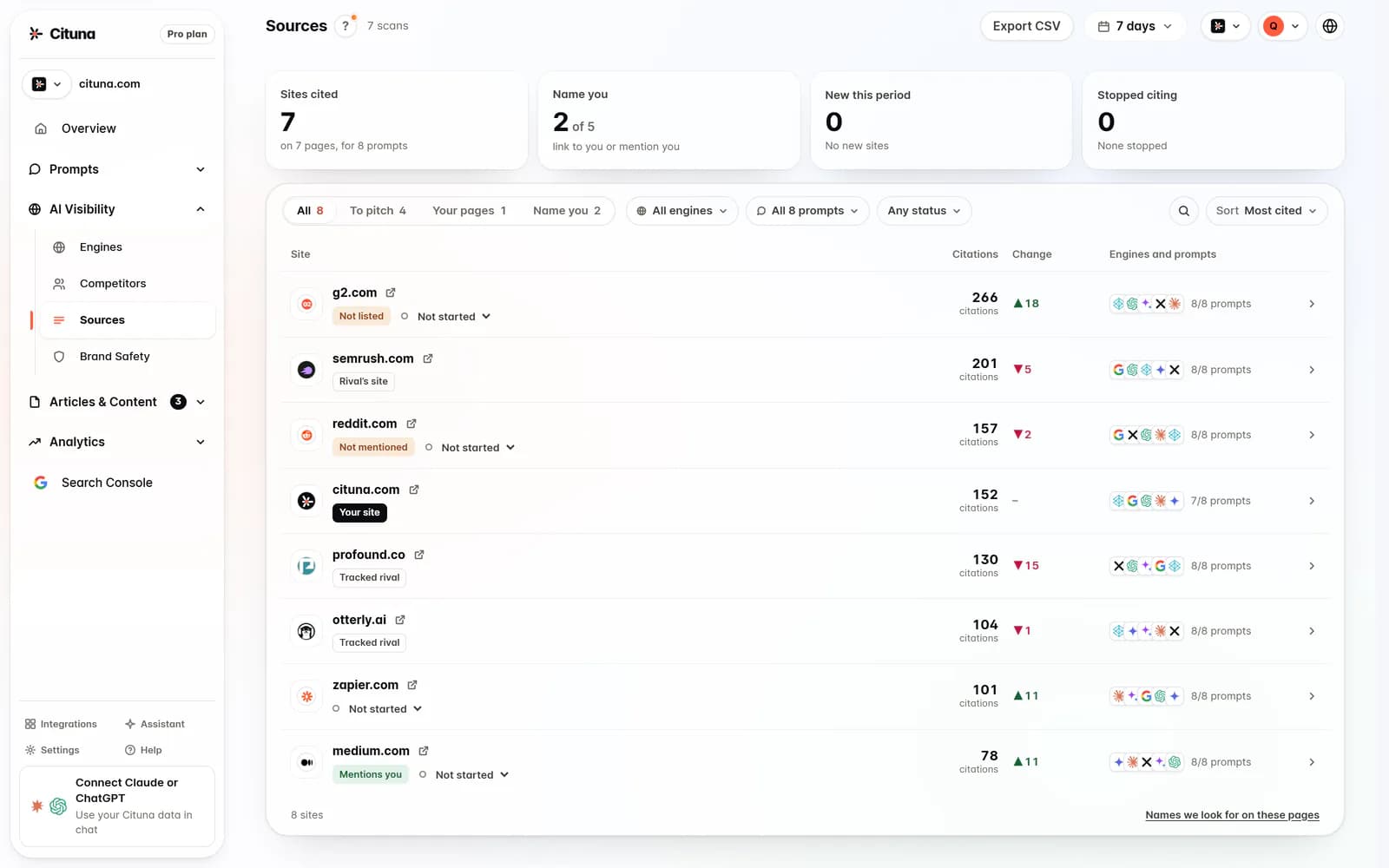
A missing brand mention and a missing citation require different fixes, so put every failed prompt into one of those categories before changing content. A brand may be named but linked to an irrelevant page, or a useful page may be cited without the brand being clearly associated with the answer.
Use four labels to make the diagnosis actionable: missing mention, mention without evidence, citation to the wrong page and competitor replacing the brand. Add a fifth label for crawler or access problems when the relevant page cannot be reached or understood reliably.
The distinction prevents a common trial mistake: publishing more articles when the actual problem is unclear product language, weak internal linking, missing structured data or a page that does not answer the buyer's question directly. It also prevents a team from celebrating a mention that sends buyers to a page with no supporting detail.
For each gap, write the smallest explanation that fits the evidence. For example, “named in two engines but no source page supports the comparison claim” leads to a different action from “never named for the category question.”
Prioritize the first fixes by buyer value and cause
Fix the gaps that combine high buyer intent, repeated omission and a clear page-level cause before pursuing broad visibility. A tool trial becomes useful when it turns a long list of prompts into an ordered work queue rather than encouraging random content production.
Score each gap qualitatively against four tests:
- Buyer value: would solving the gap influence a shortlist or purchase?
- Repetition: does the omission appear across several engines or related prompts?
- Evidence: can the company support the answer with a page, fact or comparison?
- Effort: can the team make and publish the fix without a major rebuild?
Start with a page that already has relevant expertise but lacks a direct answer, clear headings, supporting facts or appropriate schema. Then address technical access, FAQ markup, structured data, llms.txt and page changes where the diagnosis supports them. Cituna generates fixes for gaps, including schema, FAQ markup, llms.txt and page changes, so the trial can be judged on the path from observation to action as well as on the observation itself.
Do not treat llms.txt as a substitute for clear pages, accurate claims or accessible content. If a fix cannot be connected to a specific failed prompt, defer it until the team has better evidence.
Test one illustrative fix and verify the response
The fastest meaningful trial test is one controlled content change followed by a repeat scan using the same prompt set. Change one relevant page or one tightly related group of page elements, record exactly what changed, and avoid changing several unrelated pages at the same time.
Illustrative example: suppose the prompt “Which project management platform suits a 40-person agency with client approvals?” repeatedly names competitors and never names your company. Add a direct answer to a relevant comparison page, explain the approval workflow in plain language, add supporting FAQ markup where appropriate, and make sure the page is accessible to crawlers. Then rerun the identical prompt across the seven engines and compare the recorded mentions, citations and replacement competitors.
Check the result in this order:
- Confirm that the changed page is accessible and still contains the intended answer.
- Rerun the exact prompt, not a more favorable rewrite.
- Compare the brand mention, named position and cited URL with the baseline.
- Test two closely related prompts to see whether the change generalizes.
- Record any engine that did not change and keep the result as a follow-up test.
The example is illustrative, not a promised outcome. If the response does not change, inspect access, page relevance and evidence before publishing another article.
Connect visibility changes to search demand
A visibility improvement matters more when it can be connected to qualified search demand and site behavior. Use Google Search Console alongside the engine records to see whether the changed page earns more relevant clicks or impressions after publication, while keeping in mind that search movement and answer-engine movement do not always happen together.
Cituna has Google Search Console built in, so a team can view which changes moved clicks alongside its visibility data. The connection is useful for deciding whether a fix improved discoverability, attracted the right question or merely changed an answer without creating a useful next visit.
For each published change, record:
- The page and prompt group affected.
- The publication date and exact change.
- The relevant Search Console query or query group.
- Click and impression movement after a reasonable observation period.
- Whether the cited page matches the visitor's likely intent.
If visibility improves but clicks do not, inspect the answer's wording, the page title and the match between the cited page and the buyer's next step. If clicks improve but the wrong page is cited, strengthen internal paths and page-level relevance rather than assuming the trial has fully succeeded.
Make the continue, change or stop decision
Continue with a tool when the trial proves a repeatable loop from buyer question to measured gap, specific fix, published change and verification. Do not continue solely because the interface shows more prompts or because a single answer changed once.
Use this final checklist:
- Continue if the tool covers the engines your buyers use, preserves prompt history and exposes cited pages and competitors.
- Continue if the team can assign fixes and publish them without moving the work into an unrelated system.
- Change the test if prompts are too generic, the baseline is not reproducible or the tracked site is incomplete.
- Stop if the tool reports visibility but cannot help the team decide what to change next.
- Stop or pause if nobody owns approval, publishing and follow-up measurement.
Cituna's plans are $49, $119 and $399 a month, with all seven engines included and no per-engine add-ons. The platform also offers AutoSEO that can write from visibility gaps and Search Console demand, then publish to WordPress, Shopify, a GitHub repository or another CMS by webhook, with publishing held for approval or automated according to the plan. Choose that workflow only when the team has defined editorial checks and a responsible approver.
A finished trial should leave a short record of the baseline, the chosen fix, the verification result and the next decision. That record is more valuable than an unexplained score because it shows whether the tool helps the team act.
Related reading
- The Best AI Visibility & AEO Tools in 2026 | Cituna
- AI Visibility Tools vs SEO Tools
- What Is an AI Visibility Tool? (2026 Guide)
Official sources to check
- Google Search Console (support.google.com)
- Google Search Central (developers.google.com)
- OpenAI Platform (platform.openai.com)
Drafted with AI assistance from our own research and Search Console data, and reviewed by Rahul A before publishing. Rules and prices change; check the linked official source before you act.