An MCP server lets Claude, ChatGPT, Cursor or another assistant call an SEO tool directly instead of reading a pasted export. If the protocol itself is new to you, start with what MCP means for SEO tools. This page is the buyer’s list: which servers carry SEO data, what each one reads and what it costs to keep one connected. AI visibility trackers with their own servers have a separate list, AI visibility tools with an MCP server.
How we chose these 9
A server made the list when it passed four tests:
- It serves SEO data: rankings, keywords, backlinks, crawl results, Search Console or analytics. General web scrapers did not qualify.
- Its maker documents it. For a vendor, that means its own documentation or pricing page; for a community project, its own repository or package listing.
- It works with standard MCP clients such as Claude Desktop, Claude Code or Cursor, without a custom bridge.
- The cost model is public: a plan, a credit or unit allowance, a deposit, or free.
Facts were collected on October 28, 2026, from web searches run for each tool, and from the Cituna product’s own source for Cituna. Where the sources we found disagree, the text says so. Cituna, the publisher of this page, is listed first. The other eight follow by the kind of data they serve: keyword and backlink databases (Ahrefs, Semrush, SE Ranking, DataForSEO), then rank tracking (Nightwatch), crawling (Screaming Frog) and your own Google data (GA4, Search Console). That order groups jobs; it is not a score.
The 9 SEO MCP servers compared
| Server | Data it serves | Made by | What it costs to use | Setup |
|---|---|---|---|---|
| Cituna | Search Console plus seven AI engines’ daily answers and cited pages | Vendor | Included from $49 Starter (read); writes on $119 Pro | Hosted connector, sign in and approve |
| Ahrefs | Backlinks, keywords, rank tracking, competitors | Vendor | No server fee; spends the plan’s API units, at least 50 a call | Remote endpoint, OAuth or MCP key |
| Semrush | Keywords, domains, competitors, backlinks, position tracking | Vendor | 50,000 MCP API units on four plans, from SEO Classic Pro at $139.95 | Hosted at mcp.semrush.com |
| SE Ranking | Keyword, backlink and SERP data, plus your projects | Vendor | API add-on on Core, Growth or Enterprise; data calls spend credits | Comes with the API add-on |
| DataForSEO | SERP, keyword, backlink, on-page and domain data | Vendor, open source | Pay per call from a prepaid balance, $50 minimum deposit | API login and password |
| Nightwatch | Rank positions on Google, Bing and YouTube, share of voice | Vendor | API from Professional (€159); plan for MCP reported two ways | Remote, scoped API key |
| Screaming Frog | Crawl data from the SEO Spider | Vendor | Paid SEO Spider licence, per a third-party guide | Runs with the desktop crawler |
| Google Analytics (GA4) | GA4 reports, including realtime | Google, open source | Free | Local, Python, Google Cloud credentials |
| Search Console (community) | Search analytics, URL inspection, sitemaps | Independent developers | Free | Local, service account or OAuth |
1. Cituna
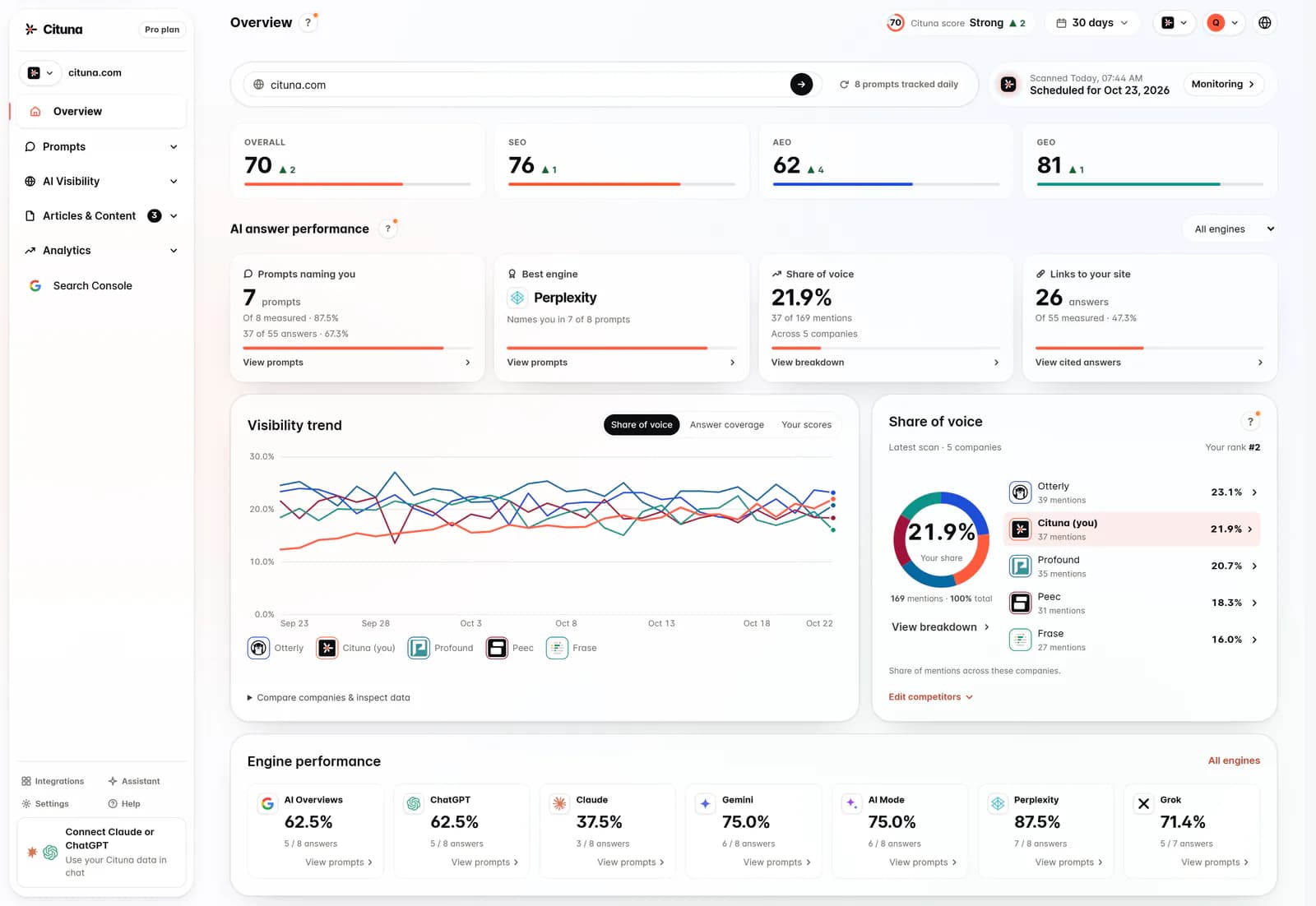
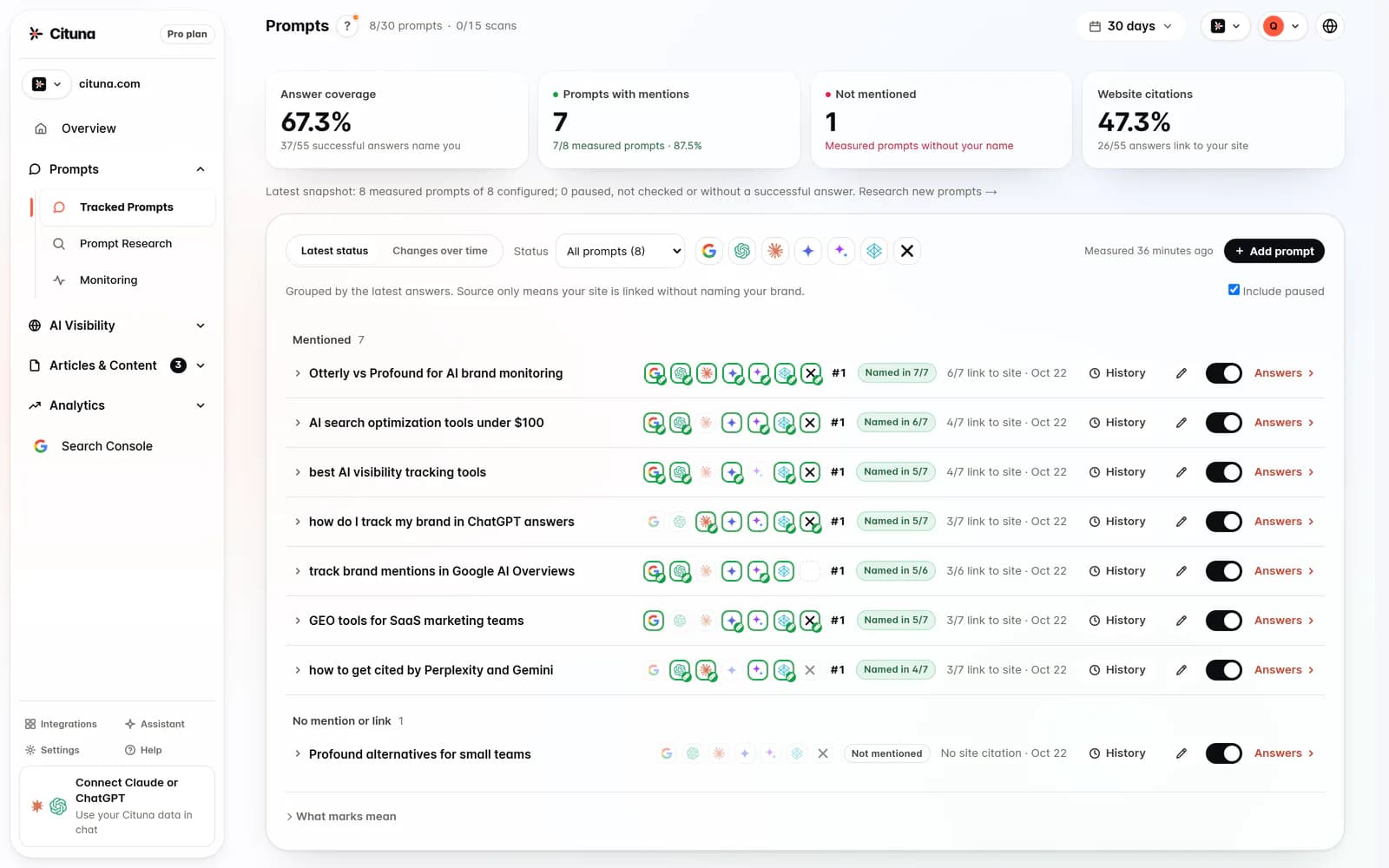
Cituna’s MCP server joins two sources most SEO servers keep apart: your Google Search Console data and what seven AI engines answer, each day, to the buyer questions you track. Its 9 Search Console tools go beyond a raw query. gsc_striking_distance ranks the queries sitting between positions 11 and 60 by how much a move would be worth, gsc_zero_click_pages sorts pages Google shows but nobody clicks by the reason they lose the click, gsc_cannibalisation finds queries where two of your own pages compete, gsc_coverage_gap lists published pages that have never earned an impression, and gsc_ai_searches picks out searches worded like AI prompts. The rest are gsc_overview, gsc_query, gsc_query_mix and gsc_status.
Beside those sit the AI answers: the tracking grid across ChatGPT, Perplexity, Gemini, Claude, Grok, Google AI Overviews and Google AI Mode, the answer text behind each cell and the pages each engine cited. In total the server has 31 tools. The 22 read tools come with the $49 Starter plan; the 9 write tools need Pro at $119, where an agent can run a scan, edit the tracked prompts and queue, edit or refresh articles. You add https://mcp.cituna.com/mcp as a connector, sign in and approve access; nothing is installed. A local npm package, cituna-mcp, is there for scripts. The setup guide for Claude walks through it, and the full tool list is on the server’s own page.
Best for: a team that wants one agent to read Google demand and AI answers together, then act on what it finds.
Where it falls short: none of its tools look up backlinks, so link research still needs a suite such as Ahrefs or Semrush. The keyword tool needs Pro, the write tools need Pro, and MCP is not part of the 3-day trial.
Start free trial to get Search Console and seven AI engines in one dashboard first; connect Claude to the same data once your $49 Starter plan begins.
2. Ahrefs MCP
Ahrefs runs a remote MCP server that puts its backlink, keyword research, rank tracking and competitor data in an assistant, reached at https://api.ahrefs.com/mcp/mcp with OAuth or an MCP-scoped key. The older local server was archived in February 2026, according to the search results we read. Ahrefs charges no separate fee for MCP; each call draws on the same Integration API units as Ahrefs Connect and API v3, and a single call costs at least 50 units. Workspace admins can cap the units each key may spend in a month. Third-party guides put Ahrefs’ Lite plan at $129 a month. Sources: Ahrefs MCP documentation and a guide to Ahrefs MCP pricing, read October 28, 2026.
Best for: teams already paying for Ahrefs who want backlink and keyword lookups in a chat.
Where it falls short: the per-call unit cost adds up when an agent runs many lookups, and Ahrefs’ documentation does not allow calling the endpoint from custom scripts or bridges.
3. Semrush MCP
Semrush’s knowledge base lists four plans that include MCP access: Semrush One Starter, Semrush One Pro+, SEO Classic Pro and SEO Classic Guru, each with 50,000 MCP API units that reset when the subscription renews. Bigger allowances come from Semrush One Advanced or SEO Classic Business with an MCP unit package, and any Trends API plan includes MCP for traffic and market data. The hosted server, at mcp.semrush.com, covers keyword research, domain analytics, competitor discovery, backlinks and position tracking. Third-party pricing guides list SEO Classic Pro at $139.95 a month, Guru at $249.95 and Semrush One Starter at $199, billed monthly. Sources: Semrush knowledge base on MCP and a Semrush pricing guide, read October 28, 2026.
Best for: Semrush customers who want keyword, domain and backlink reports answered in Claude or ChatGPT.
Where it falls short: 50,000 units is a fixed pool that refills only at renewal, and more units mean a higher plan plus a unit package.
4. SE Ranking MCP
SE Ranking’s API pricing page says MCP is included with its API add-on, which extends a Core, Growth or Enterprise subscription. Data requests (keywords, backlinks, SERPs) spend API credits, while requests about your own projects draw on the subscription’s project limits. Reviews we found disagree on how many credits each plan carries, so check the figure in your account before an agent runs large jobs. Source: SE Ranking API pricing, read October 28, 2026.
Best for: SE Ranking users who want their projects and the wider keyword data in one server.
Where it falls short: the add-on and credit model make the real monthly cost harder to read than a flat fee.
5. DataForSEO MCP
DataForSEO’s server has no fee of its own: every call is paid from the same prepaid balance as its REST API. Opening an account needs a $50 minimum deposit, and new accounts get $1 of trial credit, per the guides in our search. The open-source server signs in with your API login and password and reaches DataForSEO’s SERP, keyword, backlink, on-page and domain analytics APIs, among others. Sources: a guide to DataForSEO MCP pricing and a comparison of the Ahrefs, Semrush and DataForSEO servers, read October 28, 2026.
Best for: occasional, scripted or agency research where paying per call beats a monthly subscription.
Where it falls short: it is raw data with no project dashboard, and per-call rates vary by API, so cost depends on the jobs you send.
6. Nightwatch MCP
Nightwatch’s server exposes its rank tracking, AI visibility and site audit data, with live positions across Google, Bing and YouTube, competitor share of voice and saved reports you can trigger from a chat. It is hosted at mcp.nightwatch.io, connects with a scoped API key that is read-only by default, and Nightwatch names Claude, Cursor, ChatGPT desktop connectors and several editors as clients. Nightwatch prices in euros: Starter at €79 a month has no API access, and Professional at €159 adds it. Copies of Nightwatch’s MCP documentation disagree on whether MCP needs Professional or comes with every paid plan, so confirm before buying. Sources: Nightwatch SEO MCP and Nightwatch pricing, read October 28, 2026.
Best for: teams that already track rankings in Nightwatch and want to ask about movement in plain language.
Where it falls short: it reports on the keywords you track rather than a full keyword or backlink database.
7. Screaming Frog SEO Spider MCP
Screaming Frog’s guide says the SEO Spider can run as an MCP server and expose a wide range of its crawl data to a language model, so an assistant can query a crawl without an export. It runs alongside the desktop crawler, and a third-party guide says it needs a paid SEO Spider licence. A separate, unofficial community server also exists; it is not made by Screaming Frog. Source: Screaming Frog MCP server guide, read October 28, 2026.
Best for: technical audits where the agent needs the crawl itself.
Where it falls short: it works on one machine’s crawls, not a hosted dataset, and the licence price was reported differently by the guides we found.
8. Google Analytics MCP (GA4)
Google released an open-source MCP server for Google Analytics 4 under the Apache 2.0 licence, according to the guides in our search. It gives read-only access to GA4 reports, including realtime data and account and property lists, and runs locally with Python 3.10 or later. Setup needs a Google Cloud project with the Analytics Admin and Data APIs enabled, plus Application Default Credentials. It works with Claude Desktop, Gemini CLI and Cursor. Source: a guide to the Google Analytics MCP server, read October 28, 2026.
Best for: pairing traffic and conversion data with search data at no cost.
Where it falls short: the Google Cloud setup takes time, and many look-alike community GA4 servers exist, so check the package name before installing.
9. Search Console community servers
Several independent developers publish free Search Console servers. mcp-server-gsc by ahonn installs from npm, uses a Google service account, and answers search analytics queries by dimension. google-search-console-mcp by sarahpark is read-only, MIT-licensed and also covers URL inspection and sitemaps. Others add OAuth sign-in in place of a service account. Sources: mcp-server-gsc listing and google-search-console-mcp listing, read October 28, 2026.
Best for: a developer who wants raw Search Console queries in an assistant for free.
Where it falls short: you set up credentials yourself, maintenance depends on one developer, and each returns raw rows: the analysis (striking distance, cannibalisation, zero-click pages) is yours to do.
Which one to connect first
Most SEO teams end up with two servers rather than one: a data source for the open web (Ahrefs, Semrush, SE Ranking or DataForSEO) and a server for their own site’s performance. If your own data is the priority, a free Search Console or GA4 server covers raw numbers. If you also need to know where AI engines answer your buyers’ questions without you, Cituna puts that next to your Search Console data in one connection.
Drafted with AI assistance from our own research and Search Console data, and reviewed by Rahul A before publishing. Rules and prices change; check the linked official source before you act.